Implant-Retained Dentures: What Are They?
You have been living with a conventional denture. It rests on your gums, held in place by suction, gravity, and a prayer. For some, the upper denture is manageable. The lower denture, however, is a notorious antagonist. It floats, it shifts, it clicks when you speak, and it makes eating anything firmer than mashed potatoes a careful negotiation. You have heard about a solution that bridges the gap between a loose denture and a mouth full of fixed individual implants. It is called an implant-retained denture, or an overdenture. The question is clear: what exactly is it?
An implant-retained denture is a removable dental prosthesis that derives its stability and retention from dental implants placed in the jawbone. Unlike a conventional denture that rests solely on soft tissue, an overdenture snaps firmly onto strategically placed implants. It is removable by the patient for cleaning, but when it is in place, it is locked, secure, and functionally transformed. This article is your comprehensive guide to this life-changing, often cost-effective middle ground in tooth replacement.
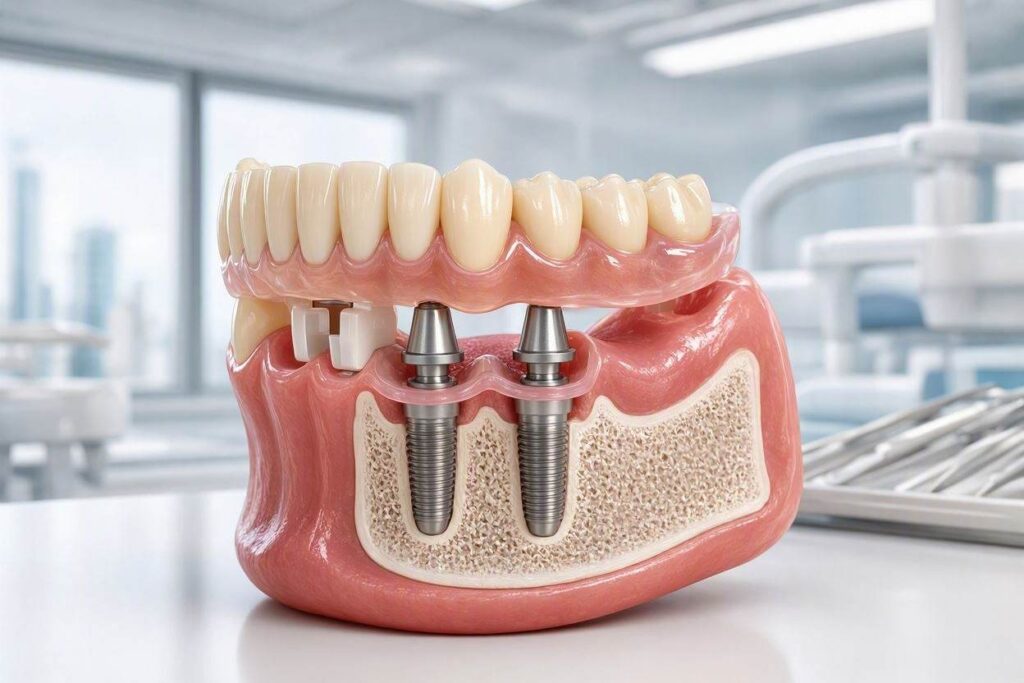
The Core Mechanism: Mechanical Retention via Attachments
The defining feature of an implant-retained denture is the connection system. The denture does not simply rest on the implants. It mechanically locks onto them via a precision attachment.
The implants, typically two to four placed in the front of the jaw, are fitted with a specific attachment system. The most common are:
- Locator Attachments: A low-profile, self-aligning system. A metal housing containing a durable nylon or PEEK insert is embedded in the underside of the denture. The insert snaps onto a corresponding abutment head screwed into the implant.
- O-Ring (Ball) Attachments: A classic system, often used with mini dental implants. The implant head is a smooth ball. The denture houses a rubber O-ring that stretches over the ball, providing a tight, frictional grip.
- Bar Attachments: Two or more implants are connected by a custom-cast metal bar. The underside of the denture has a series of clips that engage the bar along its length. This provides excellent stability and cross-arch support.
When you insert the overdenture, you press it down over the attachments. You hear and feel a definitive “snap” as each housing engages its abutment. The denture is now mechanically locked to the implants. It will not lift during speaking or shift during chewing. The stability is dramatic and immediate. To remove the denture, you use your fingers to carefully pry it up, disengaging the snaps. The small attachment heads remain visible on the gum ridge.
The Fixed vs. Removable Distinction: A Critical Difference
The world of implant-supported prostheses is divided into two distinct categories, and the terminology is a frequent source of confusion for patients. You must understand the difference between an implant-retained removable overdenture and an implant-supported fixed bridge.
Implant-Retained Removable Overdenture (The “Snap-On Denture”)
This is the subject of this article. It is supported by both the implants and the underlying gum tissue. The implants provide retention and prevent movement. The gum and the bony ridge still bear a significant portion of the chewing force. The patient removes it daily for cleaning and at night. It is the more economical option, requiring fewer implants (typically two to four per arch) and a simpler, less expensive laboratory process. The restoration itself is made of high-impact acrylic with denture teeth.
Implant-Supported Fixed Bridge (The “All-on-4” or “All-on-6”)
This is a completely fixed, non-removable prosthesis. It is supported entirely by the implants. The gum tissue bears no load. The bridge is screwed into the implants and is only removed by the dentist, usually at an annual maintenance appointment. It requires more implants (typically four to six per arch) and a more expensive, precision-milled framework (usually titanium and zirconia). The patient brushes and flosses around it like natural teeth.
The choice between a fixed bridge and a removable overdenture is a clinical, financial, and lifestyle decision. The fixed bridge feels more like having your own teeth back. The removable overdenture is easier to clean, less expensive, and can be a perfectly satisfying solution, particularly for the lower jaw, where a conventional denture is so often a failure.
The Two-Implant Lower Overdenture: The Minimum Standard of Care
For the edentulous lower jaw, an implant-retained overdenture supported by just two implants placed in the canine positions has been declared the minimum standard of care by leading dental organizations, including the McGill Consensus and the British Society for the Study of Prosthetic Dentistry. The difference between a conventional lower denture and a two-implant-retained lower overdenture is so profound, so life-changing for the patient, that it should not be considered a luxury.
The procedure is relatively straightforward. Two standard or mini implants are placed in the front of the lower jaw, the area with the most dense and available bone. They are allowed to heal and integrate. The patient’s existing lower denture, or a new one, is retrofitted with the corresponding attachment housings. The patient snaps the denture onto the implants. The transformation is immediate. The denture no longer floats on a mobile, non-retentive floor of the mouth. It is anchored. Patients who were restricted to a soft diet can often return to eating steak, apples, and salad. The psychological impact is immense. A two-implant lower overdenture is one of the most impactful and cost-effective procedures in all of dentistry.
The Cost Equation: Overdenture vs. Fixed Bridge
The financial advantage of a removable overdenture is significant and is the primary driver for many patients.
| Category | 2-Implant Retained Overdenture (Lower) | Full-Arch Fixed Bridge (All-on-4, Lower) |
|---|---|---|
| Implant Surgery | $3,000 – $6,000 | $8,000 – $12,000 |
| Attachment System | $1,000 – $2,000 | Included in framework |
| Final Prosthesis | $2,000 – $4,000 (acrylic) | $6,000 – $10,000 (zirconia) |
| Total Estimated Cost | $6,000 – $12,000 | $14,000 – $22,000 |
The overdenture path is a fraction of the cost of the fixed bridge. The trade-offs are the need for daily removal, the bulk of the acrylic covering the palate (for an upper overdenture) or the ridge, the periodic replacement of the attachment inserts, and the aesthetic and functional superiority of the fixed zirconia bridge. For many patients, the dramatic functional improvement over a conventional denture, at a manageable cost, makes the overdenture the ideal solution.
Maintenance of an Overdenture: The Wear Items
An implant-retained overdenture is not a “do it once and forget it” device. It has specific, predictable maintenance needs.
The nylon or rubber inserts in the denture housing are designed to wear out. They lose their grip over time, typically every 12 to 18 months. The denture will start to feel slightly looser, and the snap will be less crisp. The replacement of these inserts is a quick, simple, and relatively inexpensive chairside procedure. Your dentist or prosthodontist simply removes the old inserts and presses new ones into the metal housing. The full, firm retention is restored immediately.
The denture teeth and the acrylic base are also subject to wear, just like a conventional denture. The denture itself may need to be relined or replaced every five to seven years due to the normal, ongoing resorption of the underlying bone and the wear of the prosthetic teeth. The implants remain fixed in the bone; the removable prosthesis on top is the serviced and eventually replaced component.
Conclusion
Implant-retained dentures are a removable tooth replacement solution that snaps onto fixed dental implants, providing dramatic improvements in stability, function, and quality of life compared to conventional dentures. They are a cost-effective middle ground, requiring fewer implants than a fixed bridge and offering easier home care. The lower two-implant overdenture is considered the minimum standard of care for a reason: it transforms a daily struggle into a secure, confident smile.
Frequently Asked Questions
Can I upgrade my conventional denture to an implant-retained denture?
In many cases, yes. If your existing denture is in good condition—the teeth are not worn, the acrylic base fits well—your dentist can retro fit it by embedding the attachment housings into its underside. This is a cost-saving approach. If your denture is old and ill-fitting, a new overdenture will be fabricated from the start.
How many implants do I need for an upper overdenture?
The upper jaw presents more challenges. The bone is often softer, and the denture must cover the palate for suction and support. A minimum of four implants is typically recommended for an upper overdenture to provide adequate retention and to allow the palate to be horseshoe-shaped (open in the center) for improved taste and comfort.
Is an implant-retained overdenture better than a fixed bridge?
“Better” is subjective. A fixed bridge feels more like natural teeth and is permanently in place. An overdenture is easier to clean, less expensive, and can be a superior choice for patients with significant bone loss who need the acrylic flange to support the lip and cheek. The best choice is the one that matches your clinical anatomy, your budget, and your personal preference, after a thorough discussion with your prosthodontist.
Additional Resource:
For a comprehensive, patient-centered overview of dentures and implant alternatives, visit the American College of Prosthodontists: https://www.gotoapro.org/dentures/