What Does Implant Torqued Mean in Dentistry and Why It Matters
You are sitting in the dental chair. The surgical phase of your implant is underway. The dentist has prepared the bone with a precise sequence of drills. Now, the implant itself is being delivered to the site. You hear the low hum of the surgical motor, and then a clicking sound as a wrench is used. The dentist or assistant might say, “Torque is at 45,” or “We have good primary stability.” This is the language of implant torque. Torque is not just a technical specification; it is a fundamental physical and biological parameter that predicts the initial stability of your implant and governs the entire loading protocol. A torque value that is too low can mean a risky implant with a higher chance of failure. A torque value that is too high can mean a bone under destructive stress. This article demystifies the concept of torque in implant dentistry. You will learn what it means, how it is measured, and why it is one of the most critical numbers in the entire implant treatment process.
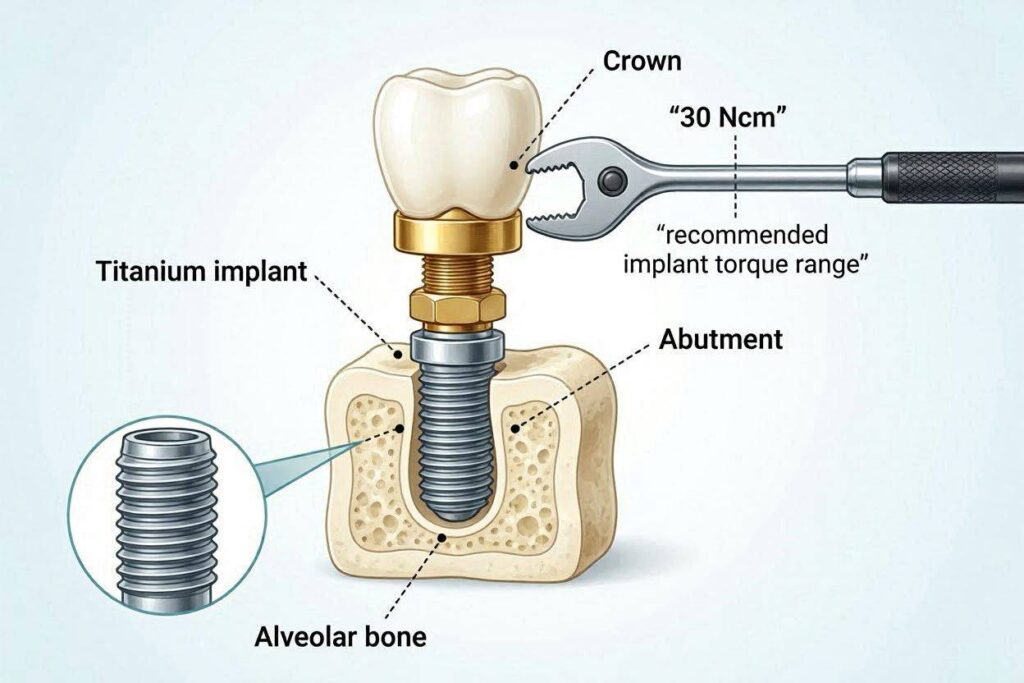
Defining Torque in Implant Dentistry
In physics, torque is a measure of the rotational force that causes an object to rotate about an axis. Think of using a wrench to tighten a bolt. The force you apply to the handle, multiplied by the length of the wrench, creates a twisting force. In implant dentistry, torque refers to the rotational force applied to the dental implant to screw it into the prepared osteotomy site. It is measured in Newton-centimeters (Ncm). One Ncm is the torque resulting from a force of one Newton applied perpendicularly to a lever arm one centimeter long. To give a practical sense, the torque required to tighten a small screw on a pair of eyeglasses is a few Ncm. The torque used to insert a dental implant ranges from about 20 Ncm to over 70 Ncm, with most stable placements falling in the 30-50 Ncm sweet spot.
Insertion Torque vs. Removal Torque
There are two distinct torque measurements in implantology. Insertion torque is the peak rotational force recorded as the implant is being threaded into its final position. This is the value the surgeon observes in real-time on the surgical motor display or the manual torque wrench. It represents the frictional resistance of the bone against the implant threads. A high insertion torque indicates a tight, compressive fit and good primary mechanical stability. Removal torque, on the other hand, is a research and diagnostic measurement. It is the force required to unscrew an implant after osseointegration has occurred. Scientists use removal torque values to quantify the strength of the bone-implant interface in studies. A high removal torque means strong osseointegration. Clinically, the reverse torque test—applying a specific unscrewing force to the implant to confirm it doesn’t move—is sometimes used as a confirmation of integration, though it is less favored now due to the risk of damaging a healing interface.
The Relationship Between Torque and Primary Stability
Primary stability is the immediate mechanical engagement of the implant with the surrounding bone after placement, before any biological healing has occurred. It is the single most important predictor of a successful osseointegration. Torque is the direct, quantifiable measurement of this primary stability. When a surgeon prepares an osteotomy that is slightly smaller in diameter than the implant, the implant compresses the surrounding bone as it is threaded in. This creates a tight friction fit. The higher the insertion torque, the tighter the fit. This mechanical lock eliminates micro-motion. An implant that is rigidly fixed at insertion will not wobble during the healing phase. This stability is the necessary environment for osteoblasts to lay down bone directly on the implant surface. If the implant moves, fibroblasts win, and a fibrous scar capsule forms.
The Threshold Values: What is “Good” Torque?
Clinical studies and expert consensus have established widely accepted torque thresholds.
- Torque below 20 Ncm: This is considered low primary stability. The implant is at high risk for micro-motion and failure if subjected to any load. A conventional loading protocol with a longer, submerged healing period of 4-6 months is mandatory. Immediate or early loading is absolutely contraindicated.
- Torque between 20 and 35 Ncm: This is moderate stability. It is acceptable for a standard two-stage or one-stage protocol with a healing cap and a delayed loading timeline of 3-6 months. It is not ideal for immediate loading.
- Torque between 35 and 50 Ncm: This is high primary stability. This is the target zone for most implant placements. It provides excellent mechanical anchorage and often meets the threshold for immediate loading protocols in selected, well-splinted cases.
- Torque above 50-70 Ncm: This is very high insertion torque. While it provides exceptional mechanical grip, it carries a risk. The excessive compressive forces can crush the bone in the threads, causing micro-fractures and localized bone necrosis. Some surgeons consider this a warning zone rather than a success, as the bone damage can paradoxically lead to failure during the remodeling phase.
The Torque Wrench: Manual vs. Motor-Driven
Torque is not guessed; it is measured with calibrated instruments. There are two main methods.
The Surgical Motor with Torque Control
Modern implant surgical motors have a built-in torque control function. The surgeon can preset a maximum torque value and a speed (RPM) on the console. The motor delivers the implant with a controlled rotational force and automatically stops or disengages when the preset torque is reached. This provides a real-time digital readout of the peak insertion torque. The motor also displays the number of rotations and can create a digital record of the insertion profile. This is the preferred method for most routine placements.
The Manual Torque Wrench
A manual torque ratchet wrench is a handheld, sterilizable instrument with a calibrated torque-limiting mechanism. It looks like a small wrench with a scale. The surgeon sets the desired torque limit, usually between 15 and 35 Ncm, and then uses the wrench to give the final turns to the implant or to tighten the abutment screw. The wrench makes an audible and tactile “click” when the preset torque is reached, preventing over-tightening. This is an essential tool for the restorative phase, for tightening abutment screws to the manufacturer’s exact specification, typically 15 Ncm for healing caps and 30-35 Ncm for final abutments. A manual wrench is a reliable, low-tech verification tool.
Torque and the Immediate Loading Protocol
Immediate loading, placing a tooth on the implant within a week of surgery, is entirely dependent on insertion torque. The critical threshold for immediate loading of a single tooth is typically an insertion torque of at least 35 Ncm, and ideally 45 Ncm or higher. For a full-arch All-on-4 restoration, the implants must have a combined high insertion torque, and they are immediately rigidly splinted together by the full-arch temporary bridge. The splinting distributes any micro-forces, protecting each individual implant interface. If the surgeon places the implant and the final insertion torque is only 25 Ncm, the immediate loading plan is rightfully abandoned. The surgeon will place a healing abutment and revert to a conventional, delayed loading protocol to protect the implant. This intra-operative decision-making is a sign of a prudent, ethical practitioner.
The Risk of Excessive Torque: Over-Compression and Bone Necrosis
More torque is not always better. There is a threshold beyond which the compressive force on the bone becomes destructive. When an implant is forced into an osteotomy that is too small or into exceptionally dense bone, the pressure can exceed the capillary perfusion pressure. The small blood vessels in the bone are crushed. The bone cells in the compressed zone are deprived of oxygen and undergo ischemic necrosis. The implant may feel rock-solid at placement, with a torque of 70 or 80 Ncm. But a few weeks later, the necrotic bone ring begins to resorb. The implant loses its stability. What felt like a great success at surgery becomes a progressive failure. This is why surgeons in very dense D1 bone will use a bone tap to pre-cut threads and may select an implant with a slightly narrower core diameter, to achieve a target torque of 35-45 Ncm, not 100 Ncm.
Torque Auditing and the Dental Record
A professional, defensible dental implant record includes the torque values. The dentist or assistant notes in the patient’s chart the final insertion torque for each implant. For an abutment, the torque to which the screw was tightened is recorded. This is a medico-legal standard of care. If an implant fails, the torque record is a critical piece of the failure analysis. Did the implant have low initial stability? Was it overloaded? Was the abutment screw tightened to the correct specification to prevent loosening? The note is simple: “Implant site #19 (4.3mm x 10mm) placed. Final insertion torque 45 Ncm. ISQ 72.” This data point travels with the patient’s lifelong record.
Torque in the Restorative Phase: Abutment Screws
The concept of torque extends beyond the surgery. The abutment screw, which connects the abutment to the implant, must be tightened to a very specific torque, typically 20 to 35 Ncm, depending on the manufacturer. This is a much smaller screw than the implant body. If it is under-torqued, it will loosen over time. A loose abutment screw is the most common mechanical complication in implant dentistry. It causes the crown to wiggle, and if left unaddressed, the micro-motion can fracture the screw or the implant itself. If the screw is over-torqued, the threads can strip, the screw head can snap, or the implant’s internal connection can deform. The dentist uses a dedicated torque wrench for restorative components and follows the manufacturer’s instructions implicitly. This is a non-negotiable protocol step.
Conclusion
Implant torque is the precise measurement of rotational force used to insert a dental implant, quantifying the critical primary stability that eliminates micro-motion and sets the stage for successful osseointegration. Target insertion torques between 35 and 50 Ncm are ideal for most protocols, while values below 20 Ncm signal a high-risk implant and excessive torque above 70 Ncm risks bone necrosis. This number, meticulously recorded and interpreted in the context of bone density, is one of the most powerful predictors of an implant’s immediate and long-term fate.
FAQ
1. Can I feel the torque when the dentist places the implant?
No. You are under profound local anesthesia. You will feel pressure, pushing, and vibration, but not a distinct twisting sensation or pain related to the torque value. The experience is of controlled, firm pressure.
2. What happens if my implant doesn’t achieve the needed torque for immediate loading?
Your dentist will wisely change the plan. They will place a healing cap and close the gum, or leave a small healing abutment, and you will follow a conventional 3-6 month healing protocol before the tooth is attached. This is a responsible adjustment, not a failure.
3. Is a high insertion torque guarantee that the implant will be successful?
No, it is only one predictor. A high-torque implant placed with surgical trauma, overheating, or in a smoker with poor oral hygiene can still fail. Torque measures initial mechanical stability; it does not guarantee the subsequent biological processes of healing and maintenance.
Additional Resource
For advanced clinical knowledge on implant stability and protocols, visit the Academy of Osseointegration: https://osseo.org/