Can Dental Implants Be Chipped?
You run your tongue over your new implant crown. It feels solid, permanent, indistinguishable from your natural teeth. Then, one day, while eating a salad, you bite down on a piece of gravel hidden in the lettuce. Or you crunch an unexpected olive pit. You feel a sharp, unnatural edge. Your tongue probes the spot, and your heart sinks. There is a rough, jagged area on your beautiful, expensive implant tooth. The question flashes through your mind with a jolt of anxiety: can a dental implant be chipped?
The answer is yes, but with a critical distinction. The titanium implant post itself, buried in your jawbone, is virtually unchippable. It is a solid piece of medical-grade metal. What can and does chip is the visible restoration on top: the crown, the bridge, or the denture tooth attached to the implant. This article will explain how and why implant restorations chip, the cost and process of repair or replacement, and how to protect your investment from this frustrating and often avoidable mishap.
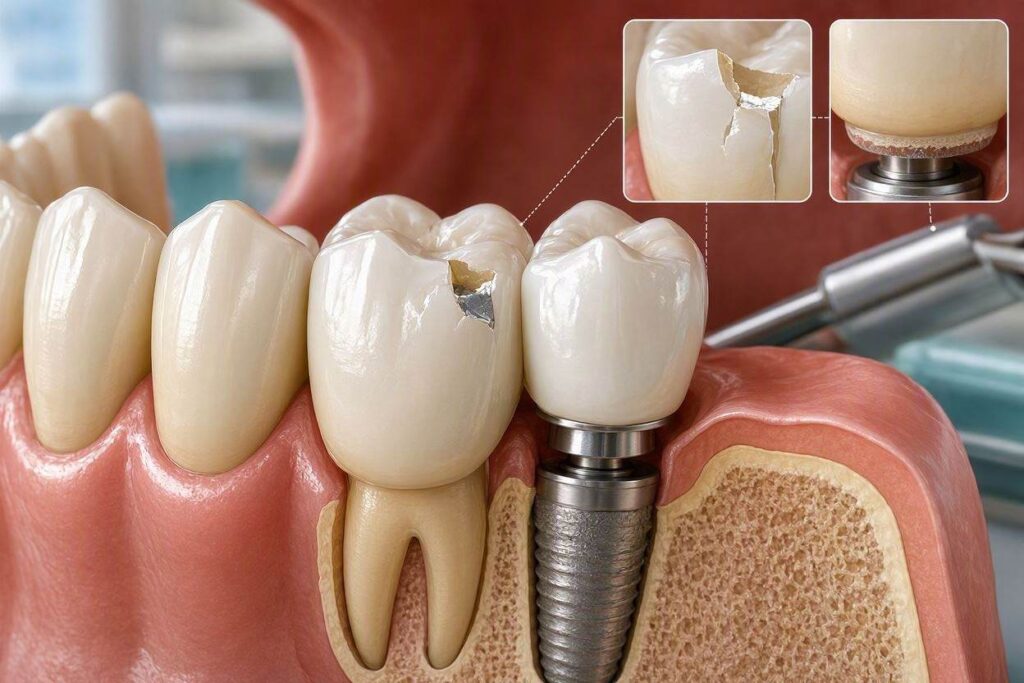
The Anatomy of a Chipped Implant Restoration
To understand a chip, you must first understand the specific material that is chipping. An implant restoration is not a monolithic block of tooth enamel. It is a manufactured dental prosthesis, made from one of several possible materials, each with its own fracture and chip behavior.
- Porcelain-Fused-to-Metal (PFM): This crown has a metal substructure for strength, with layers of esthetic porcelain baked onto it. The porcelain is a glass-like ceramic. It is strong under compressive forces but brittle and vulnerable to chipping when a sharp, point-contact force is applied. A small fleck of porcelain can shear off the underlying metal, exposing a dark grey spot. This is the most common type of chipping in older implant restorations.
- Monolithic Zirconia: This crown is milled from a solid block of zirconium dioxide, a super-strong ceramic. It is the color of a tooth through and through, with no layered porcelain. Monolithic zirconia is extraordinarily resistant to chipping and fracture. It is the material of choice for patients who grind their teeth and for full-arch implant bridges. A chip in monolithic zirconia is rare, but it can happen under extreme, traumatic force.
- Layered Zirconia or E.max: These are the most aesthetic restorations. A strong zirconia or lithium disilicate framework is hand-layered with feldspathic porcelain to create a lifelike, translucent appearance. The outer porcelain layers, while breathtakingly beautiful, are also the most susceptible to chipping, just like the porcelain on a PFM.
- Acrylic (Temporary or Hybrid Bridges): A full-arch temporary bridge, or a more economical permanent hybrid bridge, is made of high-impact acrylic resin reinforced with a metal or fiber substructure. Acrylic is significantly softer and more prone to wear, chipping, and debonding of individual denture teeth than ceramic. A chip in an acrylic bridge is a common, almost expected, maintenance event.
The Traumatic Chip: Impact and Accidental Force
The most obvious cause of a chip is a sudden, direct, traumatic force. The human jaw is a powerful lever system. When you bite down hard on an unexpected hard object, the entire force of your closing muscles is concentrated on a tiny point on the restoration. Natural teeth have a periodontal ligament, a shock-absorbing sling that provides a small amount of give and proprioceptive feedback. An implant has no ligament. It is rigidly fused to the bone. This means the impact force is not dampened. It is transmitted directly into the restoration and the abutment screw.
A single, sharp impact can shear a small chip of porcelain from the edge or the biting surface. This is a mechanical accident. It is not a material defect. The restoration was subjected to a force exceeding the cohesive strength of the ceramic. The repair depends on the size and location of the chip. A tiny, superficial chip in a non-load-bearing area can often be polished smooth by the dentist, leaving it functional and feeling fine to the tongue. A larger chip that exposes the underlying substructure, compromises the contact with the opposing tooth, or is in the aesthetic zone will require a more significant intervention.
The Micro-Fracture from Parafunction: The Slow-Motion Chip
The more insidious and common cause of chipping is not a single accident. It is a chronic, low-grade, repetitive stress: bruxism, or tooth grinding and clenching. A patient who grinds their teeth at night subjects their implant crown to hundreds of pounds of lateral, off-axis force for hours every night. No ceramic material is immune to the relentless fatigue of this abuse.
Under a microscope, the repeated flexing of the ceramic under load creates tiny, microscopic stress fractures in the porcelain. Over months and years, these micro-fractures propagate and coalesce. Eventually, a small piece of porcelain can flake off without any memorable impact event. The patient will say, “I was just chewing a piece of bread and my tooth broke.” The piece of bread was the final, trivial straw that exposed a fatigue fracture that had been slowly developing for months.
This is why a night guard is not a suggestion but a medical necessity for any implant patient with a history of bruxism. The guard, a hard acrylic splint worn over the teeth during sleep, absorbs and distributes the grinding forces, protecting the implant crown from the destructive lateral loads that cause micro-fractures. A patient who refuses a night guard after a chip repair is highly likely to chip the restoration again.
The Adversarial Occlusion: Even in a non-bruxer, an improperly designed bite on the implant crown can cause chipping. The dentist must create a precise occlusion where the implant crown makes light contact in the biting position and immediately disengages during any sideways, excursive movements. A heavy, poorly adjusted bite point acts as a constant, pinpoint stress concentrator. It is not a matter of if a chip will occur, but when.
The Repair Hierarchy: Polish, Composite, or Replace
When you present to your dentist with a chipped implant crown, the treatment decision follows a logical hierarchy based on the extent of the damage.
Option 1: Polish
A very small, superficial chip, less than a millimeter in size, in a non-aesthetic zone, can often simply be smoothed and polished. The dentist uses a series of fine diamond burs and polishing wheels to blend the chipped area into a smooth, rounded contour. The tooth feels normal to the tongue. No material is added. This is a quick, often no-charge or minimal-charge service visit.
Option 2: Intraoral Composite Repair
A moderate chip in a visible area, where the underlying ceramic substructure is intact, can be repaired with a tooth-colored composite resin, much like a filling on a natural tooth. The dentist roughens the ceramic surface with a micro-etcher or hydrofluoric acid, applies a silane coupling agent and a bonding agent, and sculpts a patch of composite to fill the defect. The repair is polished to blend with the surrounding porcelain.
This is a direct, same-day, affordable solution. The cost ranges from $150 to $400. However, the composite-porcelain bond is not as strong as the original monolithic ceramic. The repair is a patch. It will eventually stain at the margin and may debond and need replacement. It is a mid-term solution, not a permanent cure.
Option 3: Crown Replacement
A large chip that exposes the metal or zirconia substructure, a chip that involves the biting contact, or a chip in the aesthetic zone where a patch would be visibly obvious, necessitates the full replacement of the implant crown. The old crown is cut off or unscrewed. A new impression or scan is taken. A new crown is fabricated in the dental laboratory and delivered at a second appointment.
This is the most expensive and definitive solution. The cost is a repeat of the restorative phase, typically $1,200 to $2,500 for a single implant crown. The cost is often borne by the patient if the chip was caused by trauma or parafunction, or potentially covered by the dentist’s warranty if the chip is determined to be a material or fabrication defect.
The Cost of Chipping: A Financial and Emotional Toll
The financial cost of a chipped implant crown is a direct hit. A composite repair is a manageable $300. A full crown replacement is a painful $2,000 unplanned expense. The emotional cost is equally real. The trust in the solidity of the implant is shaken. The patient becomes fearful of eating normally. Every hard or crunchy food becomes a potential enemy.
The most effective strategy against this cost is prevention and a contractual understanding of the warranty. Before your implant crown is delivered, have a clear conversation with your dentist. Ask: “What is your laboratory’s warranty against fracture or chipping of this crown, and what is your office policy for a remade crown if it chips within the first year? Within the first five years?” A premium dental laboratory offers a multi-year warranty against ceramic fracture. A dentist who stands behind their work will have a clear, written policy for remakes. This conversation, had before the chip occurs, is worth its weight in saved anxiety and money.
Conclusion
Dental implants can be chipped, but the damage is limited to the visible crown or bridge, not the titanium post in the bone. Chipping is caused by a sudden traumatic impact or, more commonly, by the slow-motion fatigue of chronic grinding. A small chip can be polished or patched with composite. A large or aesthetic chip requires a full crown replacement. The best defense is a well-designed night guard and a clear understanding of your restoration’s warranty.
Frequently Asked Questions
Can a zirconia implant crown chip?
Yes, but it is rare. Monolithic zirconia is extraordinarily strong. A chip in a solid zirconia crown usually requires a significant traumatic event, like a fall or a direct blow to the mouth. Layered zirconia crowns, where porcelain is baked onto the zirconia, are more susceptible to chipping of the outer porcelain layers.
Does dental insurance cover repairing a chipped implant crown?
It depends on the specific policy and the cause of the chip. If the crown is relatively new and the chip is due to a material defect, the dentist’s warranty and the lab’s warranty should cover the replacement. If the chip is due to patient trauma or neglect, dental insurance may cover a portion of the replacement crown under the major restorative benefit, subject to the annual maximum and the replacement clause (often a 5-7 year replacement limitation). A composite repair is often covered as a basic restorative procedure.
How can I prevent my implant crown from chipping?
Wear a professionally made night guard if you have any history of grinding or clenching. Avoid chewing on hard objects like ice, hard candies, pens, and fingernails. See your dentist for an annual occlusal check to ensure the bite on the implant crown remains light and balanced. A well-maintained, protected implant crown can last a lifetime without chipping.
Additional Resource:
For a comparison of different crown materials and their durability, including resistance to fracture and chipping, visit the American College of Prosthodontists’ patient education page: https://www.gotoapro.org/dental-crowns/