How To Fix A Chipped Dental Implant?
A chipped dental implant restoration is a common and distressing event. The patient looks in the mirror or feels a rough edge with their tongue and discovers that a piece of their implant crown has broken away. It is essential to understand that the implant body—the titanium post in the jawbone—is almost never what has chipped. The damage is to the visible crown, the porcelain or zirconia restoration attached to the implant. This guide provides a comprehensive, step-by-step explanation of what to do when you chip an implant crown, how the repair is performed, when a repair is possible versus when the entire crown must be replaced, and how to prevent future chipping.
What Actually Chipped: The Crown, Not the Implant
The implant body is made of titanium alloy or zirconia. These materials are exceedingly strong and resistant to fracture. The implant body is embedded in the bone and protected from direct trauma. It does not chip. The visible, tooth-shaped portion—the crown—is made of porcelain, ceramic, or composite resin. These materials are aesthetic but can chip, just as a natural tooth can.
The abutment, the connector between the implant and the crown, is also made of titanium or zirconia and is unlikely to chip. The chip is almost always located on the porcelain or ceramic crown material.
Immediate Steps When You Discover a Chip
A chipped implant crown is not a medical emergency, but it is a dental urgency. The rough edge can irritate the tongue, cheek, or lip. The exposed underlying material may be unaesthetic. If the chip is large, the crown’s structural integrity may be compromised.
Do Not Attempt a DIY Repair
Do not use superglue, nail polish, or any household adhesive to reattach the fragment or smooth the chip. These substances are toxic, not designed for the oral environment, and will damage the crown material. They make a professional repair more difficult or impossible.
Retrieve the Fragment if Possible
If the chipped piece is a single, intact fragment, retrieve it and store it in a clean container. Bring it to your dental appointment. In some cases, the fragment can be rebonded. Do not attempt to glue it back in place yourself.
Call Your Implant Dentist
Schedule an appointment as soon as is practical. The dentist will evaluate the chip, determine the cause, and recommend the appropriate repair or replacement. Until the appointment, avoid chewing on that side. If the edge is sharp and irritating, you can cover it with a small piece of dental wax, available at a pharmacy, as a temporary measure.
The Dentist’s Evaluation
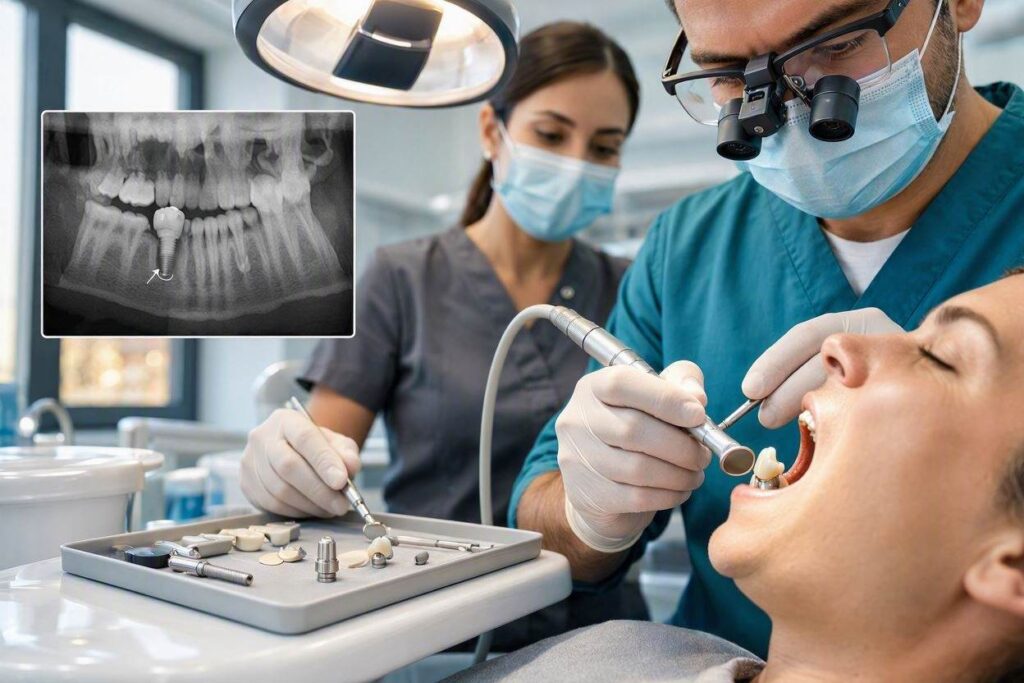
The dentist examines the chipped crown under magnification. The size, location, and depth of the chip are assessed. A periapical X-ray is taken to evaluate the implant body, the abutment, the surrounding bone, and the crown margin. The occlusion (bite) is checked to determine if the chip was caused by a heavy or misdirected bite force.
The key clinical question is: Is the chip a minor, superficial defect that can be repaired, or is it a major fracture that compromises the crown’s structure and requires replacement?
Repairing a Minor Chip: Composite Bonding
A small chip, particularly at the incisal edge of an anterior implant crown or a small flake on a posterior crown, can often be repaired with composite resin bonding. This is the same material used for tooth-colored fillings.
The Bonding Procedure
- Surface Preparation: The dentist roughens the porcelain surface around the chip with a diamond bur or an air-abrasion unit. The porcelain is treated with a silane coupling agent and a bonding adhesive. This creates a chemical and micromechanical bond between the porcelain and the composite resin.
- Composite Application: The dentist applies a tooth-colored composite resin in small increments, sculpting the material to replace the missing contour. Each increment is light-cured with a blue curing light.
- Finishing and Polishing: The composite is shaped with fine diamond burs, polished with abrasive discs and rubber points, and adjusted to fit the bite. The result is a smooth, aesthetic repair.
Limitations of Bonding
A composite repair is a patch, not a structural reconstruction. The bond between composite and porcelain is strong but not as strong as the original monolithic crown material. The repair may stain over time, as composite is more porous than glazed porcelain. A repair at the incisal edge of an anterior tooth is subjected to significant shear forces and may debond or chip again. A composite repair is often a long-term temporary solution; the crown may eventually require replacement.
Rebonding the Original Fragment
If the patient has the original porcelain fragment, and it fits precisely back onto the crown like a puzzle piece, the dentist can attempt to rebond it. The fragment and the crown are cleaned, the porcelain is etched and silanated, and the fragment is bonded back in place with a resin cement. This is the most aesthetic repair because it uses the original material. The rebonded fragment has the same long-term limitations as a composite patch.
When the Crown Must Be Replaced
If the chip is large, extends below the gumline, exposes the underlying abutment, or compromises the structural integrity of the crown, the crown cannot be reliably repaired. It must be replaced.
The Crown Replacement Procedure
Replacing an implant crown is described in detail in the earlier guide “Can Dental Implant Crowns Be Replaced?” The existing crown is removed, which for a screw-retained crown is straightforward, and for a cemented crown may require sectioning. The abutment is inspected. A new impression is taken. A temporary crown is placed. A new crown is fabricated in the dental laboratory and delivered.
The Material Upgrade Opportunity
If the original crown was porcelain-fused-to-metal and chipped, this is an opportunity to upgrade to a material with higher fracture resistance. Monolithic zirconia crowns are virtually unchippable. Lithium disilicate (e.max) crowns offer excellent aesthetics and good strength. The dentist will recommend the best material for the specific tooth position and functional demands.
The Cost of Replacement
Crown replacement is a restorative procedure with its own fee, separate from the original implant placement. The cost ranges from $1,200 to $3,000, depending on the material, the abutment status, and the geographic location. Dental insurance may cover a portion if the plan’s frequency limitation for crown replacement is met (typically 5 to 7 years).
Preventing Future Chipping
Prevention addresses the underlying causes of the chip. The dentist will identify and manage these factors.
Occlusal Adjustment
If the chip was caused by a heavy bite contact, a lateral interference, or a parafunctional grinding pattern, the dentist will carefully adjust the occlusion on the new crown and the opposing teeth. The implant crown should have lighter contact than natural teeth during heavy clenching.
Night Guard
If the patient has bruxism (grinding or clenching), a custom-fabricated night guard is mandatory. The guard absorbs the destructive forces that would otherwise fracture the implant crown, the opposing teeth, and the natural dentition. A night guard is a protective device that extends the lifespan of all dental restorations.
Material Selection
If the chipped crown was porcelain-fused-to-metal, the replacement should be considered in a more fracture-resistant material. Monolithic zirconia is recommended for posterior implant crowns in patients with heavy bite forces or a history of ceramic fracture.
Parafunctional Habit Modification
The patient should be counseled on avoiding habits that stress the implant crown: chewing ice, biting fingernails, opening packages with the teeth, and chewing on pens or hard objects.
Conclusion
A chipped dental implant crown is a restorative issue, not an implant failure, and small chips can often be successfully repaired with composite resin bonding or rebonding of the original fragment in a single office visit. Large chips that compromise the crown’s structure, expose the abutment, or cannot be aesthetically restored with bonding require replacement of the crown. Prevention of future chipping centers on occlusal adjustment, a custom night guard for bruxism, and selecting a fracture-resistant material such as monolithic zirconia for the replacement restoration.
Frequently Asked Questions
Is a chipped implant crown covered by warranty?
Many implant crown restorations are covered by a practice warranty for a defined period, typically 1 to 5 years, against defects in materials or workmanship. A chip caused by trauma or heavy bite forces may or may not be covered, depending on the specific warranty terms. The implant manufacturer’s warranty covers the implant body, not the crown. Discuss the warranty with your dentist.
Can I just leave a small chip if it doesn’t bother me?
You can, but it is not advisable. A rough, chipped edge can irritate the tongue and cheek. The exposed porcelain subsurface is more porous and will stain. The rough surface is more plaque-retentive, increasing the risk of peri-implant mucositis. A small chip can propagate into a larger fracture under continued occlusal forces. Repairing a small chip is simpler and less expensive than replacing a fractured crown.
Can a chipped implant crown cause the implant to fail?
No. The chip is in the crown material, which is separate from the implant body. The implant body in the bone is not affected by a chip in the crown. However, if the chip alters the occlusion and creates a heavy bite force or a lateral interference, the resulting biomechanical overload could, over time, contribute to abutment screw loosening or, in extreme cases, implant component fatigue. The chip should be addressed to restore proper occlusion.
Is it common for implant crowns to chip?
Porcelain chipping is a recognized complication of implant restorations, particularly porcelain-fused-to-metal crowns. The incidence of chipping has decreased significantly with the widespread adoption of monolithic zirconia crowns, which are highly fracture-resistant. With proper occlusion, a night guard for bruxers, and appropriate material selection, implant crowns are very durable.
Additional Resource
The American College of Prosthodontists provides a patient education section at gotoapro.org that explains the different materials used for implant crowns, the causes of ceramic fracture, and the repair and replacement options. A prosthodontist is the specialist in implant crown restoration and can provide an expert evaluation of a chipped crown and the most appropriate long-term solution.
Meta Description:
Learn exactly how to fix a chipped dental implant crown. A step-by-step guide to immediate actions, composite bonding repair vs. crown replacement, the rebonding procedure, costs, and the essential prevention strategies—occlusal adjustment, night guard, and material selection—to avoid future chips.
continue
Can I Still Put Braces With Implants?
A dental implant is a rigid, non-movable titanium post osseointegrated into the jawbone. Traditional braces move teeth through the bone by applying controlled, continuous forces that stimulate bone remodeling. These two facts create an apparent contradiction. The question of whether you can have braces if you already have dental implants is common among patients who have replaced missing teeth and subsequently desire orthodontic correction of their remaining natural teeth. The answer is yes, you can have braces with implants, but the approach requires careful planning, specific orthodontic mechanics, and clear communication between the orthodontist and the implant dentist. This guide provides a comprehensive explanation of how orthodontic treatment coexists with dental implants, the limitations and risks, and the alternative strategies.
The Fundamental Difference: Implants Do Not Move
The critical concept is that dental implants are ankylosed to the bone. The bone is fused directly to the implant surface. There is no periodontal ligament, the resilient, shock-absorbing tissue that surrounds natural tooth roots. The periodontal ligament contains cells that respond to orthodontic forces by resorbing bone on the pressure side and depositing bone on the tension side, allowing the tooth to move through the bone.
An implant has no periodontal ligament. It cannot be moved by orthodontic forces. Applying orthodontic force to an implant does not move the implant; it either has no effect, causes the bone around the implant to resorb (leading to implant failure), or damages the orthodontic appliance. The implant is a fixed, immovable anchor.
This immovability is both a limitation and a tool. The implant cannot be moved, but it can serve as an excellent anchor point (orthodontic anchorage) against which other teeth are moved.
The Ideal Sequence: Orthodontics Before Implants
In an ideal treatment plan, orthodontic treatment is completed before dental implants are placed. The orthodontist moves the natural teeth into their optimal positions, creating the correct spacing, alignment, and occlusal relationships. Once the teeth are in their final positions, the implant is placed into the edentulous space. The implant then serves as a stable, non-moving tooth that maintains the orthodontic result.
This sequence avoids all the complexities of working around an ankylosed implant. If you are considering both orthodontics and implants, and you have not yet had the implant placed, complete the orthodontics first.
Braces With Existing Implants: How It Works
If you already have a dental implant and now desire or require orthodontic treatment, it is possible with the following considerations.
The Implant as an Anchor (Orthodontic Anchorage)
The implant’s immovability is harnessed. The implant crown is used as a stable reference point against which orthodontic forces are applied. The orthodontist can attach brackets, bands, or temporary anchorage devices to the implant restoration or directly to the implant abutment, and use these to pull or guide the natural teeth. Because the implant will not move, it provides a predictable, stable anchor.
Protecting the Implant from Forces
While the implant is used as an anchor, it must be protected from excessive or misdirected forces. The orthodontist must ensure that the forces applied to the natural teeth do not transmit damaging forces to the bone-implant interface. This requires careful biomechanical planning. The orthodontic wires and brackets on the implant crown are passive or lightly engaged.
The Implant Crown May Need Modification
The existing implant crown was fabricated to fit the pre-existing tooth positions. As the adjacent natural teeth move, the relationship between the implant crown and the moving teeth changes. The implant crown may become too large, too small, or poorly positioned relative to the new alignment. In many cases, the existing implant crown will need to be removed and replaced with a provisional (temporary) crown during orthodontic treatment. After the teeth are aligned, a new, definitive implant crown is fabricated to match the final tooth positions.
If the implant crown is cemented, it can be removed by the restorative dentist before orthodontics begins. A temporary screw-retained crown or a healing abutment is placed. The orthodontist can bond a bracket directly to the temporary crown or use auxiliary attachments. After orthodontics, the final crown is made.
If the implant crown is screw-retained, it is easily removed. A temporary cylinder and a provisional crown can be attached and used during treatment.
Limited Movement of Adjacent Teeth
The orthodontist must be aware that moving a natural tooth into proximity with an implant is not the same as moving it adjacent to another natural tooth. The implant does not have a periodontal ligament, and the blood supply and tissue response around the implant are different. The natural tooth can be moved toward the implant, but the rate of movement must be carefully controlled to prevent damage to the peri-implant tissues or the tooth root.
Scenarios Where Braces With Implants Are Challenging
Certain clinical situations present greater difficulty.
Multiple Implants in the Same Arch
If you have multiple implants, particularly in both the upper and lower arches, orthodontic movement of the remaining natural teeth is significantly limited. The implants act as multiple, immovable obstacles. A full-arch implant reconstruction, such as an All-on-4 bridge, effectively precludes any meaningful orthodontic movement of the arch. In these cases, orthodontic treatment is generally not feasible, and any aesthetic or occlusal issues must be addressed prosthetically by modifying or replacing the implant restorations.
Implant in the Path of Needed Tooth Movement
If the implant is positioned in a location where a natural tooth needs to be moved, the orthodontic plan must work around the implant. The implant cannot be moved out of the way. The orthodontist must plan tooth movements that avoid the implant entirely, which may compromise the ideal orthodontic outcome.
Implant with a History of Peri-Implantitis
An implant with active or a history of peri-implantitis has compromised bone support. Applying orthodontic forces to such an implant, even as an anchor, is risky. The bone-implant interface may not withstand the forces. The peri-implant health must be stabilized before any orthodontic treatment is considered.
The Role of Temporary Restorations During Orthodontics
The implant crown is a static restoration. Orthodontic treatment is dynamic. The interface between the two is often a provisional restoration.
The Provisional Crown Protocol
The restorative dentist removes the definitive implant crown and places a provisional (temporary) abutment and crown. The provisional crown is made of acrylic or composite, which allows the orthodontist to easily bond brackets to it and to adjust its shape as the adjacent teeth move. The provisional crown can be modified, added to, or reduced during orthodontic appointments. At the completion of orthodontics, the provisional is removed, a new final impression is taken, and a definitive crown is fabricated to match the new smile.
The Clear Aligner Option
Clear aligners (such as Invisalign) can be used in patients with dental implants. The aligner trays are fabricated from a digital scan. The implant crown is incorporated into the digital model as a static, non-moving tooth. The aligners are designed to move only the natural teeth. The aligner fits over the implant crown passively, without applying force to it. This is often a simpler orthodontic approach for the implant patient, as the aligner does not require brackets bonded to the implant crown and exerts controlled, predictable forces on the natural teeth.
Coordination Between Specialists
Orthodontic treatment with existing implants requires close collaboration between the orthodontist, the restorative dentist, and, if involved, the implant surgeon. The team must agree on the treatment plan, the role of the implant as an anchor, the need for provisional restorations, and the timing of the final crown delivery. The patient should ensure that all providers have the relevant records and are communicating directly.
Conclusion
Yes, you can have braces with existing dental implants, but the implant acts as an immovable anchor (ankylosed unit) that cannot be moved by orthodontic forces. The orthodontic plan must be designed around the implant, using it for anchorage while protecting it from excessive force. The existing implant crown often requires replacement with a provisional restoration during treatment, and a new definitive crown is fabricated after the teeth are aligned. The ideal sequence is orthodontics before implant placement; when this is not possible, close coordination between the orthodontist and the restorative dentist is essential.
Frequently Asked Questions
Will the implant move if I wear braces?
No. A successfully osseointegrated dental implant is rigidly fused to the bone and will not move in response to orthodontic forces. If force is applied to the implant, it either remains stationary or, if the force is excessive, the bone around the implant can be damaged, leading to implant failure. The orthodontist must ensure that the implant is not subjected to active orthodontic force.
Can I get Invisalign if I have an implant?
Yes. Clear aligners are often an excellent option for patients with implants. The aligner is designed to fit passively over the implant crown and apply force only to the natural teeth. No brackets need to be bonded to the implant crown. The digital treatment plan models the implant as a static, non-moving object.
Should I get the implant or the braces first?
In almost all cases, you should complete orthodontic treatment first. The teeth are moved into their correct positions, and then the implant is placed into the stable, well-aligned arch. This avoids the complexities of working around an immovable implant and ensures the implant is placed in the optimal position.
My implant is in the front of my mouth and I want braces. Can I still get a good result?
Yes, but the aesthetic outcome depends on the ability to integrate the static implant crown with the moving natural teeth. A provisional crown will likely be used during treatment, and a new, custom definitive crown will be fabricated at the end of orthodontics to match the new alignment. The process requires patience and close coordination with your restorative dentist and orthodontist.
Additional Resource
The American Association of Orthodontists provides a patient education section at aaoinfo.org. Orthodontists are specialists in tooth movement and the management of complex interdisciplinary cases involving implants. The site offers a “Find an Orthodontist” tool and explains the principles of orthodontic treatment in adults, including considerations for patients with existing dental restorations and implants.