Do Dental Implants Have Serial Numbers?
You have a dental implant in your jaw. It sits there silently, doing its job, allowing you to chew, smile, and speak with confidence. Years after the procedure, you might need a replacement crown. Or perhaps you move to a new city and need a new dentist. The new dentist looks at your implant and asks a question you never anticipated: “What brand and size is your implant?” You stare blankly. You have no idea. Wasn’t it just a generic piece of metal? The dentist explains that without knowing the exact implant system, restoring or repairing it becomes challenging, expensive, and sometimes impossible. You then wonder, does this thing have a serial number? Is it tracked somewhere? Can I look it up?
This comprehensive guide will answer every question about the identification, tracking, and record-keeping of dental implants. We will explore the world of implant batch numbers, manufacturer tracking systems, the critical importance of your implant passport, and what to do if you have lost all records of your implant. By the end of this article, you will understand the hidden infrastructure of traceability that underpins modern implant dentistry, and you will know exactly how to protect yourself from the nightmare of an unidentifiable implant.
Understanding Dental Implant Identification
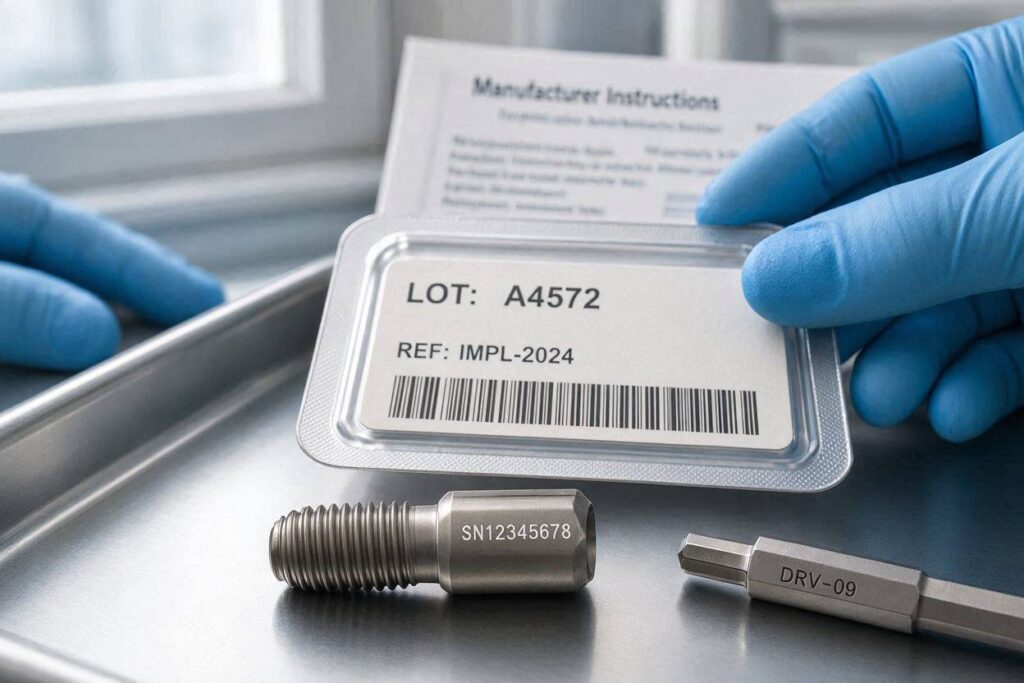
Let us start with the precise answer to the core question. Dental implants do not have unique serial numbers in the way that a car has a Vehicle Identification Number or an iPhone has an IMEI number. You cannot type a number into a global database and pull up your personal implant file. The titanium post in your jaw does not have a microscopic number laser-etched onto its surface that a dentist can read with a magnifying glass. However, implants are tracked at the batch level. Every implant is manufactured in a batch, and that batch is assigned a unique lot number. The lot number traces back to the date of manufacture, the specific manufacturing facility, the raw material source, and the quality control testing data. This lot number is printed on the implant’s sterile packaging and on the label that your dentist peels off and places in your chart.
Think of it like a prescription medication. Your bottle of antibiotics does not have a unique serial number just for you, but it has a lot number. If there is a recall of that medication due to contamination, the manufacturer can issue a recall by lot number. Dental implants work the same way. The lot number is the critical piece of traceability data.
What Is a Lot Number and Why Does It Matter?
A lot number, sometimes called a batch number, is an alphanumeric code assigned to a specific manufacturing run of implants. For example, a lot might consist of 500 implants of a specific diameter and length, manufactured on a specific day, from a specific ingot of titanium alloy. The lot number allows the manufacturer to track every implant in that batch from the factory to the distributor to the dental practice.
The lot number matters for three primary reasons: safety, accountability, and restoration. Safety is the most critical. In the rare event that a manufacturing defect is discovered, the manufacturer can issue a product recall. The recall notice will specify the affected lot numbers. Your dentist can check your chart, see that your implant is from a recalled lot, and contact you for follow-up care. Without the lot number recorded, tracing a recalled implant becomes nearly impossible.
Accountability is the legal and regulatory function. In the United States, dental implants are Class II medical devices regulated by the Food and Drug Administration (FDA). The FDA requires manufacturers to maintain traceability records. The lot number is the key that unlocks those records.
Restoration is the practical, patient-facing reason. Years after the implant is placed, the crown on top may need to be replaced. The abutment screw, the tiny screw that holds the crown to the implant, may loosen or break. To order a replacement screw, a new abutment, or a new impression coping, the dentist must know the exact implant system, platform, and connection type. The lot number alone does not provide this information, but the implant passport or record that contains the lot number also contains the brand, model, diameter, and length of the implant. The lot number is the breadcrumb that leads back to that essential clinical data.
The Implant Passport: Your Most Important Dental Document
Many implant manufacturers and dental practices provide patients with an implant passport or an implant identification card. This is a small card, similar in size to a credit card, that contains all the vital information about your implant. It is the most important dental document you own, yet many patients lose it or never receive it.
A typical implant passport includes the patient’s name, the date of implant placement, the name and contact information of the placing dentist or surgeon, the implant manufacturer’s name, the specific implant system and model, the implant diameter, the implant length, the abutment type used, and the lot number of the implant fixture. Some passports also include the type of final crown and the date it was delivered.
This card is your implant’s identity card. If you move, if your dentist retires, or if you need treatment while traveling, this card allows any competent implant dentist to instantly understand your implant. They can order compatible components. They can design a new crown that fits perfectly. They can troubleshoot a problem without having to do detective work, which often involves taking X-rays and guessing the implant type. You should keep your implant passport in a safe place, just as you keep your passport, birth certificate, or car title. Take a photograph of it and store it in a secure cloud folder. Give a copy to your general dentist for your permanent record. Do not lose this document.
The Labels on the Implant Packaging
When an implant surgeon places your implant, the implant comes in a sterile, sealed package. The package contains the implant fixture, usually a cover screw, and sometimes the healing abutment. On the outside of that package, and often on a peel-off sticker inside, is the complete identifying information for the implant. The label includes the manufacturer logo, the implant system name, the reference number for that specific implant, the dimensions in millimeters, the lot number, the sterilization expiration date, and a barcode or QR code.
The surgical team is responsible for affixing these labels to your chart, implant passport, and surgical record. This is standard operating procedure in any reputable implant practice. The dentist or surgical assistant peels the labels and sticks them onto the designated pages of your treatment record. This is not optional. It is a required step for medico-legal documentation. If your dentist did not do this, they violated the standard of care.
You, as a patient, can and should ask for a copy of these labels. At your next visit after implant placement, say to your dentist, “Can I please have a copy of the implant labels and the implant passport for my personal records?” A good practice will happily provide this. They are proud of the systems they use and the traceability they maintain.
How Dentists Identify Unknown Implants
What happens if you lost your records, your dentist retired, and you have no idea what implant is in your jaw? You are not alone. This is a common scenario. Dentists have a systematic approach to identifying unknown implants, but it is not always successful.
The first step is taking a high-quality periapical radiograph, a small X-ray of the specific implant. Different implant brands have distinct radiographic signatures. The shape of the implant body, the thread pitch and pattern, the design of the apex, and the configuration of the internal connection all show up on an X-ray. An experienced implant dentist can often narrow down the brand based on these visual clues. Some manufacturers have published implant identification guides that show radiographs of their various implant lines.
The second step is to examine the implant platform directly. If the crown is removed, the dentist can see the top of the implant and its internal connection. The connection might be an external hexagon, an internal hexagon, an internal octagon, a conical connection, or a proprietary spline design. The diameter of the platform is measured. These characteristics further narrow the possibilities.
The third step, if the implant cannot be identified, is to take an impression of the implant platform, send it to a dental laboratory, and ask the laboratory to attempt to identify it. Dental laboratories see implants from all manufacturers and have extensive experience matching unknown implants.
If all attempts at identification fail, the patient faces a difficult situation. The abutment and crown may need to be custom-fabricated by a laboratory that can use an analog of a “guessed” implant, or in the worst case, the implant may need to be surgically removed and a new one placed. This is costly, invasive, and entirely preventable if proper records were maintained. The value of the implant passport becomes brutally clear when you face the consequences of not having one.
Implant Registries: Do National Databases Exist?
Several European countries, including Sweden, the United Kingdom, and the Netherlands, have national dental implant registries. These registries collect data on every implant placed, including patient demographics, implant type, surgeon details, and outcomes. The purpose is epidemiological surveillance, quality improvement, and long-term safety monitoring. For example, the Swedish Dental and Pharmaceutical Benefits Agency maintains a registry that tracks implant survival rates across the country.
In the United States, no such national registry exists. There is no central database where you can look up your implant by your social security number. The FDA operates the Manufacturer and User Facility Device Experience (MAUDE) database, which collects reports of adverse events with medical devices, including dental implants. However, MAUDE is a passive surveillance system. It is not a registry of all implants placed. It only contains reports of problems. You cannot query MAUDE to find your implant.
Some implant manufacturers maintain their own proprietary databases. When a dentist registers an implant case with Straumann, Nobel Biocare, or Dentsply Sirona, the company records the lot number and the dentist’s information. However, this data is owned by the manufacturer and is not accessible to patients through a public portal. If you know your implant brand, you could contact the manufacturer and ask them to trace the lot number, but they would likely confirm only that the lot number was distributed to your dentist’s practice, not that it was placed in your specific jaw. The manufacturer does not receive your name linked to the lot number. That linkage exists only in your dental record.
The Serial Number Myth: Laser Etching and Microchips
There is a persistent myth that dental implants have microchips embedded in them or laser-etched serial numbers that can be read by a scanner. This myth stems from confusion with other medical devices, such as hip implants or pacemakers, which may have unique device identifiers, and from the pet microchip industry.
The reality is that dental implants are too small to practically accommodate a unique serial number that is readable after placement. An implant is typically 3 to 6 millimeters in diameter and 8 to 16 millimeters long. The surface is treated with micro-roughness to promote bone integration. Etching a serial number onto the surface would compromise the surface treatment and potentially create a niche for bacterial colonization. The implant sits submerged in bone. Even if a serial number were etched on it, you could not read it without surgically removing the implant.
Researchers have explored RFID (Radio Frequency Identification) technology for dental implants, embedding a tiny microchip in the implant that could be read wirelessly. This concept is similar to the microchips used in pets. A dentist could wave a scanner over your cheek and instantly read the implant’s identification number. This technology exists in prototype form but has not been commercialized. The challenges include the size of the chip, the need for a non-metallic antenna that would not interfere with osseointegration, and the cost. For now, the implant passport remains the state-of-the-art identification method.
The Role of QR Codes and Digital Dentistry
Modern implant practices increasingly use digital workflows. When an implant is placed, the surgical plan, the implant brand and dimensions, and the lot number are entered into the practice management software and the patient’s digital chart. Some manufacturers print QR codes on their implant packaging. The surgical team scans the QR code with a tablet or phone, and the implant data is automatically populated into the digital record.
Intraoral scanners, used to take digital impressions for the crown, can sometimes capture the emergence profile of the implant and the surrounding tissue. These digital scans become part of the permanent record. If a patient returns years later needing a new crown, the digital scan can be compared to the original, and the implant connection geometry can be analyzed.
Blockchain technology has been proposed for medical device traceability, including dental implants. A blockchain-based system would create an immutable, decentralized record of the implant’s journey from manufacturer to patient. The patient would own a private key that grants access to their implant data. This technology is being explored by healthcare startups but has not been widely adopted in dentistry.
What Information the Lot Number Provides to the Manufacturer
If a recall occurs, the manufacturer uses the lot number to trace the implant’s entire production history. The lot number links to a specific batch of raw titanium alloy. The manufacturer can pull the material certification for that alloy, verifying its chemical composition and mechanical properties. The lot number links to the specific manufacturing line, the date and time of machining, the surface treatment bath, the sterilization cycle, and the packaging line. Every quality control checkpoint in the manufacturing process is logged against that lot number.
If a patient experiences an unusual reaction, such as peri-implantitis of unknown origin or a fracture of the implant, the lot number is reported back to the manufacturer. The manufacturer investigates. If multiple reports cluster around a specific lot number, it triggers a deeper investigation that may lead to a recall. This system protects the public. It relies entirely on the lot number being correctly recorded and traceable.
Your Responsibilities as a Patient
You have a role to play in the traceability of your medical devices. You cannot assume your dentist has everything perfectly archived forever. Dental practices close. Records are lost in fires, floods, or migrations to new software. Paper charts can be misplaced. The best guardian of your implant information is you.
At the time of implant placement, request the implant passport and a copy of the implant labels. Store these documents in a fireproof safe or a secure cloud storage service. Take a clear photograph of the passport with your smartphone. If you ever have a revision surgery, such as a new abutment or a crown replacement, update your records with the new component information.
When you change dentists, provide your new dentist with your implant passport or the photograph of it. Your new dentist will be grateful and impressed. You will save them the time and uncertainty of trying to identify an unknown implant. You will also save yourself the cost of any extra diagnostic steps or custom components that might be necessary if the implant could not be identified.
The Consequences of Poor Record-Keeping in Implant Dentistry
The failure to record implant identification data is a significant patient safety issue. A 2018 survey published in the Journal of Prosthetic Dentistry found that a substantial percentage of patients could not identify their implant brand, and many dental practices had incomplete records. When a patient with an unknown implant presented with a complication, dentists reported spending significant extra time and resources trying to identify the implant, and in some cases, the inability to identify the implant led to suboptimal treatment outcomes.
This failure is not the patient’s fault. It is a failure of the dental practice to adhere to basic documentation standards. When selecting an implant dentist, you can inquire about their record-keeping practices. A question like, “How do you document the implant type and lot number, and will you provide me with an implant passport?” separates the meticulous practices from the sloppy ones. The answer will tell you a lot about the overall quality of care you can expect.
Summary of Key Facts About Implant Serial Numbers
- Dental implants do not have unique, individual serial numbers. They are tracked by batch lot numbers.
- The lot number traces the implant to its manufacturing batch, enabling recalls and quality control investigations.
- The implant passport, provided by the dentist, is the critical document that records the implant brand, model, dimensions, and lot number.
- If the implant type is unknown, dentists can attempt identification through radiographs and physical examination, but this process is not always successful.
- No national implant registry exists in the United States for patients to look up their individual implants.
- RFID and blockchain technologies for implant identification are emerging but not yet widely available.
- You should always request and safeguard your implant passport and implant labels.
Conclusion
Dental implants do not carry a unique, individual serial number like a consumer electronic device, but they are tracked through batch lot numbers that provide robust traceability from manufacturer to patient. The responsibility for linking that lot number to your specific jaw rests with your dental practice, which records the lot number in your chart and provides you with an implant passport. Safeguarding this passport is the most important action you can take to protect your long-term oral health investment. If you do not have your implant records, contact your implant dentist and request them immediately. An identifiable implant is a restorable implant.
Frequently Asked Questions (FAQ)
1. Can I look up my dental implant online using my name?
No. There is no public database where you can search for your dental implant by your name or social security number. The record of your implant exists only in your dental chart and in the manufacturer’s distribution records, which are not publicly searchable.
2. What should I do if I lost my implant passport?
Contact the dentist or oral surgeon who placed the implant. Their practice should have the implant information recorded in your chart, including the lot number label. Request a new implant passport or a copy of the labels. Do this as soon as possible, while the practice still exists and the records are accessible.
3. Are dental implant records kept forever?
Medical and dental record retention requirements vary by state. Generally, adult dental records must be kept for seven to ten years after the last visit. However, practices that close may transfer records to a storage facility or destroy them after the legal retention period. Do not rely on your dentist’s records being available forever.
4. If my implant fails, does the lot number help with a warranty claim?
Yes. Most implant manufacturers offer a warranty on their implants. To process a warranty claim, the manufacturer requires the lot number to verify that the implant was authentic and within its expiration date. Your implant passport and the lot number label are essential for warranty claims.
5. Can a CT scan or MRI identify the implant brand?
A Cone Beam CT scan shows the implant in three dimensions and can help identify the shape, thread pattern, and dimensions. An experienced radiologist or implant dentist can often narrow down the brand. MRI is less useful for identifying implant geometry but is safe for patients with titanium implants.
6. Do different countries have different implant tracking systems?
Yes. The European Union’s Medical Device Regulation (MDR) requires Unique Device Identification (UDI) for medical devices, including dental implants. This system is being implemented and will eventually create a more standardized global tracking database. Australia has a similar system. The United States FDA also requires UDI, but a comprehensive, patient-accessible database does not yet exist for dental implants.
7. Is it safe to get an MRI if I have a dental implant?
Yes. Dental implants are made of titanium or zirconia, which are non-ferromagnetic materials. They do not move or heat up significantly in an MRI scanner. However, the implant may cause artifacts, distortions, on the MRI image of the nearby anatomy. Always inform the MRI technologist that you have dental implants.
Additional Resource
For more information on medical device traceability and the FDA’s Unique Device Identification System, visit:
FDA – Unique Device Identification System (UDI System)