Can Children Get Dental Implants?
The decision to get a dental implant is a significant one for adults. But what happens when a child loses a permanent tooth? Or when a child is born with missing teeth (a condition known as hypodontia)? Parents often ask if dental implants are a viable option for their kids. The answer is not a simple yes or no. It requires a deep understanding of jaw growth and dental development.
The general rule in modern dentistry is that dental implants are not placed in children or young adolescents until their jaw has stopped growing. Placing an implant too early can lead to serious aesthetic and functional problems later in life.
This article explains why children are usually not candidates for implants, the risks of doing it too early, and what alternatives exist to help your child smile confidently while they wait for the right time.
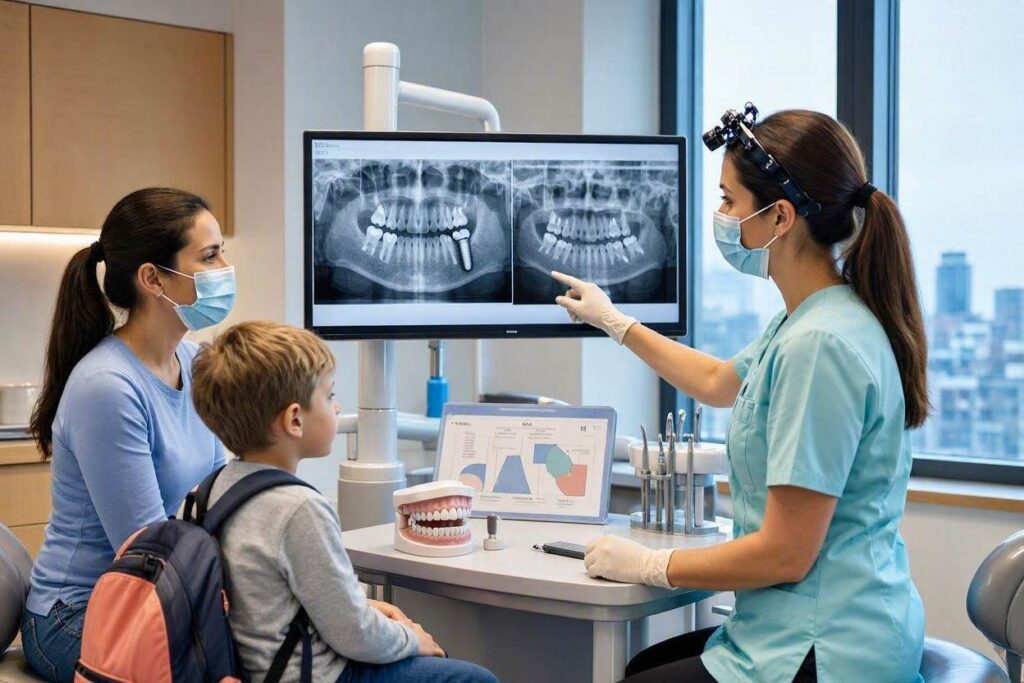
The Problem: Jaw Growth vs. Implants
To understand why implants are dangerous for kids, you need to understand a key difference between natural teeth and dental implants.
How Natural Teeth Grow
Natural teeth are connected to the jawbone by a “periodontal ligament.” This ligament acts like a suspension bridge. It is alive. It allows natural teeth to move. As a child grows, their jawbone lengthens and widens. The natural teeth shift and move within the bone to accommodate this growth. This is why orthodontics (braces) works.
How Implants Behave
A dental implant is placed directly into the bone. It is rigid. It fuses to the bone in a process called osseointegration. It has no periodontal ligament. Therefore, an implant cannot move.
The “Frozen Tooth” Effect
Imagine a 10-year-old girl gets an implant to replace a missing front tooth.
- At age 10, her jaw is small.
- At age 18, her jaw has grown significantly.
- Because the implant is fused to the bone, it stays exactly where it was placed.
- The natural teeth around it will continue to erupt and move downward and forward with the growing bone.
The result? The implant appears to “sink” up into the gum. It looks shorter than the neighboring teeth. It looks like a “baby tooth” stuck in an adult smile. This condition is called infraocclusion.
This is not a cosmetic problem that can be fixed with braces. You cannot move an implant with braces. To fix it, you usually have to remove the implant, which destroys bone.
Skeletal Maturity: The Magic Number
So, when is a child ready for an implant? Dentists don’t look at the birth certificate; they look at the bones.
Chronological Age vs. Bone Age
A child’s chronological age (e.g., 16 years old) does not tell the dentist if they have stopped growing. Some girls finish growing at 15; some boys finish at 21.
Cephalometric Radiographs
Dentists use a special X-ray of the skull (a cephalometric X-ray) to look at the bones in the hand and wrist or the skull. They look for the fusion of specific growth plates.
- For Girls: Growth typically completes around 16-18 years old.
- For Boys: Growth typically completes around 18-22 years old.
Serial Comparison
The safest way to determine growth cessation is to take two X-rays six months apart. If the bone structure has not changed between the two X-rays, growth is likely complete.
Exceptions: When Are Implants Considered for Minors?
There are rare, specific cases where a pediatric dentist might consider an implant for a patient under 18. These are exceptions, not the rule.
1. Severe Ectodermal Dysplasia
This is a genetic condition where children are born with very few or no teeth. The jawbone often does not develop properly because there are no teeth to stimulate it.
In these extreme cases, placing implants in the lower front jaw (anterior mandible) can be done earlier. This area of the jaw stops growing relatively early in life. Placing implants there allows the child to wear a stable denture. It changes their quality of life dramatically.
2. Trauma with Completed Growth
If a 17-year-old boy loses a tooth in a car accident, and X-rays show his jaw is fully mature, he can get an implant. He is a minor chronologically but a biological adult.
3. Congenital Missing Teeth (after orthodontics)
Sometimes a child is born without a lateral incisor (the small teeth next to the front teeth). The orthodontist might use braces to open the space for a future implant. However, the dentist will wait until the braces are removed and the patient is 18 or older before placing the screw.
The Risks of Placing Implants Too Early
If a dentist suggests placing an implant in a growing child without a medical necessity, be cautious. The risks are significant.
Aesthetic Disfigurement
As described earlier, the implant will remain stationary while the face grows. It will look high, small, and out of place. The gum line will be uneven. This can create a permanent “gummy” smile or an appearance of a missing tooth even though the tooth is there.
Bone Loss
Because the implant does not stimulate the bone in the same way a natural tooth does, or because it interferes with the growth pattern, the bone around it can resorb (shrink).
Orthodontic Complications
If the child later needs braces, the implant will act as an anchor. It will not move. The orthodontist will have to work around this immovable object, which can compromise the final bite.
Alternatives for Missing Teeth in Children
Just because a child cannot get an implant doesn’t mean they have to walk around with a gap. There are excellent, safe, temporary solutions designed specifically for growing mouths.
1. Removable Partial Denture
Often called a “flipper” or “spider.”
- What it is: A plastic plate with a tooth attached. It clips onto the back teeth.
- Pros: Inexpensive, non-invasive, easy to clean.
- Cons: Can feel bulky; the child might lose it; it does not preserve bone volume perfectly, but it holds the space.
- Best for: Replacing one or two teeth temporarily.
2. Maryland Bridge (Resin-Bonded Bridge)
- What it is: A false tooth (pontic) with “wings” on the sides. These wings are glued to the back of the adjacent natural teeth.
- Pros: Fixed in place (doesn’t come out); looks great; minimally invasive (little to no drilling on the anchor teeth).
- Cons: The glue can fail and the bridge can fall out; not ideal for heavy chewing forces.
- Best for: Replacing a missing front tooth in a teenager.
3. Traditional Dental Bridge
- What it is: The dentist shaves down the two teeth on either side of the gap and cements a 3-unit bridge over them.
- Pros: Very strong and stable.
- Cons: Destructive. You have to grind down healthy teeth. This is generally discouraged for young people because once you shave a tooth, it is shaved forever.
- Best for: Rarely used in children unless the adjacent teeth already have large fillings.
4. Orthodontic Space Closure
Sometimes the best option is to close the space.
- What it is: The orthodontist uses braces to move the back teeth forward to close the gap where the missing tooth was.
- Pros: No false teeth needed. The child ends with a full set of natural teeth (even if the “canine” has been reshaped to look like a “lateral incisor”).
- Cons: Takes a long time; requires reshaping teeth.
- Best for: Cases where the teeth are crowded anyway.
Comparing Temporary Solutions for Children
| Feature | Flipper (Partial) | Maryland Bridge | Orthodontic Closure |
|---|---|---|---|
| Type | Removable | Fixed | Permanent |
| Invasion | None | Minimal | Moderate (braces) |
| Durability | Low | Medium | High |
| Cost | Low | Medium | High |
| Comfort | Low (bulky) | High | High (after braces) |
| Bone Preservation | Poor | Good (maintains space) | N/A |
The Transition to an Implant
Once your child reaches skeletal maturity (usually around 18-20 for girls and 20-22 for boys), they can transition from their temporary solution to a permanent implant.
The Process
- Remove Temporary: The flipper or bridge is removed.
- Bone Graft: Sometimes, the area where the tooth was missing has lost bone volume because there was no root there. The dentist might need to place a bone graft to rebuild the ridge.
- Implant Placement: The titanium screw is placed.
- Healing: 3-6 months of waiting for the bone to fuse.
- Crown: The permanent tooth is attached.
Psychological Considerations for Parents
It is hard to see your child with a missing tooth. You want them to look perfect for school photos and proms. You might think an implant is the “best” solution because it is the most permanent. However, putting them through a surgical procedure that will fail aesthetically is not good parenting or good dentistry. Patience is the key. A well-maintained temporary denture or bridge will give them the confidence they need today, without ruining their smile tomorrow.
Conclusion
Dental implants are the gold standard for tooth replacement in adults, but they are generally inappropriate for children and young teenagers. The rigid nature of implants conflicts with the natural growth of the jaw, leading to aesthetic failure if placed too early. Parents should rely on temporary solutions like partial dentures or bridges until their child reaches skeletal maturity and is ready for a lifetime of stable smiling.
Additional Resource
For more information on children’s dental health, visit the American Academy of Pediatric Dentistry at www.aapd.org.