Can Dental Implants Be Tightened?
Dental implants feel like magic when they work. But when they feel loose, you want to know if you can just grab a wrench and fix it. The answer is: Yes, but not by you. A dental implant has specific components that require professional tools and knowledge to tighten. Attempting to tighten it yourself with household tools is impossible and highly dangerous.
This article explains what “tightening” means in the context of implants, when it is possible, and when the problem is too big for a simple turn of a screw.
The Screw Retained vs. Cement Retained Distinction
To know if an implant can be tightened, you need to know how your tooth is attached.
Screw-Retained Crowns
In this system, the crown (the white tooth) is attached directly to the abutment or the implant with a tiny screw. There is an access hole on the top of the crown filled with a white filling material.
- Can it be tightened? Yes. If this screw loosens, the dentist can drill out the filling, access the screw, and tighten it.
Cement-Retained Crowns
In this system, the crown is glued (cemented) onto the abutment. There is no screw hole.
- Can it be tightened? No. If the crown is loose, it means the cement failed. You cannot tighten glue. If the abutment under the crown is loose, the dentist must cut the crown off to reach the screw, which destroys the crown.
The Tightening Process (Step-by-Step)
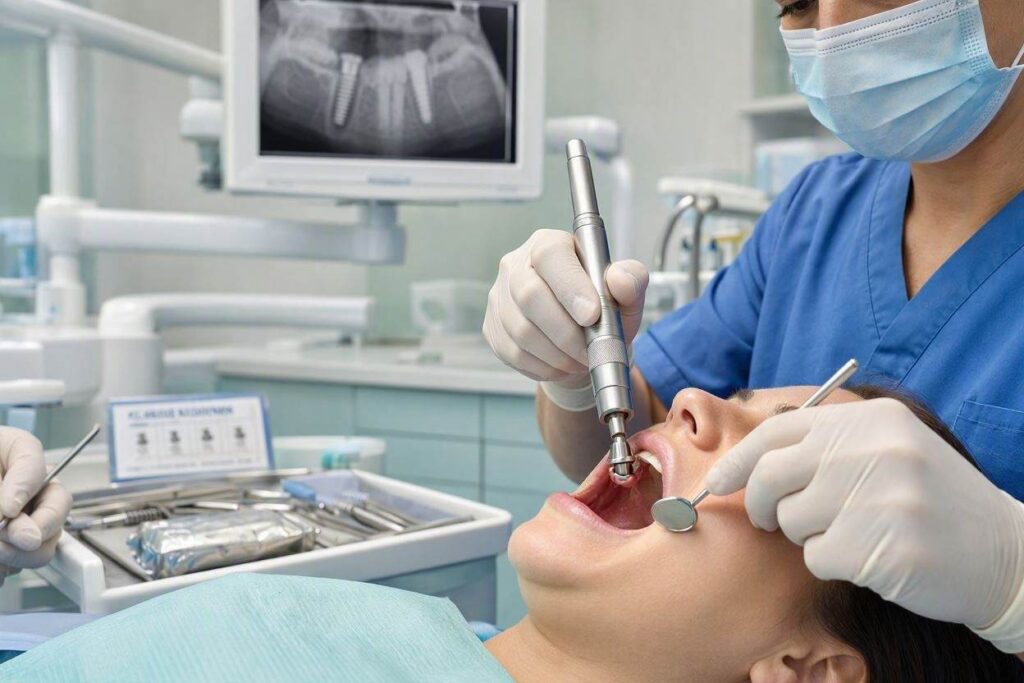
If you have a screw-retained crown, here is what the dentist does to fix it.
- Locating the Hole: The dentist feels the top of the tooth. They find the small divot where the filling is.
- Removing the Filling: They use a small drill to remove the composite filling or cotton pellet hiding the screw head.
- Inspecting the Screw: They look at the screw. Is it intact? Is it stripped?
- Torque Wrench: This is the most critical part. The dentist uses a specialized torque wrench. This device allows them to tighten the screw to a precise measurement (usually 15 to 35 Newton centimeters). This is vital. If it is too loose, it will fall out again. If it is too tight, the screw will snap.
- Re-sealing: They place a fresh piece of Teflon tape or cotton over the screw head and seal it with composite.
Note: This process takes about 20 minutes and usually does not require anesthesia (numbing).
Why Do Implant Screws Loosen?
Several reasons explain why this happens.
1. Normal Wear and Tear
Chewing puts thousands of pounds of pressure on the screw. Over years, the micro-vibrations can cause the screw to “back out.”
2. Poor Fit
If the crown does not fit the abutment perfectly, it can rock. This rocking motion acts like a lever on the screw, unscrewing it over time.
3. Bruxism
Grinding your teeth is the enemy of implants. The lateral forces are much harder on the screw than vertical chewing forces.
When “Tightening” Is Impossible
If the problem is not the screw, turning a wrench won’t fix it. Here are scenarios where tightening is not the solution.
The Implant is Moving (Bone Loss)
If the titanium post itself is moving in the bone, there is no screw to tighten on the outside. The bone has failed. Tightening the abutment screw will do nothing because the foundation (the bone) is weak.
Fractured Screw
If the screw has broken inside the implant, it needs to be removed. This is a tedious process using ultrasonic instruments to vibrate the broken piece out. You cannot “tighten” a broken screw.
Loose Abutment Under Cemented Crown
As mentioned, if the abutment is loose but the crown is cemented on top, the dentist must drill a hole through the top of the crown to access the screw (converting it to a screw-retained style) or destroy the crown.
Table: The Three Types of Looseness
| Symptom | Cause | Solution |
|---|---|---|
| White tooth clicks but post is solid | Loose Crown / Screw | Tighten or re-cement |
| Entire implant wiggles side to side | Bone Failure | Remove Implant |
| Screw head spins freely | Stripped or broken screw | Screw Removal |
Conclusion
Dental implants can indeed be tightened, but only when the mechanical connection has failed. If you notice movement, do not wait. The sooner the dentist re-tightens the screw, the less damage occurs. Delaying a loose screw can lead to it fracturing, which turns a simple fix into a complex retrieval.
Additional Resource
Learn more about implant components at the Academy of Osseointegration at www.osseo.org.