Can Dental Implants Better Align Teeth?
You look in the mirror and see a smile that needs help. Some teeth are crooked. A gap exists where a tooth was extracted years ago. You have heard about the transformative power of dental implants and the straightening magic of braces or Invisalign. A logical, hopeful question forms in your mind: can a dental implant, that sturdy, permanent replacement for a missing tooth, also be used to straighten the rest of your teeth? Can it serve as an anchor to pull the crooked ones into line?
The answer is a firm, anatomical no, followed by a strategic yes. A dental implant cannot move and will not move. It is a rigid, immovable object fused to bone. It cannot be used as an anchor to actively straighten teeth in the way you might imagine. However, a dental implant is often an essential, strategically planned component within a larger orthodontic and restorative treatment plan that results in a beautifully aligned, functional smile. This article will explain the rigid biology of the implant, its role as a passive anchor, and the correct sequence of orthodontics and implant placement.
The Immovable Object: Osseointegration vs. Orthodontic Movement
The fundamental biological difference between a natural tooth and a dental implant is the presence or absence of the periodontal ligament. This ligament, as we have discussed in previous articles, is the key to orthodontic tooth movement.
A natural tooth is not fused to the bone. It hangs in its socket by millions of tiny collagen fibers that form the periodontal ligament. When a gentle, sustained force is applied to a natural tooth by braces or an aligner, the ligament is compressed on one side and stretched on the other. This pressure and tension send biological signals that activate specialized bone cells. Osteoclasts are recruited to the compressed side to resorb bone, creating space. Osteoblasts are recruited to the stretched side to lay down new bone. The tooth moves slowly through the living bone, carried by this continuous, orchestrated process of bone remodeling.
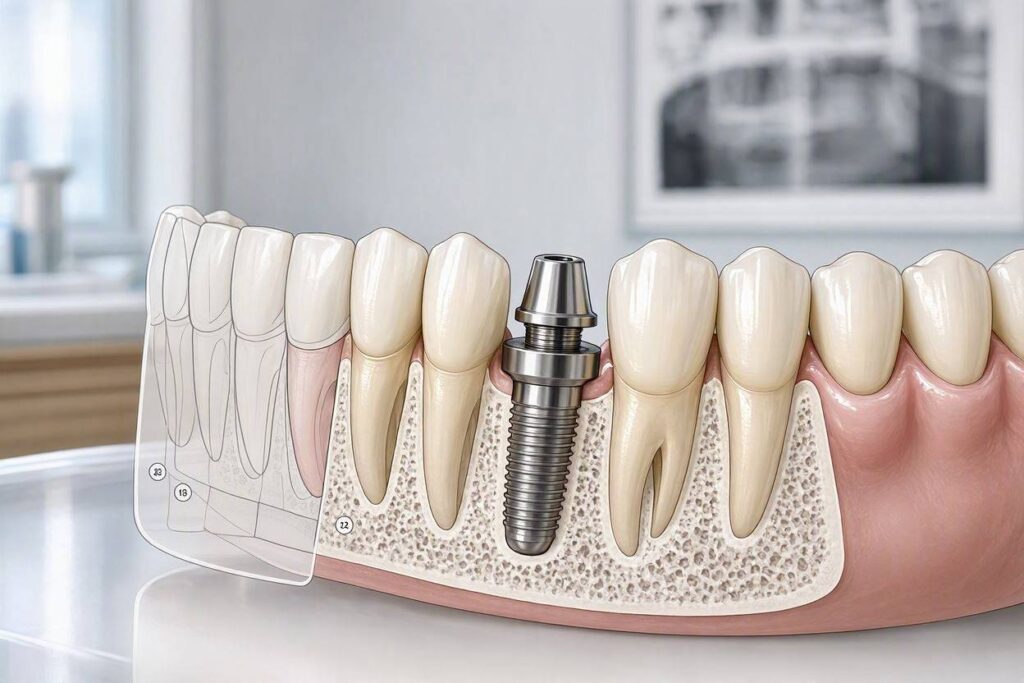
A dental implant has no periodontal ligament. After the healing period, the titanium surface is in direct, rigid contact with the jawbone. This is osseointegration, a functional ankylosis. The implant is effectively welded to the skeleton. If you apply an orthodontic force to an osseointegrated implant, there is no ligament to translate the force into a biological remodeling signal. The bone cells do not receive the message to resorb and rebuild. The force is simply transmitted through the rigid implant into the surrounding bone. If the force is light, nothing happens. The implant will not move. If the force is heavy or sustained, it will not cause the implant to move orthodontically. It will cause the bone around the implant to die from pressure necrosis, leading to implant failure. The implant is an immovable, non-negotiable post.
The Strategic Anchor: The Implant as an Orthodontic Reference Point
Because an osseointegrated implant is immovable, it serves a unique and powerful purpose in complex dental reconstruction. It is an absolute reference point, a fixed post in a sea of shifting teeth. An orthodontist cannot move the implant, but they can move natural teeth relative to the implant.
This is the strategic role of an implant in aligning a smile. A patient with several missing teeth and generalized drifting can have implants placed first in the most critical, strategic positions. These implants are allowed to heal and osseointegrate fully. They then become rigid anchor points. The orthodontist bonds brackets to the remaining natural teeth and uses the implants as absolute anchorage. The braces or aligners pull the drifting, crooked teeth back into a harmonious arch form, using the unmoving implants as the fixed destination points. The implants provide the stable frame of the puzzle, and the natural teeth are moved to fit that frame.
This is a complex, multi-disciplinary treatment plan requiring close collaboration between the implant surgeon, the restorative dentist, and the orthodontist. The sequence is everything. The implants are placed first, in their prosthetically ideal positions, and the orthodontics follow, delivering the natural teeth to the implants. This is the reverse of the more common sequence.
The Classic Sequence: Orthodontics First, Implants Second
For the vast majority of patients, the logical and biologically necessary sequence is to straighten the natural teeth first, and then place the dental implant to replace the missing tooth. This is not a matter of preference. It is dictated by the biological reality that you cannot orthodontically move an implant, but you can move natural teeth into the space an implant will occupy.
Consider a patient who has a missing lower first molar and generalized crowding of the lower incisors. If an implant is placed first in the missing molar space, its position is a guess. It is placed where the bone is available, but this may not be the ideal, prosthetically correct position relative to the final, straightened arch. The orthodontist then begins to unravel the crowding. As the incisors align and move forward, the available space for the implant crown changes. The fixed implant, placed in a pre-orthodontic position, may end up in a compromised, un-restorable location. The final crown may look odd, be difficult to clean, or be subject to destructive bite forces.
The correct sequence is orthodontics first. The braces or aligners are placed, and the natural teeth are moved into their ideal, straight positions. The precise, final dimension of the missing tooth space is created and stabilized with a retainer. Only then, with the arch form finalized, is the implant placed into that perfectly calibrated space. The implant surgeon knows exactly the mesial-distal width, the buccal-lingual dimension, and the occlusal clearance required. The implant is placed into a stable, pre-determined orthodontic result. This sequence is the standard of care for a reason.
The Single-Tooth Diastema: When the Implant is the Final Piece
A patient with a single missing tooth, surrounded by otherwise perfectly straight and well-aligned teeth, is the simplest and most satisfying scenario. There is no orthodontic problem to solve. The space is what it is, stable and correct. A single implant is placed directly into the edentulous site. The implant crown is fabricated to match the shape, size, and color of the adjacent teeth. The implant does not align the other teeth. It simply fills the gap in an already aligned arch. In this context, the implant perfectly “aligns” the smile by restoring a missing element in an otherwise harmonious composition.
The Full-Arch Restoration: A Different Definition of Alignment
A patient who has lost all their teeth and receives a full-arch implant-supported bridge, the All-on-4 concept, is not having their teeth aligned in the orthodontic sense. The failing, malpositioned natural teeth are removed. The implants are placed in the available bone, often angled to maximize bone engagement and avoid anatomical structures. The final bridge is fabricated with the teeth set in an ideal, straight, aesthetic arch form. The alignment is achieved not by moving teeth through bone, but by the prosthetic design of the bridge. The new teeth, the ones on the bridge, are perfectly straight and aligned because they were designed that way by the ceramist and the dentist. The implants underneath provide the rigid support. The alignment is a prosthetic creation, not a biological movement.
Conclusion
Dental implants cannot actively align natural teeth. They are rigid, osseointegrated posts that will not move with orthodontic force. However, they are invaluable as passive, strategic anchors in complex cases where natural teeth must be moved relative to a fixed reference point. In the standard sequence of care, orthodontics is completed first to create the ideal space and arch form, and the implant is placed second into that stabilized, perfect window. The implant then restores the missing tooth, completing a beautifully aligned smile.
Frequently Asked Questions
Can Invisalign move a tooth that has a dental implant?
No. Invisalign aligners apply force to the crowns of natural teeth, which are connected to a living periodontal ligament. An implant is ankylosed to the bone. The aligner tray will simply not exert any moving force on the implant crown. It will pass over it passively. Invisalign can move the natural teeth around an implant, but not the implant itself.
I have an implant in the wrong place. Can it be moved?
No. An osseointegrated dental implant cannot be orthodontically moved. If the implant is in a severely compromised position that cannot be restored acceptably, the only solution is to surgically remove it, graft the bone, and after healing, consider a new implant in a more ideal position. This is a costly and time-consuming corrective procedure, which is why the initial treatment planning sequence is so critical.
Can a dental implant act as an anchor for a bridge to straighten tilted teeth?
No, not in the way orthodontic anchorage works. A fixed dental bridge, supported by an implant and a natural tooth, is a rigid, passive prosthetic device. It does not exert active, sustained forces to move teeth orthodontically. If a natural tooth is tilted, it must be uprighted with orthodontics before being incorporated into a bridge.
Additional Resource:
For an understanding of orthodontic treatment sequencing with dental implants, visit the American Association of Orthodontists’ patient education resource: https://www.aaoinfo.org/blog/can-i-get-braces-if-i-have-dental-implants/