How Long Does an Implant Last
If you are considering a dental implant—or you already have one—the biggest question on your mind is likely the same one most people ask. How long does an implant last? You want a solution that works. You want something that feels natural. But above all, you want to know if this investment will stand the test of time.
The honest answer is both simple and complex. A dental implant can last a lifetime. But that does not mean it always will. The difference between an implant that fails after five years and one that stays solid for forty years comes down to a handful of key factors. Some of those factors are within your control. Others are not.
This guide gives you a realistic, no-hype look at dental implant longevity. You will learn what the research actually says, how different parts of the implant age, and what you can do to maximize your chances of keeping your implant for decades.
Let us start with the most important truth you need to hear right away.
Note: No two patients are identical. Your medical history, daily habits, and oral hygiene routine will directly influence how long your implant lasts. This guide provides general benchmarks based on clinical studies and expert consensus.
What Does “How Long Does an Implant Last” Really Mean?
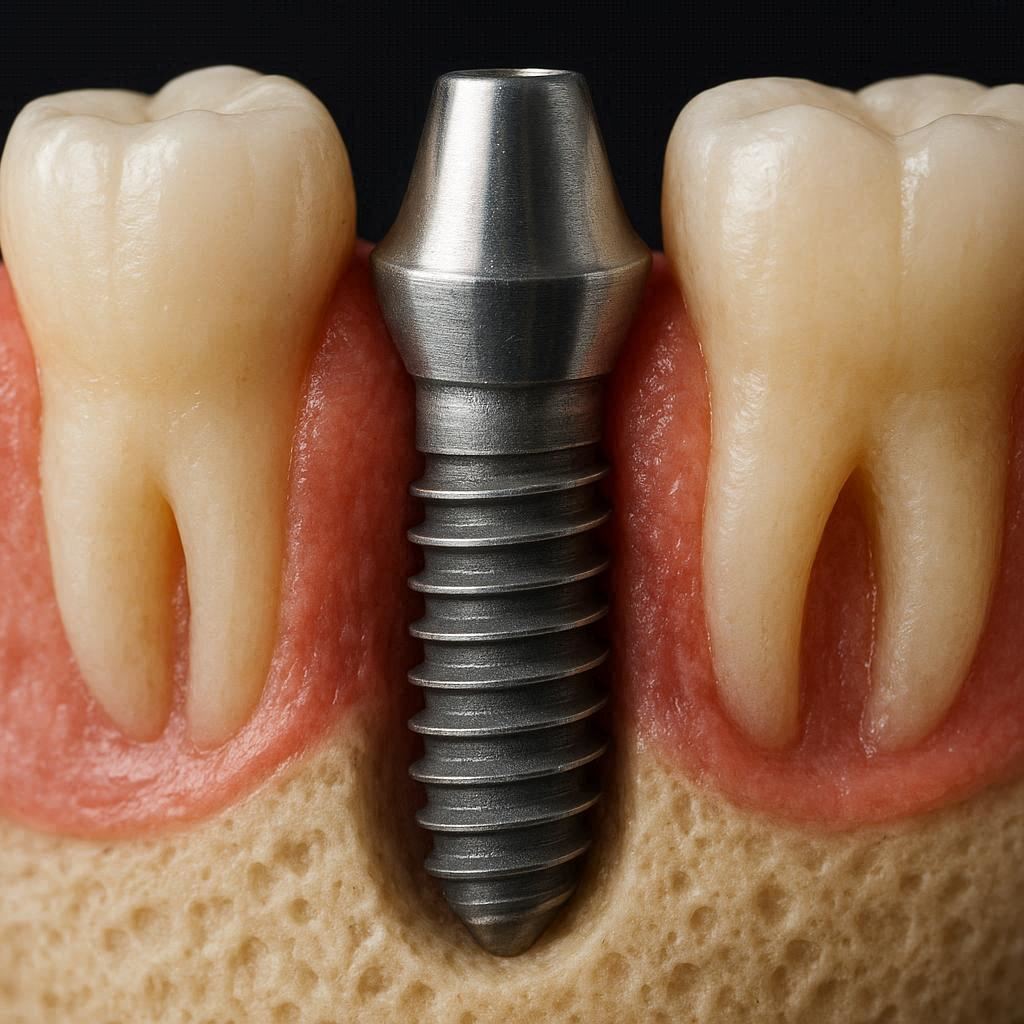
Before we dive into numbers and timelines, we need to clarify something important. When people ask “how long does an implant last,” they are often thinking of the entire implant as a single unit. In reality, a dental implant has three distinct parts. Each part has its own expected lifespan.
The Three Components of a Dental Implant
- The Implant Fixture (The Screw): This is the titanium or ceramic post that your surgeon places into your jawbone. It acts like the root of a natural tooth.
- The Abutment: This is a small connector piece that sits on top of the implant fixture. It links the fixture to the visible crown.
- The Dental Crown (The Prosthesis): This is the part you see and chew with. It looks like a natural tooth. Crowns are usually made from porcelain, zirconia, or porcelain fused to metal.
Each of these components experiences different types of wear and stress. They also have different average lifespans.
Average Lifespan by Component
| Component | Average Lifespan | Most Common Reason for Replacement |
|---|---|---|
| Implant Fixture (screw) | 20+ years to lifetime | Bone loss, peri-implantitis, failed osseointegration |
| Abutment | 10–15 years | Screw loosening, wear, fracture |
| Dental Crown | 10–15 years | Chipping, wear, staining, fracture |
As you can see, the fixture itself is the most durable part. Once your jawbone grows around it—a process called osseointegration—that bond is incredibly strong. The crown, however, is exposed to everything you eat and drink. It will wear down over time, just like natural teeth.
This distinction matters. When someone tells you their implant “failed,” they might simply mean the crown broke. That is a minor repair. A failing fixture is a much more serious problem.
What the Research Says: Real Numbers on Implant Longevity
Let us look at actual clinical data. These numbers come from long-term studies spanning ten, twenty, and even thirty years.
Five-Year and Ten-Year Survival Rates
A large body of research shows that modern dental implants have excellent survival rates.
- Five-year survival rate: 95% to 98%
- Ten-year survival rate: 90% to 95%
These numbers refer to the implant fixture itself. In other words, after ten years, approximately 90 to 95 out of 100 implants are still securely fused to the jawbone and functioning without major issues.
For the crowns attached to those implants, the numbers are slightly lower.
- Five-year crown survival rate: 90% to 95%
- Ten-year crown survival rate: 80% to 85%
This means that if you have a single implant crown, there is about an 80% to 85% chance that same crown will still be in place after ten years without needing replacement. The fixture underneath it will almost certainly still be fine.
Twenty-Year and Longer Studies
Long-term studies become rarer after twenty years, but the available data is encouraging.
A landmark study published in the International Journal of Oral & Maxillofacial Implants followed patients for up to thirty years. The researchers found that:
- After twenty years, roughly 85% to 90% of implants remained successful.
- After thirty years, the success rate dropped to around 75% to 85%, depending on patient factors.
The main reasons for late failures (after ten years) were not sudden trauma or rare complications. They were slow, progressive conditions like peri-implantitis and bone loss.
What These Numbers Mean for You
If you are in good general health, do not smoke, and maintain excellent oral hygiene, your implant fixture has a very high chance of lasting twenty years or more. Your crown will likely need replacement once or twice during that time. That is normal. Natural teeth also require crowns to be replaced eventually.
The key takeaway is realistic and positive: a dental implant is the longest-lasting tooth replacement option available today. It significantly outlasts bridges and dentures. But it is not truly “lifelong” for every single person in every single situation.
The Critical Factor That Nobody Wants to Talk About: Peri-Implantitis
If you want to understand how long an implant lasts, you need to understand peri-implantitis. This is the number one cause of late implant failure. It is also largely preventable.
What Is Peri-Implantitis?
Peri-implantitis is an inflammatory condition that affects the gum tissue and bone surrounding a dental implant. Think of it as a more aggressive version of periodontitis (gum disease) but around an implant instead of a natural tooth.
Here is how it develops:
- Plaque and bacteria accumulate around the implant, especially below the gumline.
- Your immune system responds with inflammation (red, swollen, bleeding gums).
- Over time, this inflammation destroys the soft tissue attachment.
- Next, it starts eating away at the jawbone supporting the implant.
- As bone loss progresses, the implant becomes loose.
Once significant bone loss occurs, the implant fixture may no longer be stable. At that point, removal is often the only option.
How Common Is Peri-Implantitis?
Research suggests that:
- Mild to moderate peri-implantitis affects between 20% and 30% of implant patients.
- Severe peri-implantitis affects between 5% and 10% of implant patients.
These numbers may sound alarming. But remember: many cases are caught early and treated successfully. The real problem is when patients skip regular dental checkups and the condition progresses silently.
Who Is Most at Risk?
Certain factors dramatically increase your risk of peri-implantitis.
- Smoking or tobacco use: Smokers have a significantly higher failure rate.
- History of gum disease: If you lost natural teeth due to periodontitis, you are at higher risk.
- Poor oral hygiene: This is the biggest modifiable factor.
- Uncontrolled diabetes: High blood sugar impairs healing and increases infection risk.
- Genetic factors: Some people are simply more prone to inflammation.
Important Note: Peri-implantitis does not hurt in its early stages. You can have significant bone loss around an implant and feel absolutely nothing. This is why regular radiographic (X-ray) monitoring is essential.
How Long Each Part Lasts: A Detailed Breakdown
Let us go component by component so you have a clear, realistic picture of what to expect.
The Implant Fixture: 20+ Years (Often Lifetime)
The titanium or ceramic screw itself is biologically inert. Your body does not reject it. Once osseointegration occurs (usually within three to six months after placement), the bone grows right up against the implant surface. That bond is incredibly strong.
In the absence of infection or excessive mechanical overload, the fixture can last fifty years or more. In fact, many of the earliest dental implants placed in the 1970s and 1980s are still functioning today.
However, the fixture can fail for specific reasons:
- Failure to osseointegrate (early failure): This happens in the first year. Causes include poor bone quality, infection at placement, smoking, or medical conditions.
- Peri-implantitis (late failure): This happens after years of use. It is the main reason fixtures eventually fail.
- Fracture: Extremely rare with modern implants, but possible if you grind your teeth severely or if the implant is very narrow.
- Mechanical overload: Excessive forces (like clenching or grinding) can, over many years, cause bone loss around the implant.
The Abutment: 10 to 15 Years
The abutment is the connecting piece. It screws into the implant fixture. The crown then attaches to the abutment, either with cement or with another screw.
Abutments are strong, but they experience constant micro-movements during chewing. Over time, the screw that holds the abutment can loosen. This is not a failure, but it does require a quick visit to your dentist to retighten.
Reasons you might need a new abutment:
- Screw threads strip or wear out.
- Abutment fractures (rare, but possible with zirconia abutments).
- The connection between abutment and implant becomes less precise, leading to movement.
The Dental Crown: 10 to 15 Years (Sometimes Longer)
The crown is the workhorse. It takes the full force of your bite, day after day, year after year.
Modern crowns are made from strong materials, but they do wear.
- Porcelain-fused-to-metal (PFM) crowns: Last 10 to 15 years. The porcelain can chip or crack. The metal underneath may become visible as gums recede.
- Full porcelain or ceramic crowns: Last 10 to 15 years. Very natural looking, but can fracture under extreme force.
- Zirconia crowns: Last 10 to 20 years. Extremely strong and resistant to chipping. Increasingly the material of choice.
Signs your crown may need replacement:
- Visible chips or cracks
- Food trapping around the crown margin
- The crown feels rough when you run your tongue over it
- A dark line at the gum line (for older PFM crowns)
- The crown has lost its fit and feels loose
A Realistic Timeline Example
Imagine you receive a single dental implant today.
- Year 1: Healing, osseointegration, crown placement.
- Year 8: The crown develops a small chip from biting a hard piece of food. You replace the crown. Fixture is still perfect.
- Year 14: The abutment screw loosens. Your dentist tightens it. No replacement needed.
- Year 16: The crown shows general wear and has lost its original shape. You replace the crown again.
- Year 22: The abutment connection is slightly worn. You replace the abutment and crown together.
- Year 30: The implant fixture is still stable. No bone loss visible on X-rays.
In this realistic scenario, the implant fixture lasted thirty years and counting. The crown was replaced twice. The abutment was replaced once. The total cost over three decades was significantly less than replacing a bridge multiple times.
7 Factors That Directly Influence How Long Your Implant Lasts
Some of these factors you control. Others you do not. Understanding each one helps you make better decisions.
1. Your Daily Oral Hygiene Routine
This is the single most important factor you control. An implant needs cleaning just like a natural tooth, but it is not exactly the same.
Natural teeth have a ligament that attaches the tooth root to the bone. That ligament has a blood supply and some ability to fight infection.
Implants have no ligament. The bone attaches directly to the implant surface. There is no “shock absorber” and no natural defense system at the attachment point.
This means bacteria around an implant can do damage more quickly than bacteria around a natural tooth.
What you need to do:
- Brush twice daily with a soft toothbrush.
- Floss daily, using implant-specific floss or superfloss.
- Use a water flosser to clean around the abutment and below the crown margin.
- Consider interdental brushes for larger spaces between implants.
- Avoid abrasive toothpaste that can scratch the crown surface.
2. Smoking and Tobacco Use
If you smoke, this is painful to hear, but it is true. Smoking dramatically reduces implant success rates.
A 2015 meta-analysis of multiple studies found that smokers have a two to three times higher risk of implant failure compared to non-smokers.
Why? Nicotine constricts blood vessels. Less blood flow means less oxygen to the healing bone and gums. Smokers also have more plaque and higher rates of peri-implantitis.
The best thing you can do for your implant (and your overall health) is to quit. If you cannot quit completely, reducing the number of cigarettes per day still helps, but the risk remains elevated.
3. Your History of Gum Disease
People who have lost teeth due to periodontitis are more susceptible to peri-implantitis. The same bacteria that destroyed your natural tooth ligaments can attack your implant site.
This does not mean you cannot have implants. It means you need more aggressive maintenance.
If you have a history of gum disease, you should plan on:
- Professional cleanings every three to four months (instead of every six months).
- Regular probing depth measurements to detect early bone loss.
- Possibly using prescription mouth rinses like chlorhexidine.
- Being extremely diligent with home care.
4. Grinding and Clenching (Bruxism)
Do you wake up with a sore jaw or headaches? Do you grind your teeth at night? Bruxism is a major threat to implant crowns and, in severe cases, to the implant fixture itself.
Natural teeth have ligaments that absorb some of the force from grinding. Implants do not. All of that force transfers directly into the crown, the abutment, the screw, and the bone.
Over years, excessive forces can cause:
- Crown fracture or chipping
- Abutment screw loosening or fracture
- Bone loss around the implant
- Implant fixture fracture (very rare, but possible)
Solution: If you grind, wear a custom nightguard. Do not skip this. Replacing a broken crown is expensive. Losing an implant to bruxism is devastating.
5. The Quality and Quantity of Your Jawbone
Your surgeon will evaluate this before placing the implant. If you have enough healthy bone, the implant has a high chance of success. If your bone is thin, soft, or insufficient, your surgeon may recommend a bone graft.
Bone grafting is common. It adds healing time (often four to twelve months), but it dramatically improves long-term outcomes.
Placing an implant into poor bone without grafting is like building a house on sand. It might work for a while, but eventually, problems will appear.
6. Your General Health Conditions
Certain medical conditions affect how long an implant lasts.
| Condition | Impact on Implant Longevity |
|---|---|
| Uncontrolled diabetes | High risk of failure and peri-implantitis |
| Osteoporosis (with certain meds) | Some medications (bisphosphonates) increase risk of bone necrosis |
| Autoimmune diseases | May affect healing and infection resistance |
| Immunosuppression | Higher infection risk |
| Radiation to the jaw | Significantly reduced healing capacity |
Do not hide your medical history from your dentist. Most conditions can be managed, but your treatment plan may need adjustments.
7. Who Places and Restores the Implant
This is a sensitive topic, but it matters. The skill of your surgeon and restorative dentist directly affects implant longevity.
- Poor implant positioning makes it difficult to clean, increasing peri-implantitis risk.
- Improper crown design creates areas where food and bacteria accumulate.
- An ill-fitting crown puts excessive force on one side of the implant.
- Contamination of the implant surface during surgery prevents osseointegration.
Choosing an experienced implant team costs more upfront. But it reduces your risk of early failure and extends the life of your implant.
Maintenance Schedule for Maximum Longevity
If you want your implant to last twenty or thirty years, follow this maintenance schedule.
Daily Home Care (Your Responsibility)
- Morning brushing (2 minutes)
- Evening brushing (2 minutes)
- Flossing around the implant every single night
- Water flosser on low setting, directed at the gumline around the implant
- Avoid chewing ice, hard candies, or non-food objects
Professional Maintenance (Every 6 Months, or More Often if at Risk)
During your regular checkups, your dentist or hygienist should:
- Examine the crown for chips, cracks, or wear.
- Check the abutment for looseness.
- Probe around the implant to measure gum attachment levels.
- Take periapical X-rays annually to monitor bone levels.
- Clean the implant surface with specialized plastic or carbon-fiber instruments (metal scalers can scratch titanium).
- Assess your bite to ensure forces are evenly distributed.
Warning Signs That Need Immediate Attention
Do not wait for your next checkup if you notice any of these:
- The crown feels loose or moves slightly when you push it with your finger.
- You see bleeding when brushing or flossing around the implant.
- The gum around the implant looks red, swollen, or receding.
- You notice a bad taste or odor coming from the area.
- It hurts to chew on that side.
- The crown has changed color or looks different.
Early intervention can save an implant that is developing problems.
Implant vs. Other Tooth Replacement Options: A Longevity Comparison
How does an implant compare to alternatives? Let us look at realistic lifespans.
| Restoration Type | Average Lifespan | Pros | Cons |
|---|---|---|---|
| Single Dental Implant | 20+ years for fixture; 10-15 years for crown | Longest lasting; preserves bone; no adjacent tooth damage | Higher upfront cost; requires surgery |
| Traditional Dental Bridge | 7-10 years on average | Faster; no surgery | Requires shaving healthy teeth; does not preserve bone |
| Removable Partial Denture | 5-8 years | Lowest upfront cost; no surgery | Uncomfortable; accelerates bone loss; can damage adjacent teeth |
| Complete Dentures | 5-7 years (relines needed sooner) | Non-invasive | Bone loss continues; poor stability; needs frequent adjustments |
| Implant-Supported Bridge | 15+ years | Combines implant benefits with replacing multiple teeth | More expensive than a traditional bridge |
A traditional bridge rarely lasts more than ten years without needing replacement. Each time you replace a bridge, more tooth structure is lost from the abutment teeth. Eventually, those teeth may fail, requiring a longer bridge or implant.
An implant, on the other hand, has no moving parts and does not rely on adjacent teeth. When the crown wears out, you simply replace the crown. The fixture keeps working.
Over a twenty-year period, a single implant is often less expensive than replacing a bridge twice, especially when you factor in the value of preserving bone and healthy adjacent teeth.
Can an Implant Last 30, 40, or 50 Years?
Yes. Absolutely yes. But let us be clear about what that means.
An implant fixture can absolutely last thirty, forty, or fifty years. Many of the earliest Swedish implants placed by Professor Per-Ingvar Brånemark in the 1960s and 1970s were still functioning perfectly when the patients passed away decades later.
However, the crown attached to that fixture will almost certainly need replacement multiple times over fifty years. That is not a failure. That is normal wear and tear, exactly as you would expect with natural teeth.
To put it in perspective:
- A natural tooth crown (your original enamel) lasts your entire life with good care, but it can still get cavities, cracks, and wear.
- A dental crown is a restoration. It is not as hard as natural enamel. Replacing it every ten to twenty years is expected.
So when someone asks, “Can an implant last a lifetime?” the honest answer is: the fixture can. The crown probably will need maintenance.
That is still an extraordinary outcome. No other tooth replacement option comes close.
Special Cases and Honest Caveats
Let us address specific situations where implant longevity may be shorter than average.
Implants in People with Uncontrolled Diabetes
If your HbA1c is consistently above 7.5% to 8%, your implant failure risk increases significantly. High blood sugar impairs healing, increases infection risk, and accelerates peri-implantitis.
Recommendation: Get your diabetes under control before implant placement. Work with your physician. Once controlled, your outcomes approach those of non-diabetic patients.
Implants in Heavy Smokers
As noted earlier, smokers have two to three times higher failure rates. If you smoke a pack a day or more, be realistic: your implant may last five to ten years, not twenty.
If you are unwilling or unable to quit, consider whether an implant is the right choice for you. A bridge might be a better short-term solution, although it also has lower success rates in smokers.
Implants in People with Severe Bruxism
Grinders put tremendous stress on implants. Even with a nightguard, your implant crown may need replacement every five to eight years instead of every ten to fifteen. In extreme cases, the abutment or even the implant fixture may fail prematurely.
Recommendation: Use a high-quality, hard acrylic nightguard. Consider zirconia crowns for maximum strength. Have your bite checked annually.
Implants Placed Many Years Ago (Older Designs)
If you received an implant in the 1980s or 1990s, the technology was less advanced. Older implants may have:
- Rough surfaces that are harder to clean
- Weaker connections between implant and abutment
- Less biocompatible materials
These implants may not last as long as modern ones. If you have an older implant that is still functioning, continue monitoring it carefully. Be aware that replacement may eventually be necessary, and that replacement surgery is more complex than the initial placement.
Implants in Growing Children and Adolescents
Surgeons generally wait until jaw growth is complete (around age 18 for females, 20-22 for males) before placing implants. Placing an implant earlier can lead to it appearing “sunken” as the rest of the jaw continues to grow around it.
If you are considering an implant for a teenager, temporary solutions like a removable partial denture or a bonded bridge are better until growth is complete.
Frequently Asked Questions (FAQ)
1. How long does a dental implant last on average for most people?
For the implant fixture itself, most studies show a 90% to 95% survival rate at ten years. That means nine out of ten implants are still functioning well after a decade. For the crown, expect ten to fifteen years before replacement is needed.
2. Can a dental implant fail after 20 years?
Yes, but it is not common. The primary cause of late failure (after ten years) is peri-implantitis, which is largely preventable with good oral hygiene and regular professional cleanings. Other causes include excessive bite forces from grinding or trauma.
3. How long do full mouth dental implants last?
Full mouth restorations (like All-on-4 or implant-supported dentures) have similar fixture longevity—twenty years or more. However, the prosthetic teeth and the bar or framework holding them typically need replacement or significant maintenance every ten to fifteen years.
4. Do dental implants need to be replaced every 10 years?
No. Only the crown on top of the implant needs periodic replacement. The implant fixture itself should last much longer. Think of it like a natural tooth: the tooth (fixture) lasts a lifetime, but a filling or crown on that tooth (prosthesis) may need replacement.
5. What happens when a dental implant fails?
If the crown fails, your dentist simply removes the old crown and makes a new one. If the abutment fails, it can be unscrewed and replaced. If the implant fixture fails (due to bone loss or infection), it must be surgically removed. After healing, a new implant can often be placed in the same location.
6. How can I make my dental implant last longer?
Practice meticulous oral hygiene, do not smoke, wear a nightguard if you grind, see your dentist every six months for professional cleanings, and address any bleeding or discomfort immediately. These simple steps dramatically extend implant life.
7. Are implant failures painful?
Implant fixture failure from peri-implantitis is usually painless until the implant becomes loose. By that point, significant bone loss has already occurred. This is why regular X-rays are essential. Crown or abutment problems can cause mild discomfort or a feeling that something is “off.”
8. Do dental implants get cavities?
No. The implant fixture and abutment are made of metal or ceramic, which do not decay. The crown is also cavity-proof because it is not living tissue. However, the gums and bone around the implant can get infected (peri-implantitis), which is even more damaging than a cavity.
Additional Resources
For a deeper dive into the clinical research behind dental implant longevity, the American Academy of Implant Dentistry (AAID) maintains a patient education library with evidence-based articles and a surgeon finder tool.
Link: American Academy of Implant Dentistry – Patient Resources (Note: replace with your preferred internal or external link before publication)
Conclusion
Here is what you need to remember.
A dental implant fixture can last twenty years, thirty years, or even a lifetime when properly cared for. The crown on top will typically need replacement every ten to fifteen years due to normal wear. Your daily habits—especially oral hygiene and avoiding tobacco—are the single biggest factors determining how long your implant lasts.
Disclaimer: This article is for informational purposes only and does not constitute medical or dental advice. Individual results vary. Always consult with a qualified dental professional for diagnosis, treatment recommendations, and care specific to your situation. Do not use this information to self-diagnose or delay seeking professional care.