Can Dental Implants Correct An Overbite?
You have lived with an overbite for as long as you can remember. Your upper front teeth protrude noticeably beyond your lower teeth. Perhaps you are self-conscious about your profile. Perhaps you have difficulty biting into certain foods. Perhaps your dentist has warned you that the misalignment is causing uneven wear on your teeth. Now you are missing one or more teeth, and you are considering dental implants. A hopeful question crosses your mind: if I am getting implants anyway, can they be placed in a position that corrects my overbite, solving two problems with one treatment?
The answer requires a fundamental clarification of what dental implants can and cannot do. Dental implants, by themselves, cannot correct an overbite. An overbite, technically termed an increased overjet or a Class II malocclusion, is a skeletal or dental misalignment of the entire jaw relationship. It involves the position of the maxilla relative to the mandible, the angulation of the teeth, and the interplay of the chewing muscles and the temporomandibular joints. A dental implant replaces a single tooth root. It is a local solution to a local problem. Placing an implant in a different position will not change the underlying skeletal relationship between the upper and lower jaws.
However, dental implants can play a supporting role in a comprehensive treatment plan that does correct an overbite. When combined with orthodontics, orthognathic surgery, or full-mouth rehabilitation, implants can restore missing teeth within a newly aligned occlusal scheme. The key is sequencing: the skeletal and dental alignment must be corrected first, and the implants are then placed into the stable, corrected position. Understanding this distinction prevents the disappointment of unrealistic expectations and guides you toward the appropriate multidisciplinary care.
This guide explains the relationship between dental implants and overbite correction. We will define what an overbite actually is, why implants cannot move the jaw, the role of implants in full-mouth reconstruction for patients with malocclusion, and the treatment sequence that produces a stable, functional, and aesthetic result.
Understanding Overbite: Skeletal vs. Dental
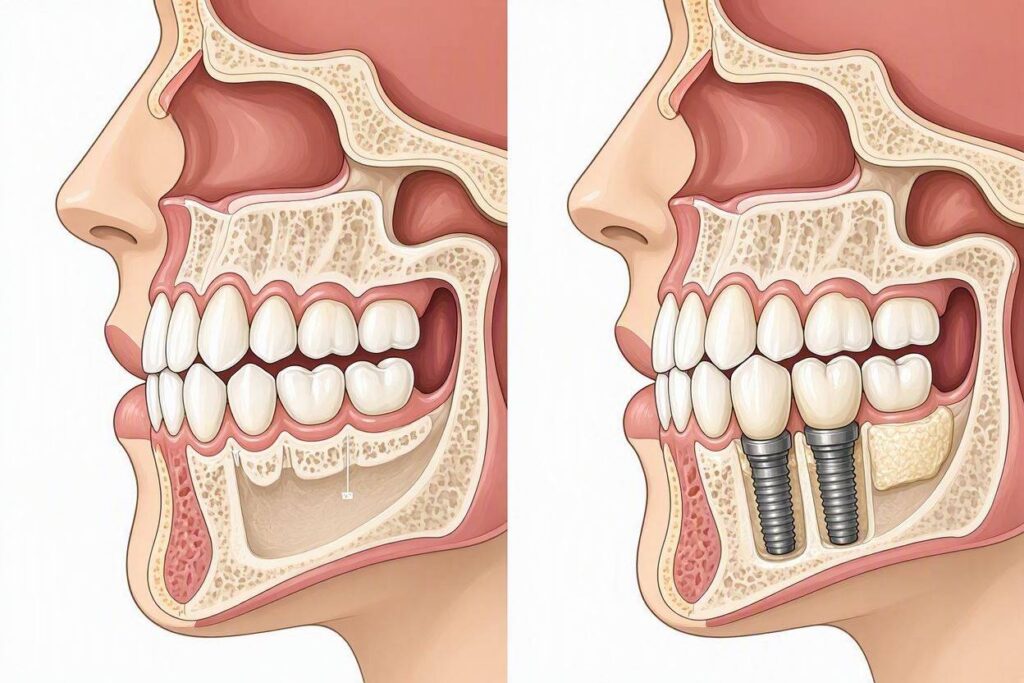
The term “overbite” is used loosely by patients to describe several different conditions. A precise understanding of what you have is the starting point for determining the appropriate treatment. In orthodontic terminology, overbite refers to the vertical overlap of the upper front teeth over the lower front teeth. Overjet refers to the horizontal distance between the upper and lower front teeth. A patient with “buck teeth” has an increased overjet, with the upper incisors protruding forward. Many patients use “overbite” to describe both conditions.
An overbite or overjet can be dental in origin, skeletal in origin, or a combination of both. A dental overbite is caused by the position and angulation of the teeth themselves. The jaws are in a normal relationship, but the teeth have drifted or erupted into a misaligned position. A dental overbite can be corrected with orthodontics alone, using braces or clear aligners to move the teeth into proper alignment.
A skeletal overbite is caused by a discrepancy in the size or position of the upper and lower jaws. The lower jaw, the mandible, may be too small or positioned too far back relative to the upper jaw. The upper jaw, the maxilla, may be too far forward. This is a structural, bony problem. A severe skeletal overbite in an adult cannot be corrected with braces alone because the bones are no longer growing. It requires orthognathic surgery: a procedure in which an oral and maxillofacial surgeon cuts and repositions the jaws, moving the mandible forward, the maxilla backward, or both, to achieve a harmonious skeletal relationship. Orthodontic braces are placed before and after the surgery to align the teeth within the new jaw positions.
A dental implant is a tooth root replacement. It does not possess the biological machinery to influence jaw growth or to move the jawbone. It is a passive anchor. An implant placed into a jaw with a skeletal overbite will simply occupy a position within that misaligned skeletal framework. The implant crown can be contoured to fit the existing bite, but it cannot change the bite.
Why Implants Cannot Move Teeth or Jaws
The immobility of a dental implant, which is its greatest strength as a tooth replacement, is the very reason it cannot be used for orthodontic correction. Orthodontic tooth movement relies on the periodontal ligament, which translates sustained pressure into the biological signals that cause bone resorption on the pressure side and bone deposition on the tension side. A natural tooth can be moved through bone.
An implant is ankylosed, fused directly to the bone with no intervening ligament. Applying orthodontic force to an implant will not cause it to move. The force will either dissipate harmlessly, or, if excessive, will cause the bone around the implant to resorb and the implant to fail. An implant is a fixed landmark. Orthodontists use implants as stable anchors against which to move natural teeth, a technique discussed in an earlier article. The implant is the anchor, not the moving element.
Because the implant cannot move, any attempt to “correct” an overbite by placing an implant in a different position is futile. The overbite is a relationship between the upper and lower arches. Changing the position of a single tooth within one arch, even if it could be done, does not change the relationship between the arches. The lower teeth will still be behind the upper teeth. The skeletal disharmony will remain.
The Role of Implants in Full-Mouth Reconstruction
While implants alone cannot correct an overbite, they are often an essential component of a full-mouth reconstruction that addresses both tooth loss and malocclusion. A patient with a severe overbite who has also lost multiple teeth faces a complex restorative challenge. The treatment plan must simultaneously restore the missing teeth, correct the bite, and achieve a stable, functional, and aesthetic result.
In this context, the treatment sequence is critical. The first phase is diagnosis and treatment planning, which involves a comprehensive examination, photographs, dental impressions or digital scans, a CBCT scan, and often collaboration between a restorative dentist, an orthodontist, and an oral surgeon. The team develops a coordinated plan that addresses the skeletal, dental, and restorative needs in the correct order.
The second phase is orthodontic treatment. Braces or clear aligners are placed to move the remaining natural teeth into their ideal positions. The orthodontist works to level and align the dental arches, to close spaces or create appropriately sized spaces for future implants, and to establish the correct angulation of the teeth. The orthodontic treatment plan is designed with the final implant positions in mind. The orthodontist creates the space for the implant and ensures that the roots of adjacent teeth are parallel and will not interfere with implant placement.
If the overbite is skeletal and severe, orthognathic surgery is the third phase, performed after the teeth have been orthodontically prepared. The surgeon repositions the jaws to correct the skeletal discrepancy. Orthodontic treatment continues for several months after surgery to fine-tune the bite. The patient is now in a stable, corrected skeletal and dental relationship.
Implant Placement in the Corrected Bite
Only after the jaws and teeth are in their final, stable positions are dental implants placed. The implant surgeon now works within a corrected, harmonious occlusal scheme. The implant positions are planned using the final orthodontic result and the planned final crowns. The surgeon places the implants where they will best support the prosthetic teeth within the new bite.
This sequenced approach—orthodontics first, then surgery if needed, then implants—produces a result where the implants are integrated into a correctly aligned mouth. The implants themselves did not correct the overbite, but they are essential to completing the reconstruction. Without the implants, the spaces created by missing teeth could not be filled with fixed restorations, and the corrected bite could not be fully restored.
Attempting the reverse sequence—placing implants first and then trying to correct the overbite with orthodontics—is fraught with difficulty. The implants become immovable obstacles within the orthodontic treatment plan. The orthodontist must work around them, which severely limits the achievable tooth movements. The result is almost always a compromise.
The Cosmetic Illusion: When an Implant Crown Masks an Overbite
In a limited number of cases, a skilled restorative dentist can use an implant crown to create the cosmetic illusion of a corrected overbite, even though the underlying skeletal relationship is unchanged. This is possible when the overbite is mild, and the primary concern is the appearance of a single protruding or missing tooth.
If a patient has a missing upper central incisor and a mild overjet, the implant crown can be fabricated with a slightly more palatal inclination than the original tooth. The crown can be designed to emerge from the gum at an angle that reduces the apparent protrusion. The laboratory technician can layer the ceramic to create an optical illusion of better alignment. This is a cosmetic compensation, not a true overbite correction. The jaw relationship is unchanged, and the lower teeth are still in the same position. The functional bite may be unchanged or slightly improved.
This approach has limits. If the overjet is significant, simply tilting an implant crown backward will create an unsightly, bulky emergence profile and an unstable occlusal relationship. The crown will be subjected to unfavorable forces that risk mechanical failure or implant overload. Cosmetic compensation is a tool for mild cases, not a solution for significant malocclusion.
Conclusion
Dental implants cannot correct an overbite because they are immobile anchors that replace tooth roots without influencing the skeletal or dental relationship between the jaws. The correction of an overbite requires orthodontics to move the natural teeth and, in skeletal cases, orthognathic surgery to reposition the jaws. Implants play a vital supporting role in comprehensive treatment by restoring missing teeth after the bite has been corrected. The treatment sequence must be orthodontics and surgery first, implants second, never the reverse.
Frequently Asked Questions
Q: Can I get braces after I already have dental implants?
A: Yes, but with significant limitations. The implants will not move. The orthodontist must plan the tooth movements around the fixed implant positions. This is feasible for minor tooth movements but severely restricts major orthodontic correction. If you anticipate needing orthodontics in the future, complete the orthodontic treatment before placing implants whenever possible.
Q: Will insurance cover the combined orthodontic, surgical, and implant treatment?
A: Coverage varies widely. Orthodontic coverage for adults is often limited. Orthognathic surgery may be covered by medical insurance if it is deemed medically necessary to correct a functional impairment, not merely for cosmetic reasons. Dental implant coverage is provided by dental insurance, subject to the usual limitations. A pre-treatment estimate from each insurer for each phase of treatment is essential for financial planning.
Q: How long does the full process of overbite correction and implant placement take?
A: A comprehensive treatment plan involving orthodontics, orthognathic surgery, and implant restorations can span two to four years from start to finish. The orthodontic phase typically lasts 12 to 24 months. Surgical recovery and post-surgical orthodontics add several months. Implant healing after placement adds three to six months before the final restorations are delivered. The time investment is substantial, but the result is a fully corrected, stable, and functional dentition.
Q: Can Invisalign correct an overbite before I get implants?
A: Yes, Invisalign can correct many types of dental overbites and overjets. The aligner treatment is planned to create the appropriate spaces for future implants and to align the adjacent teeth properly. The same sequencing principle applies: complete the aligner treatment, verify the stability of the result, and then proceed with implant placement.
Additional Resource:
For information on orthognathic surgery and corrective jaw procedures, visit the American Association of Oral and Maxillofacial Surgeons: https://www.aaoms.org/