Can Dental Implants Give You Headaches?
You are weeks or months past your dental implant surgery, or perhaps you have recently received the final crown. You expected some soreness in the jaw, but you did not anticipate the headaches. A dull ache that radiates from the temple. A tight band of pressure across the forehead. A throbbing sensation that seems to originate near the implant site and spread upward. You wonder if the titanium post in your jawbone is somehow connected to the pain in your head. Is the implant causing these headaches, or is the timing coincidental?
The answer is that dental implants can be associated with headaches, but the relationship is almost always indirect, mediated through the masticatory muscles, the occlusion, or the proximity of the implant to sensory nerves. The implant itself, inert and osseointegrated, does not emit pain signals. The headaches arise from the response of the surrounding biological system to the implant’s presence or to the changes it has introduced. In most cases, implant-related headaches are transient and resolve as the tissues heal and adapt. In a small number of cases, persistent headaches signal a problem that requires diagnosis and intervention.
This guide traces the potential pathways from dental implant to headache. We will distinguish between the normal postoperative headache that resolves within days, the muscle tension headache that can develop during the adaptation period, the headache caused by occlusal imbalance from a poorly adjusted crown, and the rare but serious headache associated with nerve injury or implant proximity to the sinus. Understanding which type of headache you are experiencing is the first step toward effective relief.
The Postoperative Headache: Normal and Temporary
The immediate postoperative period following implant surgery is the most common time for patients to experience headaches. These headaches are not caused by the implant itself but by the surgical procedure: the local anesthetic injection, the prolonged mouth opening during surgery, the vibration and pressure of the drilling, and the body’s inflammatory response to the surgical trauma.
The local anesthetic injection, particularly when a nerve block is administered in the posterior mandible, can cause a transient headache as the anesthetic wears off. The injection itself may traumatize a small blood vessel, leading to a hematoma within the muscle that refers pain to the temple or the forehead. This headache is self-limiting and resolves within 24 to 72 hours.
Muscle fatigue from prolonged mouth opening is a significant contributor to postoperative headaches. The muscles of mastication—the masseter, the temporalis, and the medial and lateral pterygoids—are placed under sustained tension during the implant procedure, which can last an hour or more. The patient may unconsciously guard or clench during the surgery, adding to the muscle strain. The resulting myofascial pain can manifest as a tension-type headache, a dull, pressing pain that wraps around the head. This headache typically peaks on the first postoperative day and fades over several days as the muscles recover. Gentle jaw stretching, warm compresses, and over-the-counter analgesics provide relief.
The inflammatory response to the surgery releases prostaglandins and other chemical mediators that can sensitize pain pathways and contribute to a generalized headache. This is part of the normal healing process. As the acute inflammation subsides over the first week, the headache resolves in parallel. A headache that persists beyond the first week after surgery, or that intensifies rather than fades, is not a normal postoperative sequela and warrants a call to the surgeon.
The Occlusal Headache: When the Bite Is Off
The most common cause of persistent or recurrent headaches following implant restoration is an occlusal imbalance created by the new crown. As discussed in the previous article on TMJ, an implant crown that contacts too heavily against the opposing tooth creates an occlusal interference. The patient senses the high spot, consciously or unconsciously, and the jaw muscles adapt by shifting the mandible into a position that avoids the interference.
This altered jaw posture places the muscles of mastication under chronic, abnormal strain. The temporalis muscle, a broad, fan-shaped muscle on the side of the head, is particularly susceptible. Chronic temporalis strain produces a characteristic headache pattern: a dull ache in the temple region that can radiate across the forehead and behind the eye. The patient may notice that the headache is worse in the morning, after a night of clenching or grinding on the high spot, or worse after meals, when chewing has fatigued the muscles.
The diagnosis is made by examining the occlusion. The dentist uses articulating paper to mark the contact points and observes the pattern. A heavy contact on the implant crown, particularly one that appears before the other teeth contact, is the classic finding. The patient may be able to feel the high spot immediately when the dentist asks them to tap their teeth together.
The treatment is occlusal adjustment. The dentist uses a fine diamond bur to selectively polish the high spot on the implant crown, reducing the premature contact. The adjustment is typically minor, measured in microns, but the relief can be dramatic. The muscles relax, the adaptive jaw posture is abandoned, and the headaches resolve, often within days. No medication is required. The implant itself is unchanged; only the surface contour of the crown is modified.
The Muscle Adaptation Headache
Even without a true occlusal interference, the introduction of a new implant crown can provoke muscle tension headaches as the neuromuscular system adapts to a changed oral environment. The brain has spent years or decades with a specific configuration of teeth. When a missing tooth is replaced, or when multiple implants alter the occlusal scheme, the sensory and motor patterns must be recalibrated.
The tongue, the cheeks, and the lips explore the new crown. The chewing muscles learn the new contact points. The temporomandibular joints adjust to the altered occlusal plane. This neuroplastic adaptation can involve a period of mild, diffuse muscle tension that manifests as a tension-type headache. The headache is typically mild to moderate, generalized rather than localized, and gradually fades over a period of weeks as the brain accepts the new normal.
This type of headache is more common with extensive implant restorations, such as a full-arch All-on-4 bridge, where the entire occlusal scheme has been fundamentally changed. The muscles and joints are essentially learning to function with a completely new set of teeth. A period of soft diet, jaw exercises prescribed by the dentist or a physical therapist, and patience are the appropriate management. The headaches of adaptation are self-limiting.
Nerve-Related Headaches: A More Serious Concern
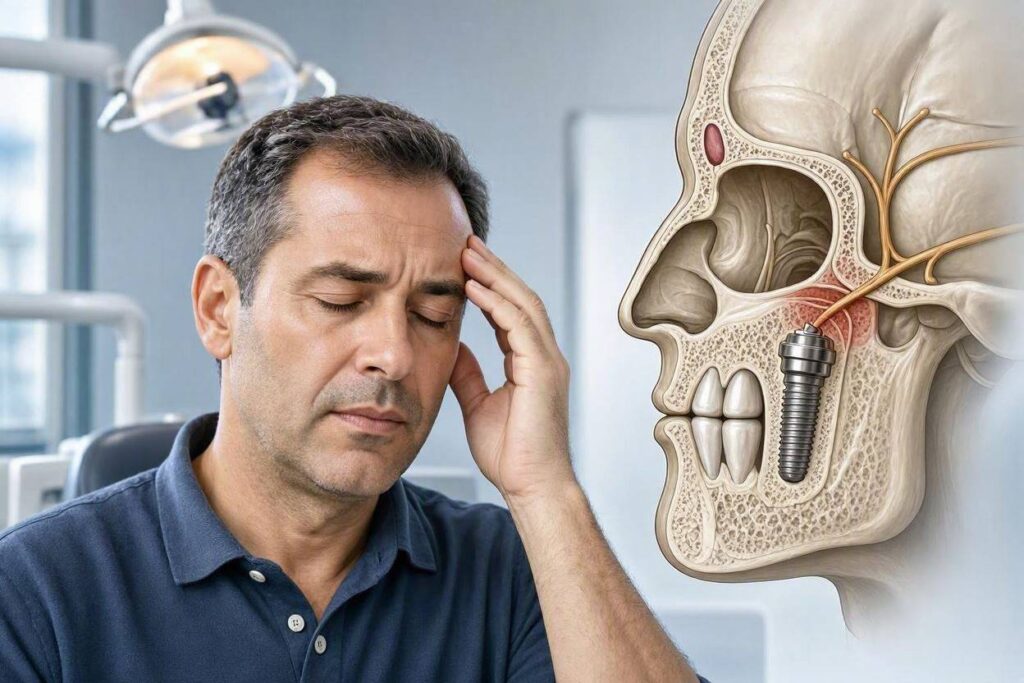
The trigeminal nerve is the great sensory nerve of the face, providing sensation to the teeth, the jaws, the sinuses, and the meninges, the coverings of the brain. It is intimately involved in many headache disorders, including migraine. The branches of the trigeminal nerve run in close anatomical proximity to the sites where dental implants are placed. The inferior alveolar nerve traverses the mandibular canal in the lower jaw. The infraorbital nerve runs in the floor of the orbit above the upper jaw. The posterior superior alveolar nerve innervates the upper molars and the sinus.
A dental implant placed in the posterior mandible that encroaches on the mandibular canal can contact, compress, or traumatize the inferior alveolar nerve. The most common symptom is paresthesia or dysesthesia of the lower lip and chin: numbness, tingling, or burning. However, nerve injury can also trigger neuropathic pain that radiates into the temple, the ear, and the head, manifesting as a persistent, often burning or electric-shock-like headache on the side of the implant.
An implant placed in the posterior maxilla that protrudes into the maxillary sinus can irritate the branches of the trigeminal nerve that innervate the sinus membrane. The resulting pain can be referred to the temple, the cheek, and the forehead, mimicking a sinus headache. The headache may worsen with changes in atmospheric pressure, with head position, or with air travel.
Nerve-related headaches from dental implants are rare, but they are serious. They do not resolve with time or with conservative measures like occlusal adjustment. A patient with persistent, unilateral headache following implant surgery, particularly if accompanied by altered sensation in the face, lip, or tongue, requires a thorough evaluation. A CBCT scan can assess the proximity of the implant to the nerve. In confirmed cases of nerve compression, early removal or repositioning of the implant offers the best chance of nerve recovery. Chronic nerve injury can be permanent.
The Sinus Headache Connection
Upper posterior implants, particularly those replacing first and second molars, are often placed in close proximity to the maxillary sinus floor. A sinus lift procedure may have been performed to create adequate bone height. The implant may be in intimate contact with the sinus membrane, or it may slightly protrude into the sinus cavity.
In some patients, this proximity triggers a chronic, low-grade inflammation of the sinus membrane on that side. The patient experiences a persistent, dull ache in the cheek, the upper teeth, and the temple, often with a sensation of pressure or fullness. The pain may be mistaken for a chronic sinus infection. An ENT evaluation and a CBCT scan can clarify the relationship between the implant and the sinus. If the implant is causing the sinus irritation, treatment options include medications to reduce sinus inflammation, or in refractory cases, surgical modification of the implant or the sinus.
When Headaches Are Unrelated to the Implant
It is important to resist the temptation to attribute every headache to the most recent dental procedure. Headache disorders are among the most prevalent neurological conditions in the general population. Tension-type headache, migraine, and medication-overuse headache affect millions of people who have never had a dental implant. The implant patient who develops headaches may simply be experiencing the onset or exacerbation of a common headache disorder that is temporally but not causally related to the implant.
A careful headache history, taken by the dentist or the patient’s primary care physician, can often distinguish between implant-related and implant-unrelated headaches. Implant-related headaches are usually localized to the side of the implant, temporally related to the surgery or the crown delivery, and associated with other local symptoms such as muscle tenderness, occlusal awareness, or altered sensation. Headaches that predate the implant, that occur on both sides, that have a clear migraine pattern with aura, nausea, and photophobia, or that respond to standard headache medications are more likely to be unrelated.
Conclusion
Dental implants can be associated with headaches through several mechanisms: the normal postoperative inflammatory and muscle fatigue response, occlusal imbalance from a poorly adjusted crown, neuromuscular adaptation to a changed bite, and, rarely, nerve proximity or sinus irritation. Most implant-related headaches are transient and resolve with healing, occlusal adjustment, or muscle adaptation. A persistent, severe, or unilateral headache, especially when accompanied by altered facial sensation, demands prompt evaluation to rule out nerve injury, a serious but uncommon complication.
Frequently Asked Questions
Q: How long after implant surgery is it normal to have a headache?
A: A mild, generalized headache is common for the first 24 to 72 hours after implant surgery, primarily due to the anesthetic, muscle fatigue from prolonged mouth opening, and the normal inflammatory response. A headache that persists beyond the first week, intensifies, or is localized to the temple on the side of the implant should be evaluated by the surgeon.
Q: Can the implant crown being too high really cause headaches?
A: Yes. A high implant crown creates an occlusal interference that forces the jaw muscles to adapt with an altered posture. The chronic strain on the temporalis muscle, in particular, produces a characteristic temple headache. The headache typically resolves within days of the dentist adjusting the high spot, a simple, non-invasive procedure.
Q: Will removing the implant cure my headaches?
A: If the headaches are definitively caused by an implant that is compressing a nerve, or by an uncorrectable occlusal or sinus problem, removal may be indicated and can lead to resolution of the headaches. However, removal is a last resort. Most implant-related headaches are managed by less invasive means: occlusal adjustment, muscle therapy, medication, or sinus management. Thorough diagnosis must precede any decision to explant.
Q: Can a dental implant trigger migraines?
A: The relationship is not well-established. Dental procedures, including implant surgery, can trigger a migraine attack in a susceptible individual through the stress and physiological disruption of the procedure. An implant that creates chronic muscle tension or nerve irritation could theoretically contribute to the transformation of episodic migraine into chronic migraine, but this is rare. A patient with migraine should inform their implant surgeon and neurologist so that perioperative migraine management can be optimized.
Additional Resource:
For information on headache disorders and orofacial pain, visit the American Headache Society: https://americanheadachesociety.org/