Can You Use Aligners With Implants?
You have a dental implant. It replaced a missing tooth and restored your ability to chew and smile confidently. Now, years later, your other teeth have shifted. Perhaps you never wore your retainer after braces, or age and natural drifting have created new crowding or spacing. You want to straighten your teeth again, but you are unsure how that works with an implant. You know that an implant is a rigid titanium post fused to your jawbone. It cannot move. Traditional braces can move natural teeth, but can clear aligners work around an immovable implant? Will the aligners damage the implant? Will the implant prevent your other teeth from moving? The answer is yes, you can use aligners with implants, but the treatment requires a nuanced, carefully planned approach.
This comprehensive guide will explain how clear aligners interact with dental implants. We will discuss the critical differences between moving natural teeth and working around an ankylosed implant. We will explore the strategic uses of implants as anchors. We will address the risks and the essential role of an experienced provider. By the end, you will understand exactly how aligners and implants can coexist in your treatment plan.
The Fundamental Difference: Tooth Movement vs. Implant Immobility
To understand how aligners work with implants, you must first understand the fundamental biological difference between a natural tooth and a dental implant. A natural tooth is suspended in the jawbone by the periodontal ligament, a network of collagen fibers that acts as a shock absorber and a mediator of tooth movement. When a force is applied to a natural tooth by braces or an aligner, the ligament compresses on one side and stretches on the other. This pressure triggers a cellular response: osteoclasts break down the bone on the pressure side, and osteoblasts build new bone on the tension side. The tooth moves through the bone. This is the basis of all orthodontics.
A dental implant has no periodontal ligament. It is ankylosed, meaning it is directly fused to the bone. There is no ligament, no cellular intermediary, and no capacity for physiologic movement. If a heavy force is applied to an implant, one of two things happens: nothing, the implant stays put and the force dissipates, or the implant is overloaded, and the bone around it resorbs, the abutment screw loosens, or the implant fails. Implants cannot be moved orthodontically. They are absolute anchors.
This immobility is not a problem to be overcome; it is a clinical reality to be leveraged. In orthodontic treatment with aligners, the implant acts as a fixed reference point. The aligner is designed to move the natural teeth around the implant. The implant is a stationary island in a moving sea of teeth.
Using Implants as Orthodontic Anchorage
The inability of an implant to move is actually a powerful tool in orthodontics. One of the classic challenges in braces treatment is anchorage control. When you push or pull on one tooth, Newton’s Third Law dictates that there is an equal and opposite reaction force. If you are trying to close a gap by pulling a back tooth forward, the front teeth you are anchoring from may move backward. Unwanted tooth movement, called anchorage loss, can complicate treatment.
An implant, because it is immobile, provides absolute anchorage. It cannot be moved. The orthodontist can use the implant as a fixed anchor point to move teeth with precision, without worrying about reactive forces causing unwanted movement. The aligner can be programmed to push off the implant to close spaces, upright tilted teeth, or intrude over-erupted teeth, without the implant budging a millimeter.
Common Scenarios for Aligners with Implants
Let us walk through the most common clinical situations where aligners are used in a mouth that already has an implant.
Scenario 1: The Single Implant and Generalized Crowding
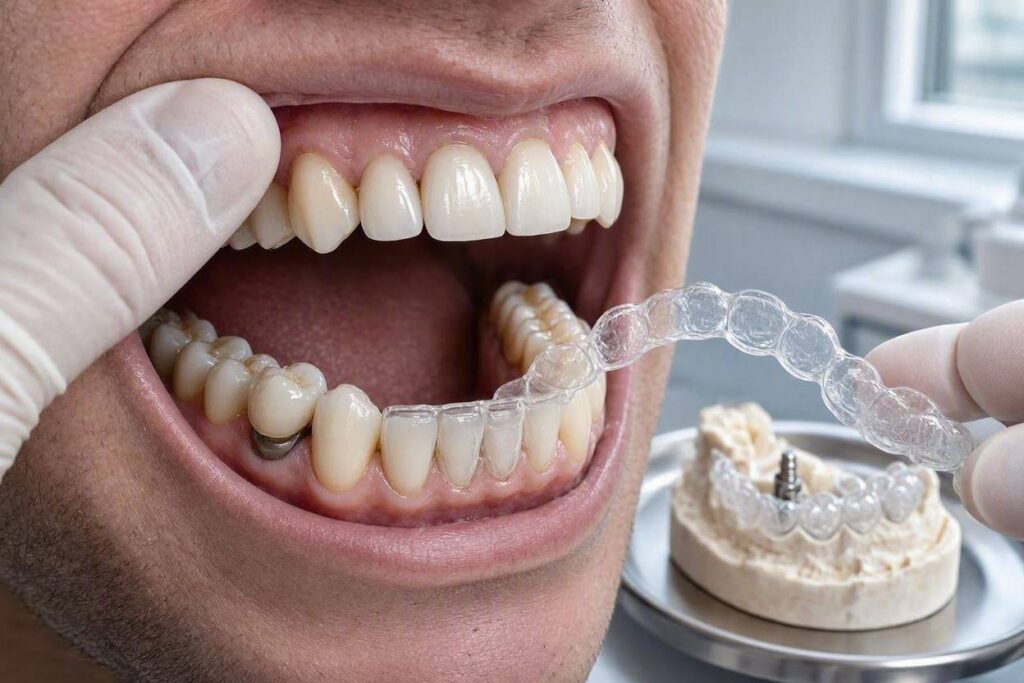
A patient has a single implant replacing a lower first molar. The rest of the teeth have developed mild crowding over the years. The patient wants Invisalign to straighten the teeth. The aligner is designed to move all the natural teeth into alignment. The implant crown remains exactly where it is. The aligner fits over the implant crown just as it fits over the other teeth, but no force is programmed against the implant crown to move it. The implant is a passive tooth in the aligner. The aligner buttons and attachments are placed on the natural teeth to provide the grip for movement.
The critical factor here is that the implant crown must fit well within the aligner. The digital model of the teeth must accurately capture the shape of the implant crown. If the implant crown is a different shape or size than a natural tooth, or if it is angled differently, the aligner must be designed to accommodate it passively. The aligner may have a slightly looser fit over the implant crown to avoid applying any force to it.
Scenario 2: Closing a Space Adjacent to an Implant
A patient has an implant in the position of the upper right central incisor. The adjacent lateral incisor has drifted slightly, opening a small gap. The aligner is designed to close the gap by moving the lateral incisor toward the implant. The implant is the stationary anchor. The aligner pushes the lateral incisor mesially, toward the midline, while the implant crown remains fixed. The gap closes, and the contact between the implant crown and the natural tooth is reestablished.
Scenario 3: Uprighting a Tipped Molar Distal to an Implant
A patient has an implant at the second premolar position. The first molar behind it has tipped forward into the space. The aligner is programmed to upright the molar, pushing the roots backward and the crown forward. The implant provides anchorage for the aligner to push against. The aligner may have a precision cut and an elastic hooked from the aligner to a button on the molar to generate the uprighting force. The implant remains stationary.
Scenario 4: Full Arch Alignment with Multiple Implants
A patient has multiple implants, perhaps two or three, in an arch. Aligners can be used to align the remaining natural teeth. The more implants present, the more complex the treatment, because there are more stationary islands that the natural teeth must move around. The aligner must be segmented in its force application, moving the natural teeth while completely bypassing the implants. This is achievable but requires an experienced orthodontist with advanced digital treatment planning skills.
The Digital Planning Advantage of Aligners
Aligners have a significant advantage over traditional braces when working with implants: digital planning. With Invisalign or similar systems, the orthodontist uses ClinCheck software to plan every tooth movement. The implant crown is marked as a “pontic” or a “non-movement” tooth. The software predicts the final position of the natural teeth while keeping the implant crown stationary. The orthodontist can see a 3D simulation of the entire treatment. They can verify that the teeth will fit harmoniously around the implant at the end of treatment.
This digital precision is invaluable. The alternative, moving teeth with braces and wires around an implant, is less precise. The wire slides through the bracket on the implant crown. It is difficult to ensure that the implant experiences no force. The wire may inadvertently press against the implant crown, transmitting force to the implant-bone interface.
Risks and Challenges of Aligners with Implants
While aligners can be used successfully with implants, risks and challenges exist.
Force Application to the Implant. The greatest risk is that the aligner inadvertently applies force to the implant crown. Even a small, sustained force on an implant can be problematic. The implant may not move, but the bone around it may be stressed. The goal is a perfectly passive fit over the implant crown. If the aligner is even slightly tight, it could act as an orthodontic appliance trying to “intrude” or push the implant. The implant will not move, but the constant pressure could cause discomfort or, theoretically, bone strain.
Aligners Lifting Off. If the aligner is too passive over the implant crown, it may not seat fully. The aligner may lift off the back teeth, causing a poor fit and allowing the teeth to move unpredictably. Achieving the Goldilocks fit, neither too tight nor too loose, over an implant crown requires careful attention to the digital model and sometimes in-office adjustments.
Attachment Debonding. Attachments, the small composite bumps bonded to teeth to give the aligner grip, cannot be bonded to an implant crown with the same predictable strength as to natural enamel. Composite does not bond to porcelain or zirconia as well as it bonds to etched enamel. If the treatment plan requires an attachment on an implant crown, the dentist must use a special primer and bonding protocol for the ceramic surface. Attachments on implant crowns have a higher risk of debonding.
Implant Crown Replacement. If the implant crown is old, poorly contoured, or not ideally positioned, the orthodontist may recommend replacing the crown after the alignment is complete. The natural teeth will move to new positions, and the existing implant crown may no longer harmonize with the new arch form. The patient must understand that orthodontic treatment may necessitate a new implant crown as a separate restorative phase. The cost of a new crown must be factored into the overall treatment budget.
The Role of the Restorative Dentist
Aligners with implants are a collaborative treatment. The orthodontist or general dentist providing the aligners must communicate with the restorative dentist who originally placed the implant crown or who will manage the restoration after orthodontics. A team approach is essential.
The restorative dentist can provide information about the implant system, the abutment type, and the crown material. If the implant crown must be temporarily removed during treatment, the restorative dentist can manage that. If the plan includes a new implant crown after alignment, the restorative dentist will take over at that stage. The patient benefits when the orthodontic and restorative teams are in sync.
Alternatives to Aligners When an Implant Is Present
If the tooth movement needed is around a single implant and is relatively minor, sectional fixed braces, small sections of braces on a few teeth, may be an alternative. In some cases, the implant crown can be sectioned off and the abutment removed, leaving a healed implant buried under the gum while orthodontics moves the adjacent teeth. After the teeth are in their ideal positions, the implant is uncovered, and a new abutment and crown are fabricated. This approach eliminates the challenge of working around the implant crown entirely, but it involves more surgery and a new crown. It is reserved for complex cases where the implant position is significantly compromising the orthodontic plan.
Conclusion
You can absolutely use clear aligners even if you have dental implants. The implant acts as an immovable anchor, and the aligner is digitally designed to move the natural teeth around it without applying force to the implant. The success of this treatment depends on careful digital planning to ensure a passive aligner fit over the implant crown, accurate bonding of attachments, and a collaborative approach between the orthodontic and restorative teams. If you have an implant and want to straighten your remaining teeth, consult an experienced Invisalign provider who can assess your specific situation and design a treatment plan that respects the immobility of your implant while achieving the smile you desire.
Frequently Asked Questions (FAQ)
1. Will an aligner try to move my implant?
A properly designed aligner will have a passive fit over the implant crown, meaning it exerts no force on it. The implant remains stationary.
2. Can I have attachments placed on my implant crown?
Attachments can be placed on implant crowns, but the bond strength is lower than on natural enamel. They are used only when necessary and with special bonding protocols.
3. What if my implant crown is in the wrong position for ideal alignment?
Sometimes, orthodontics is performed to optimize the position of the natural teeth, and the implant crown is replaced afterward to match the new arch form.
4. Is Invisalign safe for my dental implant?
Yes, when planned correctly. The aligner should not apply force to the implant. The treatment is safe for the implant and the surrounding bone.
5. Can I get Invisalign if I have multiple implants?
Yes, but the complexity increases. An experienced orthodontist can design a plan that moves the natural teeth around the multiple fixed implant positions.
6. Do I need a referral from my restorative dentist for Invisalign with implants?
Not necessarily, but communication between your orthodontist and your restorative dentist is highly recommended for optimal results.
7. Will my implant feel different during aligner treatment?
You should not feel any pressure or discomfort on the implant itself. If you do, the aligner may be pressing on the implant crown, and you should contact your orthodontist.
Additional Resource
For more information on orthodontic treatment with clear aligners, visit:
Invisalign – How It Works