Can You Wear Braces After Implants?
The journey to a perfect smile often requires a combination of dental disciplines, and two of the most powerful tools in modern dentistry are orthodontics and dental implants. One moves teeth through bone; the other replaces a missing tooth with a titanium anchor fused to the bone. A common and complex question arises when a patient who already has a dental implant needs or desires orthodontic treatment, or when a patient with braces is considering a future implant. The question “Can you wear braces after implants?” is one of the most critical sequencing questions in interdisciplinary dentistry, and the answer is a nuanced, carefully qualified yes.
You can absolutely wear braces after you have a dental implant, but you must understand a fundamental biological law of implantology: a dental implant is ankylosed. It is fused directly to the jawbone and cannot be moved by orthodontic forces. A natural tooth is connected to the bone by the periodontal ligament, which allows it to be slowly, biologically repositioned through the bone by the gentle, sustained pressure of braces. The implant is a fixed, immovable anchor. If you attempt to move an implant with braces, you will fail. The implant will not budge, and the force will simply be dissipated, or worse, it will cause bone loss and implant failure. The implant, therefore, becomes a fixed point in your orthodontic treatment plan. The braces are designed around the implant, and the implant can even be used as a powerful anchor—an orthodontic anchorage unit—to move the natural teeth precisely where they need to go. This guide will explore the biomechanical principles of orthodontics around implants, the ideal timing of implant placement in relation to braces, the risks of doing it in the wrong order, and the beautiful, coordinated results that a skilled orthodontist and implant surgeon can achieve together.
The Immovable Anchor: Why Implants Don’t Move
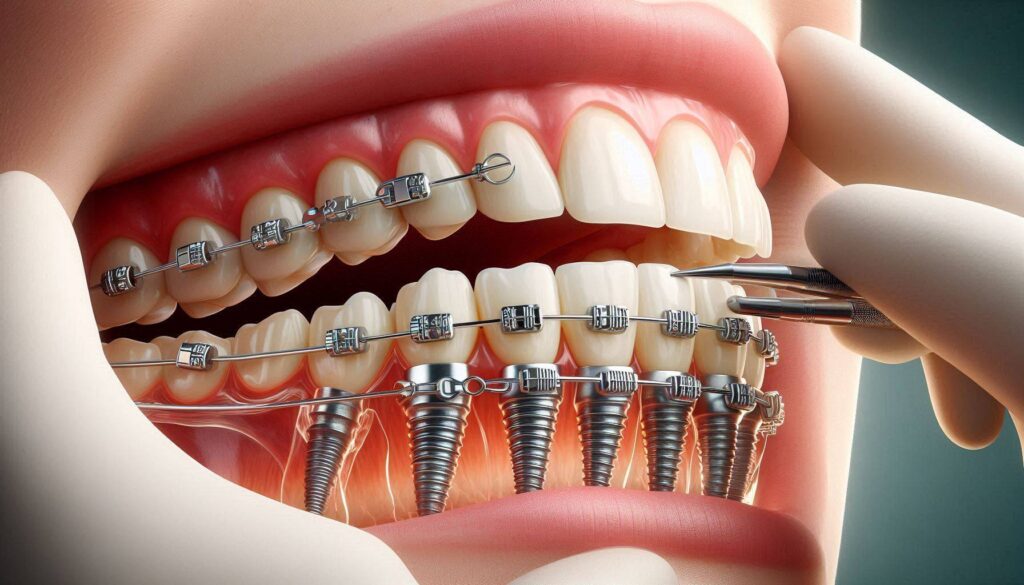
To grasp the clinical reality, you must visualize the difference between a natural tooth root and an implant. A natural tooth has its root encased in a sling of periodontal ligament fibers. When an orthodontist places a gentle, sustained force on the tooth—via a bracket, a wire, and an elastic—the ligament on the pressure side is compressed. The body responds by resorbing the bone on that side, creating a space for the tooth to move into. On the tension side, the ligament is stretched, and the body lays down new bone to fill the void. This is the biological miracle of orthodontic tooth movement.
A dental implant has zero periodontal ligament. It is a direct bone-to-implant interface. There is no biological mechanism for the bone to resorb in a controlled manner in response to orthodontic force. If you apply a force to an implant, one of three things will happen: the force will be below the threshold to do anything and the implant will remain stationary, the force will exceed the implant’s stability and the bone around the implant will be overloaded and resorb pathologically (leading to implant failure), or the orthodontic appliance will simply fail and the tooth on the other end of the chain will be pulled toward the implant. The implant itself will not move. This immovability is not a flaw; it is a feature. It makes the implant the most perfect orthodontic anchor ever devised. It is a “temporary anchorage device” (TAD) on steroids. The orthodontist can use the implant to pull a malposed tooth into perfect alignment without causing any reciprocal movement of the implant.
The Ideal Scenario: Braces First, Implants Second
The interdisciplinary standard of care, whenever possible, is to complete all orthodontic treatment before placing the final dental implant. The reason is simple: it is far easier to move natural teeth into an ideal arch form when there is no immovable titanium post dictating the position of one tooth. The orthodontist has complete freedom to open spaces, close spaces, correct rotations, and level the arch.
Consider a young patient who is congenitally missing a lateral incisor. The orthodontist places braces on all the teeth. The orthodontic treatment plan includes opening a precisely measured space for the future lateral incisor implant. The orthodontist uses coil springs and elastics to create the perfect mesiodistal width and to align the roots of the adjacent teeth so that they are parallel and leave a corridor of bone for the future implant. Once the braces are removed and the teeth are in their final positions, the patient is placed in a retainer. The implant surgeon then takes a 3D Cone Beam CT scan, visualizes the pristine, orthodontically created space, and places the implant in the exact center of the ridge. The implant is then restored with a crown. The result is seamless. This is the textbook model of interdisciplinary care, and it produces the most predictable, aesthetic, and stable long-term outcomes.
The same principle applies to a patient who is losing a failing tooth and knows they want an implant. If the tooth can be temporarily retained, or if the space can be temporarily filled with a removable retainer, the orthodontic treatment is completed first. The failing tooth is then extracted, and the implant is placed into the orthodontically optimized site.
Braces After Implants: The Workaround for Existing Implants
What if you already have a dental implant and now you need or want braces? Perhaps you had an implant placed years ago, and now your other teeth have shifted, or your bite has changed, or you are seeking full-mouth rehabilitation with orthodontics. You can proceed with braces, but the orthodontist must design a specific treatment plan that works around the implant.
The implant is a fixed post. It will not have a bracket placed on it in the traditional sense, or if a bracket is placed for passive inclusion in the archwire, the wire will not be shaped to put active force on the implant. Instead, the implant crown is often left uncovered by the bracket, or a bracket is placed on the crown but it is ligated with a passive tie, meaning no force is applied. The implant acts as a reference point. The orthodontist will move all the other teeth into alignment relative to the implant. The implant’s position is accepted as immutable. This is completely feasible if the implant is already in a relatively good position. If the implant is severely malpositioned—too far forward, too far back, or tilted—its immovability becomes a liability. The orthodontist may recommend removing the implant crown, placing a healing abutment, and allowing the surgeon to assess if the implant can be surgically repositioned or if it must be removed and re-placed in the correct location after orthodontics.
The risk of attempting to move an implant is implant failure. The orthodontic force will not translate into tooth movement. It will create a constant, unremitting pressure on the bone-implant interface. The bone will begin to resorb in an attempt to relieve the pressure, and the implant will become loose and fail. This is why the interdisciplinary communication between the orthodontist and the implant surgeon is paramount. The orthodontist must know the exact implant type, diameter, and position from the surgical records and a current CBCT scan.
The Implant as a Perfect Orthodontic Anchor
While you cannot move an implant, you can certainly pull against it. This is one of the great strategic advantages in modern adult orthodontics. A fully integrated implant is the ultimate anchor. It does not move. If the orthodontist needs to close a space, retract a protruding tooth, or upright a tilted molar, they can use the implant as a fixed point of force application. The natural teeth will move; the implant will stand fast. This allows for extremely precise, predictable tooth movements without the unwanted side effects of reciprocal anchorage loss that occur when using other teeth as anchors.
The orthodontist may bond a bracket to the implant crown or use a temporary anchorage device that screws into the implant’s internal connection. A light, continuous force is applied via an elastic chain or a coil spring from the implant to the tooth that needs to move. The tooth moves. The implant remains stable. This is a highly sophisticated, efficient, and elegant use of the existing implant.
The Special Case of Full-Arch Implant Bridges
A patient with a full-arch “All-on-4” or Hybridge fixed implant bridge presents a unique orthodontic scenario. The entire bridge is a single, rigid, immovable prosthesis supported by multiple integrated implants. You cannot put braces on a full-arch implant bridge and expect to move any of the teeth in the bridge, because they are all part of one monolithic acrylic and metal structure. The bridge itself is the anchor.
If a patient with a full-arch bridge in one jaw needs orthodontics in the opposing jaw, the treatment can proceed. The bridge is stable and can even be used as an anchor for elastics. If a patient has a failing natural dentition in the opposite arch and is considering a second full-arch bridge, the orthodontics are often done in a limited fashion before the second surgery, with the first bridge serving as a fixed template for the ideal occlusal plane.
Conclusion
It is possible to wear braces after having a dental implant, but the implant is an immovable object fused to the bone and cannot be orthodontically moved; the treatment must be designed around the implant, often using it as a fixed anchor to reposition the natural teeth. The ideal, lowest-risk sequence is to complete all orthodontic treatment first, creating the perfect space, and then place the implant into that stable, optimized site. The successful combination of braces and implants requires a meticulously coordinated interdisciplinary plan between the orthodontist and the implant surgeon, respecting the biological law that the implant stands still while the teeth move.
FAQ
Can an implant be moved with braces like a natural tooth?
No. A dental implant is ankylosed to the bone and has no periodontal ligament, so it cannot be moved by orthodontic forces. Attempting to move it can cause implant failure.
Should I get braces before or after a dental implant?
Whenever possible, you should complete all orthodontic treatment before the implant is placed. This allows the orthodontist to create the ideal space and alignment without an immovable implant in the way.
What happens if I already have an implant and want braces?
Your orthodontist will plan the treatment around the implant. The implant will not be moved. It will serve as a fixed reference point or an anchor, and the natural teeth will be moved into the correct position relative to it.
Can an implant be used as an anchor for braces?
Yes, a dental implant is the most perfect orthodontic anchor. It does not move, so it can be used to pull misaligned natural teeth into position with precise, predictable forces.
Will braces damage my dental implant?
No, braces will not damage a healthy, integrated implant as long as the orthodontic force is not applied to the implant itself in an attempt to move it. A passive bracket on the implant crown for anchorage is safe.
Additional Resources
To understand the interdisciplinary planning of orthodontics and implant surgery, consult the American Association of Orthodontists: https://www.aaoinfo.org/