Can’t Get Dental Implants Due To Nerves?
You have made the decision. You want a dental implant. You have done your research, saved your money, and you are ready to fix that gap in your smile. But there is one thing standing in your way: a wave of anxiety that washes over you every time you think about the surgery. The thought of drills, incisions, and titanium posts in your jawbone makes your heart race.
You might be thinking, “I just can’t do it. My nerves won’t let me.” This is a very real and very common barrier. Dental anxiety affects millions of people, and the idea of implant surgery can be terrifying for even the bravest souls.
The good news is that “nerves” (both the psychological kind and the physical kind) very rarely disqualify you from getting dental implants. Modern dentistry has developed incredible techniques, medications, and technologies to manage both anxiety and pain, making the implant process comfortable and manageable.
This guide will explore the two meanings of “nerves” in dentistry—the anxiety you feel and the physical nerves in your jaw—and show you how to overcome both.
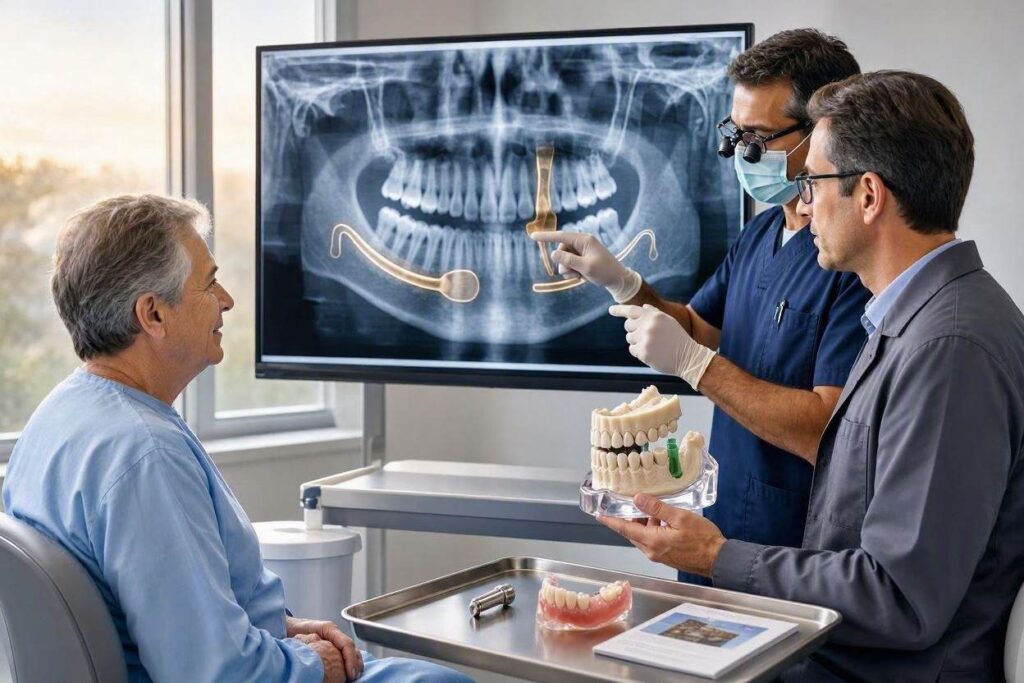
Part 1: The Psychological Nerves (Dental Anxiety and Phobia)
For most patients who say they “can’t get implants due to nerves,” they are talking about fear. This fear is valid. It is a surgical procedure. But you do not have to be fully awake, white-knuckling the dental chair to get through it.
The Solution: Sedation Dentistry
Sedation dentistry is the game-changer for anxious patients. It allows you to undergo the implant surgery in a state of deep relaxation or sleep. Here are your options, ranging from mild to deep.
1. Oral Sedation (The “Happy Pill”)
- How it works: About an hour before your appointment, you take a prescribed pill (usually a benzodiazepine like Halcion or Valium). By the time you sit in the chair, you are incredibly relaxed and drowsy. You are conscious and can respond to commands, but you are in a “twilight” state. Many patients have little to no memory of the procedure afterward.
- Best for: Mild to moderate anxiety.
2. Nitrous Oxide (Laughing Gas)
- How it works: You inhale a mixture of nitrous oxide and oxygen through a mask placed over your nose. Within minutes, you feel a warm, floating, euphoric sensation. The gas is easily adjusted, and it wears off quickly once the mask is removed. You can often drive yourself home.
- Best for: Mild anxiety, or as an adjunct to other methods.
3. IV Sedation (Twilight Sleep)
- How it works: An anesthesiologist or trained dentist inserts a small IV line into your arm. Medication is administered directly into your bloodstream. You enter a state of deep sedation. You are technically conscious, but you are completely unaware of what is happening. You will not feel pain, and you will likely not remember the surgery.
- Best for: Moderate to severe anxiety, or for long/complex surgeries.
4. General Anesthesia
- How it works: You are completely unconscious. This is performed in a hospital or surgical center by an anesthesiologist. You are intubated and monitored closely.
- Best for: Severe phobia, special needs patients, or extensive full-mouth reconstruction. This is rarely necessary for a single implant but is an option.
Important Note: Not all dentists offer IV sedation or general anesthesia. If you know you need this level of care, look for an oral surgeon or a “sedation dentist” who is specifically trained and licensed to provide it.
The Role of the Psychologist
If your fear is severe (a true phobia), you might also benefit from cognitive behavioral therapy (CBT). This type of therapy helps you identify and change the thought patterns that trigger your fear. In a few sessions, a therapist can teach you coping mechanisms that make visiting the dentist bearable.
Part 2: The Physical Nerves (Anatomy and Risk)
There is a second, entirely different meaning of “nerves” when it comes to dental implants. This refers to the actual physical nerves inside your jawbone. In the lower jaw, there is a major nerve called the Inferior Alveolar Nerve (IAN) . It runs through a canal in the bone and provides sensation to your lower lip, chin, and teeth.
If a dental implant is placed too deep or in the wrong position, it can impact this nerve. This is a serious complication that can cause paresthesia—a tingling, numbness, or “pins and needles” sensation in the lip, chin, or tongue. In some cases, this numbness is temporary. In rare cases, it can be permanent.
Are your nerves too close for an implant?
This is a crucial question. In the past, dentists relied on standard 2D X-rays to estimate the location of the nerve. This was risky because 2D images can be distorted. Sometimes, the nerve was closer than the X-ray suggested.
The Solution: 3D CBCT Scanning and Nerve Mapping
Modern implantology has virtually eliminated the guesswork. Before any implant is placed, your dentist should take a 3D CBCT scan (Cone Beam Computed Tomography).
- What it does: This scan creates a 3-dimensional digital model of your jaw. The dentist can rotate the model on a computer screen and measure the exact distance between the bone surface and the nerve canal.
- The Safety Margin: The rule of thumb is to leave at least 2 millimeters of space between the bottom of the implant and the top of the nerve canal. With the 3D scan, the dentist chooses an implant length that fits safely within the available bone, avoiding the nerve entirely.
If the nerve is simply too close (meaning the bone is too shallow), you have options:
- Shorter Implants: Modern “short” implants (6mm to 8mm) can be placed in areas with limited bone height, staying well away from the nerve.
- Nerve Repositioning: This is a complex surgical procedure where the surgeon physically moves the nerve to the side. It is rarely done anymore due to the high risk of complications.
- Alternative Sites: Sometimes, the dentist can angle the implant to avoid the nerve.
The “Nerve” in the Upper Jaw
In the upper jaw, the concern is the Maxillary Sinus, not a nerve. If the bone is too thin, the implant can penetrate the sinus cavity. This is managed with a sinus lift or a shorter implant.
The Fear of Pain: It is Different Than You Think
Many patients confuse “nerves” with the fear of pain. They think the surgery will be excruciating.
Here is the reality:
- During the surgery: You will feel pressure and vibration, but no sharp pain. The local anesthetic completely numbs the bone and gum tissue.
- After the surgery: Once the anesthesia wears off, you will feel soreness, similar to a bruise. Most patients manage this with over-the-counter ibuprofen (Advil/Motrin) and ice packs. The pain is rarely severe and typically peaks within 48 hours.
The “Gag Reflex” and Other Physical Obstacles
Sometimes, “nerves” are triggered by a strong gag reflex. The thought of instruments in the back of the mouth causes a physical reaction. Sedation dentistry is excellent for this. Oral or IV sedation suppresses the gag reflex, allowing the dentist to work efficiently without triggering anxiety.
The Financial “Nerves”: Anxiety About Cost
It is worth mentioning that sometimes “nerves” is actually code for “financial stress.” The cost of an implant can be daunting, and sometimes the anxiety about the price manifests as anxiety about the procedure.
If this resonates with you, talk to the dental office’s financial coordinator. There are often payment plans, financing options, and strategies (like phasing treatment across two calendar years) that can make the procedure affordable. Taking the financial burden off your mind can significantly reduce your overall stress about the implant.
How to Overcome the “Nerves” and Move Forward
If you want the implant but your nerves are stopping you, take these steps:
- Acknowledge the Fear: Do not be embarrassed. Dental anxiety is one of the most common phobias in the world. Tell your dentist about your fears. A good dentist will not judge you; they will adapt their approach.
- Schedule a “Chat Only” Visit: You do not have to commit to surgery just because you walk in the door. Ask for a consultation where you just talk. No tools, no chair time. Just a conversation about what to expect.
- Ask About Sedation: If the fear is high, ask specifically about oral or IV sedation. Knowing you can “sleep through it” often provides the peace of mind needed to book the appointment.
- Bring a Support Person: Bring a friend or family member to hold your hand (literally or figuratively). They can drive you home if you are sedated.
- Get a Second Opinion: If the first dentist tells you that your case is too risky due to nerve proximity, go see an oral surgeon who uses 3D imaging. They might have the technology and expertise to do it safely.
Conclusion
When patients say they “can’t get implants due to nerves,” they are usually referring to anxiety or the anatomical risk of the inferior alveolar nerve. Psychological nerves can be managed with sedation dentistry, ranging from mild oral pills to full general anesthesia. Physical nerves are managed with 3D CBCT imaging that allows the surgeon to plan the implant placement safely around the nerve canal. With these modern tools, most nervous patients can successfully receive implants comfortably and safely.
Frequently Asked Questions (FAQ)
1. What does it feel like if the nerve is damaged during an implant?
If the inferior alveolar nerve is damaged, you will likely experience a persistent tingling or numbness in your lower lip or chin. It can feel like the area is “asleep” (like after a dental filling, but it doesn’t go away). It might also affect your ability to feel if food is on your chin. This is why 3D planning is so critical.
2. Is IV sedation safe?
Yes, for most patients. IV sedation is administered by a trained professional who monitors your heart rate, blood pressure, and oxygen levels throughout the procedure. During your consultation, your medical history will be reviewed to ensure you are a good candidate for sedation.
3. How do I find a dentist who does IV sedation for implants?
Search for “sedation dentistry” or “sleep dentistry” in your area. Oral and maxillofacial surgeons routinely offer IV sedation. Check the credentials of the provider to ensure they have the proper training and permits.
4. If I have a very small jawbone, will the implant hit the nerve?
Not if it is planned correctly. The dentist will use a CBCT scan to measure the available bone. If the bone is too shallow for a standard implant, they will use a short implant, or they will perform a bone graft to increase the bone height. Hitting the nerve is an avoidable error in modern dentistry.
5. Can anxiety affect the healing of the implant?
High levels of stress can affect your immune system. While anxiety itself won’t cause the implant to fail, it can make the experience more difficult and might slightly slow your recovery. Managing anxiety with sedation is beneficial for both your mental and physical health during the procedure.