Dental Implant Post Op Instructions
So, you just got your dental implant. First, take a deep breath. You have made a great decision for your long-term health. Now comes the most important part: the healing.
Think of these instructions as your personal roadmap. The next few weeks are a partnership between you and your mouth. Follow these steps closely, and you will greatly increase your chances of a smooth, pain-free recovery.
This guide covers everything from the first hour after surgery to the moment your final crown is placed. Let us walk through this together, day by day.
Understanding the Healing Process
Before we jump into the lists and timelines, let us talk about what is actually happening inside your jaw. A dental implant is a small titanium post. Your dentist placed it into your bone to act as a new tooth root.
Your body is smart. It will begin to grow bone right up against that titanium surface. This process is called osseointegration. It takes time, usually several months. Your job during this time is to create a perfect environment for that bone to grow.
Good healing depends on three things:
- Protection: Keeping the area safe from pressure and germs.
- Nutrition: Giving your body the fuel it needs to repair tissue.
- Patience: Not rushing back to normal activities too soon.
Important note: Everyone heals at a different speed. Do not compare your recovery to a friend’s or what you read online. Listen to your own body and your dentist’s specific advice.
The First 24 Hours: Your Immediate Action Plan
The first day is all about control. You will manage bleeding, start to reduce swelling, and simply rest.
Controlling Bleeding
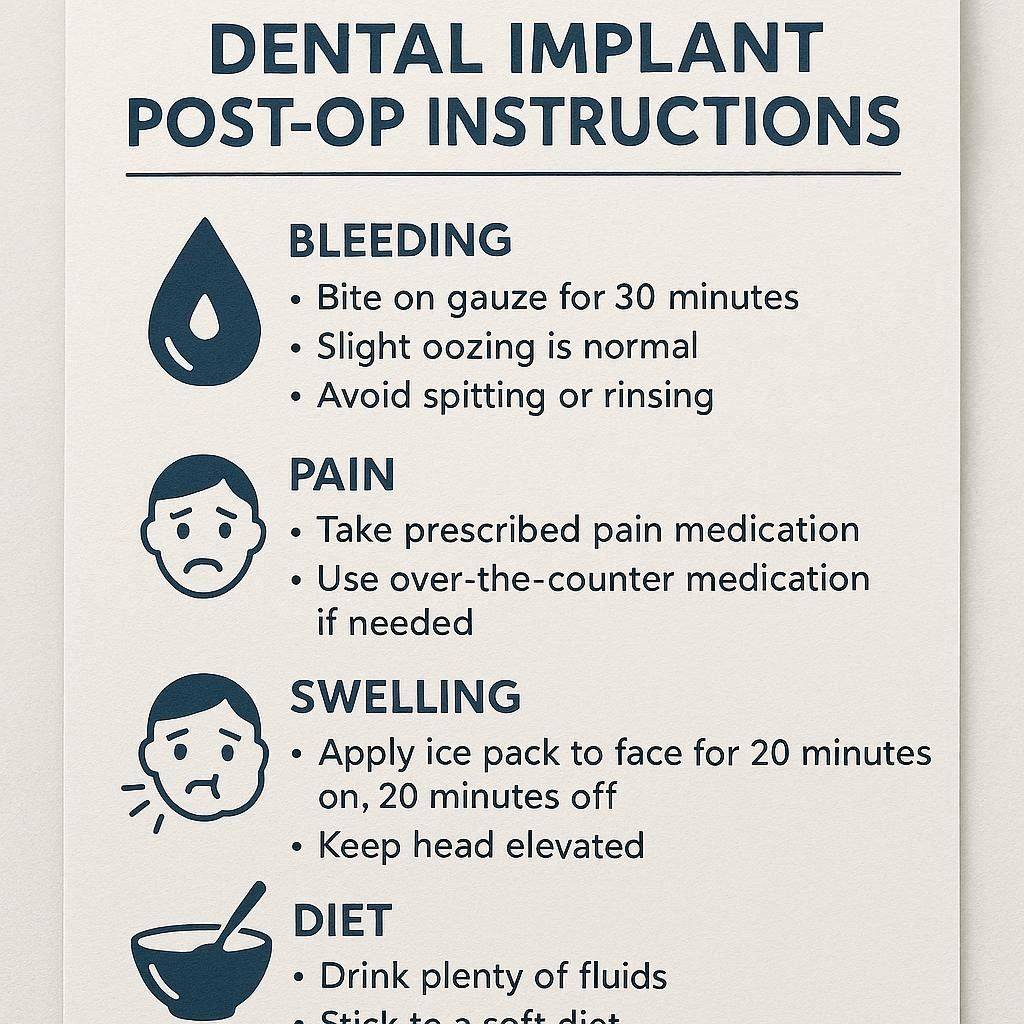
Some minor bleeding is normal for the first 12 to 24 hours. Your saliva might look pink or streaked with red. This is rarely a real emergency.
What to do:
- Bite gently but firmly on the gauze pad your dentist gave you.
- Keep that gauze in place for 30 to 45 minutes.
- If bleeding continues, replace it with a fresh, damp gauze pad.
- Apply light pressure again for another 30 minutes.
What to avoid:
- Do not spit forcefully.
- Do not use a straw.
- Do not rinse your mouth vigorously.
- Do not poke the area with your tongue or finger.
A little oozing overnight is common. You might see a small spot of blood on your pillow. This is usually fine. If you see active, bright red bleeding that does not stop after an hour of pressure, call your dentist.
Managing Swelling and Discomfort
Swelling usually peaks around 48 hours after surgery. You can get ahead of it right now.
Use ice:
- Apply an ice pack to the outside of your face.
- Keep it on for 15 to 20 minutes.
- Take it off for 15 to 20 minutes.
- Repeat this cycle for the first 6 hours after you get home.
Ice is your best friend today. It constricts blood vessels and reduces swelling before it really starts. After the first 24 hours, ice becomes less effective. Then you can switch to warm compresses if you like.
Pain management:
Take your prescribed pain medication as directed. Many people find the worst discomfort happens as the local anesthetic wears off, about 3 to 4 hours after surgery.
If your dentist recommended over-the-counter ibuprofen (Advil) or acetaminophen (Tylenol), take it on a schedule. Do not wait for the pain to become severe. Staying ahead of the pain is much easier than catching up to it.
Rest and Positioning
Keep your head elevated. Use two pillows when you lie down. This reduces blood flow to the surgical site and helps control both bleeding and swelling.
Do not lie flat. Lying flat increases pressure in your head and face. That pressure can make throbbing sensations worse.
Avoid any bending over, heavy lifting, or strenuous activity for the first three days. A raised heart rate increases blood pressure in your head, which can restart bleeding.
What to Eat After Dental Implant Surgery (Days 1 to 7)
Nutrition is medicine. You need calories to heal, but you cannot chew. The solution is a soft, cool, or lukewarm diet.
Safe Foods for the First Week
Here is a simple table to guide your grocery shopping.
| Category | Good Choices | Avoid |
|---|---|---|
| Liquids | Water, protein shakes, milk, smoothies (no seeds) | Hot coffee, hot tea, alcohol, soda |
| Soft solids | Yogurt, applesauce, pudding, mashed potatoes | Rice, bread with hard crusts, chips |
| Proteins | Scrambled eggs, cottage cheese, blended soups | Steak, nuts, seeds, crunchy granola |
| Fruits/veg | Banana, avocado, pureed vegetable soup | Raw carrots, apples, corn on the cob |
Tips for Eating Well
- Cool is better than hot. Heat dilates blood vessels and can restart bleeding or increase swelling. Let your soup cool to room temperature.
- Chew on the opposite side. This seems obvious, but you would be surprised how often people forget.
- Use a spoon. Avoid using a straw for at least one week. The sucking motion can dislodge the blood clot that protects your bone.
- Stay hydrated. Drink plenty of water. Dehydration slows down every part of the healing process.
Reader note: If you are a coffee drinker, I know this is hard. But giving up hot coffee for just 72 hours makes a real difference. After that, lukewarm coffee is acceptable, but still avoid using a straw.
Sample One-Day Menu (Day 3)
- Breakfast: A protein shake and a small cup of yogurt.
- Lunch: Scrambled eggs with a side of mashed avocado.
- Snack: Pudding or a smoothie (made with milk, banana, and protein powder).
- Dinner: Blended tomato soup with a spoonful of cottage cheese mixed in.
Oral Hygiene During Healing
Keeping your mouth clean is critical. But you cannot brush normally around a fresh surgical site. Let us break this down into phases.
First 24 Hours: No Rinsing at All
Do not rinse. Do not spit. Do not swish water. Let the area rest completely. The blood clot that forms over the implant site is fragile. Losing it too early leads to a painful condition called dry socket (even for implants).
Days 2 to 14: Gentle Salt Water Rinses
After the first full day, you can start gentle rinsing.
Make the rinse:
Mix one teaspoon of salt into a cup of warm water.
How to rinse:
- Take a small sip of the salt water.
- Tilt your head gently from side to side.
- Do NOT swish or puff out your cheeks.
- Simply let the water move by gravity.
- Let the water fall out of your mouth into the sink. Do not spit.
Do this two to three times per day, especially after meals.
Brushing Your Teeth
You will continue brushing your other teeth normally. Use your regular toothbrush and toothpaste.
For the surgical area:
- Do not brush directly over the implant site for the first week.
- Brush the teeth next to the area carefully.
- Keep your toothbrush bristles away from the gums near the implant.
After one week, your dentist will tell you how to begin gently cleaning around the implant. You will likely use a very soft toothbrush or a special post-operative brush.
Medications: Antibiotics and Pain Relief
Your dentist likely prescribed one or two medications. Use them exactly as written.
Antibiotics
These prevent infection around your new implant. An infection in the bone is serious and can cause the implant to fail.
- Take the full course. Do not stop early even if you feel fine.
- Take them with food to avoid an upset stomach.
- If you develop a rash or difficulty breathing, stop and seek medical help (this is rare, but serious).
Pain Medication
You may have a prescription for a narcotic pain reliever like hydrocodone or codeine. Or your dentist may recommend high-dose ibuprofen.
| Medication Type | Benefits | Side Effects to Watch |
|---|---|---|
| Ibuprofen (Advil/Motrin) | Reduces pain AND swelling | Stomach irritation. Take with food. |
| Acetaminophen (Tylenol) | Reduces pain only | Safe for most people. Do not exceed dose. |
| Prescription narcotics | Strong pain relief | Drowsiness, nausea, constipation. Do not drive. |
Important: Do not take aspirin unless your dentist told you to. Aspirin thins your blood and can increase bleeding.
Physical Activity Restrictions
You might feel fine after a few days. But your bone is still very fragile. Too much activity increases blood flow and pressure in your head. This can cause throbbing, delayed bleeding, and even implant movement.
Week One: Complete Rest from Exercise
- No running, jogging, or cardio.
- No weightlifting or heavy resistance training.
- No yoga poses where your head is below your heart (downward dog, forward folds).
- No bending over to tie shoes or pick up heavy items. Squat down instead.
Week Two to Four: Light Activity Only
- Walking is excellent. Walk as much as you like.
- Gentle stretching is fine.
- No heavy lifting over 10 to 15 pounds.
- No high-intensity interval training (HIIT).
After One Month
Ask your dentist at your follow-up appointment. Most people can return to full activity by week four if healing looks good. But if you had bone grafting or a sinus lift, you may need to wait six weeks or longer.
Common Complications vs. Real Emergencies
It helps to know what is normal and what is not. Let us separate simple discomfort from serious problems.
Normal (Do not panic)
- Bruising: Yellow or purple bruising on your cheek or under your chin. This is just blood spreading under the skin. It fades in 7 to 10 days.
- Stiff jaw: You may not be able to open your mouth fully for a week. This is from the injection and the procedure. Gentle stretching helps.
- Bad taste: A slightly metallic or salty taste is common from the healing tissues.
- Slight bleeding: Pink-tinged saliva for 2 to 3 days.
Call Your Dentist (During office hours)
- Swelling that gets worse after 72 hours (instead of better).
- Pain that increases after day three or four.
- Low-grade fever (under 101°F or 38.3°C).
- You cannot see the small healing cap (it may have fallen off).
Seek Emergency Care (Immediately)
- Heavy, bright red bleeding that fills your mouth after 10 minutes of pressure.
- Difficulty breathing or swallowing.
- High fever over 101.5°F (38.6°C).
- Numbness that spreads beyond your lip to your chin or cheek (may indicate nerve involvement).
Reader note: When in doubt, make the call. Dentists expect post-op questions. You are not bothering them. It is their job to help you heal safely.
Smoking and Alcohol: A Hard Truth
Let me be completely honest with you. Smoking is the single biggest risk factor for dental implant failure.
Why Smoking Is Dangerous for Implants
Nicotine constricts your blood vessels. That means less oxygen reaches your bone. Without oxygen, new bone cannot grow around the implant. The titanium post never locks into place.
The numbers are real:
- Non-smokers have success rates above 95%.
- Smokers have success rates around 85% to 90%.
- Heavy smokers (more than 10 per day) have even lower success.
What you should do:
If you can quit permanently, now is the perfect time. If you cannot quit, you must stop for at least two weeks after surgery. Two full weeks of no smoking gives the initial blood clot and bone healing a fighting chance.
Alcohol
Alcohol thins your blood. It also dehydrates you. Both are bad for healing.
- First 72 hours: Zero alcohol.
- Days 4 to 14: One small drink occasionally is probably fine, but no heavy drinking.
- Beware of mixing: Do not drink alcohol while taking narcotic pain medication or antibiotics (like metronidazole).
The Timeline: What Happens When?
Let me give you a realistic week-by-week look at the healing journey. This is for a single, uncomplicated implant. Multiple implants or bone grafts take longer.
Week One: The hardest part
- Swelling and discomfort peak around day two or three.
- You will eat soft foods only.
- You will feel tired and want to rest.
- Sutures (stitches) are still in place.
Week Two: Turning the corner
- Swelling is mostly gone.
- You can eat soft, chewable foods like pasta or omelets.
- You may have a follow-up appointment to check healing.
- Non-dissolving sutures may be removed.
Week Three to Four: Feeling normal again
- Most discomfort is gone.
- You can return to normal exercise.
- You can eat most foods except very hard or sticky items.
- The gum tissue looks pink and healthy.
Month Two to Six: The quiet healing phase
- You feel completely normal. You might forget you have an implant.
- Deep bone healing (osseointegration) happens quietly beneath the surface.
- You will visit your dentist for periodic x-rays.
Month Six to Eight: The restoration phase
- Your implant is now integrated with your bone.
- Your dentist will uncover the implant (a tiny procedure).
- You will have impressions made for your final crown.
- Two to three weeks later, your new tooth is screwed into place.
Special Situations: Bone Grafts and Sinus Lifts
Some people need extra procedures before or during implant placement. These are common and still very successful. But they do require stricter post-op care.
If You Had a Bone Graft
A bone graft adds donor bone or synthetic bone to your jaw. It needs even more protection than a standard implant.
Extra instructions for bone grafts:
- No pressure at all on the graft site for at least 4 weeks. That means no chewing anywhere near it.
- Do not touch the area with your tongue. You might feel tiny hard particles. That is the graft. Leave it alone.
- Wear your denture or flipper only if your dentist modified it. An unmodified denture can crush a bone graft.
- Healing takes longer. Expect 6 to 9 months before your implant is ready for a crown.
If You Had a Sinus Lift (Upper Back Teeth)
A sinus lift involves lifting the sinus membrane and placing bone graft underneath it. This is delicate.
Extra instructions for sinus lifts:
- Do not blow your nose for two full weeks. If you need to sneeze, keep your mouth open.
- No sucking or spitting. That includes no smoking, no straws, no playing a wind instrument.
- Avoid air pressure changes. No flying in an airplane for 4 weeks. No scuba diving for 3 months.
- Do not use a decongestant unless your dentist approves. You want your sinus pressure low, not high.
If you feel liquid going up into your nose when you drink, or if your nose bleeds from the same side as your surgery, call your dentist immediately. This could mean a communication between your sinus and your mouth.
Frequently Asked Questions (FAQ)
Let me answer the questions I hear most often from real patients.
1. How long does the pain last after a dental implant?
Most people have mild to moderate pain for 3 to 5 days. The second day is usually the worst. By day seven, you may not need any pain medication at all. Some people feel a dull ache for up to two weeks, especially when chewing on that side.
2. Can I sleep on my side after implant surgery?
Yes, but try to sleep on the opposite side for the first three nights. Sleeping directly on the surgical side increases swelling and can put pressure on the healing gum. Use an extra pillow to keep your head elevated no matter which side you choose.
3. When can I eat normally again?
You can eat soft, chewable foods (like pasta, soft bread, cooked vegetables) by day 7 to 10. You can try crunchy foods like chips or nuts around week 4, but chew carefully on the opposite side. Very hard foods like hard candies or ice should wait until your final crown is placed.
4. What if my implant feels loose?
Your implant should never feel loose, even during healing. The metal post is tightly screwed into your bone from day one. If you feel movement, call your dentist immediately. That is not normal and may indicate a failed integration. Do not wait for your next appointment.
5. Can I use a Waterpik or water flosser?
Wait at least 2 to 3 weeks. The water pressure can be too strong for a fresh surgical site. After one month, you can use a Waterpik on the lowest setting. Aim the water at the tooth surface, not directly into the gum pocket.
6. My gums look white around the implant. Is that a problem?
A white or grayish film can be normal for the first few days. That is often just fibrin, a protein involved in clotting. However, if the area is also painful, has a bad odor, or if the white color spreads, you might have an infection. When in doubt, send a photo to your dentist or go in for a quick look.
7. How do I know if my implant is healing correctly?
Signs of good healing include:
- Decreasing pain and swelling after day three.
- Pink, firm gum tissue (not bright red or blue).
- No bad taste or odor.
- You can see the small silver or white healing cap in the center of the gum.
8. Can I kiss my partner after surgery?
Yes, but be gentle for the first week. Avoid passionate kissing that creates suction. Suction can dislodge the blood clot. Also, ask your partner to avoid touching the surgical area with their tongue or lips.
A Complete 30-Day Recovery Checklist
Use this checklist to track your progress. Print it out or save it on your phone.
Day 1:
- Bite on gauze for 30 minutes.
- Apply ice packs on a 15/15 cycle.
- Take first dose of pain medication.
- Drink only cool liquids.
- Keep head elevated to sleep.
Day 2:
- Continue ice packs (still helpful today).
- Start salt water rinses (gentle, no spitting).
- Eat soft foods like yogurt or smoothies.
- No straw, no smoking, no alcohol.
- Rest. No work or school if possible.
Day 3:
- Swelling may peak today. Normal.
- Switch to warm compresses if you like.
- Soft foods only. Add scrambled eggs.
- Continue gentle salt water rinses.
- You can return to desk work if you feel up to it.
Days 4 to 7:
- Pain should be mild or gone.
- Swelling should begin going down.
- You can eat soft, small-cut foods like pasta.
- Still no heavy lifting or cardio.
- Brush other teeth normally, avoid the site.
Week 2:
- Attend follow-up appointment (usually day 10 to 14).
- Sutures removed (if non-dissolving).
- You can begin very light jogging or cycling.
- You can eat most soft solid foods.
- Ask your dentist about gently brushing the implant site.
Week 3:
- Return to full exercise (listen to your body).
- Try crunchy foods carefully.
- No restrictions on kissing or normal activity.
- Continue good oral hygiene around the implant.
Week 4:
- The surgical site should look and feel normal.
- You have likely forgotten the implant is there.
- Schedule your next check-up (usually month three).
- Celebrate. The hard part is over.
Emotional Recovery: The Unexpected Side
Let me take a moment to talk about something most guides ignore: your emotions.
Many people feel surprisingly down after dental surgery. You are tired. You cannot eat your favorite foods. Your face looks different. You might worry about every little twinge.
This is all normal.
Healing requires energy. Your body is diverting resources away from your mood and toward your bone. Give yourself permission to feel frustrated or anxious. It does not mean something is wrong.
A few tips for your mental recovery:
- Plan a binge-watch list before surgery.
- Accept help from family or friends.
- Do not read horror stories online. They are rare and will only scare you.
- Remind yourself daily: “This is temporary. I am healing.”
By the end of the second week, most people feel back to their normal selves emotionally. If you feel persistently sad or anxious beyond two weeks, talk to your doctor or dentist. They can help.
When Your Final Crown Is Placed
You waited several months. Now it is time for the final step. This is the exciting part.
What happens during crown placement?
Your dentist will:
- Remove the healing cap from your gum.
- Place an abutment (a small connector) onto the implant.
- Take impressions for your custom crown.
- Screw or cement your new crown into place.
This appointment is not surgical. You will have very little discomfort afterward. Most people take no pain medication at all.
Post-op care for the final crown
Your implant is healed, but your new crown needs normal daily care.
- Brush and floss around the crown just like a natural tooth.
- Use a soft toothbrush to avoid scratching the crown’s surface.
- Floss with superfloss or interdental brushes to clean under the crown.
- Visit your hygienist every 6 months for professional cleanings.
- Wear a night guard if you grind your teeth. Grinding can crack your crown or even fracture the implant.
Lifelong maintenance
Dental implants cannot get cavities, but they can get a disease called peri-implantitis. This is inflammation and bone loss around the implant. It is similar to gum disease.
To prevent peri-implantitis:
- Clean around the implant daily.
- Do not smoke.
- See your dentist for yearly x-rays to check the bone level.
- Report any bleeding or bad taste around your implant immediately.
With good care, your implant can last 20, 30, or even 40 years. Some patients keep their implants for life.
Additional Resources
For more trusted, science-based information on dental implants and long-term maintenance, visit the American Academy of Implant Dentistry’s patient education page. They offer free guides, videos, and a directory of qualified implant dentists.
👉 Link placeholder: American Academy of Implant Dentistry – Patient Resources
Note: Insert your actual affiliate or reference link here.
Final Summary and Disclaimer
Conclusion:
Healing from a dental implant takes time, but following clear post-op instructions makes all the difference. Control bleeding and swelling in the first 24 hours, eat soft foods for one to two weeks, and avoid smoking or heavy activity for at least a month. With patience and good oral hygiene, your implant will integrate successfully and serve you for decades.
Disclaimer:
This article is for general informational purposes only and does not constitute medical or dental advice. Every patient and every surgical procedure is unique. Always follow the specific post-operative instructions provided by your own dentist or oral surgeon. If you are experiencing severe pain, uncontrolled bleeding, fever, or difficulty breathing, seek professional medical attention immediately. The author and publisher assume no responsibility for any adverse outcomes resulting from the use of this information.