Dental Implants in Essex
Losing a tooth can feel frustrating. You might avoid smiling in photos. You might struggle to chew your favourite foods. Perhaps you feel self-conscious during conversations.
You are not alone. Thousands of people across Essex face the same challenge every year.
The good news? Modern dentistry offers a solution that looks, feels, and functions like a natural tooth. That solution is the dental implant.
But let’s be honest. The internet is full of confusing advice, unrealistic promises, and scary stories. Some clinics make implants sound like magic. Others make them sound terrifying.
This guide takes a different approach.
We will walk you through everything you need to know about dental implants in Essex—without the hype. You will learn how they work, what they cost, how to find a qualified dentist, and what to expect during recovery. We will also share honest limitations and risks.
By the end, you will feel confident making an informed decision for your smile.
What Exactly Is a Dental Implant? (A Simple Explanation)
Imagine replacing a natural tooth from the root up. That is the basic idea behind a dental implant.
A natural tooth has two main parts:
- The root (hidden under your gum)
- The crown (the visible white part)
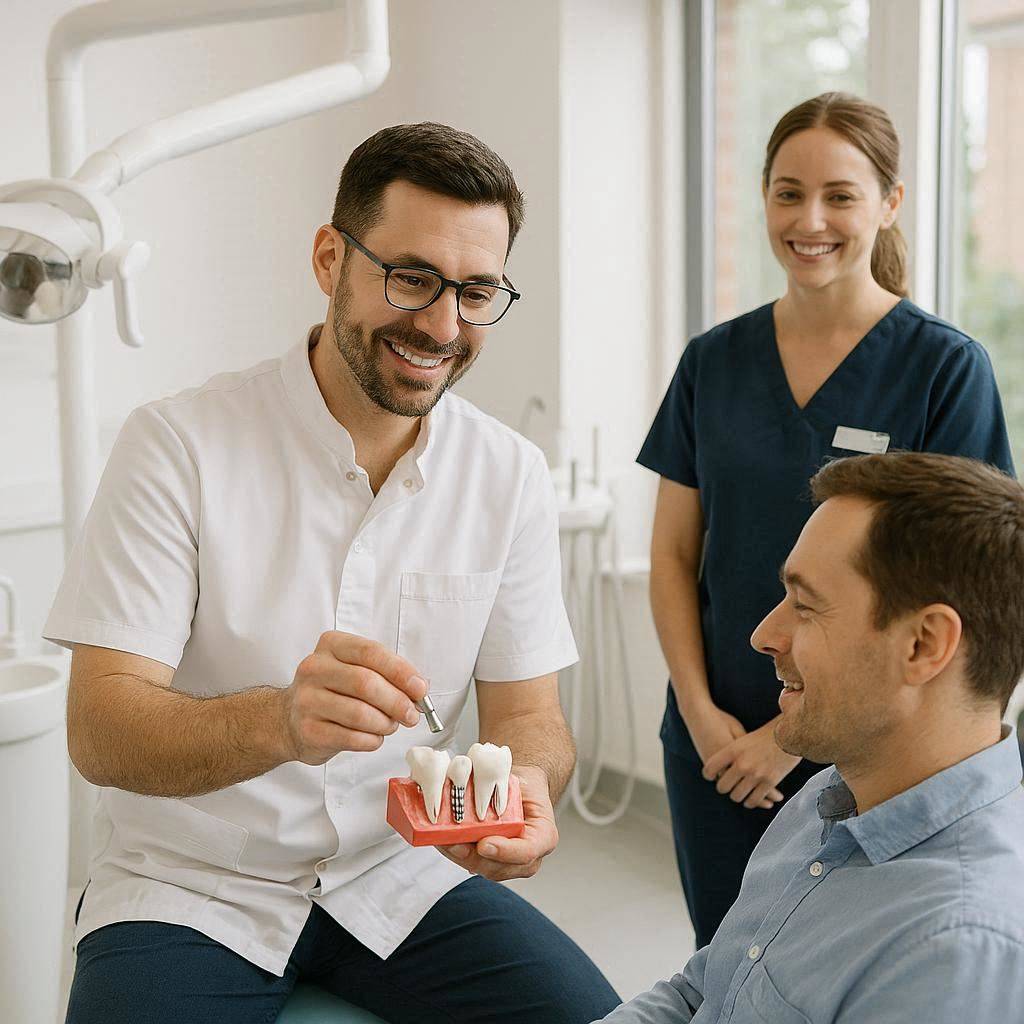
A dental implant mimics this structure using three components:
- The implant post – A small screw made of titanium. A dentist places this into your jawbone. It acts as the new root.
- The abutment – A connector piece that attaches to the post. It sits at gum level.
- The crown – The artificial tooth. A dental lab custom-makes it to match your other teeth.
Think of it like building a table. The post is the leg. The abutment is the bracket. The crown is the tabletop.
Important note: The term “dental implant” technically refers only to the titanium screw. However, most patients use it to describe the entire tooth replacement system.
Unlike dentures or bridges, implants do not rely on neighbouring teeth for support. They stand independently. This makes them incredibly stable and long-lasting.
Why Consider Dental Implants in Essex? The Real Benefits
You have choices when replacing a missing tooth. Dentures. Bridges. Or doing nothing.
So why choose implants? Let us look at the genuine, everyday benefits.
1. Eat Normally Again
Dentures can slip when you bite into an apple or chew steak. Implants fuse with your jawbone. They offer about the same chewing power as natural teeth. You can enjoy crunchy, chewy, and sticky foods without worry.
2. Protect Your Jawbone
When you lose a tooth, the jawbone beneath it starts to shrink. This happens because the bone no longer receives stimulation from chewing. Implants provide that stimulation. They keep your bone strong and healthy.
3. Save Your Remaining Teeth
A traditional bridge requires shaving down the two teeth next to the gap. Those teeth become weaker permanently. Implants leave neighbouring teeth untouched. You preserve your natural tooth structure.
4. No Adhesives or Removal
Dentures need messy creams and daily removal for cleaning. Implants stay in your mouth permanently. You brush and floss them just like natural teeth. No soaking. No adhesives.
5. Natural Look and Feel
Modern implant crowns use high-quality ceramic that reflects light like real enamel. The gum tissue grows around the abutment naturally. Unless you tell someone, they will never know you have an implant.
6. Long-Term Value
A traditional bridge lasts 5 to 10 years. Dentures last 5 to 7 years. A well-maintained dental implant can last 25 years or more. Many patients keep theirs for life. The upfront cost is higher, but the long-term value is excellent.
7. Clear Speech
Ill-fitting dentures can slip and cause slurring or clicking sounds. Implants stay firmly in place. You speak clearly and confidently.
8. High Success Rate
Clinical studies show success rates of 95% to 98% for lower jaw implants and 90% to 95% for upper jaw implants. These numbers apply to healthy, non-smoking patients with good oral hygiene.
Who Is a Good Candidate? (Honest Eligibility)
Not everyone can get dental implants straight away. A good candidate has:
- One or more missing teeth (single, multiple, or full arch)
- Sufficient jawbone density to support the post
- Healthy gums without active gum disease
- Good overall health (certain conditions may require extra caution)
- Non-smoker or willing to quit during treatment
- Realistic expectations about the process and timeline
Situations That May Require Extra Steps
| Condition | Impact on Implants | Solution |
|---|---|---|
| Gum disease | High risk of implant failure | Treat gum disease first (scale and root planing) |
| Low bone density | Implant won’t integrate | Bone graft or sinus lift |
| Uncontrolled diabetes | Poor healing | Work with GP to stabilise blood sugar |
| Heavy smoking | Reduced blood flow to gums | Quit smoking for 2 weeks before and after surgery |
| Teeth grinding (bruxism) | Excessive pressure on implant | Wear a custom nightguard |
| Pregnancy | Hormonal changes affect healing | Wait until after delivery |
Note from our team: Age is rarely a barrier. Healthy adults in their 80s and 90s successfully receive implants. What matters is your general health, not your age.
The Complete Step-by-Step Process (From Consultation to Final Crown)
Understanding the timeline helps manage expectations. The entire process usually takes 4 to 9 months. Here is what happens at each stage.
Step 1: Initial Consultation (1 hour)
Your dentist will:
- Examine your mouth visually
- Take dental X-rays or a 3D CBCT scan
- Review your medical history
- Discuss your goals and budget
- Provide a written treatment plan with costs
What you should ask:
- “How many implants have you placed?”
- “What happens if the implant fails?”
- “Do you offer any guarantees?”
Step 2: Pre-Treatment (If Needed)
Some patients require preparatory work:
- Tooth extraction – If a damaged tooth remains in the gap
- Bone graft – Adding artificial bone powder to thin areas
- Sinus lift – Lifting the sinus floor to create space in the upper jaw
- Gum disease treatment – Deep cleaning and antibiotics
These steps add 3 to 12 months to your overall timeline. Do not skip them. They are essential for long-term success.
Step 3: Implant Placement Surgery (1 to 2 hours per implant)
Your dentist will:
- Numb the area with local anaesthetic
- Make a small incision in your gum
- Drill a precise hole into your jawbone
- Insert the titanium implant post
- Suture (stitch) the gum closed over or around the implant
Most patients report feeling pressure but no pain. You can drive yourself home afterwards if you only received local anaesthetic.
Step 4: Osseointegration (3 to 6 months of healing)
This is the most critical period. Your jawbone grows tightly around the titanium surface. This process is called osseointegration. During this time:
- You eat soft foods
- You avoid chewing on the implant site
- You maintain gentle but thorough oral hygiene
Your dentist will schedule check-ups every 4 to 8 weeks to monitor healing.
Step 5: Abutment Placement (30 minutes)
Once the implant is fully fused to your bone, your dentist makes a small opening in your gum to attach the abutment. This is a minor procedure with local anaesthetic. Healing takes 2 to 4 weeks.
Step 6: Crown Fabrication (2 to 3 weeks)
Your dentist takes impressions of your mouth. A dental lab uses these to create your custom crown. They match the colour, shape, and size to your natural teeth.
Step 7: Crown Attachment (30 minutes)
Your dentist screws or cements the crown onto the abutment. They check your bite and make small adjustments. That is it. You now have a new tooth.
Types of Dental Implants Available in Essex
Not all implants are the same. Essex dentists offer several types depending on your situation.
1. Single Tooth Implant
Replaces one missing tooth. One post. One crown. This is the most common type.
2. Implant-Supported Bridge
Replaces two or more missing teeth in a row. Two implants support a bridge of three or four crowns. This avoids placing an individual implant for every missing tooth.
3. All-on-4 (Full Arch)
Replaces all teeth on your upper or lower jaw using only four implants. The implants are placed at strategic angles for maximum stability. You receive a fixed bridge of 10 to 14 teeth.
4. All-on-6
Similar to All-on-4 but uses six implants. Offers extra support for patients with higher bite forces or softer bone.
5. Implant-Overdenture
For patients who want removable dentures but with better stability. Two to four implants snap into the denture. You can still remove it for cleaning.
6. Zygomatic Implants
For patients with severe upper jaw bone loss. The implants anchor into the cheekbone (zygoma) instead of the jawbone. This avoids the need for a bone graft. Only a few specialists in Essex offer this.
Comparison: Implant Types at a Glance
| Type | Number of Implants | Best For | Removable? | Typical Cost (Essex) |
|---|---|---|---|---|
| Single implant | 1 | One missing tooth | No | £2,000 – £3,500 |
| Implant bridge | 2 | 2-4 missing teeth in a row | No | £4,500 – £7,000 |
| All-on-4 | 4 | Full arch (all teeth missing) | No | £12,000 – £18,000 |
| All-on-6 | 6 | Full arch with high bite force | No | £15,000 – £22,000 |
| Implant overdenture | 2-4 | Denture wearers seeking stability | Yes | £6,000 – £10,000 |
How Much Do Dental Implants Cost in Essex? (Realistic Pricing)
Let us talk money openly. Implants are an investment. Prices in Essex vary significantly depending on:
- The dentist’s experience and qualifications
- The implant brand (premium vs budget)
- Lab fees for the crown
- Whether you need bone grafting or extractions
- The location of the practice (Central Chelmsford vs a village clinic)
Typical Price Ranges (2025 estimates)
| Service | Low End | Average | High End |
|---|---|---|---|
| Single implant + crown | £2,000 | £2,800 | £3,500 |
| Bone graft (small) | £350 | £500 | £800 |
| Sinus lift | £800 | £1,200 | £1,800 |
| Extraction (surgical) | £150 | £250 | £400 |
| CT scan (3D imaging) | £150 | £250 | £350 |
| Full All-on-4 (per arch) | £12,000 | £15,000 | £18,000 |
| Full All-on-6 (per arch) | £15,000 | £18,000 | £22,000 |
What Is Usually Included in a Quote?
A professional quote should itemise:
- Consultation fee (often free or deducted from treatment)
- CT scan cost
- Implant post
- Abutment
- Crown (including lab fees)
- Local anaesthetic
- Sutures
- Follow-up appointments (usually 1 year)
What Is Often Extra?
- Sedation (IV sedation costs £200-£500)
- Temporary denture during healing (£300-£800)
- Replacement crown if damaged after 5 years
- Private prescription for antibiotics or painkillers
Important note: Beware of “all-inclusive” packages that seem too cheap. A single implant for £1,200 often excludes the crown, or uses low-quality materials from outside the EU. Always ask for a written breakdown.
Dental Implants vs Alternatives: An Honest Comparison
Sometimes implants are not the right choice for your situation or budget. Here is how they compare to other options.
Dental Implant vs Fixed Bridge
| Factor | Implant | Bridge |
|---|---|---|
| Affects neighbouring teeth? | No | Yes (shaved down) |
| Lifespan | 20+ years | 5-10 years |
| Protects jawbone? | Yes | No |
| Cost (initial) | Higher | Lower |
| Cost (long-term) | Lower | Higher (replacements) |
| Surgical procedure? | Yes (minor surgery) | No |
Our view: If you are healthy and can afford the upfront cost, an implant is almost always superior to a bridge.
Dental Implant vs Removable Denture
| Factor | Implant | Denture |
|---|---|---|
| Stability while eating | Excellent | Poor to moderate |
| Affects speech | No | Possible clicking/slipping |
| Requires adhesive | No | Yes (usually) |
| Daily removal | No | Yes |
| Cost | Higher | Lower |
| Feels like natural teeth | Yes | No |
Our view: Dentures work well as a temporary solution or for patients who cannot have surgery. But for daily comfort, implants win clearly.
Dental Implant vs Doing Nothing
Leaving a gap is free today, but costly tomorrow.
| Consequence of leaving a gap | Timeline |
|---|---|
| Adjacent teeth tilt into the gap | 1-2 years |
| Opposite tooth drifts upward | 2-3 years |
| Bone loss at the gap site | 3-12 months |
| Difficulty cleaning tilted teeth | 2-3 years |
| Tooth decay in crowded areas | 3-5 years |
Our view: Filling the gap now—with any solution—is better than waiting. But implants offer the most long-term protection.
How to Choose a Dentist for Dental Implants in Essex
Not every dentist who offers implants has the same training. Here is how to find a safe, skilled professional.
Essential Qualifications to Look For
- GDC registration (General Dental Council – mandatory for all UK dentists)
- Postgraduate training in implantology (Diploma or MSc level)
- Membership in professional bodies:
- Association of Dental Implantology (ADI)
- International Team for Implantology (ITI)
- British Society of Oral Implantology (BSOI)
Questions to Ask Before Booking
- “How many implants have you placed in the last 12 months?”
*(Look for 50+ per year for a general dentist, 200+ for a specialist)* - “What implant brand do you use and why?”
(Reputable brands: Straumann, Nobel Biocare, Dentsply, Zimmer, Megagen) - “What happens if my implant fails within 12 months?”
(Good answer: We replace it at no charge for the implant post) - “Do you have before-and-after photos of your own cases?”
(Avoid stock photos or images of other dentists’ work) - “Who handles emergencies outside office hours?”
(A clear on-call system matters)
Red Flags to Avoid
- Promising a permanent crown in less than 3 months (unless it’s a same-day “Teeth in an Hour” system)
- Refusing to provide a written treatment plan
- Pressuring you to decide within 24 hours
- Offering discounts for paying in cash (tax evasion risk)
- No CBCT scanner on-site (3D imaging is standard for implant planning)
Essex Regions with Quality Implant Dentists
You will find skilled implant dentists across the county:
- Chelmsford – Several specialists near Broomfield Hospital
- Colchester – Options around Turner Road and the University area
- Southend-on-Sea – Multiple implant clinics along the seafront
- Basildon – Growing number of implant-trained dentists
- Brentwood – Some private clinics with advanced CBCT technology
- Romford (historically Essex) – Many implant specialists here too
Recovery, Aftercare, and Long-Term Maintenance
Getting the implant placed is only half the journey. Proper aftercare determines whether your implant lasts 5 years or 25 years.
First 24 Hours After Surgery
Do:
- Bite gently on gauze for 30-60 minutes
- Apply an ice pack to your face (15 minutes on, 15 minutes off)
- Eat soft, cool foods (yogurt, soup, smoothies)
- Take prescribed painkillers before numbness wears off
- Sleep with your head elevated
Do not:
- Spit, rinse, or use a straw (dislodges the blood clot)
- Smoke or vape
- Drink alcohol (interferes with healing)
- Chew on the implant side
- Touch the area with your tongue or fingers
Days 2 to 14
- Swelling typically peaks on day 2 or 3, then subsides
- Rinse gently with warm salt water (half teaspoon in a cup) 3 times daily
- Brush other teeth normally, avoid the implant site
- Return to work after 1-3 days (sedation may require 48 hours off)
Long-Term Maintenance
Treat your implant like a premium car. It needs regular care.
Daily home care:
- Brush twice daily with a soft toothbrush
- Floss with implant-specific floss or superfloss
- Use a water flosser (Waterpik) on low pressure around the abutment
- Avoid metal scrapers or hard picks
Professional maintenance:
- Dental check-up every 6 months
- Implant-specific cleaning with plastic or carbon-fibre instruments
- Annual X-ray to check bone levels around the implant
Signs of a Problem (Peri-Implantitis)
Peri-implantitis is gum disease around an implant. It is the leading cause of implant failure.
Watch for:
- Red or puffy gums around the implant
- Bleeding when brushing or flossing near the implant
- Pus coming from the gum pocket
- A bad taste in your mouth
- The implant feeling loose (late-stage)
If you notice any of these, see your dentist immediately. Early treatment can save the implant.
Risks and Complications: An Honest Discussion
Every surgical procedure carries some risk. Pretending otherwise is irresponsible. Here are the real risks with dental implants.
Common (But Usually Minor)
| Risk | Frequency | Management |
|---|---|---|
| Swelling and bruising | Nearly all patients | Ice, rest, resolves in 7-10 days |
| Minor bleeding | Common | Pressure with gauze |
| Discomfort at night | 60-70% | Over-the-counter painkillers |
| Food trapping around abutment | 40-50% | Water flosser, interdental brushes |
Uncommon (But Serious)
| Risk | Frequency | Management |
|---|---|---|
| Implant fails to integrate | 2-10% | Remove implant, bone graft, try again |
| Nerve damage (lower jaw) | <1% | Usually temporary numbness; permanent rare |
| Sinus perforation (upper jaw) | 2-5% | Usually heals spontaneously; sometimes needs repair |
| Infection at surgical site | 2-4% | Antibiotics, drainage if abscess forms |
| Damage to adjacent teeth | <1% | Repair or root canal on damaged tooth |
Who Has Higher Risk?
- Smokers: 2x higher failure rate
- Diabetics with poor control: 3x higher failure rate
- Patients with bruxism: 4x higher crown fracture rate
- Patients with poor oral hygiene: 5x higher peri-implantitis rate
Our honest advice: Implants are safe for most healthy people. But they are not 100% guaranteed. Choose a dentist who discusses risks openly and has a plan for managing complications.
Financing and Payment Options in Essex
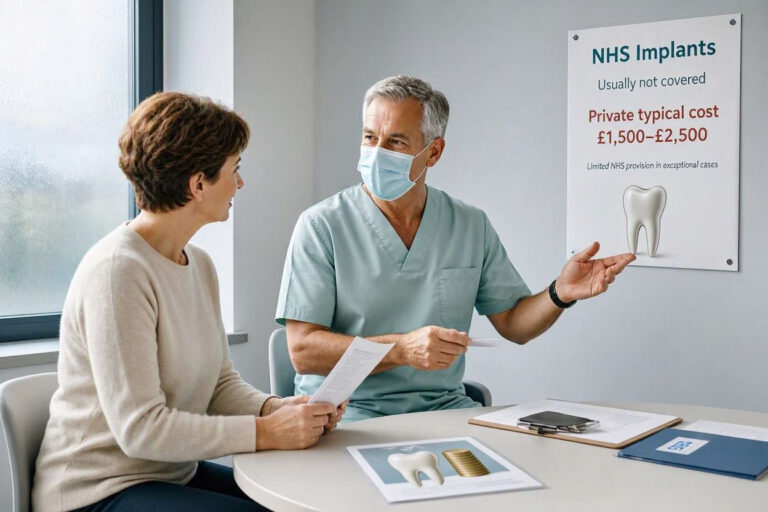
Dental implants are rarely available on the NHS for adults. (NHS implants are only provided in exceptional cases like cancer or severe accidents.)
That means you will likely pay privately. Here are real ways Essex patients afford treatment.
1. Pay as You Go (Stage Payments)
Most clinics allow you to pay in stages aligned with treatment phases:
- Deposit for CT scan and planning: £200-£500
- Stage 1: Implant placement surgery: 40-50% of total
- Stage 2: Abutment: 10-15% of total
- Stage 3: Crown: Remaining balance
2. 0% Finance (Denplan, Chrysalis, Medenta)
Many Essex implant clinics offer interest-free credit over 6 to 12 months. Some extend to 24 months with a small fee. You will need a credit check.
3. Low-Interest Dental Loans (Up to 60 months)
Companies like Tabeo (formerly Dental Finance) offer loans specifically for implant treatment. Typical APR: 9.9% to 15.9%.
4. Dental Membership Plans
Some Essex practices offer monthly membership (£15-£30) that includes:
- Two check-ups per year
- Two hygienist visits
- Discounted treatment (10-15% off implants)
- Worldwide dental emergency cover
5. Health Cash Plans (Medicash, Simplyhealth, Westfield)
These plans reimburse a portion of dental costs. Most have annual limits of £500-£1,500 for implants. They work best as a supplement, not a primary funding source.
Example Monthly Cost (Single Implant, £2,800 Total)
| Payment Method | Term | Monthly | Total Interest |
|---|---|---|---|
| Stage payments (deposit + 2 stages) | 4 months | £700 average | £0 |
| 0% finance | 12 months | £233 | £0 |
| 0% finance | 24 months | £117 | £0 (with fee sometimes) |
| Dental loan (9.9% APR) | 36 months | £90 | £438 |
| Dental loan (9.9% APR) | 60 months | £59 | £753 |
Before and After: Realistic Expectations
Let us set realistic expectations about how implants will change your life.
Realistic Improvements
✅ You will eat steak, apples, and nuts again
✅ You will smile without hiding your mouth
✅ You will stop worrying about dentures slipping in public
✅ You will preserve your jawbone and facial structure
✅ Your remaining natural teeth will stay healthier
✅ You will brush and floss normally
What Implants Will NOT Do
❌ Make you look 20 years younger (though they help maintain natural facial support)
❌ Fix gum recession or discolouration on other teeth
❌ Replace the need for regular check-ups
❌ Work if you ignore oral hygiene for months
❌ Feel 100% identical to a natural tooth (very close, but not exact)
Before-and-After Timeline Example (Single Implant)
| Month | What Happens | How You Feel |
|---|---|---|
| Month 0 | Tooth extracted | Sore but relieved |
| Month 1-3 | Bone healing | Forgetting about the gap |
| Month 4 | Implant placed | Nervous but fine during procedure |
| Month 4-7 | Osseointegration | Impatient but getting used to soft foods |
| Month 7 | Abutment placed | Minor discomfort for 1 day |
| Month 8 | Crown delivered | Thrilled. Crying happy tears. Eating pizza. |
Patient Stories (Anonymised, Realistic Cases from Essex)
Case 1: Sarah, 42, Teacher from Chelmsford
Problem: Lost a lower molar to decay. Hated the removable partial denture.
Solution: Single implant with zirconia crown.
Timeline: 7 months (included 2 months of gum disease treatment first).
Cost: £3,100.
Quote from Sarah: “I didn’t realise how much I was avoiding crunchy foods until I got my implant back. I ate an apple in the staff room without hiding. Small win, huge confidence.”
Case 2: David, 68, Retired from Southend
Problem: All upper teeth failing. Wore a denture that flopped down when he laughed.
Solution: All-on-4 upper arch.
Timeline: 6 months (healing was slower due to age).
Cost: £14,500.
Quote from David: “My wife says I laugh louder now. That’s worth every penny.”
Case 3: Leena, 29, Marketing from Colchester
Problem: Missing lateral incisor (next to front tooth) since birth.
Solution: Single implant with ceramic crown.
Timeline: 5 months (no bone graft needed).
Cost: £2,650.
Quote from Leena: “I used to pose with my hand over my mouth in photos. Now I can’t stop smiling. Best money I ever spent on myself.”
Frequently Asked Questions (FAQ)
1. Do dental implants hurt?
Most patients report less pain than a tooth extraction. The procedure uses local anaesthetic. You feel pressure, not sharp pain. Afterward, paracetamol or ibuprofen manages any soreness for 2-3 days.
2. How long do dental implants last?
With proper care, 25 years to life. The crown may need replacement after 10-15 years due to normal wear. The titanium post can last indefinitely.
3. Can I get dental implants on the NHS in Essex?
Rarely. NHS implants are only for patients with specific medical conditions (cancer, severe trauma, genetic disorders affecting teeth). Most Essex patients pay privately.
4. What is the success rate?
95-98% for lower jaw. 90-95% for upper jaw. Success rates drop in smokers (80-85%) and uncontrolled diabetics (70-80%).
5. How long does the whole process take?
Typically 4 to 9 months from extraction to final crown. Bone grafting adds 3-12 months. “Same-day implants” exist but are only suitable for specific cases.
6. Can I have implants if I have gum disease?
Yes, but you must treat the gum disease first. Placing implants into infected gums almost guarantees failure.
7. Will my insurance cover implants?
Most standard dental insurance excludes implants or offers very low limits (£500-£1,500). Check your policy. Health cash plans offer more coverage but still partial.
8. Can I smoke with dental implants?
You can, but you shouldn’t. Smoking significantly increases failure risk. If you must smoke, wait at least 2 weeks after surgery and reduce as much as possible.
9. What happens if the implant fails?
Your dentist removes the failed implant (minor procedure). After 3-6 months of bone healing, you can try again, often with a larger or different implant. Some clinics offer free replacement within 12 months.
10. Are dental implants safe for older adults?
Yes. Age is not a barrier. As long as you are healthy enough for minor oral surgery, you can have implants. Many patients in their 80s and 90s receive them successfully.
Additional Resources
For more reliable information about dental implants, visit the Association of Dental Implantology (ADI) UK patient information section:
This resource includes:
- A search tool to find accredited implant dentists near you
- Downloadable patient guides in plain English
- Information on implant safety and standards
- A checklist for what to ask during your consultation
Conclusion
Dental implants in Essex offer a reliable, permanent solution for missing teeth. They protect your jawbone, preserve your remaining teeth, and restore your ability to eat and smile with confidence.
The process takes time—typically 4 to 9 months—and requires a financial investment of £2,000 to £18,000 depending on your needs. But for most patients, the long-term benefits far outweigh the upfront costs and temporary inconvenience.
Your next step is simple. Book two or three consultations with different implant dentists in your area. Ask the questions listed in this guide. Compare their answers. Then choose the professional you trust most—not just the cheapest option.
Your smile is worth doing right.
Disclaimer: This article provides general information and does not replace professional medical or dental advice. Every patient’s situation is unique. Always consult a fully qualified dentist registered with the General Dental Council (GDC) before making decisions about dental implant treatment. The author and publisher assume no liability for any outcomes based on the information provided in this guide.