Dental Implants In Lubbock: A Realistic Guide to Restoring Your Smile
If you are reading this, you are likely dealing with a missing tooth—or several. You might feel self-conscious when you laugh, or you might struggle to chew your favorite foods. You are not alone.
For decades, the only solutions for missing teeth were uncomfortable dentures or bridges that required shaving down healthy teeth. Today, things are different. Dental implants have changed the game.
But let us be honest: The world of dental implants can feel confusing. There is a lot of jargon. There are confusing price tags. And if you live in or around Lubbock, you probably want to know where to go and what to expect locally.
This guide aims to clear up the confusion. We will walk through everything step-by-step. No fluff. No false promises. Just a reliable, friendly roadmap to help you decide if implants are right for you.
A note before we start: This article is for educational purposes. It does not replace professional medical advice. Always consult a licensed dentist in Lubbock for a personal examination.
What Exactly Is a Dental Implant?
Let us start with the basics. A lot of people think an implant is the fake tooth you see. That is actually the last piece.
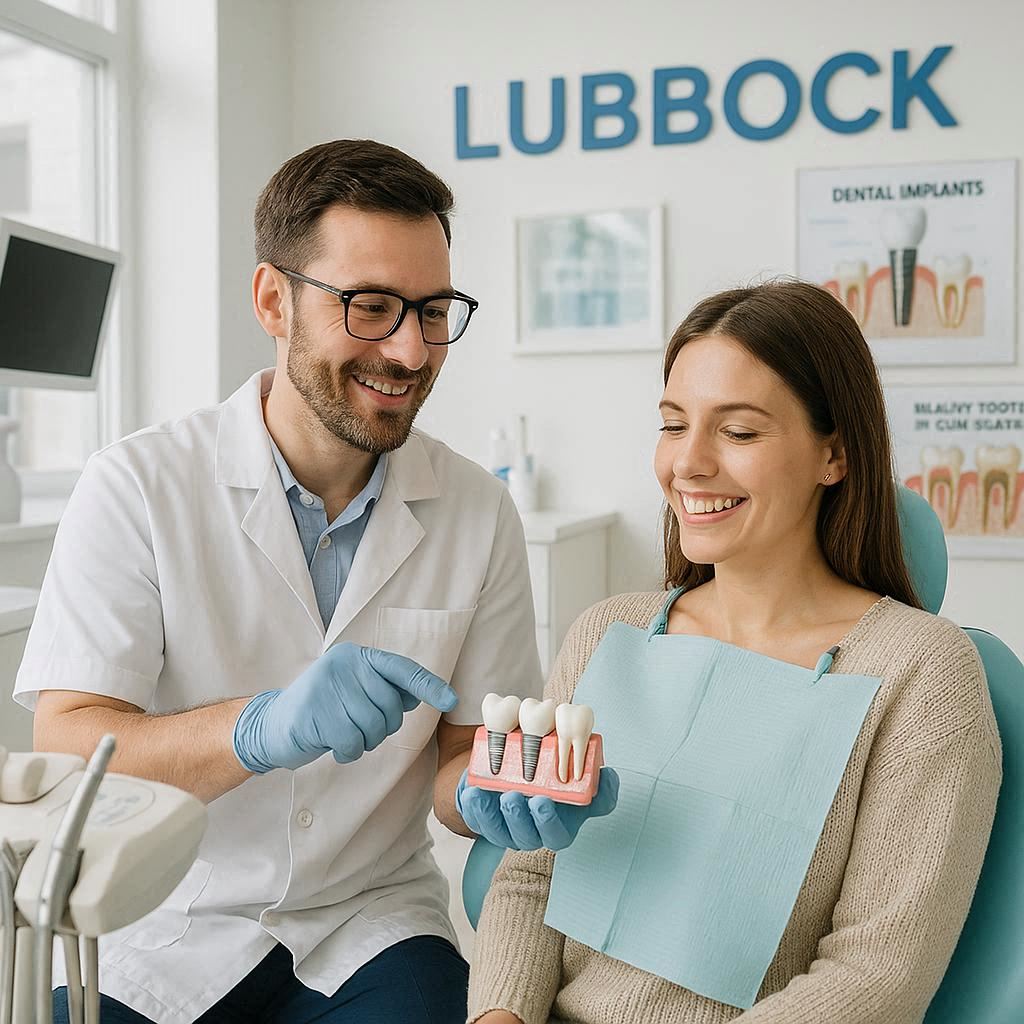
A dental implant is technically a small, screw-like post made of titanium. A surgeon places this post into your jawbone. Over time, your bone grows around the screw. This creates a rock-solid anchor. Think of it as an artificial tooth root.
Once that anchor is secure, the dentist attaches an abutment (a connector piece) and finally a crown (the visible tooth).
Why titanium?
Your body usually rejects foreign objects. But titanium is special. It is “biocompatible.” Your bone accepts it and fuses to it. This process is called osseointegration. It sounds complex, but it simply means your jaw and the implant become one solid unit.
The three main parts of an implant
- The Implant Fixture (The Root): The screw inserted into the bone.
- The Abutment (The Connector): A small metal piece screwed into the fixture.
- The Prosthesis (The Tooth): The crown, bridge, or denture that attaches to the abutment.
Why Lubbock Residents Are Choosing Implants Over Dentures
You might wonder, “If dentures are cheaper, why bother with implants?” That is a fair question. Living in West Texas, we face dust, wind, and tough steaks. You need a solution that works.
Here is a realistic comparison.
| Feature | Traditional Dentures | Dental Implants |
|---|---|---|
| Stability | Move or click when you talk/eat | Fixed permanently in place |
| Bone Health | Accelerates bone loss over time | Prevents bone deterioration |
| Diet | Soft foods only; difficult to chew meat | Eat almost anything (steak, apples, corn) |
| Maintenance | Need adhesives, soaking, removal | Brush and floss like natural teeth |
| Speech | Can cause slurring or clicking | Natural speech patterns |
| Lifespan | Replace every 5-7 years | Can last 30+ years with care |
The honest truth: Dentures are like a spare tire. They work in an emergency, but they are not the same as the original. Implants are the closest thing to your real teeth.
The Complete Process: What to Expect in a Lubbock Clinic
Let us walk through the timeline. Many people avoid implants because they fear the process. It helps to know exactly what happens.
Step 1: The Initial Consultation (1 hour)
Your journey starts with a conversation. A Lubbock implant specialist will take a 3D CT scan of your mouth. This is not a simple x-ray. This scan shows the density of your bone, the location of nerves, and your sinus position.
What the doctor checks:
- Do you have enough jawbone?
- Are your gums healthy?
- Do you have uncontrolled diabetes or other health conditions?
Step 2: Preparatory Work (If needed)
Sometimes, your jaw is not ready. If you have been missing a tooth for years, the bone may have melted away (atrophied).
In this case, you might need a bone graft. This sounds scary, but it is routine. The dentist adds bone powder (donated or synthetic) to your jaw. You wait 4 to 6 months for it to heal.
Step 3: Implant Placement Surgery (1-2 hours)
On surgery day, the dentist numbs the area. They make a small cut in your gum, drill a precise hole into the bone, and insert the titanium screw.
How painful is it? Most patients say it is less painful than a tooth extraction. You feel pressure, not sharp pain.
Step 4: Osseointegration (The waiting game)
This is the longest step. You wait 3 to 6 months. During this time, the bone grows around the screw. Do not worry. You are not walking around with a hole in your smile. You will have a temporary tooth or a healing cap.
Step 5: Placing the Abutment & Crown
Once the implant is fused, you return. The dentist uncovers the implant, attaches the abutment, and takes impressions. Two weeks later, you return to screw or cement the final crown.
Total timeline: Usually 5 to 8 months, though it can be faster or slower depending on your healing.
How Much Do Dental Implants Cost in Lubbock?
Let us talk money. This is the biggest barrier for most people. Do not trust anyone who gives you a single number without examining you. Prices vary wildly based on bone grafts, materials, and the dentist’s experience.
However, you can expect a general range in Lubbock.
Average price breakdown (Per tooth)
- Single Implant (Post + Crown): 3,500to6,000
- Implant-Supported Bridge (3-4 teeth): 7,000to15,000
- Full Arch (All-on-4 / Top or Bottom): 15,000to30,000 per arch
Hidden costs to ask about
When calling Lubbock dental offices, ask these specific questions:
- Does the quote include the CT scan?
- Is the temporary tooth included?
- What if the implant fails? Is there a warranty or replacement guarantee?
- Does your price include the final crown material (porcelain vs. zirconia)?
Real talk: If a deal looks too good to be true (like $1,500 for a full implant), run. Cheap implants often skip the abutment, use low-quality metal, or are placed by inexperienced dentists. You pay for what you get.
Does insurance help?
Traditional dental insurance usually does not cover implants fully. However, many plans cover parts of the procedure.
- The crown: Often covered 50%.
- Extractions and bone grafts: Often covered.
- The implant post itself: Rarely covered.
Check your medical insurance too. If you lost teeth due to an accident (trauma), medical insurance might pay.
Financing options in Lubbock
Most local dental offices offer:
- CareCredit: A healthcare credit card with 6-12 month interest-free plans.
- LendingClub or Proceed Finance: Medical loans.
- In-house membership plans: Some Lubbock dentists offer a discount for cash patients without insurance.
Types of Implants: Which One Is Right for You?
Not all implants are the same. Depending on your situation, the dentist may recommend a different style.
1. Single Tooth Implant
Best for: One missing tooth.
Pros: Does not touch neighboring teeth.
Cons: Most expensive per tooth.
2. Implant-Supported Bridge
Best for: Two or three missing teeth in a row.
How it works: Two implants go into the bone. They hold a bridge of three fake teeth in between.
Pros: Fewer implants needed.
Cons: Harder to floss between the fake teeth.
3. All-on-4 (Full Arch)
Best for: Patients missing all teeth on top or bottom.
How it works: The dentist places four implants strategically (two straight, two angled). They screw a fixed denture onto them. You never remove it.
Pros: Removable dentures are gone. You eat normally.
Cons: Very expensive. Difficult to repair if one implant fails.
4. Mini Implants (MDIs)
Best for: Stabilizing lower dentures.
How it works: Smaller, thinner screws (like toothpicks). They snap into your denture.
Pros: Cheaper. No surgery flap required. Immediate loading.
Cons: Less durable. Not for individual crowns. More likely to break over 10 years.
| Type | Number of Implants | Average Cost (Lubbock) | Recovery Time |
|---|---|---|---|
| Single | 1 | 3,500−5,500 | 4-6 months |
| Bridge (3 units) | 2 | 7,000−10,000 | 4-6 months |
| All-on-4 (Full) | 4 | 18,000−28,000 | 6-8 months |
| Mini Implants | 2-4 | 2,000−4,000 | 1 month |
Recovery and Aftercare: Living with Implants in Lubbock
The surgery is the easy part. The recovery requires patience. Here is a realistic week-by-week guide.
Days 1-3 (The hard part)
- Swelling: Expect a puffy face. Use ice packs (20 minutes on, 20 off).
- Bleeding: Light oozing is normal. Bite on gauze.
- Diet: Only cold, soft food. Smoothies, yogurt, mashed potatoes, soup.
- Pain: Take ibuprofen (Advil) or prescribed medication.
- No: Spitting, using straws, smoking, or touching the site.
Days 4-14 (Getting better)
- Swelling goes down.
- You can eat warm, soft foods (scrambled eggs, pasta).
- Start rinsing with warm salt water (gently – do not swish hard).
- Stitches may dissolve or need removal.
Months 1-6 (Healing)
- You barely feel the implant.
- Warning: Avoid chewing hard foods directly on the healing implant (no jerky, nuts, or ice).
- Maintain excellent hygiene. Use a soft brush.
Long-term maintenance (Forever)
Implants do not get cavities, but they can get gum disease (peri-implantitis). This is the number one reason implants fail later.
Your new routine:
- Water flosser: Use a Waterpik daily around the abutment.
- Interdental brushes: These tiny brushes clean under the bridge.
- Night guards: If you grind your teeth (bruxism), you need a plastic guard. Grinding can break the crown or the screw.
- Professional cleanings: Visit your Lubbock dentist every 6 months. They have special plastic scalers that won’t scratch the implant.
Risks and Complications: Being Honest
I promised you a realistic guide. Here is the truth. Implants have a 95% success rate after 10 years. That is excellent. But failure happens.
Early failure (Within 3 months)
- Infection: Bacteria gets into the surgical site.
- Overheating bone: If the drill gets too hot during surgery, it kills the bone cells.
- Smoking: Nicotine shrinks blood vessels. Smokers have a 20% failure rate. You must quit for 2 weeks before and 2 months after surgery.
Late failure (After 6 months)
- Peri-implantitis: Gum disease around the implant. It causes bone loss.
- Overloading: Chewing too hard, too fast before the bone is healed.
- Poor hygiene: Plaque buildup leads to inflammation.
What happens if an implant fails?
Do not panic. The dentist can remove the loose screw (it takes 10 minutes). They clean the site. You let it heal for 2 months. Then you try again. Sometimes, the dentist will refund the implant cost, but not the crown.
Finding the Right Implant Dentist in Lubbock
You live in Lubbock. You have options. But not every general dentist should place implants. This is a surgical procedure.
Who places implants?
- Oral Surgeons: Specialists in bone and surgery. Best for difficult cases (low bone, nerve risk).
- Periodontists: Gum specialists. Best for patients with gum disease history.
- General Dentists with training: Many Lubbock GPs take weekend courses. Ask about their number of placed implants.
Questions to ask before booking
- How many implants have you placed in the last year? (Look for 100+)
- Do you use a CT scan (3D imaging) on every patient? (If no, leave.)
- What brand of implant do you use? (Nobel Biocare, Straumann, or Zimmer are top brands.)
- Do you provide the temporary tooth?
- Who handles the emergency if the crown breaks on a Friday night?
Red flags to avoid
- “Same day teeth” for every patient (Only works in perfect bone conditions).
- No pre-op CT scan (They are flying blind).
- Prices under $2,000 for a full implant (It is likely a mini implant or imported junk).
- “We pull the tooth and place the implant today” without explaining the infection risk.
Diet Guide: What to Eat After Surgery (Lubbock-Friendly)
You live in the land of BBQ and Tex-Mex. You will need to avoid these for a while. Here is a survival guide.
Week 1 (Liquid & mush)
- Smoothies (no seeds, no straw)
- Protein shakes
- Greek yogurt
- Mashed sweet potatoes
- Bone broth (great for healing)
Week 2-4 (Soft & chopped)
- Scrambled eggs with cheese
- Pancakes (soaked in syrup)
- Cottage cheese
- Pasta (well-cooked)
- Hummus
Month 2-6 (Careful chewing)
- Soft bread
- Cooked vegetables (no raw carrots)
- Ground beef (taco meat is fine if cut small)
- Fish
After healing (Normal eating… almost)
- Yes: Steak (cut into strips), chips, pizza.
- No (ever): Hard candy, ice cubes, unpopped popcorn kernels (they crack porcelain crowns).
- Careful: Corn on the cob (cut it off the cob), ribs (don’t pull on the bone).
Comparing Lubbock Dental Implants to Other Cities
You might wonder if it is worth driving to Dallas or Houston for cheaper implants.
| City | Average Single Implant | Travel Cost | Follow-up visits |
|---|---|---|---|
| Lubbock, TX | $4,200 | $0 | Easy (20 min drive) |
| Dallas, TX | $4,800 | $100 gas + hotel | Traffic hell |
| Houston, TX | $5,000 | 200gas+200 hotel | 10+ hours round trip |
| Mexico (Dental tourism) | $1,500 | 600flight+500 hotel | Impossible if infection occurs |
The verdict: Lubbock prices are fair for West Texas. You save money on travel and time. Most importantly, if you have a problem (loose crown, broken abutment), you need to see your surgeon within 24 hours. You cannot drive to Mexico for an adjustment.
The Psychological Benefit: More Than Just Teeth
We have focused on mechanics and money. But let us talk about how you feel.
Living with missing teeth changes your personality. You might:
- Cover your mouth when you laugh.
- Stop going to social dinners.
- Mumble because you are afraid dentures will click.
- Avoid dating because you feel “old.”
Dental implants stop that. Because they are fixed in bone, your brain eventually forgets they are there. You laugh loudly. You order a ribeye steak. You wake up with no gooey adhesives on your gums.
One patient in Lubbock told me: “I didn’t realize how much energy I spent hiding my teeth. After the implant, I felt like myself again. That is worth every penny.”
Frequently Asked Questions (FAQ)
1. Are dental implants painful?
The surgery is not painful (numbing works well). The week after feels like a deep bruise. Most patients say a tooth extraction hurts more.
2. How long do implants last?
With good hygiene, 20 years to a lifetime. The crown (fake tooth) may wear out after 10-15 years, but the screw in your bone can last forever.
3. Can I get an implant if I smoke?
Technically, yes. But your failure rate is high (15-20% vs 2-5% for non-smokers). You must stop smoking for at least 2 weeks before and 8 weeks after surgery. Vaping is also dangerous (the heat and chemicals delay healing).
4. What is the age limit?
There is no upper age limit. Healthy 90-year-olds get implants. The lower limit is 18 for girls and 20 for boys (when the jaw stops growing).
5. Can I have an MRI if I have implants?
Yes. Titanium is not magnetic. MRIs are safe. However, inform the technician you have implants so they adjust the machine.
6. Do implants look natural?
Yes. A good lab can match the color, translucency, and shape of your adjacent teeth. Only your dentist will know which tooth is fake.
7. What is the “All-on-4” recovery like?
Harder than a single implant. You will have a liquid diet for 2 weeks. Swelling lasts 5-7 days. You eat soft foods for 2 months. After that, you eat steak.
8. Can my body reject titanium?
True rejection (autoimmune) is extremely rare (less than 0.1%). Most “rejections” are actually infections.
9. How do I clean under a bridge?
Use a super floss (has a stiff end to thread under the fake tooth) or a water flosser on the lowest setting. Do this once a day.
10. What if I don’t have enough bone?
You get a bone graft. The dentist takes bone from a donor, a cow, or your chin/hip. You wait 4-9 months for it to harden. Then you place the implant.
Conclusion
Restoring your smile is a journey, not an emergency room visit. Dental Implants In Lubbock offer a permanent, natural-feeling solution that beats dentures in every category except upfront cost. While the process requires patience (several months) and a significant financial investment (3,500to6,000 per tooth), the long-term payoff—eating steak, laughing freely, and preserving your jawbone—is unmatched. Your next step is simple: book three consultations with local Lubbock oral surgeons, ask the hard questions about warranties and bone grafts, and choose the provider who makes you feel safe, not sold.
Additional Resources
For a deeper dive into implant technology and to verify dentist credentials, visit the American Academy of Implant Dentistry (AAID) official patient guide.
👉 Click here for the AAID Patient Resource Center (Opens in a new tab)
Disclaimer: This article is for general informational purposes only and does not constitute medical or dental advice. Individual results vary based on health history, bone density, and oral hygiene. Always seek the advice of a qualified dentist or oral surgeon in Lubbock, Texas, with any questions you may have regarding a medical condition or dental treatment. Never disregard professional advice because of something you read in this article.