Dental Implants In Lakewood Ranch
Losing a tooth can feel frustrating. Maybe you hide your smile in photos. Perhaps chewing has become a chore. You might even worry about future bone loss in your jaw.
You are not alone. Millions of adults face the same situation. The good news? Modern dentistry offers a solution that looks, feels, and functions like a natural tooth.
That solution is the dental implant.
If you live in Lakewood Ranch or the surrounding Manatee County area, you have access to excellent implant specialists. But where do you start? What does the procedure actually involve? How much should you expect to pay?
This guide walks you through everything. No fluff. No medical jargon. Just honest, practical information to help you make a confident decision.
Note to readers: Every mouth is different. The information below serves as a general educational guide. Always consult with a licensed Lakewood Ranch dentist for a personal examination.
What Exactly Are Dental Implants?
Let’s clear up a common confusion right away.
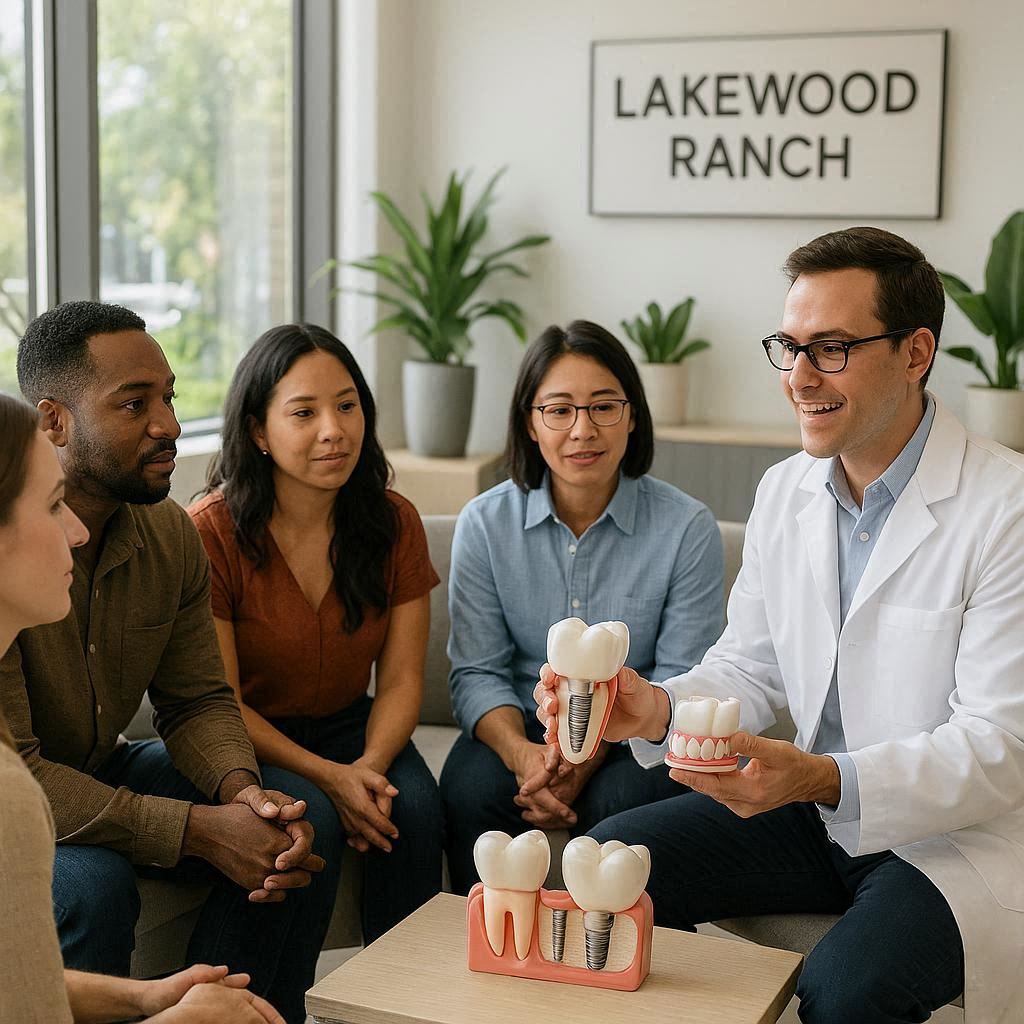
A dental implant is not the tooth itself. It is a small, screw-like post made of medical-grade titanium. A dentist surgically places this post into your jawbone. Over time, the bone grows around it. This creates a rock-solid anchor.
Once the implant heals, the dentist attaches an abutment (a connector piece) and finally a custom-made crown. That crown is the part you see and chew with.
Think of it this way:
- Implant = new tooth root
- Abutment = connector
- Crown = visible tooth
This three-part system makes implants incredibly stable. Unlike dentures, they do not slip. Unlike bridges, they do not harm neighboring teeth.
Why Lakewood Ranch Residents Are Choosing Implants
Lakewood Ranch is a growing, active community. From Lakewood Ranch Main Street to the Polo Club and the Sarasota border, residents value quality of life. They want solutions that last.
Implants fit that lifestyle perfectly. You can eat an apple, laugh out loud, and brush your teeth normally. No adhesives. No nightly soaking. Just a permanent solution.
The 4 Biggest Benefits of Choosing Implants
Before diving into costs and procedures, let’s highlight why implants consistently outperform older methods like bridges or dentures.
1. They Preserve Your Jawbone
When you lose a tooth, the jawbone in that area starts to deteriorate. Why? Because it no longer receives stimulation from chewing. Over years, this can change your facial shape. Your chin may look pointier. Your cheeks may sink in.
A dental implant replaces the root. That stimulates the bone. It keeps your jaw healthy and your face looking natural.
2. They Protect Nearby Teeth
Traditional bridges require grinding down the two adjacent teeth. Those teeth lose healthy enamel forever. With implants, no neighboring teeth are touched. Your dentist leaves them completely intact.
3. Long-Term Cost Effectiveness
Yes, implants have a higher upfront cost. But consider this: a typical bridge lasts 7 to 10 years. A denture may need relining or replacement every 5 to 8 years. A well-maintained dental implant can last 25 years, often a lifetime.
Over two decades, an implant often costs less than repeated replacements of other options.
4. Comfort and Confidence
Dentures rub. They click. They restrict what you can eat. Implants feel like your own teeth. You forget they are there. That alone is priceless for many Lakewood Ranch professionals, retirees, and parents.
“I had a partial denture for three years. I never got used to it. With my implant, I honestly forgot which tooth it was after a month. It just feels normal.” – Diane, Lakewood Ranch resident.
Who Is a Good Candidate for Dental Implants?
This is one of the most common questions. The short answer: most healthy adults.
But let’s get specific.
Ideal Candidates Usually:
- Have one or more missing teeth
- Have a fully grown jawbone (typically over age 18)
- Have sufficient bone density to support the implant
- Have healthy gums (no active gum disease)
- Do not smoke heavily (smoking slows healing)
- Are committed to good oral hygiene
What If You Lack Enough Bone?
Do not worry. Many Lakewood Ranch implant dentists offer bone grafting. This is a procedure where they add bone material to a thin or weak jaw area. After a few months of healing, you can proceed with implants.
Even patients who have been missing teeth for years are often candidates after a graft.
Health Conditions to Discuss
Certain conditions do not automatically disqualify you, but they require extra planning:
- Uncontrolled diabetes
- Autoimmune diseases
- Blood clotting disorders
- Heavy smoking
- Radiation therapy to the jaw area
Always share your full medical history with your Lakewood Ranch dentist. Transparency leads to safety.
The Step-by-Step Procedure: What to Expect Locally
Knowing what happens helps reduce anxiety. Here is the typical timeline for a single dental implant in Lakewood Ranch.
Step 1: Initial Consultation (1 hour)
Your dentist will:
- Take 3D X-rays (CBCT scan)
- Examine your teeth and gums
- Review your medical history
- Discuss your goals and budget
This is your chance to ask questions. Bring a list. A good dentist will welcome them.
Step 2: Treatment Planning (1–2 weeks)
The dentist creates a surgical guide. This digital blueprint ensures the implant goes exactly where it needs to go. Precision matters.
Step 3: Implant Placement Surgery (1–2 hours)
On surgery day, you receive local anesthesia. Some offices also offer sedation if you feel nervous.
The dentist makes a small incision in your gum. They drill a precise hole into the bone. They insert the titanium implant. Then they stitch the gum closed.
Most patients report mild discomfort, not sharp pain. You drive home afterward. No hospital stay.
Step 4: Osseointegration – The Healing Phase (3 to 6 months)
This is the most important part. Your jawbone grows around the implant. It bonds with the titanium surface. Rushing this step leads to failure.
During this time, you may wear a temporary partial denture or a flipper tooth. You eat softer foods for a few days. Otherwise, you live normally.
Step 5: Abutment Placement (30 minutes)
Once osseointegration is complete, the dentist reopens the gum slightly. They attach the small metal abutment. This sticks out above the gumline. It acts as the base for your crown.
Healing from this minor procedure takes about two weeks.
Step 6: Crown Fabrication and Placement (2–4 weeks)
Your dentist takes impressions. A dental lab crafts your permanent crown. They match the color, shape, and size to your natural teeth.
When the crown arrives, you return for a final visit. The dentist screws or cements it onto the abutment. That’s it. You have a new tooth.
Total Timeline: 4 to 8 months
Complex cases (multiple implants, bone grafts, or full arches) can take 12 months or more. Rushed implants fail. Patience pays.
Cost Breakdown for Dental Implants in Lakewood Ranch
Let’s talk numbers openly. Prices vary, but here are realistic ranges for the Lakewood Ranch area as of 2025.
| Procedure Component | Estimated Cost (Per Tooth) |
|---|---|
| Consultation & 3D scan | 150–350 |
| Implant placement (surgery) | 1,500–2,500 |
| Abutment | 300–600 |
| Custom crown | 1,200–2,000 |
| Total (Single Implant) | 3,150–3,150–5,450 |
Additional Costs to Consider
- Bone graft: 500–1,500 per site
- Sinus lift (upper back teeth): 1,500–3,000
- Sedation (oral or IV): 300–800
- Temporary tooth during healing: 200–500
Why Such a Wide Range?
Several factors affect pricing:
- The dentist’s experience and training
- The implant brand used (Nobel Biocare, Straumann, Zimmer, etc.)
- Lab fees for the crown
- Geographic location within Lakewood Ranch (offices near Lakewood Ranch Medical Center may have different overhead)
Does Insurance Cover Implants?
Traditional dental insurance often excludes implants. However, more plans now offer partial coverage. Typically, they might cover:
- The crown (as a basic restorative service)
- The extraction of the damaged tooth
- The abutment
The implant post itself is often denied. That said, always call your provider. Ask for the exact codes. Appeal if necessary.
Financing Options in Lakewood Ranch
Most local implant dentists offer:
- CareCredit (medical credit card, 6–12 months no interest)
- LendingClub or Alphaeon (patient financing)
- In-house payment plans (ask directly; smaller offices may offer this)
Do not let cost alone stop you. Many patients break payments into manageable monthly amounts.
Dental Implants vs. Alternatives: An Honest Comparison
You have options. Here is how implants stack up against the two most common alternatives.
| Feature | Dental Implant | Fixed Bridge | Removable Denture |
|---|---|---|---|
| Looks like natural tooth | Yes | Usually | Sometimes |
| Prevents bone loss | Yes | No | No |
| Requires altering adjacent teeth | No | Yes | No |
| Average lifespan | 20+ years | 7–12 years | 5–8 years |
| Eating restrictions | None | Avoid very hard foods | Many restrictions |
| Cleaning | Brush & floss normally | Special floss needed | Remove & soak |
| Upfront cost (per tooth) | $$$ | $$ | $ |
The Bridge Trade-Off
Bridges cost less initially. But they put stress on the anchor teeth. Those teeth may eventually fail. You then need a longer bridge. It can become a cascade of dental work.
The Denture Trade-Off
Dentures are the cheapest option. But they do not stop bone loss. Over time, your jaw shrinks. Dentures loosen. You need adhesives, relines, or new dentures. Many patients eventually switch to implants anyway.
*“I wore dentures for 12 years. The last two were miserable. My dentist in Lakewood Ranch placed four implants for a snap-on denture. I wish I had done it years ago.”* – Robert, Bradenton.
Finding the Right Implant Dentist in Lakewood Ranch
Not all dentists place implants. You need a specialist or an experienced general dentist with advanced training.
Types of Implant Providers
- Oral Surgeon – Focuses on the surgical placement. Often works with your general dentist for the crown.
- Periodontist – Gum specialist. Excellent for cases with gum disease or thin tissue.
- Prosthodontist – Expert in restoration (crowns, bridges, dentures). Often handles complex full-mouth cases.
- General Dentist with Implant Training – Convenient for single implants. Ask about their number of placed implants and continuing education.
Questions to Ask Before Committing
- How many dental implants have you placed?
- What is your success rate?
- Do you use 3D CT scanning?
- What implant brand do you use, and why?
- What happens if the implant fails?
- Do you offer sedation?
- Can you share before-and-after photos of Lakewood Ranch patients?
Red Flags to Avoid
- Prices that seem “too good to be true” (often cheap implants with low-quality components)
- No CBCT machine (2D X-rays are not sufficient)
- Rushing the timeline (anyone promising an implant and crown in under 3 months)
- Vague answers about warranties or failure policies
Local Resources
Start with the Lakewood Ranch Dental Society or read Google Reviews for specific implant dentists. Also check the American Academy of Implant Dentistry (AAID) for accredited members in zip codes 34202, 34211, and 34240.
Recovery and Aftercare: Your Role in Success
An implant can fail even with perfect surgery if you neglect aftercare.
First 24 Hours After Surgery
- Bite on gauze to stop bleeding
- Apply ice packs to your cheek (15 minutes on, 15 off)
- Eat soft foods (yogurt, smoothies, mashed potatoes)
- Do not spit, use straws, or smoke
- Take prescribed or OTC pain relievers as directed
First Two Weeks
- Rinse gently with warm salt water after meals
- Avoid the surgical site when brushing
- Do not chew on that side
- Avoid hot, spicy, or crunchy foods
Long-Term Maintenance (For Life)
Implants cannot get cavities, but they can get peri-implantitis. This is gum inflammation around the implant. Untreated, it leads to bone loss and implant failure.
Do this every day:
- Brush twice daily with a soft toothbrush
- Floss using implant-specific floss or water flosser
- Use a low-abrasive toothpaste (no baking soda or charcoal)
Do this every 6 months:
- Professional cleaning at a Lakewood Ranch dental office
- Your dentist will check the implant crown for wear
- X-rays to monitor bone levels
Signs of Problems
Contact your dentist if you notice:
- Persistent pain or throbbing
- The implant feels loose
- Red, swollen, or bleeding gums around it
- Bad taste or odor
Early intervention saves implants.
Special Cases: Multiple Teeth, Full Arch, and All-on-4
Not everyone needs a single implant. Lakewood Ranch dentists also offer solutions for extensive tooth loss.
Multiple Individual Implants
If you miss three non-adjacent teeth, you can place three separate implants. Each functions independently. This is the gold standard.
Implant-Supported Bridge
For three or four missing teeth in a row, two implants can support a fixed bridge. Fewer implants lower cost, but cleaning underneath is harder.
All-on-4 or All-on-6
This is for patients missing all teeth on the upper or lower arch. Four to six implants support a full fixed denture. You never remove it. It feels like natural teeth.
Typical cost for All-on-4 in Lakewood Ranch: 20,000–35,000 per arch.
Many patients travel from Sarasota, Bradenton, and even Tampa for this procedure. Recovery is longer, but the transformation is life-changing.
Same-Day Implants (Teeth-in-a-Day)
True same-day implants exist, but only in specific cases. You need excellent bone and no infection. The dentist places the implant and attaches a temporary crown that day. The permanent crown comes later.
Be cautious with marketing promises. Rush the bone healing, and you risk failure.
Common Myths About Dental Implants
Let’s bust a few persistent myths.
Myth 1: “Implants are painful.”
Fact: Most patients say the procedure hurts less than a tooth extraction. Modern anesthetics and sedation make it very manageable.
Myth 2: “My body might reject the implant.”
Fact: Titanium is biocompatible. True rejection is extremely rare. Failure usually comes from infection, overloading, or poor healing—not rejection.
Myth 3: “I’m too old for implants.”
Fact: Age is not a barrier. As long as you are healthy enough for a simple oral surgery, you can get implants. Patients in their 80s and 90s receive them successfully.
Myth 4: “Implants look fake.”
Fact: A skilled lab technician crafts your crown to match your existing teeth. No one will know unless you tell them.
Myth 5: “They are not worth the cost.”
Fact: Over a lifetime, implants often cost less than bridges and dentures when you factor in replacements, repairs, and bone loss treatments.
A Realistic Look at Risks and Complications
Honesty matters. Implants have a high success rate—over 95% for lower jaw, 90-95% for upper jaw. But they are not risk-free.
Possible Complications
- Infection: At the surgical site (1-2% of cases)
- Nerve damage: Temporary numbness in the lip or chin (rare with 3D planning)
- Sinus perforation: For upper back implants (manageable with precautions)
- Implant failure: The bone does not fuse (more likely in smokers or uncontrolled diabetics)
- Peri-implantitis: Gum disease around the implant (preventable with hygiene)
What Happens If an Implant Fails?
Your dentist removes it, allows the bone to heal (often 3-6 months), and tries again. Sometimes a bone graft is needed. Most patients still succeed on the second attempt.
Do not let fear of complications stop you. Your dentist will explain your personal risk profile during the consultation.
Preparing for Your First Implant Consultation in Lakewood Ranch
You want to walk into that appointment prepared. Here is a checklist.
Bring With You:
- Insurance card and ID
- List of current medications (including supplements)
- Any recent dental X-rays (or let them request from your previous dentist)
- Notes on your medical history (surgeries, allergies, chronic conditions)
- A notepad and pen
Questions to Ask:
- How many implants like mine have you placed?
- What brand of implant do you use?
- What is the total estimated cost, including everything?
- Do you offer payment plans?
- What sedation options do you have?
- How long until I can eat normally?
- What warranty do you offer on the implant and crown?
What to Expect:
The dentist will likely take a CBCT scan right there. This 20-second scan shows your bone in 3D. Do not worry about radiation—it is very low, comparable to a cross-country flight.
After reviewing the scan, they will give you a treatment plan. Take it home. Compare it with another office. This is a major medical decision. Second opinions are smart.
Insurance and Payment Strategies
Paying for implants requires strategy. Here is how Lakewood Ranch residents make it work.
Dental Insurance Tips
- Check for a “missing tooth clause.” Some plans do not cover any tooth that was missing before the policy started.
- Ask about implant-specific riders. Some employers offer optional implant coverage.
- Use your FSA or HSA. Pre-tax dollars can pay for implants, bone grafts, and even sedation.
- Split the procedure across two plan years. Place the implant in December and the crown in January. Double your insurance benefit.
Medical Insurance Possibilities
If your tooth loss is due to an accident, facial trauma, or a congenital condition, your medical insurance may cover part of the implant surgery. Always file a claim. Many patients miss this opportunity.
Negotiating Cash Prices
If you pay without insurance, ask for a cash discount. Many Lakewood Ranch dental offices offer 5-15% off for upfront payment. Do not be shy to ask.
Real Patient Journey: A Lakewood Ranch Example
Let’s follow “Sarah,” a 52-year-old Lakewood Ranch resident who broke her lower left molar.
Month 1: Sarah has a consultation and CBCT scan at a local implant dentist. Cost: 200(insurancepaid0). The dentist confirms she needs a bone graft first.
Month 2: Bone graft procedure. Cost: 1,200(insurancepaid100). Healing for 4 months.
Month 6: Implant placement. Cost: 2,000(insurancepaid0). Healing for 5 months.
Month 11: Abutment and crown. Cost: 1,800(insurancepaid500).
Total out-of-pocket: $4,600. Timeline: 11 months. Result: A functional, beautiful tooth.
Sarah says: “It felt long, but now I can’t imagine not doing it. I chew on that side like nothing ever happened.”
Maintaining Your Implant for Decades
You are the key to longevity. Follow these rules.
Daily Hygiene
- Use an interdental brush (like a tiny pipe cleaner) to clean around the abutment.
- Consider a water flosser (Waterpik) set to medium pressure.
- Avoid metal scrapers (like some tartar removers); they can scratch the crown.
Professional Maintenance
- See your hygienist every 6 months.
- Ask them to use plastic or graphite instruments on your implant crown (not metal).
- Request annual X-rays to check bone levels.
Lifestyle Choices
- Quit smoking. Smokers have double the failure rate.
- Wear a night guard if you grind your teeth. Excess force can break the crown or screw.
- Avoid chewing ice, pens, or hard candies. Your implant crown is strong, but not indestructible.
Frequently Asked Questions (FAQ)
Q: How long do dental implants last?
A: With good care, 20 years to a lifetime. The crown may need replacement after 10-15 years due to normal wear, but the implant itself often lasts forever.
Q: Is the surgery done in a hospital?
A: No. Implant placement happens in a dental office under local anesthesia. It is outpatient.
Q: Can I get an implant if I have gum disease?
A: You must treat the gum disease first. Active infection leads to failure. Once your gums are healthy, you can proceed.
Q: Will my insurance cover any part?
A: Some plans cover the crown or extraction. Few cover the implant post itself. Always verify.
Q: How soon can I return to work?
A: Most people return the next day. If you receive sedation, take that day off.
Q: Are mini implants the same as regular implants?
A: No. Mini implants are narrower and less stable. They work for stabilizing dentures but are not ideal for single tooth replacement.
Q: Do implants hurt?
A: The procedure itself does not hurt. After anesthesia wears off, you may feel soreness similar to a tooth extraction. Over-the-counter pain relievers usually suffice.
Q: Can I have an MRI later with an implant?
A: Yes. Titanium is not magnetic. MRIs are safe. Always tell the technician you have dental implants.
Additional Resources
For more trustworthy information, visit the American Academy of Implant Dentistry’s patient education page:
https://www.aaid.com/patients/
This resource offers implant dentist directories, procedure videos, and consumer checklists.
Conclusion
Dental implants in Lakewood Ranch offer a permanent, natural-looking solution for missing teeth. They preserve your jawbone, protect neighboring teeth, and restore your confidence to eat, speak, and smile freely. While the process requires time and investment, the long-term benefits—often a lifetime of comfort—make it a wise choice for eligible residents.
Disclaimer: This article is for informational purposes only and does not constitute medical or dental advice. It does not replace a professional consultation with a licensed dentist. Individual results vary. Always seek the advice of your own dentist or qualified healthcare provider with any questions you have regarding a medical condition or dental treatment.