Do Dental Implants Need A Crown?
The relationship between dental implants and crowns is fundamental to understanding tooth replacement. A dental implant is the artificial root. The crown is the artificial tooth. The question of whether implants need crowns touches on the very purpose of implant treatment. This article explains the implant-crown relationship, the scenarios in which an implant might exist without a conventional crown, and the various restoration options that complete implant treatment.
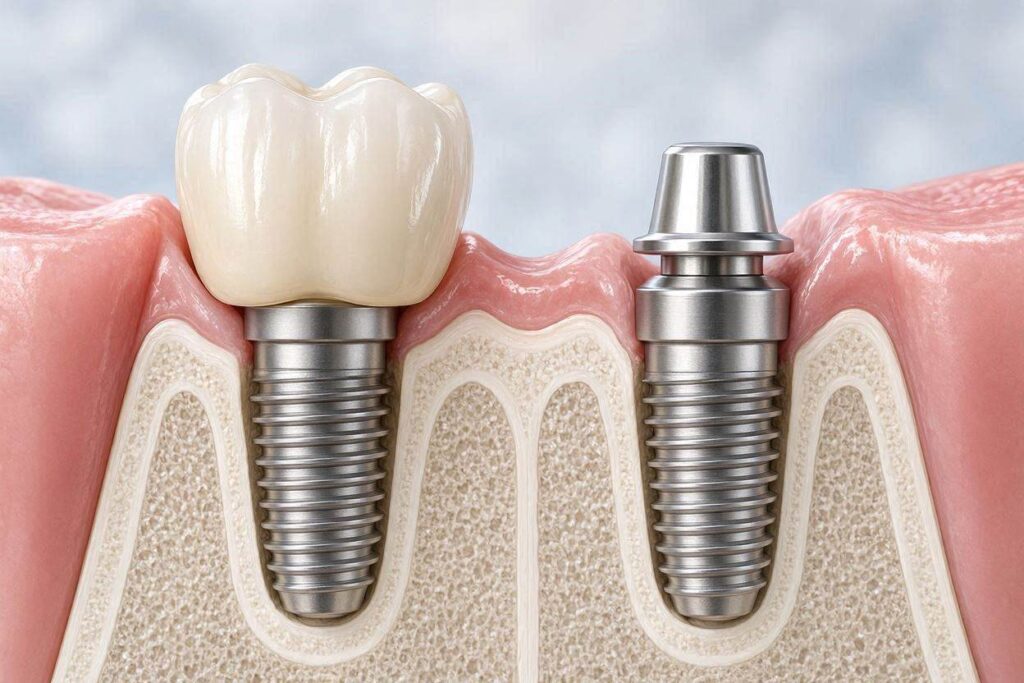
The Components of an Implant Restoration
Understanding the terminology clarifies the discussion.
The Implant Fixture
The implant fixture, sometimes simply called the implant, is the titanium or zirconia post surgically placed into the jawbone. It lies entirely beneath the gum tissue or at the gum level. The fixture replaces the root portion of the missing tooth. By itself, it does not replace any visible tooth structure. An implant fixture without a restoration is a buried foundation waiting for completion.
The Abutment
The abutment is the connector that attaches to the implant fixture and protrudes through the gum into the oral cavity. It serves as the foundation for the crown. Abutments can be stock, custom-fabricated, or integrated into the crown itself. The abutment is an intermediate component essential for crown attachment.
The Crown
The crown, also called the restoration or prosthesis, is the visible tooth portion. It is custom-fabricated to match adjacent teeth in size, shape, and color. The crown attaches to the abutment through cement retention or screw retention. This is the component that restores function and aesthetics.
The Fundamental Answer
Yes, dental implants need a restoration to fulfill their purpose. The implant fixture alone does not replace a tooth. It replaces only the root. The crown, or in some cases another type of prosthesis, completes the tooth replacement.
Implants Without Crowns: Temporary Scenarios
An implant may exist without a crown during specific phases of treatment.
During the osseointegration period, the implant is buried beneath the gum or covered by a healing abutment. No crown is present because the implant must heal undisturbed before loading. This phase lasts three to six months in most cases.
In two-stage implant protocols, the implant is intentionally buried beneath the gum for initial healing. A second minor surgery exposes the implant and places a healing abutment. Between these stages, no crown is present.
In cases where the implant fails to integrate or the patient cannot complete treatment for financial or medical reasons, a buried implant may remain without a crown indefinitely. This outcome represents a failure of treatment, not an acceptable endpoint.
Healing Abutments vs. Crowns
After implant exposure, the dentist places a healing abutment, a small metal cylinder that protrudes through the gum. The healing abutment shapes the gum tissue for the eventual crown. Patients sometimes mistake the healing abutment for a small, abnormal-looking tooth. It is a temporary component, not the final restoration.
Crown Alternatives for Implant Restorations
While “crown” is the common term, several restoration types can complete implant treatment depending on the clinical situation.
Single Implant Crown
This is the standard restoration for a single missing tooth. The crown is custom-made to match the adjacent teeth. It can be screw-retained or cement-retained. Materials include porcelain-fused-to-metal, all-ceramic such as lithium disilicate, or zirconia. The single crown is the most common implant restoration.
Implant-Supported Bridge
When multiple adjacent teeth are missing, an implant-supported bridge may be fabricated. Two or more implants support a series of connected crowns, replacing multiple teeth. The bridge is fabricated as a single unit and attached to the supporting implants. Fewer implants than missing teeth may be required, depending on the span and location.
Implant Overdenture
For patients missing all teeth in an arch, an implant overdenture provides a removable prosthesis that snaps onto supporting implants. The overdenture is a complete denture with attachments on the tissue side that engage corresponding attachments on the implants. The patient can remove the prosthesis for cleaning. Implant overdentures dramatically improve stability and function compared to conventional dentures.
Fixed Full-Arch Prosthesis
Often marketed as All-on-4, Teeth-in-a-Day, or hybrid denture, this restoration replaces an entire arch of teeth with a fixed prosthesis supported by four to six implants. The prosthesis is fabricated from acrylic with denture teeth, monolithic zirconia, or other materials. It is fixed in place and removed only by the dentist. This restoration does not involve individual crowns but rather a single multi-tooth prosthesis.
Implant-Supported Partial Denture
In partially edentulous patients, a removable partial denture can be supported and retained by implants. This option provides improved stability over a conventional partial denture while remaining removable for cleaning. It represents a middle ground between fixed restorations and conventional removable prostheses.
The Importance of Completing Implant Treatment
Leaving an implant without a restoration has consequences.
Functional Incompleteness
An unrestored implant does not replace chewing function. The patient continues to chew on other teeth, potentially overloading them. The space remains, allowing adjacent teeth to drift.
Risk to the Implant
A healing abutment left for an extended period without a crown may accumulate plaque and cause peri-implant tissue inflammation. The implant surface can become contaminated, potentially compromising long-term health.
Bone Maintenance
While the implant itself preserves some bone through physical presence, functional loading through a crown is the stimulus that maintains bone density. An unloaded implant does not provide the full bone-preserving benefit of a completed restoration.
The Laboratory Process for Crown Fabrication
Understanding what goes into creating the crown that completes an implant helps patients appreciate its necessity.
After the implant has integrated and the gum tissue has matured around the healing abutment, the restorative dentist captures an impression. Digital scanning or conventional impression techniques record the exact three-dimensional position of the implant. This information goes to a dental laboratory.
The laboratory technician designs the abutment and crown. The design considers the implant position, the adjacent and opposing teeth, the bite forces, and the aesthetic requirements. The crown is fabricated using the selected material. Multiple firings and characterizations create lifelike aesthetics for visible teeth.
The completed restoration returns to the dentist for try-in and delivery. The fit, occlusion, contacts, and aesthetics are verified. Adjustments are made as needed. The restoration is then secured to the implant.
Conclusion
Dental implants require a crown or other prosthesis to complete tooth replacement. The implant fixture is the root replacement only. The crown, bridge, overdenture, or fixed prosthesis provides the visible and functional tooth replacement. An implant without a restoration is a treatment in progress or a treatment failure. The completion of implant treatment with an appropriate restoration is essential for function, aesthetics, and long-term implant health.
Frequently Asked Questions
Can I leave the healing abutment on and not get a crown?
A healing abutment is a temporary component not designed for long-term function. Leaving it indefinitely risks tissue inflammation and implant contamination. The implant must be restored with a proper prosthesis.
How long can an implant go without a crown?
During treatment, the healing period of three to six months without a crown is normal. Beyond that, completing the restoration promptly protects the implant investment.
Is the abutment the same as the crown?
No. The abutment is the connector between the implant and crown. The crown is the tooth portion. Some restorations combine abutment and crown into a single unit, but they remain conceptually distinct components.
Does every implant need its own crown?
Not necessarily. In full-arch restorations, multiple implants support a single prosthesis. In implant-supported bridges, implants may support pontic teeth between them.
Additional Resource
For further information on implant restoration types, visit the American College of Prosthodontists at www.gotoapro.org. The ACP offers patient education materials on fixed, removable, and implant-supported prostheses.