Do Dental Implants Need To Be Tightened?
You have a dental implant. It feels solid, like a natural tooth. Years pass. You go about your life, eating, smiling, and speaking without giving the implant much thought. Then a question arises, perhaps during a routine dental visit or a conversation with a friend who also has an implant. Do dental implants need to be tightened? Like the bolts on a bicycle or the screws on a piece of furniture, do these titanium posts in your jaw require periodic maintenance to ensure they remain snug and functional? The answer is both simple and nuanced. Understanding it requires a clear distinction between the implant fixture, the abutment, and the crown, as well as an appreciation for the engineering principles behind implant dentistry.
This guide will explain exactly which parts of an implant system may need tightening, which parts absolutely must not be disturbed, and the professional protocols that keep your implant secure for decades. By the end, you will know how to care for your implant and what to do if you suspect something has come loose.
The Three Components: Understanding What Can and Cannot Be Tightened
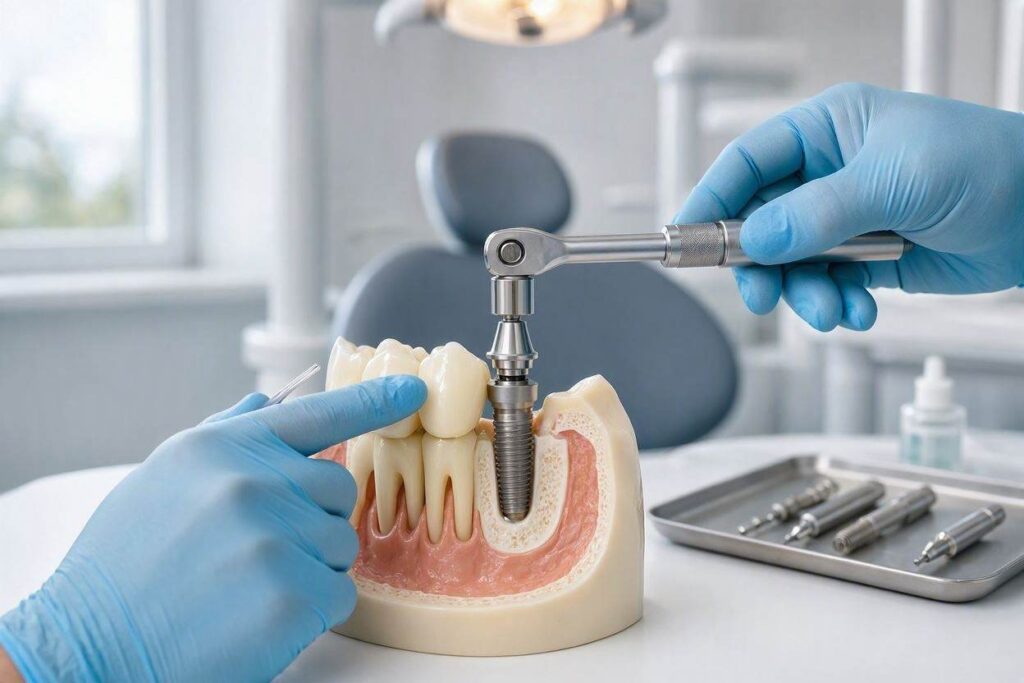
A dental implant restoration is a system of three distinct components. Each has a different relationship with tightness and stability.
The Implant Fixture. This is the titanium or zirconia post surgically placed in your jawbone. It is threaded, like a screw, and it is torqued into the bone during surgery. Once placed, the goal is for the bone to fuse to the implant surface, a process called osseointegration. A successfully integrated implant is absolutely immobile. It does not need to be “tightened” in the bone, and it cannot be. The implant fixture is designed to remain in the bone for life. There is no maintenance procedure to retighten the implant-bone interface. If an implant fixture becomes loose, it is not a maintenance issue; it is a failure of osseointegration, and the implant must be removed.
The Abutment. This is the connector piece that attaches to the implant fixture. It serves as the anchor for the crown. The abutment is secured to the implant with a small abutment screw. This screw is tightened to a precise torque specification, typically 25 to 35 Newton-centimeters, using a calibrated torque wrench. The abutment screw is the component most likely to loosen over time, though this is still a relatively uncommon complication. The abutment screw can be retightened if it loosens.
The Crown. This is the visible, tooth-shaped restoration. It attaches to the abutment in one of two ways: it is either cemented onto the abutment, or it is screw-retained with a separate screw that passes through the crown and into the abutment or implant. A cemented crown that is loose cannot be simply tightened; it must be re-cemented. A screw-retained crown with a loose screw can have that screw retightened.
The Abutment Screw: The Critical Tightness Point
The abutment screw is the mechanical linchpin of the implant system. It is a small, precisely engineered screw that holds the abutment to the implant. The stability of the entire restoration depends on this screw maintaining its preload, the clamping force generated when the screw is tightened.
When the dentist tightens the abutment screw to the specified torque, the screw stretches slightly within its elastic limit. This stretching creates a clamping force that pulls the abutment tightly against the implant platform. The friction at the interface prevents the abutment from rotating or moving. This is the same principle used in automotive and aerospace engineering. The screw does not simply “hold” the parts together like a nail. It actively clamps them together under tension.
Over time, several factors can cause the abutment screw to lose its preload. Microscopic settling of the mating surfaces, cyclic loading from chewing forces, and vibrations can all contribute to screw loosening. If the screw loosens enough, the preload is lost, and the abutment begins to move microscopically. The patient may feel a clicking sensation or the crown may feel loose. This is more common in single-tooth implants in the molar region, where chewing forces are highest, and in patients who grind or clench their teeth.
If an abutment screw loosens, the dentist can retighten it. The procedure involves removing the crown, cleaning the internal connection, inspecting the screw, and retightening it to the correct torque with a new screw if the old one is damaged or stretched. This is a routine, non-surgical procedure. The implant fixture itself remains stable in the bone.
The Screw-Retained Crown: Access and Tightening
For a screw-retained crown, the screw that secures the crown passes through a small access hole on the biting surface of the crown. This hole is filled with a tooth-colored composite resin or a small piece of cotton and resin to hide it. If the screw inside a screw-retained crown loosens, the dentist can remove the filling material, access the screw, retighten it, and replace the filling. The crown does not need to be cut off or destroyed. The entire procedure is conservative and quick.
The Cemented Crown: When Tightening Is Not an Option
A cemented crown is permanently bonded to the abutment with dental cement. There is no access hole. If a cemented crown feels loose, the problem is either that the cement bond has failed, or that the abutment screw under the crown has loosened. A loose cemented crown cannot simply be tightened. The dentist must either remove the crown by breaking the cement seal with a special instrument, which can be difficult and may risk damaging the crown, or cut the crown off and fabricate a new one. If the abutment screw is loose under a cemented crown, the crown must be removed to access the screw. This is a more involved procedure than retightening a screw-retained crown. For this reason, many modern implant dentists favor screw-retained crowns. They allow for retrievability. If a problem develops, the crown can be unscrewed, the issue addressed, and the crown reseated without damaging it.
Professional Maintenance: What Your Dentist Checks
During your regular implant maintenance visits, which should occur every three to six months, the dentist or hygienist will check the stability of your implant restoration. They will visually inspect the crown for any signs of movement, cracks, or wear. They will apply gentle pressure to the crown to feel for any rocking or clicking. They may use instruments to test the occlusion and ensure the bite forces are balanced. They will take periodic X-rays to evaluate the bone level around the implant and to check the fit of the abutment.
If the restoration is stable and there are no signs of loosening, no tightening is performed. The old engineering adage applies: if it is not loose, do not tighten it. Unnecessary retightening of an abutment screw can disrupt the stable interface, introduce contaminants, or even over-torque the screw and cause it to fracture. The implant system is designed to be stable long-term without routine mechanical retightening.
At-Home Monitoring: What You Should Look For
You are the first line of defense. Pay attention to your implant. A healthy implant should feel exactly like a solid, natural tooth. It should not move. It should not click. It should not feel different when you bite down. If you notice any of the following signs, you may have a loose component that needs professional attention.
- A clicking or popping sensation when you chew or when you press on the crown with your finger.
- A feeling that the crown is slightly mobile or rocking.
- A change in the way the implant feels when you floss around it, such as the floss catching or shredding.
- A new gap between the implant crown and the gum that was not there before.
- A bad taste or odor, which could indicate bacterial leakage into a loose interface.
- Bleeding or pus around the implant, which indicates inflammation that could be caused by a loose component trapping bacteria.
If you experience any of these signs, do not attempt to tighten anything yourself. You do not have the torque wrench, the sterile environment, or the diagnostic knowledge to safely retighten an implant component. You could strip the internal threads of the implant, fracture the screw, or introduce bacteria into the implant-abutment connection. Call your dentist and schedule an evaluation.
Implant-Supported Bridges and Full-Arch Prostheses
The principles remain the same for larger implant restorations. An implant-supported bridge or a full-arch screw-retained prosthesis, such as an All-on-4 bridge, is attached to multiple implants with multiple screws. These screws are torqued to specification. They can loosen over time. A loose screw in a full-arch prosthesis may cause the entire bridge to rock or may cause a localized clicking sensation. The prosthesis must be removed by the dentist, cleaned, and the screws retightened or replaced. The prosthesis is then reseated, and the access holes are filled with new material. This is part of the regular maintenance protocol for full-arch implant prostheses. Your dentist will typically recommend removing and professionally cleaning the prosthesis every one to two years, at which time the screws are inspected and retightened as needed.
The Role of Occlusion and Bruxism
Excessive biting forces from a poor bite or from bruxism, tooth grinding and clenching, are the leading causes of abutment screw loosening and mechanical complications. An implant has no periodontal ligament to absorb shock. The force is transmitted directly to the screw joint. A well-designed bite should have light contact on the implant crown in maximum intercuspation and no contact on excursive movements. A nightguard, a custom-fabricated occlusal splint, is essential for patients who grind their teeth. The nightguard absorbs the grinding forces and protects the implant components from overload, dramatically reducing the risk of screw loosening, screw fracture, and even implant fracture.
Summary of Key Points on Tightening Dental Implants
- The implant fixture in the bone does not need and cannot be tightened. Osseointegration is a biological bond, not a mechanical one.
- The abutment screw and the screw of a screw-retained crown are the components that can loosen and can be retightened by a dentist.
- Cemented crowns cannot be tightened. If loose, they must be removed and re-cemented or replaced.
- If an implant component feels loose, see your dentist. Do not attempt to tighten it yourself.
- Regular professional maintenance visits, a balanced bite, and a nightguard for bruxers are the best defenses against mechanical loosening.
Conclusion
Dental implants do not need routine tightening like the wheels on a car. The implant fixture is biologically fused to the bone and must never be disturbed. The abutment screw and the screw of a screw-retained crown can occasionally loosen over time due to occlusal forces, but this is a complication that requires professional attention, not a scheduled maintenance task. If your implant feels solid and your regular checkups confirm its stability, it needs no tightening. If you feel movement, clicking, or any change, see your dentist promptly for a diagnosis and treatment. A stable implant is a silent implant, and silence is the sound of a successful restoration.
Frequently Asked Questions (FAQ)
1. How often should I have my dental implant checked?
You should have your implant and the surrounding tissues examined professionally every three to six months as part of your regular dental recall visits.
2. Can I use an electric toothbrush on my implant crown?
Yes. Electric toothbrushes are safe and effective for cleaning implant crowns. The vibrations will not loosen the implant or the abutment.
3. Is it normal for an implant to click?
No. A clicking sensation is often a sign of a loose abutment screw or a loose crown. See your dentist for an evaluation.
4. What happens if an abutment screw breaks?
A broken abutment screw is a mechanical complication. The dentist must attempt to retrieve the broken screw fragment from inside the implant. This can be a delicate procedure. If the fragment cannot be retrieved, the implant may need to be removed.
5. Can an implant be over-tightened?
Yes. If the dentist applies torque exceeding the manufacturer’s specification, the screw can be stretched beyond its elastic limit and fracture, or the internal threads of the implant can be stripped.
6. Why do some dentists prefer screw-retained crowns?
Screw-retained crowns are retrievable. They can be removed without damaging the crown, allowing access to the abutment screw and the implant connection. This simplifies the management of mechanical and biological complications.
7. Do implant-supported dentures need their attachments tightened?
The locator housings and the screws that retain the bar do not typically need routine tightening, but they should be checked during maintenance visits. The nylon inserts in the denture wear out and are replaced periodically, not tightened.
Additional Resource
For more information on the maintenance and care of dental implants, visit the Academy of Osseointegration’s patient resource:
Academy of Osseointegration – Implant Care