Does Kern Family Cover Dental Implants?
Kern Family Health Care is a managed care health plan serving Medi-Cal (California Medicaid) beneficiaries in Kern County. Understanding whether this specific plan covers dental implants requires a detailed look at the intersection of Medi-Cal adult dental benefits, the managed care delivery model, and the strict medical necessity criteria that govern implant coverage. This guide provides a transparent, realistic answer to the question, explains the limitations and prior authorization process, and outlines alternative pathways to implant care for Kern County residents who do not qualify under the plan’s criteria.

Understanding Kern Family Health Care
Kern Family Health Care is a local, community-based health plan that contracts with the California Department of Health Care Services to administer Medi-Cal benefits to residents of Kern County. It is not a traditional insurance company; it is a managed care organization (MCO). Members select or are assigned to a primary care physician within the Kern Family network, and all covered services are coordinated through this network.
Dental benefits for Medi-Cal members are carved out of the medical managed care plan in California. Dental services are administered through the Medi-Cal Dental Program, also known as Denti-Cal. However, Kern Family Health Care members access Denti-Cal benefits through a dental managed care plan or through the fee-for-service Denti-Cal delivery system, depending on their county and enrollment status. In Kern County, most Medi-Cal members receive dental services through the Denti-Cal fee-for-service program, not through a dental managed care plan.
This distinction is critical. Kern Family Health Care manages your medical benefits, not your dental benefits. When you seek dental care, you are accessing the Denti-Cal program, which is a separate administrative entity, even though both are part of Medi-Cal. The dental provider bills Denti-Cal directly.
Medi-Cal Adult Dental Benefits and Implants
The Denti-Cal program provides a defined set of dental benefits for adults aged 21 and older. The scope of these benefits has been expanded and contracted through various state budget cycles, but as of the current benefit structure, Denti-Cal covers a comprehensive range of services for adults, including exams, X-rays, cleanings, fillings, extractions, root canals in anterior teeth, crowns, complete and partial dentures, and, under specific conditions, dental implants.
The restoration of dental implants is a covered benefit for adult Medi-Cal members when the service is medically necessary. This is the central criterion. The implant is not an elective cosmetic procedure under Medi-Cal; it is a medically necessary restoration for a qualifying clinical condition. The Denti-Cal program covers the implant body, the abutment, and the implant-supported crown when the patient meets the criteria and the procedure receives prior authorization.
The Medical Necessity Criteria for Implants Under Denti-Cal
Denti-Cal does not approve implants simply because a tooth is missing. The program requires documentation that the implant is medically necessary to restore function and that alternative, less expensive treatments are not clinically appropriate. The criteria are stringent.
Qualifying Conditions
The Denti-Cal program considers dental implants medically necessary for adults when the following types of conditions are documented:
- Severe Bone Atrophy: The patient has such extensive jawbone resorption that a conventional removable complete denture or partial denture cannot achieve adequate retention, stability, or function. The denture would be non-functional, causing the patient to be unable to chew a normal diet. A comprehensive clinical exam and radiographic evidence (panoramic and/or CBCT) must demonstrate the severe atrophy.
- Unfavorable Oral Anatomy: The patient has anatomical limitations, such as large maxillary or mandibular tori (bony growths), a high floor of the mouth, a shallow vestibule, or a skeletal relationship that precludes the successful use of a conventional removable prosthesis.
- Hyperactive Gag Reflex or Psychological Inability: The patient has a documented, severe hyperactive gag reflex or a diagnosed psychological condition that makes the wearing of a removable prosthesis impossible. This requires documentation from a physician or mental health professional.
- Oncology Reconstruction: The patient has lost teeth and jawbone due to surgical resection for oral cancer or other pathology and requires implant-supported reconstruction to restore function.
- Trauma: The patient has sustained traumatic avulsion of teeth and associated alveolar bone that requires implant-supported restoration.
A simple single-tooth replacement with an implant in a patient who has an otherwise intact dentition and could function adequately with a fixed bridge or a removable partial denture does not meet the Denti-Cal medical necessity threshold. The patient would be directed to the less expensive, clinically appropriate alternative.
The Prior Authorization Requirement
All dental implant services under Denti-Cal require prior authorization, also called Treatment Authorization Request (TAR). The dentist submits a TAR to the Denti-Cal program. The submission must include a comprehensive treatment plan, diagnostic radiographs (panoramic and periapical), a CBCT scan if available, a detailed narrative of medical necessity explaining why alternative treatments are not viable, and documentation of any contributing medical or psychological conditions.
The Denti-Cal dental consultant reviews the TAR. They may approve, deny, or request additional information. The prior authorization process takes time, typically several weeks. The dentist must receive the approved TAR before the implant surgery is scheduled. A patient cannot simply present their Kern Family Health Care membership card at an implant dentist and expect coverage; the administrative approval must precede the clinical service.
The Practical Reality for Kern Family Health Care Members
The practical reality is that the vast majority of Kern Family Health Care members seeking a single-tooth implant replacement for a routine tooth loss will not qualify for Denti-Cal coverage. The medical necessity criteria are designed to cover implants for patients with severe functional impairment, not for standard restorative convenience.
A member who has been edentulous for many years, has severe mandibular ridge resorption, cannot wear a lower denture, and has documented nutritional deficiencies due to the inability to chew may qualify for two to four mandibular implants to support an overdenture. This is a classic and approvable scenario. A member with a single missing premolar and a healthy adjacent dentition requesting an implant instead of a fixed bridge will likely be denied.
If a Kern Family Health Care member has a medical condition or trauma that crosses over into medical necessity (for example, a mandibular fracture with tooth loss treated by an oral surgeon), the medical side of Medi-Cal, coordinated through Kern Family Health Care, may cover the hospital and surgical facility fees, while Denti-Cal covers the dental implant and restoration. This coordination of benefits requires precise coding and communication between the medical and dental providers.
Alternative Pathways to Implant Care in Kern County
For Kern County residents who do not qualify for Denti-Cal implant coverage, several alternative pathways exist.
Dental Schools and Residency Programs
The closest dental schools with implant programs are in the Los Angeles area: UCLA School of Dentistry, USC Herman Ostrow School of Dentistry, and Western University of Health Sciences College of Dental Medicine. These programs offer reduced-cost implant placement by residents and students under faculty supervision. The travel distance from Bakersfield is approximately two hours each way. For a patient requiring multiple appointments over several months, this is a significant time and transportation commitment, but the cost savings can be substantial.
Community Health Centers with Sliding Fee Scales
Federally Qualified Health Centers in Kern County, such as Clinica Sierra Vista and Omni Family Health, provide comprehensive dental services on a sliding fee scale. While FQHCs may not offer implants directly, they can assess your oral health, provide preliminary treatment, and refer you to affordable implant providers. The FQHC’s patient navigator or care coordinator may be aware of local resources or grant-funded programs for implant care.
Dental Tourism from Kern County
Bakersfield’s geographic position, approximately three hours by car from the U.S.-Mexico border at Calexico and Mexicali, and five hours from Los Algodones (the dental tourism hub near Yuma, Arizona), makes cross-border implant care a logistically feasible option. A patient can drive to Los Algodones, stay for two or three days for the surgical phase, return for a second trip months later for the restoration, and still achieve total savings of 50% to 70% compared to U.S. private pay fees. Thorough research into the clinic’s credentials and laboratory standards is mandatory.
Private Financing and In-House Payment Plans
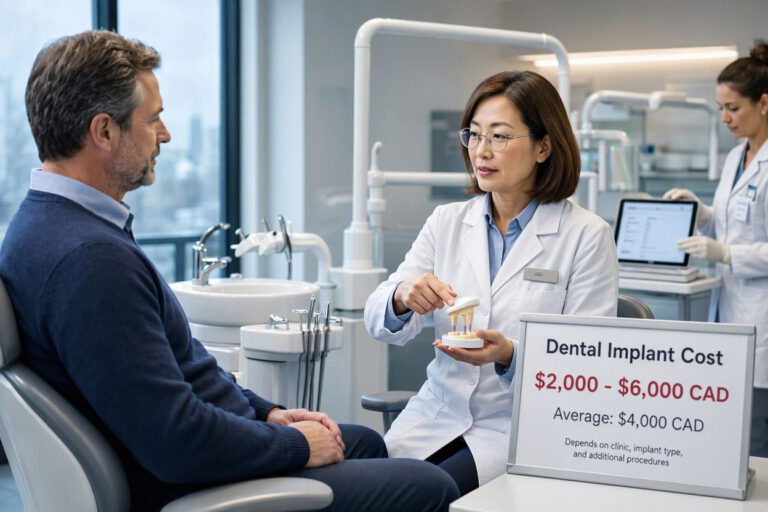
Private implant dentists in Bakersfield and the surrounding area offer financing through third-party lenders or in-house payment plans. A single implant and crown in Kern County privately costs $3,000 to $5,000. Financing with a CareCredit promotional period or a fixed-rate loan can reduce the monthly burden to $100 to $200. For a patient who does not qualify for Denti-Cal coverage, this self-pay pathway is the most direct route to implant care.
The Future of Medi-Cal Implant Coverage
The California state budget and the Department of Health Care Services periodically review the Medi-Cal dental benefit. The trend in adult dental benefits has been toward expansion. The restoration of implants as a covered benefit with medical necessity criteria represents a more progressive stance than many other state Medicaid programs. Advocacy by dental professional organizations and patient groups may broaden the criteria over time. Kern Family Health Care members should check the Denti-Cal provider bulletins annually for any updates to the medical necessity criteria or prior authorization process.
Conclusion
Kern Family Health Care does not directly cover dental implants; the dental benefit is administered through the Denti-Cal program, which covers implant restoration for adults only when strict medical necessity criteria are met, such as severe bone atrophy rendering a denture non-functional, oncology reconstruction, or documented trauma. The implant procedure requires a Treatment Authorization Request with comprehensive documentation and prior approval before surgery, and the majority of routine single-tooth implant requests will not meet the threshold. Kern County residents who do not qualify can seek reduced-cost care at dental schools, explore sliding fee clinics, consider dental tourism in nearby Mexico, or utilize private financing.
Frequently Asked Questions
Will Kern Family Health Care pay for an implant if I have a missing front tooth?
A single missing anterior tooth in an otherwise intact arch is not considered medically necessary for an implant under Denti-Cal criteria unless specific extenuating circumstances exist, such as a traumatic avulsion with loss of the supporting bone that prevents a fixed bridge. A fixed bridge or a removable partial denture is the covered alternative benefit.
How long does the Denti-Cal prior authorization process take?
The TAR review process typically takes two to four weeks from the time the dentist submits a complete application. Incomplete applications, those lacking radiographic documentation or a sufficient narrative of medical necessity, are returned with a request for additional information, extending the timeline. The dentist’s office should inform you of the expected processing time.
Can I choose any implant dentist if I have Denti-Cal coverage?
No. You must see a dentist who is enrolled as a Denti-Cal provider and who accepts Denti-Cal assignment for implant procedures. Not all implant dentists are Denti-Cal providers. The Denti-Cal provider directory lists participating dentists. The number of providers placing and restoring implants under Denti-Cal is limited. You may need to travel outside of Kern County to find an implant provider who accepts Denti-Cal.
What happens if my implant TAR is denied?
The denial letter specifies the reason. You have the right to appeal. The dentist can submit additional documentation, a more detailed narrative, or a letter from your physician supporting the medical necessity. The appeal is filed with the Denti-Cal program. If the appeal is denied, the patient and dentist may explore a cash-pay arrangement or alternative treatment.
Additional Resource
The California Department of Health Care Services maintains the Denti-Cal website at dental.dhcs.ca.gov. This is the authoritative source for the current Medi-Cal Dental Provider Handbook, which details the specific coverage criteria for dental implants, the TAR submission process, and the complete schedule of covered services and limitations. Patients can also find the Denti-Cal provider directory and member helpline number.