Does Mass Health Cover Dental Implants?
MassHealth, Massachusetts’ combined Medicaid and Children’s Health Insurance Program, provides healthcare coverage for eligible low-income residents. Dental benefits under MassHealth have expanded in recent years, but coverage for advanced procedures like dental implants remains limited and subject to specific criteria. Understanding what MassHealth covers helps beneficiaries plan for tooth replacement needs realistically.
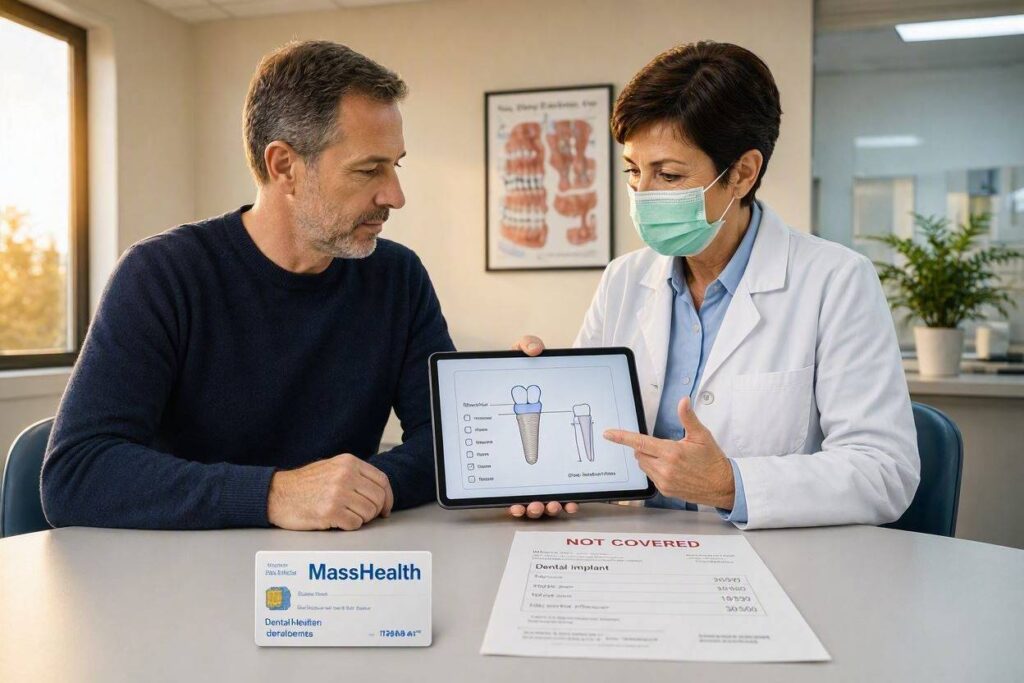
MassHealth generally does not cover dental implants for adults as a routine benefit. Coverage is limited to extremely specific circumstances where implants are considered medically necessary and prior authorization is obtained. These circumstances typically involve reconstructive needs related to trauma, congenital conditions, or cancer treatment. Routine tooth replacement with implants is not covered. Alternative treatments like partial or complete dentures receive coverage.
MassHealth Dental Coverage Overview
Understanding the structure of MassHealth dental benefits provides context for implant coverage limitations.
Types of MassHealth Dental Coverage
MassHealth provides different dental benefit levels depending on membership type and age.
MassHealth Standard (Adults 21 and Over):
Comprehensive dental benefits including preventive care, restorative treatment, extractions, root canals, crowns, dentures, and periodontal treatment. Annual benefit limits and prior authorization requirements apply to many services.
MassHealth CarePlus:
Similar comprehensive dental benefits for adults enrolled through the Health Connector.
MassHealth Family Assistance:
Limited dental benefits varying by plan type.
MassHealth Limited:
Emergency dental services only.
Children Under 21 (All MassHealth Types):
Comprehensive dental benefits through the Children’s Health Insurance Program including preventive, restorative, and orthodontic services when medically necessary.
Services Covered Under Adult Dental Benefits
MassHealth adult dental coverage includes many services relevant to tooth replacement, though implants are specifically excluded in most circumstances.
Covered Services:
Examinations and cleanings (twice annually). Fillings and crowns. Root canal treatment. Extractions (simple and surgical). Complete and partial dentures. Denture relines and repairs. Periodontal treatment. Oral surgery services.
Not Covered for Adults:
Dental implants (except specific medical necessity circumstances). Cosmetic procedures. Adult orthodontics (except in specific medical circumstances). Certain premium materials and techniques.
“MassHealth provides meaningful dental coverage for adults, including dentures when teeth cannot be saved. However, the program does not routinely cover dental implants, which it considers a premium treatment option beyond basic medically necessary care.” — Massachusetts Executive Office of Health and Human Services
When MassHealth Might Cover Dental Implants
MassHealth covers dental implants only in narrow circumstances where they are deemed medically necessary rather than elective tooth replacement.
Medically Necessary Criteria
Prior authorization for implant coverage requires documentation demonstrating that implants are medically necessary for the patient’s health and function. Qualifying circumstances include:
Congenital Conditions:
Patients born without teeth (ectodermal dysplasia, hypodontia) or with craniofacial anomalies may qualify for implant coverage as part of reconstructive treatment. These cases involve structures that never developed normally, not teeth lost to disease.
Traumatic Injury:
Implants may be covered for reconstruction following accidental trauma resulting in tooth loss and jaw damage. The traumatic nature, rather than dental disease, distinguishes these cases from routine tooth loss.
Cancer Treatment Sequelae:
Patients who lost teeth and jaw structures due to cancer surgery or radiation therapy may qualify for implant-supported reconstruction. These cases represent disease treatment consequences rather than preventable dental conditions.
Severe Atrophy Affecting Function:
Patients unable to wear conventional dentures due to extreme bone loss may qualify for implants to retain dentures when documentation demonstrates that conventional dentures cannot provide adequate function. This is the most common path for potential implant coverage but requires extensive documentation.
Prior Authorization Requirements
Any MassHealth implant coverage requires prior authorization before treatment begins. The process involves:
Comprehensive clinical documentation explaining why implants are medically necessary. Documentation that alternative treatments (conventional dentures) have been attempted and failed, or are contraindicated. Radiographic imaging (panoramic X-ray, CBCT if available). Letter of medical necessity from the treating dentist or specialist. Supporting documentation from physicians if medical conditions contribute to the need for implants.
Authorization is not guaranteed. Many requests are denied on initial submission and require appeal. The prior authorization process takes 2-6 weeks for initial determination, longer if appeals are pursued.
Dental School and Hospital-Based Coverage
MassHealth beneficiaries receiving treatment at hospital-based dental clinics or dental schools may access implant treatment through teaching programs that offer reduced fees. These institutions sometimes provide implants to MassHealth patients when the case offers educational value for residents or students.
Boston University, Tufts University, and Harvard School of Dental Medicine operate clinics serving MassHealth patients. Implant treatment through these institutions may be available at reduced cost compared to private practice, though MassHealth coverage for the implant procedure itself remains limited.
Alternative Tooth Replacement Covered by MassHealth
MassHealth provides coverage for several tooth replacement options that serve as alternatives to implants.
Complete Dentures
Full dentures replacing all teeth in one or both arches are covered benefits.
Coverage Details:
Complete upper and lower dentures are covered. Prior authorization is required. Replacement dentures covered after 5-8 years (varies by medical necessity). Immediate dentures placed at the time of extractions are covered. Coverage includes necessary adjustments and relines during the initial accommodation period.
Patient Cost: $0 copayment for MassHealth Standard members
Partial Dentures
Partial dentures replacing multiple missing teeth when some natural teeth remain are covered.
Coverage Details:
Cast metal partial dentures (the standard for durability and fit) require prior authorization. Acrylic partial dentures may be covered as temporary or transitional prostheses. Replacement partials are subject to frequency limitations similar to complete dentures.
Patient Cost: $0 copayment for MassHealth Standard members
Fixed Bridges
In specific circumstances, fixed bridges may be covered when they represent the most appropriate treatment for a given clinical situation. Bridge coverage requires prior authorization and documentation of medical necessity.
Bridges are not automatically covered as an alternative to implants. MassHealth generally considers removable partial dentures the standard of care for multiple tooth replacement in the absence of qualifying medical necessity for fixed alternatives.
Extractions With No Replacement
MassHealth covers necessary tooth extractions, including surgical removal of impacted teeth. While this addresses pain and infection, MassHealth does not require or guarantee tooth replacement coverage following extraction.
Patients facing extraction of all remaining teeth should discuss replacement options and obtain prior authorization for dentures before proceeding with extractions to ensure coverage for the complete treatment plan.
Steps to Take If You Need Implants and Have MassHealth
MassHealth beneficiaries needing or wanting implant treatment have several pathways to explore.
1. Determine if You Meet Medical Necessity Criteria
Review your specific situation against the medical necessity categories:
Were you born with missing teeth or a craniofacial condition? Did you lose teeth due to accidental injury (not dental disease)? Are you a cancer survivor with treatment-related tooth and jaw loss? Have you tried and failed to function with conventional dentures?
If your situation falls outside these categories, MassHealth implant coverage is unlikely. Explore alternative treatments or alternative funding sources.
2. Obtain a Comprehensive Evaluation
Visit a MassHealth-participating dentist for a complete examination. The dentist evaluates your oral health, discusses treatment options, and determines whether your situation might qualify for implant consideration.
If potential medical necessity exists, the dentist documents clinical findings and may refer you to a specialist (oral surgeon, periodontist, or prosthodontist) for further evaluation.
3. Pursue Prior Authorization
If the evaluating providers believe implant treatment is medically necessary, they submit a prior authorization request to MassHealth with supporting documentation.
Be prepared for initial denial. Many medically necessary implant requests are denied initially and require appeal. The appeal process involves additional documentation, potentially including letters from physicians, documentation of failed alternative treatments, and narrative explanations of medical necessity.
4. Explore Dental School Options
Contact Boston University, Tufts University, or Harvard School of Dental Medicine to inquire about implant treatment availability for MassHealth patients. These institutions may offer reduced fees or accept MassHealth for portions of treatment even when full implant coverage is not available through standard MassHealth benefits.
5. Consider Financing or Saving for Private Treatment
If MassHealth coverage is not available and dental school options do not provide sufficient cost reduction, private-pay implant treatment becomes the remaining option.
Some private practices offer sliding-scale fees or payment plans. Healthcare financing through CareCredit or similar services may be available to patients with adequate credit, though qualification is more challenging for low-income beneficiaries.
6. Accept Alternative Covered Treatments
MassHealth provides complete and partial dentures as covered benefits. While these alternatives do not match implants in stability or function, they restore the ability to eat and speak with improved aesthetics compared to being toothless.
Modern dentures fabricated by skilled practitioners can provide satisfactory function and appearance. Maximizing the quality of covered alternative treatments may be the most practical option for many MassHealth beneficiaries.
| Pathway | Likelihood of Implant Access | Time and Effort Required |
|---|---|---|
| Medical Necessity Authorization | Low to Moderate | Extensive documentation; appeals likely |
| Dental School Treatment | Moderate | Wait lists; multiple longer appointments |
| Private Pay with Financing | High (if budget allows) | Credit qualification; ongoing payments |
| Accept Covered Alternatives (Dentures) | N/A (alternative treatment) | Standard treatment timeline |
Massachusetts Health Connector and Alternative Insurance Options
MassHealth beneficiaries who do not qualify for implant coverage may explore whether other insurance options provide better coverage.
Health Connector Dental Plans
Massachusetts residents not eligible for MassHealth, or those who lose eligibility, can purchase dental coverage through the Massachusetts Health Connector. Standalone dental plans are available with varying levels of implant coverage.
Some Connector dental plans include implant coverage with annual maximums and waiting periods. Premiums and out-of-pocket costs apply. Compare plan benefits carefully before enrollment.
Employer-Sponsored Dental Insurance
MassHealth beneficiaries who gain employment with dental benefits may access implant coverage through employer plans. Coordination of benefits between MassHealth and private insurance follows standard rules, with private insurance typically primary.
Medicare Considerations
Dual-eligible beneficiaries (Medicare and MassHealth) should note that Original Medicare does not cover dental implants. Some Medicare Advantage plans available in Massachusetts include dental benefits with implant coverage. Dual-eligible special needs plans may offer enhanced dental benefits.
Changes and Updates to MassHealth Dental Policy
MassHealth dental benefits have expanded significantly over the past two decades. Adult dental coverage was restored in 2013 after being eliminated during budget cuts. Since restoration, coverage has gradually expanded to include crowns, root canals, and dentures.
Advocacy for implant coverage under MassHealth continues from dental professional organizations and patient advocacy groups. The argument for coverage emphasizes the long-term cost-effectiveness of implants compared to repeated denture replacements and the medical consequences of inadequate tooth replacement.
Future policy changes may expand implant coverage, but beneficiaries should not anticipate imminent changes when making current treatment decisions. Base decisions on current coverage rather than hoped-for future benefits.
Frequently Asked Questions
Does MassHealth cover dental implants for adults?
Generally, no. MassHealth does not routinely cover dental implants. Coverage is limited to specific medical necessity circumstances with prior authorization.
Will MassHealth cover implants if I cannot wear dentures?
Possibly, if you can document that conventional dentures have been attempted and failed, or are contraindicated due to anatomical limitations. Extensive documentation and prior authorization are required.
Does MassHealth cover All-on-4 dental implants?
Extremely unlikely except in the most compelling medical necessity cases. All-on-4 is considered a premium treatment option beyond what MassHealth provides.
Do children with MassHealth get implant coverage?
Children with congenital missing teeth or traumatic tooth loss may qualify for implant coverage when medically necessary and when growth is sufficiently complete. Authorization requires specialist documentation.
What tooth replacement does MassHealth cover?
MassHealth covers complete and partial dentures, denture relines and repairs, and necessary extractions. Fixed bridges may be covered in specific circumstances.
Can I appeal a MassHealth denial for implant coverage?
Yes. The denial letter includes appeal instructions. Appeals require additional documentation supporting medical necessity and may involve a fair hearing process.
Are there any Massachusetts programs that help pay for implants?
Beyond MassHealth medical necessity exceptions, no state programs specifically fund dental implants for low-income adults. Dental schools and some community health centers offer reduced fees.
How do I find a MassHealth dentist who does implants?
Search the MassHealth provider directory for participating oral surgeons and prosthodontists. Contact these providers to inquire about MassHealth implant cases and medical necessity evaluations.
Additional Resources
For more information about MassHealth dental coverage:
- MassHealth Dental Program: www.mass.gov/masshealth (search “dental services”)
- Massachusetts Dental Society: www.massdental.org (find-a-dentist tool)
- Health Care For All Massachusetts: www.hcfama.org (consumer assistance)
- Boston University Dental Health Center: www.bu.edu/dental
- Tufts University School of Dental Medicine: dental.tufts.edu