What Is The Turnaround Time For Dental Implants?
When you decide to get a dental implant, you are making a commitment. It is not a quick fix like a filling or a simple crown. A dental implant involves surgery, healing, and multiple visits to the dentist. One of the most common questions patients ask is: “When will I finally have my new tooth?”
The answer is not a single number. The turnaround time for dental implants depends on your specific body, the condition of your jawbone, and the type of procedure your dentist recommends. It can range from a single day to over a year.
This guide will walk you through the traditional timeline, explain the stages of healing, and introduce you to the “same-day” options that are changing the game. By the end, you will have a realistic understanding of what to expect on your journey to a restored smile.
The Traditional Timeline: The “Gold Standard” Approach
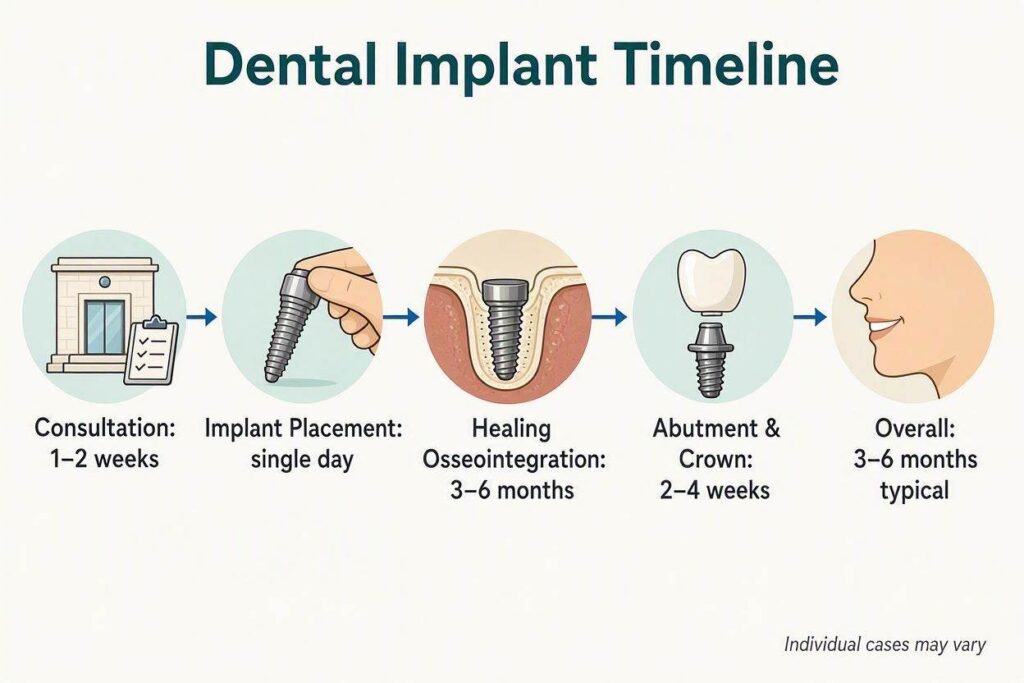
The most common and time-tested approach to dental implants involves a staged process. This is designed to give your body the best possible chance of healing and fusing with the implant. The traditional timeline typically takes 3 to 6 months (or longer) from start to finish.
Here is the breakdown of the phases:
Phase 1: Consultation and Preparation (1-2 Weeks)
Before any surgery, you meet with your dentist or oral surgeon. They take X-rays or a 3D CT scan to evaluate your bone density and plan the surgery. If you have a damaged tooth that needs to be removed, this is usually discussed here.
Phase 2: Tooth Extraction and Bone Grafting (If Needed)
If the failing tooth is still in your mouth, it needs to be extracted. Often, a bone graft is placed into the socket at the same time.
- Extraction Alone: If you just need a tooth pulled and the bone is healthy, you might wait 2 to 4 months for the socket to heal before placing the implant.
- Bone Grafting: If you have lost bone mass (which is common after tooth loss), the jawbone is too thin to hold an implant. The dentist places a bone graft material to build up the area. This graft needs time to integrate and turn into solid bone. This adds 3 to 6 months to the timeline. This is often the biggest source of delay.
Phase 3: Implant Placement Surgery (1 Day)
This is the day the titanium post is placed into the bone. The surgery itself usually takes 1 to 2 hours. After the surgery, the implant is buried under the gum.
Phase 4: Osseointegration (3 to 6 Months)
This is the waiting period. This is where the “magic” happens. The bone cells grow and attach to the surface of the titanium implant. This process is called osseointegration. It is critical that the implant remains completely stable during this time. If you put pressure on it too soon, the implant will fail. For the lower jaw, this takes about 3 months. For the upper jaw (which has softer bone), it takes 4 to 6 months.
Phase 5: Abutment Placement (2 Weeks)
Once the implant is fused, the dentist makes a small incision in the gum to expose the top of the implant. A metal or ceramic connector (the abutment) is screwed on. The gum is allowed to heal around the abutment for about 2 weeks.
Phase 6: Crown Fabrication and Delivery (2-3 Weeks)
Finally, the dentist takes impressions (or digital scans) of your mouth. These are sent to a dental lab, which fabricates your custom crown. When it is ready, you return to the office to have it cemented or screwed into place.
Total Traditional Timeline: 4 to 12 Months (average is about 6 months).
The “Same-Day” Implant: Fact or Fiction?
The idea of walking into a dental office with a missing tooth and walking out an hour later with a new one is incredibly appealing. This is often advertised as “Teeth in a Day” or “Same-Day Implants.” This concept is real, but it requires a nuanced understanding.
What it really means:
In a same-day procedure, the dentist places the implant post and attaches a temporary crown (or a temporary bridge/denture) on the same day. This is called “immediate loading.”
The Pros:
- Instant Aesthetics: You don’t have to walk around with a gap in your smile for 3-6 months. You leave with a tooth.
- Fewer Surgeries: You avoid a second surgery to expose the implant.
The Cons:
- Higher Risk of Failure: The implant is not fused to the bone yet. It relies on “primary stability” (the mechanical tightness of the screw in the bone). If you bite down too hard on the temporary tooth, the implant can move, and osseointegration will fail.
- Strict Diet: Patients with same-day implants must stick to a strict soft-food diet for months. They cannot chew on the temporary tooth at all.
- It is Still Temporary: The tooth you leave with is usually a temporary one. After the 3-6 month healing period, you will likely need to return to have a final, stronger, more aesthetic crown made.
Who is a candidate for same-day implants?
Not everyone. You need excellent bone quality and quantity. The implant must be able to achieve high initial torque (tightness) when placed. This is often easier in the lower front jaw.
The “All-on-4” Turnaround Time
For patients who are missing all of their teeth on an arch (upper or lower), the “All-on-4” concept is a popular solution. It involves placing 4 to 6 implants and attaching a full bridge of teeth to them.
The turnaround time for the surgical phase is one day—you get a fixed set of teeth that day. However, the journey is similar to single implants:
- Surgery Day: Implants placed, temporary bridge attached.
- Healing (3-6 Months): The temporary bridge is worn while the implants fuse.
- Final Bridge (2-4 Weeks): A stronger, more customized permanent bridge is fabricated and fitted.
So, while you have teeth the whole time, the final result still takes months.
Factors That Slow Down the Process
If you are hoping for a quick turnaround, you need to be aware of the roadblocks that can extend your timeline.
1. Bone Grafting (The Biggest Delay)
If you have been missing a tooth for years, the bone in that area has likely resorbed (shrunk). Without enough bone, an implant cannot be placed. A bone graft (using synthetic material, cow bone, or your own bone) is required to rebuild the foundation. Waiting for this graft to solidify can add 3 to 6 months to your treatment.
2. Sinus Lifts
If you are replacing upper back teeth (molars), the sinus cavity sits very close to the jawbone. Often, the bone is too thin here. A “sinus lift” surgery is performed to lift the sinus membrane and place bone graft underneath it. This has a healing time of 6 to 9 months.
3. Infection or Complications
If you get an infection after surgery, or if you smoke (which drastically impairs healing), the timeline can be extended or the implant can fail entirely, forcing you to start over.
4. Lab Time
Even after the implant is healed, the crown takes time to make. While some dentists have in-office milling machines (CEREC) that can make a crown in an hour, most use external labs that take 2 to 3 weeks.
How to Speed Up the Turnaround (Safely)
While you cannot rush biology, there are ways to ensure you don’t experience unnecessary delays.
1. Choose an Experienced Team
A periodontist or oral surgeon who places implants every day will have a streamlined process. They know how to plan the surgery efficiently and minimize complications.
2. Do Not Smoke
This is non-negotiable. Smoking constricts blood vessels and starves the bone of oxygen. It dramatically slows healing and increases the risk of implant failure. Many dentists will refuse to place an implant if you are a smoker unless you commit to quitting during the healing phase.
3. Follow Instructions
If the dentist says “do not eat on that side” or “use this antibiotic mouthwash,” do it. Patients who follow post-operative instructions heal faster and avoid infections.
4. Ask About “Immediate Implants”
If you need a tooth extracted, ask if you are a candidate for an “immediate implant.” This is when the dentist removes the tooth and places the implant into the socket during the same surgery. This saves you 2-4 months of waiting for the socket to heal. However, this is only possible if there is no infection at the root of the tooth.
The Patience Payoff
It is frustrating to wait six months for a tooth. You want to chew, smile, and get on with your life. But this is a case where patience is a virtue.
The reason dental implants have a 95% success rate is precisely because of the waiting period. The process of osseointegration is biological. It cannot be rushed. If you try to rush it, you risk the implant moving, which causes the body to reject it.
Think of the timeline like building a house. You can put up the walls quickly, but if the foundation hasn’t cured, the house will fall down. The waiting period is the concrete curing. It is the foundation of your new tooth.
Conclusion
The total turnaround time for a dental implant varies. A simple case without bone grafting can be completed in about 3 to 4 months. A complex case requiring extractions, bone grafts, or sinus lifts can take 9 to 12 months or more. “Same-day” options provide immediate cosmetics but do not eliminate the need for the 3-6 month healing period before the final tooth is placed. The key to a successful implant is patience and following the biological timeline for bone healing.
Frequently Asked Questions (FAQ)
1. Why do I have to wait so long after a bone graft?
A bone graft is like scaffolding. Your body needs time to dissolve the scaffolding and replace it with your own living bone cells. If you place an implant too soon, the graft material is too soft to hold the screw. The implant will lack stability and fail.
2. Can I have a temporary tooth while I wait for the implant to heal?
Yes. There are several options. You can have a “flipper” (a removable denture-like tooth), a “Essix retainer” (a clear plastic tray with a tooth in it), or a bonded bridge (a fake tooth glued to the back of the adjacent teeth). Your dentist will advise you on which is best for your situation.
3. Is the “same-day” implant more expensive?
Yes, often it is. The technology, planning software, and the temporary crown fabrication involved in immediate loading add to the cost. You are paying for the convenience of not having to wait.
4. What happens if I accidentally bite down on my same-day implant too hard?
You might feel a sharp pain, or the implant might feel loose. You must call your dentist immediately. If the implant has moved, they may need to remove it, place a bone graft, and start the process again after healing.
5. Is there a way to get a crown faster from the lab?
Some dental labs offer “rush” services for an additional fee. If you are in a hurry (for a wedding or a major event), ask your dentist if a rush order is available. It might cut the lab time from 3 weeks down to 1 week.