Dry Socket After Implant Placement: Causes, Symptoms & Recovery
You have just undergone dental implant surgery. You followed the post-operative instructions, but a few days later, a deep, throbbing pain sets in. It radiates to your ear and temple. Over-the-counter painkillers barely touch it. You look at the surgical site, and you see an empty-looking hole where you expected a healing wound. Your mind races: “Is this a dry socket? Can an implant even get a dry socket?” The answer is nuanced. A true dry socket, or alveolar osteitis, is a classic complication of tooth extraction, not implant surgery. However, a very similar and equally painful condition can occur around an implant, and it is often described by patients and even some clinicians as a “dry socket” phenomenon. This article will clearly distinguish between the two, explain the causes of severe post-implant pain, describe the symptoms, and provide a definitive guide to professional treatment and home recovery.
What Is a True Dry Socket (Alveolar Osteitis)?
To understand why an implant “dry socket” is a different entity, you must first understand the classic dry socket. When a tooth is extracted, a blood clot forms in the empty socket. This clot is a critical biological dressing. It covers the exposed bone nerve endings, provides the scaffold for new tissue growth, and prevents food and bacteria from packing into the hole. A dry socket occurs when this blood clot is prematurely dislodged or dissolves. The underlying alveolar bone is exposed to the oral cavity. Air, saliva, and food strike the bare bone, causing an intense, persistent, aching pain that typically begins 2-4 days after the extraction. The pain is often described as a dull, deep ache that is not relieved by standard analgesics, often radiating to the ear. The socket appears empty, with a whitish-greyish bone visible at the base, and there is a characteristic foul odor. The treatment is a medicated dressing packed into the socket by the dentist to soothe the nerve endings.
Can an Implant Get a Dry Socket? The Critical Distinction
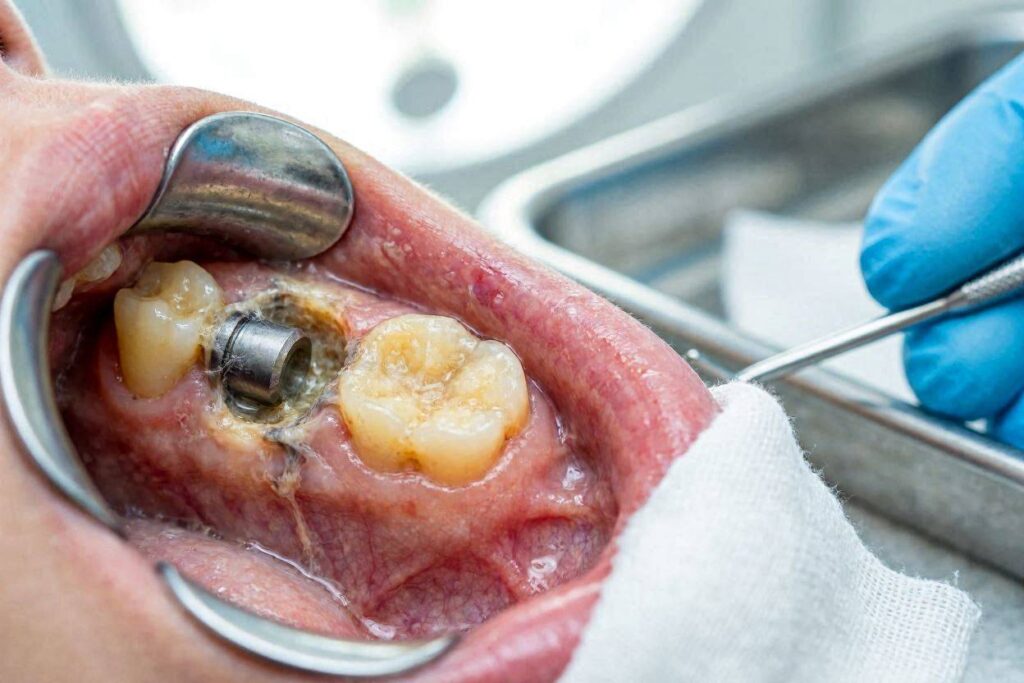
A dental implant is placed into a precisely drilled osteotomy, and it immediately fills that hole. The implant itself acts as the space occupier. There is no empty extraction socket left open. Therefore, a classic dry socket where an entire clot dislodges from an open cavity cannot technically occur. The implant fixture and the sutured gum tissue protect the underlying bone. However, a condition with an almost identical pain profile can occur. This is a localized osteitis or an infected, necrotic clot around the implant’s healing abutment or under the sutures. The pain arises from inflammation and exposure of the bone crest, a loss of the protective clot, and the beginning of a soft tissue breakdown. Patients universally call this a “dry socket,” and for good reason—the experience is nearly the same. It is a post-operative complication of the implant surgical site, characterized by a severe, radiating ache, often with a bad taste and the visual appearance of an exposed, empty-looking area around the implant.
The Exposed Bone Crest and Clot Breakdown
What the patient sees is not an empty tooth socket but a breakdown of the soft tissue around the implant cover screw or healing cap. The gum edges may retract, leaving the rough bone margin exposed. The blood clot that was protecting this bone has disintegrated. The exposed bone is exquisitely sensitive to thermal and mechanical stimuli. This is the mechanism for the “dry socket” pain. This is not a failure of the implant’s osseointegration, which is happening deeper in the bone. It is a localized, painful infection and inflammation of the superficial soft and hard tissues.
Causes of Post-Implant Dry Socket-Like Pain
The causes mirror those of a traditional dry socket, with additional factors related to the implant surgery itself.
1. Premature Dislodgement of the Protective Clot
The most common cause is mechanical disruption of the fragile clot that forms around the implant’s transmucosal collar. A patient who vigorously rinses, spits forcefully, uses a straw, or aggressively brushes the surgical site in the first 48 hours can wash away or physically tear the clot. Once the clot is lost, the bone and highly sensitive nerve endings on the bone surface are exposed.
2. Bacterial Infection and Fibrinolysis
Just as in a tooth extraction socket, oral bacteria can produce enzymes called kinases that dissolve the fibrin meshwork of the blood clot. A high bacterial load in the mouth, pre-existing periodontal disease, or poor oral hygiene around the healing site can trigger this process. The clot literally dissolves, leaving the bone uncovered. This is a localized infection.
3. Overheating of Bone During Surgery
As discussed in the article on implant drills, if the surgeon fails to use copious, cooled saline irrigation during the osteotomy preparation, the bone can be overheated. Temperatures above 47°C for more than a minute cause bone cell necrosis. This devitalized bone does not support a healthy clot. The tissue above it breaks down, exposing a layer of dead, painful bone. This is a surgeon-induced cause of a post-operative “dry socket” presentation.
4. Excessive Compression and Bone Necrosis
An implant that is forced into an osteotomy with excessive torque (above 70 Ncm) can crush the bone cells in the threads. This localized area of compressed, ischemic bone dies and can act as a sequestrum, a fragment of dead bone that the body tries to expel. The overlying gum breaks down, exposing the fragment and causing a localized, sharp pain that patients liken to a dry socket.
5. Smoking
Smoking is the single most powerful patient-related risk factor. The vasoconstriction from nicotine reduces the oxygen supply to the healing wound. The suction action of drawing on a cigarette can physically dislodge the clot. The heat and chemicals of the smoke delay healing and promote infection. A smoker’s risk of a post-operative complication mimicking a dry socket is dramatically elevated.
Recognizing the Symptoms: A Diagnostic Guide
The classic dry socket symptom profile is distinct from normal post-surgical discomfort. Normal surgical pain peaks at 24-48 hours and then declines. Pain from a dry socket-like condition begins, or sharply increases, on day 3 to 5 after surgery.
The Pain Profile
The pain is severe, deep, and throbbing. It is constant and does not respond well to over-the-counter pain relief alone. It typically radiates from the implant site along the nerve pathways to the ear, temple, eye, or lower jaw. The pain can make sleeping and concentrating difficult. It is not a vague soreness; it is a distinct, unrelenting ache that patients often grade as 7 or 8 out of 10.
Visual Signs and Bad Taste
When you look at the site with a mirror, the gum around the implant healing cap may look open or retracted. You may see a whitish or greyish area of exposed bone. There is often a distinctly bad taste in the mouth and halitosis (bad breath) that was not present before. There may be an absence of a visible, jelly-like blood clot over the area. Crucially, unlike peri-implantitis, the implant post itself is still rigid and not mobile.
Professional Treatment: What the Dentist Will Do
This condition requires active professional intervention. Home remedies alone are insufficient to manage the exposed bone pain.
Step 1: Irrigate and Debride
The dentist will gently flood the area with a warm sterile saline or chlorhexidine solution to flush out debris, food particles, and any loose, necrotic tissue. They will not scrape the bone aggressively, but will gently remove any obvious loose fragments.
Step 2: Medicated Dressing
The definitive treatment is the placement of a sedative dressing directly into the open, painful area. This dressing is a paste or a small piece of gauze saturated with a medicament. The most common is Alvogyl, which contains eugenol (clove oil, a natural analgesic and antiseptic), butamben (a local anesthetic), and iodoform (an antimicrobial). Other dressings contain zinc oxide and eugenol. The dressing is loosely packed into the defect. The patient experiences profound, near-immediate pain relief as the eugenol soothes the exposed nerve endings.
Step 3: Analgesia and Antibiotics
The dentist will prescribe a strong analgesic, often a combination of an NSAID and, for severe pain, a short course of a narcotic. If there is a spreading infection, systemic antibiotics like amoxicillin or clindamycin are prescribed. The dressing will need to be changed every 2-3 days until the pain resolves and granulation tissue begins to cover the exposed bone. This typically takes 5-10 days.
Home Care and Recovery: What the Patient Must Do
Your role is to support the professional treatment and protect the healing site.
- Avoid all negative pressure. No straws, no smoking, no spitting.
- Gentle saline soaks. Hold warm salt water over the area and let it dribble out. Do not swish.
- Diet modification. Consume only soft, bland foods. Avoid anything crunchy, spicy, or with small seeds that can lodge in the socket. Chew on the opposite side.
- Hydration. Drink plenty of water, but do not use a straw.
- Rest. Avoid strenuous physical activity that increases blood pressure and throbbing in the wound.
Important Note: Do not attempt to self-medicate a post-implant dry socket by placing over-the-counter gels or clove oil directly into the wound with your finger or a cotton swab. The concentration and sterility are uncontrolled. You can cause a chemical burn or introduce more bacteria. The medicated dressing must be placed by a professional.
Distinguishing the Condition from a Failing Implant
This is a critical clinical differentiation. A post-operative osteitis or “dry socket” is a painful, superficial complication. It does not mean the implant is failing. A failing implant during the osseointegration phase presents differently. The hallmark of a failing implant is mobility. If you can feel the implant post wiggle, it is a failure. A dry socket-like condition typically presents with a rigid implant. The pain is in the soft tissue and superficial bone, not from a mobile implant-bone interface. The dentist will use a gentle bimanual test to confirm the implant’s rigidity. A radiograph will show no continuous radiolucent halo around the entire implant body, which would indicate a fibrous encapsulation. The X-ray may show some minor crestal bone loss at the very top, but the implant body is surrounded by healthy bone.
Conclusion
A “dry socket” after dental implant placement is not the classic empty-socket alveolar osteitis, but a painful condition of clot breakdown and exposed bone crest around the healing implant, caused by clot dislodgement, bacterial infection, or surgical trauma. It presents with severe, radiating pain and a bad taste, starting a few days post-surgery, and requires professional irrigation and a sedative dressing for relief. With prompt treatment, it resolves without compromising the underlying implant’s long-term osseointegration.
FAQ
1. How long does the pain from an implant dry socket last?
Without treatment, it can last for a week or more, until the bone is covered by granulation tissue. With a medicated dressing, pain relief is almost immediate, and the dressing is changed over 5-10 days until the site is healed.
2. Can I use clove oil from the pharmacy on my implant dry socket?
No. While the eugenol in clove oil is the active ingredient in professional dressings, pure clove oil is highly concentrated and can cause chemical burns, tissue necrosis, and allergic reactions. Only a dentist should apply it in a controlled formulation.
3. Will a dry socket cause my dental implant to fail?
No, if treated promptly and correctly. This is a localized superficial tissue issue. The osseointegration deep in the bone is protected. However, if it progresses to a deep, uncontrolled infection, it could threaten the implant, which is why professional treatment is essential.
Additional Resource
For more on post-operative complications and their management, visit the American Association of Oral and Maxillofacial Surgeons: https://www.aaoms.org/