How Are Dental Implants Manufactured?
Dental implants are precision medical devices that must meet exacting standards. The manufacturing process involves advanced technology, rigorous quality control, and careful attention to detail. Understanding how implants are made helps patients appreciate the engineering behind these remarkable devices.
This guide explains the dental implant manufacturing process from raw materials to finished product. You will learn about the materials used, the machining processes, surface treatments, and quality control measures.
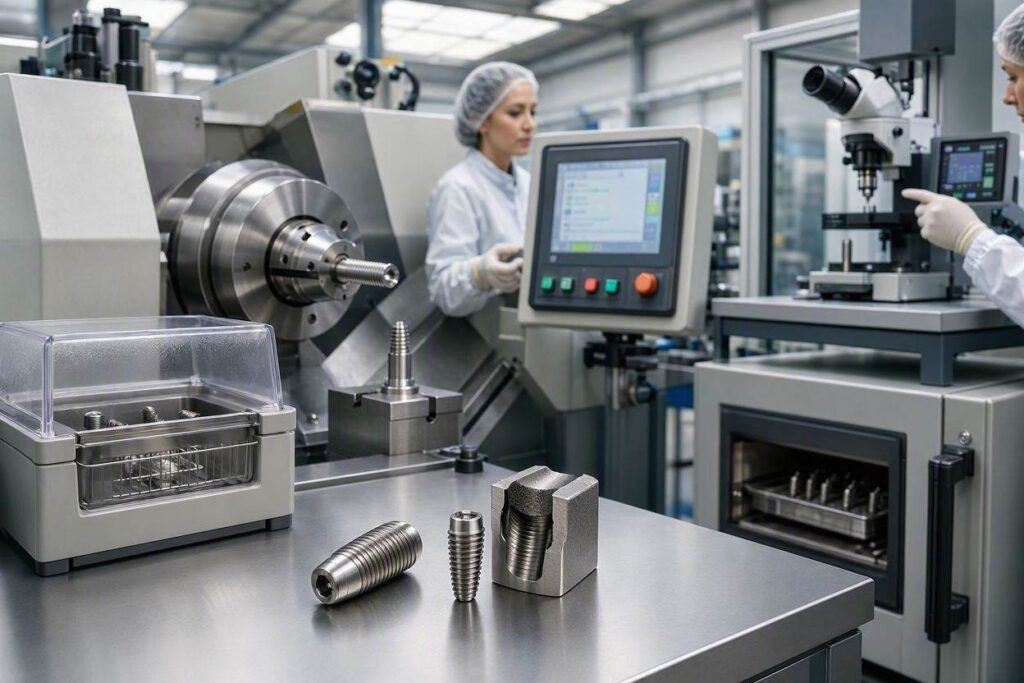
Materials Used in Dental Implant Manufacturing
The choice of material is critical for implant success. The material must be biocompatible, strong, and resistant to corrosion.
Titanium
Titanium is the most commonly used material for dental implants. It is lightweight, strong, and highly biocompatible. The human body accepts titanium without mounting an immune response. Titanium also has the unique ability to osseointegrate, or fuse with bone.
There are two grades of titanium used in implants. Commercially pure titanium is used for most implants. It is available in four grades, with Grade 4 being the strongest. Titanium alloy, specifically Ti-6Al-4V, is used when additional strength is needed. This alloy contains 6% aluminum and 4% vanadium.
Zirconia
Zirconia is a ceramic material used for metal-free implants. It is made from zirconium dioxide. Zirconia is white, which offers aesthetic advantages. It is also biocompatible and suitable for patients with metal sensitivities.
Zirconia implants are newer than titanium but have shown promising results. The manufacturing process for zirconia is different from titanium because zirconia is a ceramic rather than a metal.
The Manufacturing Process for Titanium Implants
The manufacturing of titanium implants involves several precise steps.
Raw Material Selection
The process begins with selecting high-quality titanium. The titanium must meet strict specifications for purity and mechanical properties. The raw material is typically in the form of rods or bars.
Machining
The titanium rod is machined into the implant shape. This is done using computer-controlled lathes and milling machines. The machining process creates the external threads, internal connection, and overall shape of the implant.
The precision required is remarkable. Implant dimensions are measured in micrometers, which are one-thousandth of a millimeter. Even tiny deviations can affect the fit and function of the implant.
Surface Treatment
After machining, the implant surface is treated to enhance osseointegration. The surface treatment creates a rough texture that bone cells can attach to.
Several surface treatment methods are used. Sandblasting involves blasting the surface with abrasive particles to create roughness. Acid etching uses strong acids to create a micro-textured surface. Anodization uses an electrical current to create a thickened oxide layer with a porous structure.
Modern implants often combine multiple surface treatments. For example, a sandblasted and acid-etched surface, known as SLA, is common. This surface has been shown to promote rapid and strong bone integration.
Cleaning and Sterilization
After surface treatment, the implant is thoroughly cleaned to remove any residues. The cleaning process involves ultrasonic baths, chemical cleaning, and rinsing with sterile water.
The implant is then packaged and sterilized. Sterilization is typically done using gamma radiation or ethylene oxide gas. The sterile packaging protects the implant until it is ready for use.
The Manufacturing Process for Zirconia Implants
Zirconia implants require a different manufacturing process because zirconia is a ceramic material.
Powder Preparation
Zirconia implants start as a fine powder of zirconium dioxide. The powder is mixed with binding agents to create a moldable material.
Molding
The zirconia mixture is pressed into a mold to create the rough shape of the implant. This is done under high pressure.
Sintering
The molded implant is heated to very high temperatures, typically 1,400 to 1,600 degrees Celsius. This process, called sintering, fuses the zirconia particles together, creating a dense, strong ceramic.
Machining
After sintering, the implant is machined to its final shape. Zirconia is extremely hard, so diamond tools are used for machining.
Surface Treatment
Zirconia implants also receive surface treatments to enhance osseointegration. The surface may be etched or blasted to create roughness.
Cleaning and Sterilization
Like titanium implants, zirconia implants are cleaned and sterilized before packaging.
Quality Control in Implant Manufacturing
Quality control is essential in implant manufacturing. Every implant must meet strict standards to ensure safety and effectiveness.
Dimensional Inspection
Every implant is inspected to ensure it meets dimensional specifications. This is done using precision measuring equipment, including optical comparators and coordinate measuring machines.
Surface Inspection
The implant surface is inspected to ensure the surface treatment is consistent and meets specifications. This may involve scanning electron microscopy to examine the surface at high magnification.
Mechanical Testing
Implants are tested for mechanical properties, including tensile strength, fatigue resistance, and torque resistance. These tests ensure the implant can withstand the forces of chewing.
Biocompatibility Testing
Materials used in implants are tested for biocompatibility. This includes testing for cytotoxicity, sensitization, and irritation. These tests ensure the implant will not cause adverse reactions in the body.
Sterility Testing
Packaged implants are tested to ensure they remain sterile. This is done by incubating samples and checking for microbial growth.
Regulatory Oversight
Dental implants are regulated as medical devices. In the United States, the Food and Drug Administration oversees implant manufacturing. Manufacturers must obtain FDA clearance before marketing their implants.
In Europe, implants must meet the requirements of the Medical Device Regulation. This includes demonstrating safety and effectiveness through clinical data.
Advancements in Implant Manufacturing
The field of implant manufacturing continues to evolve. New technologies are improving the quality and performance of implants.
3D Printing
Additive manufacturing, or 3D printing, is being explored for implant production. This technology can create complex geometries that are difficult to achieve with traditional machining. Some manufacturers are using 3D printing to create porous implant surfaces that enhance osseointegration.
Nanotechnology
Nanotechnology is being used to create implant surfaces at the molecular level. Nano-scale surface modifications may improve bone integration and reduce healing time.
Custom Implants
Advances in imaging and manufacturing are making custom implants possible. Using 3D scans of the patient’s jaw, manufacturers can create implants tailored to the individual patient’s anatomy.
Important Notes for Patients
- Dental implants are precision medical devices manufactured to exacting standards.
- Titanium is the most common material, with zirconia as a metal-free alternative.
- Surface treatments enhance osseointegration by creating a rough texture.
- Quality control measures ensure every implant meets strict specifications.
- Regulatory agencies oversee implant manufacturing to ensure safety.
- New technologies like 3D printing are advancing the field.
Frequently Asked Questions
What are dental implants made of?
Most dental implants are made of titanium or titanium alloy. Some are made of zirconia, a ceramic material.
Why is titanium used for dental implants?
Titanium is used because it is biocompatible, strong, and has the unique ability to fuse with bone through osseointegration.
How are dental implants machined?
Dental implants are machined using computer-controlled lathes and milling machines. The precision is measured in micrometers.
What is the surface treatment on dental implants?
Surface treatments like sandblasting and acid etching create a rough texture on the implant surface. This roughness helps bone cells attach and promotes osseointegration.
Are dental implants sterile?
Yes, dental implants are sterilized and packaged in sterile containers. They remain sterile until the package is opened at the time of surgery.
How are zirconia implants made?
Zirconia implants are made by pressing zirconia powder into a mold, sintering at high temperatures, and machining to the final shape.
What quality control measures are used in implant manufacturing?
Quality control includes dimensional inspection, surface inspection, mechanical testing, biocompatibility testing, and sterility testing.
Are custom dental implants available?
Custom implants are an emerging technology. Using 3D imaging and manufacturing, implants can be tailored to the individual patient’s anatomy.
Conclusion
Dental implants are manufactured through a precise process involving high-quality materials, computer-controlled machining, surface treatments, and rigorous quality control. Titanium is the most common material due to its biocompatibility and ability to osseointegrate. Zirconia offers a metal-free alternative. The manufacturing process ensures that every implant meets strict standards for safety and effectiveness. Advancements in technology continue to improve implant quality and performance.
Additional Resource
For more information on dental implant technology and treatment, visit the American Academy of Implant Dentistry at www.aaid.com. This professional organization offers patient education resources on implant dentistry.