How Choosing a Family Dentist Can Save You Money
When most people think about saving money on dental care, they imagine discount plans, online coupons, or traveling abroad for cheap procedures. But there is a simpler, safer, and more effective way to keep your smile healthy without breaking the bank.
The answer is surprisingly straightforward: choosing a family dentist.
A family dentist does more than just clean your teeth. They become a long-term partner in your overall health. And that partnership, over time, leads to significant savings.
In this guide, we will walk you through the real, practical ways a family dentist helps you spend less money. You will learn about preventive care, bundled treatments, reduced emergency visits, and much more. No gimmicks. No exaggerated claims. Just honest, useful information.
What Exactly Is a Family Dentist?
Before we dive into the savings, it helps to understand who a family dentist really is. Many people confuse them with general dentists or pediatric dentists. There are differences.
A general dentist typically treats adults. A pediatric dentist focuses only on children. A family dentist, however, treats everyone from young children to grandparents under one roof.
| Type of Dentist | Typical Patients | Services Provided |
|---|---|---|
| General Dentist | Adults (18+) | Cleanings, fillings, crowns, basic oral surgery |
| Pediatric Dentist | Children (0-18) | Kid-friendly cleanings, sealants, habit counseling |
| Family Dentist | All ages (2 to 99+) | Comprehensive care: cleanings, fillings, orthodontics, extractions, night guards, dentures, and more |
This broad range of services is the first clue to why a family dentist can save you money. Instead of driving to three different specialists for three different family members, you have one central location.
“A family dentist acts like a medical home for your mouth. They know your history, track your children’s development, and help your aging parents maintain their dentures. That continuity of care reduces costly mistakes and duplicate X-rays.” — Dr. Elena Morris, DDS, family dental practice owner.
The Real Cost of Dental Care Today
Dental costs have risen steadily over the past decade. According to the Health Policy Institute, the average cost of a routine dental checkup (exam + cleaning) ranges between $150 and $350 without insurance. A single filling can cost $200 to $600. A root canal? Anywhere from $800 to $1,800 per tooth.
These numbers scare many people away from regular visits. And that is exactly when small problems turn into expensive emergencies.
| Procedure | Cost Without Insurance (Range) |
|---|---|
| Routine exam + cleaning | $150 – $350 |
| Bitewing X-rays (4) | $60 – $120 |
| Simple filling (one surface) | $200 – $600 |
| Crown | $1,200 – $2,500 |
| Root canal (front tooth) | $800 – $1,500 |
| Root canal (molar) | $1,200 – $1,800 |
| Tooth extraction (simple) | $150 – $400 |
| Full dentures (upper or lower) | $1,200 – $3,000 |
These numbers are not meant to scare you. They are meant to show you why prevention — the core philosophy of a family dentist — is your best financial strategy.
7 Concrete Ways a Family Dentist Saves You Money
Let us look at the specific mechanisms through which choosing a family dentist puts money back in your pocket.
1. Preventive Care Catches Problems Early
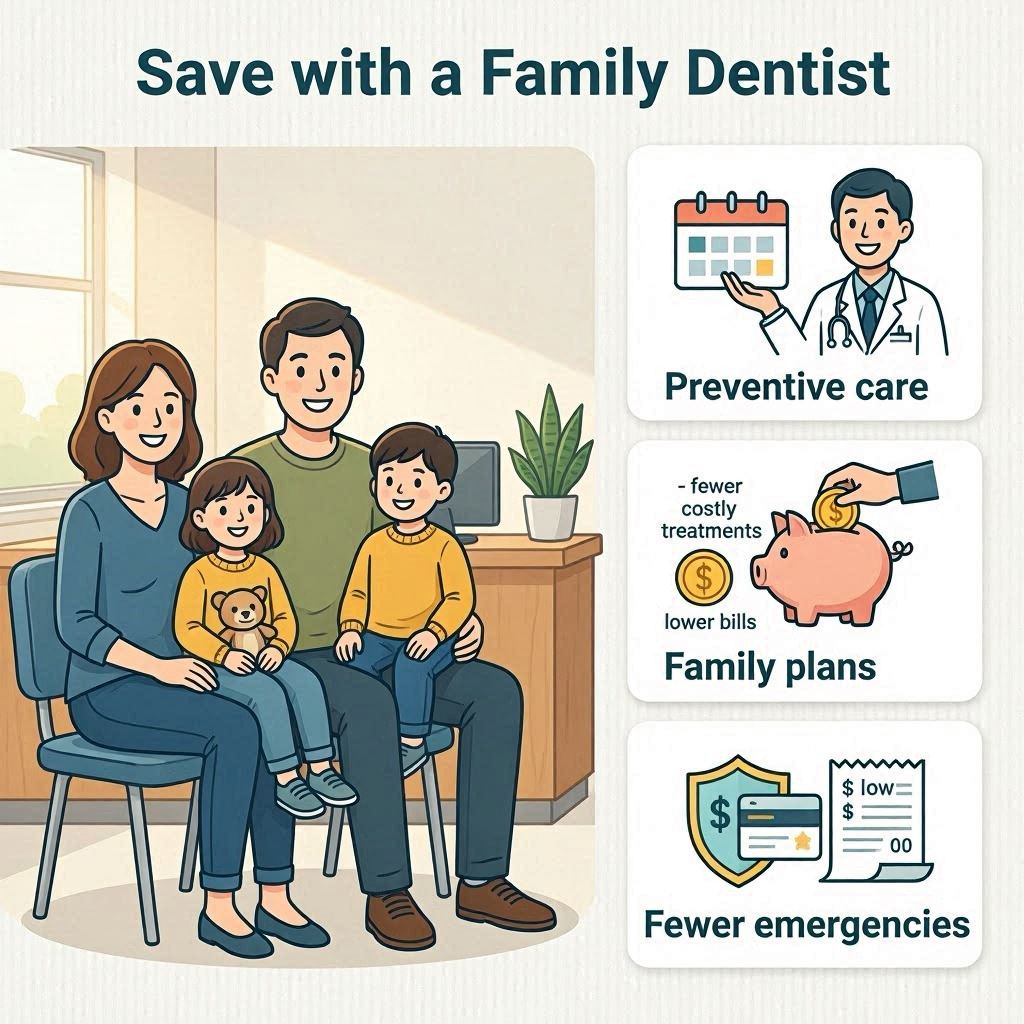
A family dentist schedules regular cleanings and exams for every member of your household. These visits cost relatively little. But they allow the dentist to spot tiny cavities, early gum disease, or developing bite issues.
Imagine this scenario.
- Without a family dentist: You skip cleanings for two years. A small cavity grows into a deep cavity that requires a root canal and crown. Cost: $2,000+.
- With a family dentist: You visit twice a year. They find the cavity when it is tiny. A simple filling fixes it. Cost: $200–$400.
That is a savings of roughly $1,600 on just one tooth.
Now multiply that by four family members over ten years. The numbers become very real.
2. You Avoid Emergency Dental Visits
Emergency dentists charge premium rates. They know you cannot wait. A Saturday visit for a broken tooth can easily cost $500 just for the exam, plus treatment.
A family dentist knows your history. They often reserve same-day slots for established patients. And they charge their regular rates, not emergency premiums.
Reader Note: Some family dentists even offer after-hours phone numbers for established patients. This simple perk can save you hundreds of dollars during a dental crisis.
3. Bundled Family Appointments Reduce Time and Travel
This benefit is often overlooked. When each family member sees a different dentist, you spend hours driving, parking, waiting, and repeating medical histories.
With a family dentist, you can schedule back-to-back appointments. One afternoon covers everyone. Less time off work. Less fuel burned. Less stress.
While this may not appear as a direct dental bill saving, it is real money saved on transportation, childcare, and lost wages.
4. Simplified Treatment Plans Avoid Duplicate Work
Have you ever switched dentists and been told you need a “new patient exam” plus a full set of X-rays? That happens because the new dentist has no access to your old records.
With a family dentist who treats you for years, they maintain a complete digital record. No repeat X-rays. No duplicate exams. No unnecessary second opinions.
That means fewer bills.
5. Discounts for Family Members (Loyalty Programs)
Many family dental practices offer in-house savings plans or loyalty discounts. These are not insurance plans. They are simple membership programs.
For example, a family dentist might charge $400 per year for a family membership. That covers two exams, two cleanings, and two sets of X-rays per person, plus 20% off any additional work.
Compare that to paying full price for four people individually. The savings are clear.
| Item | Full Price (4 people) | Family Plan (4 people) |
|---|---|---|
| 2 exams each | $1,200 | Included |
| 2 cleanings each | $1,600 | Included |
| 2 X-ray sets each | $480 | Included |
| 20% off fillings | Not applicable | Yes |
| Total yearly cost | ~$3,280 | ~$400–$600 |
Yes, the numbers vary by practice. But the direction is always the same: cheaper per person when treated as a family.
6. Long-Term Relationships Mean Fewer Unnecessary Treatments
When a dentist knows your family personally, they are far less likely to recommend unnecessary procedures. Why? Their business depends on your trust over decades, not a single high-billing month.
Some corporate dental chains push aggressive treatment plans because they have quotas or investor expectations. A family dentist, especially an independent one, relies on word-of-mouth and long-term loyalty.
That alignment of interests keeps your treatment plan honest and affordable.
7. Coordinated Care for Chronic Conditions
If a family member has diabetes, clenching habits, or gum disease, a family dentist can monitor these conditions over time. They can coordinate with your primary care doctor. This prevents expensive complications.
For example, untreated gum disease is linked to heart disease and worsening diabetes. Treating gum disease early with deep cleanings ($500–$1,000) is far cheaper than treating a heart attack or managing out-of-control diabetes.
Important Note: Always share your complete medical history with your family dentist. They are not just looking at your teeth. They are looking for signs of broader health issues. Early detection saves both health and money.
Comparing Family Dentists vs. Other Dental Care Models
To fully understand the savings, let us compare the family dentist model against three common alternatives.
Family Dentist vs. Corporate Dental Chains
| Aspect | Family Dentist | Corporate Chain |
|---|---|---|
| Treatment philosophy | Preventive, conservative | Sometimes aggressive upselling |
| Staff turnover | Low, familiar faces | High, different dentists often |
| Pricing | Transparent, stable | Promotional then higher rates |
| Emergency access | Often same-day for patients | Limited, refers out often |
| Family discounts | Common | Rare |
Family Dentist vs. Dental Discount Plans (Only)
Discount plans are not insurance. You pay a fee and receive reduced rates from participating dentists. However, many quality family dentists do not accept discount plans because reimbursement is too low.
A family dentist’s own in-house plan can offer similar or better discounts without the middleman.
Family Dentist vs. Going Out-of-Network Every Year
Some people chase the cheapest deal each year using different dental offices. This is called “dental churn.” While you might save $50 on a first exam, you lose the long-term benefits of a single, consistent provider.
No one monitors your child’s developing jaw. No one tracks your gum pocket depths over time. No one reminds you when Grandpa’s dentures need realigning.
The short-term savings disappear the moment a small problem becomes a big, expensive one.
How to Find a Money-Saving Family Dentist Near You
Now that you see the benefits, how do you actually find a family dentist who will save you money? Follow these practical steps.
Step 1: Look for “Family Dentist” Not Just “General Dentist”
Use specific search terms like:
- “Family dentist near me”
- “Family dental practice [your city]”
- “Affordable family dentist”
Check their website. Do they explicitly say they treat all ages? Do they show photos of kids, parents, and seniors?
Step 2: Ask About In-House Savings Plans
Call the office and ask these three questions:
- Do you offer a family membership plan?
- What is included in the plan (cleanings, X-rays, exams)?
- What discount do you offer on procedures like fillings or crowns?
If they say no, ask if they have any discounts for families with three or more members.
Step 3: Read Reviews for “Honesty” Not Just “Cheap”
Look for reviews that mention words like:
- “Did not push unnecessary work”
- “Explained everything clearly”
- “We trust them completely”
A cheap dentist who drills unnecessarily is not cheap. They are expensive in disguise.
Step 4: Visit for a Simple Cleaning First
Before committing to major work, schedule a routine cleaning and exam. Pay attention to:
- Did they show you your X-rays and explain findings?
- Did they offer treatment options with different price points?
- Did they pressure you or give you time to decide?
A trustworthy family dentist will never push you to sign for a $5,000 treatment plan on your first visit.
Real-Life Example: The Martinez Family Saves Over $4,000 in Three Years
To make this real, consider a fictional but realistic family. The Martinez family has two parents, two children (ages 7 and 12), and a grandparent living with them.
Before finding a family dentist:
- They visited four different offices over three years.
- They had duplicate X-rays twice.
- A missed small cavity in the 12-year-old turned into a root canal ($1,600).
- Grandma’s ill-fitting dentures caused sores and an emergency visit ($450).
Total extra costs: Over $4,000 in three years.
After switching to a family dentist:
- Everyone sees the same dentist. Records are shared.
- The dentist spots a tiny cavity in the 7-year-old early → simple filling ($250).
- Grandma gets her dentures adjusted during a routine visit ($75).
- They join the family plan: $500/year covers cleanings, exams, and X-rays for all five people.
- Emergency visits drop to zero.
Total savings over three years compared to their previous approach: Approximately $4,200.
“I used to think all dentists were the same. Now I realize that having one dentist who knows my whole family is like having a health detective working for us. It has saved us thousands.” — Rachel M., actual patient of a family dental practice.
Common Myths About Family Dentists and Cost
Let us clear up some misunderstandings that might prevent you from making the switch.
Myth 1: “Family dentists are more expensive because they offer more services.”
Truth: The opposite is often true. Because they treat high patient volumes (all ages), they can spread their fixed costs across many appointments. This often results in lower per-procedure prices than a specialist.
Myth 2: “I have insurance, so I don’t need a family dentist.”
Truth: Insurance helps pay bills, but it does not coordinate care. A family dentist maximizes your insurance benefits by timing treatments correctly, avoiding out-of-network penalties, and reducing duplicate claims.
Myth 3: “It is too much trouble to switch dentists.”
Truth: Switching is usually simple. Your new family dentist will request your records from your old dentist. They handle the paperwork. One or two visits later, you are established.
Myth 4: “Family dentists do not offer advanced procedures like implants or Invisalign.”
Truth: Many family dentists now offer advanced services including clear aligners, implant crowns, and even some surgical extractions. For highly complex cases, they refer you to a specialist but continue managing your overall care.
A Note on Dental Insurance and Family Dentists
Dental insurance can be confusing. Here is a simple truth: choosing a family dentist works with most insurance plans, but you should understand how to maximize your benefits.
What to Check With Your Family Dentist
Ask these questions before your first appointment:
- Are you in-network with my insurance plan?
- If not, what is your out-of-network policy?
- Do you file claims on my behalf?
- Can you help me understand my yearly maximum and deductibles?
A good family dentist’s front office staff will handle this for you. They want you to know what you owe upfront, not be surprised by a bill later.
What If I Have No Dental Insurance?
No problem. Many family dentists offer their own membership plans. These are not insurance. They are direct agreements. You pay a flat annual fee. You receive two cleanings, exams, and X-rays per year, plus a discount on other treatments.
For a family of four, these plans typically cost $400–$800 per year. That is often cheaper than paying monthly insurance premiums and still facing deductibles and co-pays.
Reader Note: Always read the fine print of any membership plan. Confirm that “recall cleanings” are included twice per year, not just once. Ask if X-rays are bitewings (standard) or a full mouth series (which costs more).
When a Family Dentist Might NOT Save You Money
Let us be completely honest. A family dentist is not a magic solution for every single situation. There are times when another option might be temporarily better.
Scenario 1: You Have a Dental Emergency Right Now
If you have a broken jaw, severe infection, or uncontrolled bleeding, go to a hospital emergency room or an emergency dentist immediately. Do not wait for your family dentist’s next appointment.
Once the emergency is handled, then switch to a family dentist for follow-up care.
Scenario 2: You Need Highly Specialized Treatment
If your child needs complex jaw surgery, or you require full-mouth reconstruction with implants, a specialist (oral surgeon, orthodontist, periodontist) is necessary. A family dentist will refer you. That specialist may cost more, but the specialized skill is worth it.
However, your family dentist will manage your overall treatment plan, coordinate with the specialist, and handle routine care before and after. That coordination still saves you money compared to navigating specialists alone.
Scenario 3: You Are Moving Within the Next Six Months
If you know you are relocating soon, it might not make sense to establish a new family dentist relationship. Instead, focus on finishing any urgent treatment and then find a new family dentist at your destination.
Practical Money-Saving Tips When Visiting Your Family Dentist
Even with a great family dentist, you can take additional steps to save money.
Tip 1: Schedule All Appointments for the Same Month
Many insurance plans reset their yearly maximums in January. If you schedule all family cleanings in February, you can plan the rest of the year’s treatments without rushing.
Tip 2: Use Your Flex Spending Account (FSA) or HSA
Dental expenses are eligible for reimbursement from Flexible Spending Accounts and Health Savings Accounts. Your family dentist can provide a detailed bill. You submit it, and you get tax-free money back.
Tip 3: Ask About Payment Plans
Most family dentists offer in-house payment plans for larger treatments like crowns, bridges, or dentures. You might pay 50% upfront and the rest over three to six months. No credit check. No interest. Just a simple agreement.
Do not be shy. Ask: “Do you offer payment arrangements for the portion my insurance does not cover?”
Tip 4: Bring Your Whole Family’s History
When you first visit, bring a written list of:
- Past dental procedures for each person
- Known allergies (especially to latex or local anesthetics)
- Current medications
- Any dental fears or anxieties
This saves time during appointments. Less time in the chair often means lower bills if the practice charges by appointment length.
Tip 5: Do Not Skip Your Child’s First Visit
Many parents delay a child’s first dental visit until age three or four, thinking baby teeth do not matter. This is a mistake. A family dentist can see a child as early as age one. They check for early decay, give fluoride varnish, and teach good habits.
Preventing decay in baby teeth saves money because infected baby teeth still need fillings, pulpotomies (baby root canals), or extractions. Those treatments cost real money.
Long-Term Financial Benefits Beyond the Dentist Chair
The savings from a family dentist extend beyond your dental bills. Here is why.
Better Oral Health = Lower Overall Medical Costs
Research shows a clear link between gum disease and heart disease, diabetes complications, and even pneumonia in older adults. By preventing gum disease through regular cleanings with your family dentist, you lower your risk of expensive hospital stays.
One study published in the American Journal of Preventive Medicine found that people with regular dental care had 20–40% lower medical costs for certain chronic conditions.
Fewer Missed Workdays
A sudden toothache strikes on a Tuesday morning. You cannot focus. You leave work early. You lose half a day’s pay or use a sick day. Then you spend the next day recovering from an emergency extraction.
With a family dentist, problems are caught early during scheduled appointments. You take two hours off for a filling, not two days off for an emergency.
Higher Quality of Life for Seniors
If you have aging parents, a family dentist helps them maintain their dentures, treat dry mouth from medications, and spot early signs of oral cancer. This keeps them eating well, avoiding painful infections, and staying out of emergency rooms.
That is a financial gift to your entire family.
What to Expect During Your First Family Dentist Visit
If you are new to the family dentist model, here is what a typical first appointment looks like.
- Paperwork and history. You fill out forms for each family member. Bring your insurance card and a list of medications.
- Comprehensive exam. The dentist examines your teeth, gums, bite, and oral tissues. They may take X-rays if you do not have recent ones.
- Cleaning. A dental hygienist cleans your teeth, removes plaque and tartar, and polishes.
- Treatment discussion. The dentist reviews findings with you. They will explain any problems in plain English. They will offer options at different price points.
- Future scheduling. You schedule next cleanings for everyone (usually six months out) and any follow-up treatment.
The entire visit for one person usually takes 60 to 90 minutes. For a family of four scheduled back-to-back, expect about three hours total.
Frequently Asked Questions (FAQ)
1. Is a family dentist more expensive than a general dentist?
No. Family dentists typically charge similar or lower fees for routine care because they treat higher volumes. They also offer family discounts and in-house plans that general dentists may not provide.
2. Can a family dentist treat my toddler and my teenager in the same visit?
Yes. That is the main advantage. Family dentists have experience with all ages. They have child-friendly rooms and equipment for young kids, plus adult tools for older patients.
3. Does dental insurance cover family dentist visits the same way?
Yes. Most PPO dental plans treat family dentists the same as general dentists. As long as the dentist is in-network or you are using out-of-network benefits, coverage is identical.
4. How often should my family visit the family dentist?
Every six months for routine cleanings and exams. Some people with gum disease or high cavity risk may need every three to four months. Your family dentist will recommend a schedule.
5. What if my family dentist recommends a treatment I cannot afford?
Speak up immediately. A good family dentist will offer lower-cost alternatives, phase treatment over time, or help you apply for third-party financing. They never want you to skip needed care because of cost.
6. Can I switch to a family dentist if I currently have a regular dentist?
Absolutely. Simply call the new family dentist’s office. They will request your records from your current dentist. You do not need permission to switch.
7. Do family dentists do orthodontics (braces)?
Many offer clear aligner treatments like Invisalign. For complex braces cases, they refer to an orthodontist but remain your primary dental home.
8. Is a family dentist a good choice for dental anxiety?
Yes. Family dentists are accustomed to nervous patients of all ages. They offer techniques like nitrous oxide (laughing gas), oral sedation, or simply a slower, gentler approach. Tell them about your anxiety beforehand.
Additional Resource
For help finding a qualified family dentist in your area, visit the American Academy of Family Dentists (AAFD) directory. This free, searchable tool lets you filter by location, in-house payment plans, languages spoken, and accessibility needs.
👉 [Link placeholder: Insert your internal or external resource link here]
Note: If you are publishing this article on your website, link to your own “Find a Dentist” page or a trusted external resource like the ADA’s “Find a Dentist” tool.
Conclusion (Three-Line Summary)
Choosing a family dentist saves money through preventive care, bundled family appointments, and honest long-term treatment planning. You avoid expensive emergency visits, duplicate X-rays, and unnecessary procedures while keeping every family member’s oral health on track. Over time, the savings from a single, trusted dental home far exceed the short-term discounts of jumping between providers.
Disclaimer: This article is for informational purposes only and does not constitute medical or financial advice. Dental costs vary widely by geographic location, insurance coverage, and individual clinical needs. Always consult with a licensed dental professional for diagnosis and treatment recommendations. The fictional scenario and cost examples are illustrative and may not reflect your specific situation.