How Do Dental Implants Maintain Their Position?
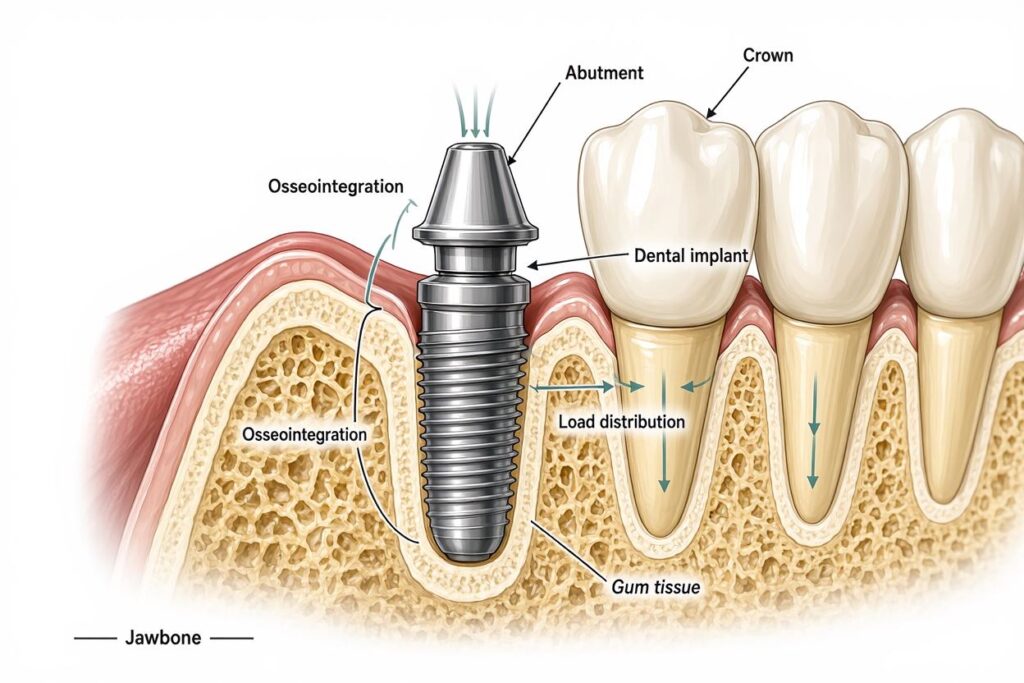
One of the most fascinating aspects of dental implants is their stability. Unlike dentures that slip and slide, implants stay put. But how? There is no glue holding them in. The secret lies in a biological process called osseointegration and the physical shape of the implant itself.
This article explains the science behind how implants stay anchored in your jaw for decades.
The Miracle of Osseointegration
The term “osseointegration” comes from the Greek words osteon (bone) and the Latin integrare (to integrate).
The Discovery
In the 1950s, a Swedish researcher named Per-Ingvar Brånemark discovered that titanium could not be removed from bone after it had healed. The bone had literally grown into the microscopic pores of the metal. This was the birth of modern implantology.
The Process
- Surgical Trauma: When the dentist drills into the bone, the body treats it like a broken bone.
- Blood Clot: Blood fills the space around the implant threads.
- Cellular Response: Bone-forming cells (osteoblasts) migrate to the area.
- Bone Deposition: The osteoblasts lay down new bone matrix directly onto the titanium surface. They grow into the tiny crevices and undercuts of the implant surface.
- Maturity: After 3-6 months, the bone is solidly interlocked with the implant. It is a mechanical and biological bond.
Important: The implant is not “glued” to the bone. It is mechanically locked in by bone growth.
The Role of Implant Threads (Macro Design)
The visible shape of the implant matters.
Screw Threads
Implants look like wood screws. The threads serve three purposes:
- Primary Stability: When the surgeon twists the implant in, the threads cut into the bone. This immediate grip is called “primary stability.”
- Surface Area: The threads increase the surface area of the implant. More surface area means more bone contact, which distributes the load better.
- Force Distribution: The threads redirect chewing forces from a vertical push to a lateral push against the bone walls. Bone responds well to compression and poorly to tension.
The Micro Surface (Micro Design)
Modern implants are not smooth. They are treated to create a rough surface at the microscopic level.
- Sandblasting: The surface is blasted with grit to create pits.
- Acid Etching: Chemicals create a honeycomb texture.
- Anodization: An electrical process creates a thick oxide layer.
Why it matters: Bone cells attach much better to rough surfaces than smooth ones. A smooth implant has a higher failure rate. The rough surface allows the bone to “grip” the implant like velcro.
The Bone Remodeling Cycle
Bone is not static. It is living tissue that constantly breaks down and rebuilds. This is how the implant maintains its position over decades.
Wolff’s Law
Bone adapts to the load placed upon it.
- When you chew: The force travels down the implant and compresses the bone.
- The Response: The bone recognizes the mechanical load and reinforces itself. It becomes denser around the implant.
- If you stop chewing (or the implant fails): The bone resorbs (shrinks away).
The implant maintains its position by actively stimulating the bone to stay dense and strong.
Soft Tissue Seal
The bone holds the screw, but the gum also plays a role.
- The “Biological Width”: The gum tissue attaches to the abutment (or the implant collar) with a sticky substance called hemidesmosomes.
- The Barrier: This creates a seal that prevents bacteria from reaching the bone.
- Maintenance: If you don’t floss, plaque builds up. The seal breaks down, bacteria reach the bone, and the bone erodes. The implant loses its position.
Table: The Stability Formula
| Layer | Function | Risk Factor |
|---|---|---|
| Titanium Surface | Attracts bone cells | Poor manufacturing |
| Screw Threads | Mechanical lock | Poor bone density |
| Living Bone | Osseointegration | Infection (Peri-implantitis) |
| Gum Seal | Bacterial barrier | Poor hygiene |
Conclusion
Dental implants maintain their position through a combination of mechanical locking and biological integration. The bone literally grows into the surface of the titanium, creating a bond that is stronger than a natural tooth ligament. This bond is maintained through the constant stimulation of chewing and requires good oral hygiene to protect the surrounding tissue.
Additional Resource
For more on the science of osseointegration, visit the Academy of Osseointegration at www.osseo.org.