How Safe Are One Day Dental Implants?
The promise of “Teeth in a Day” is alluring. You walk into a dental office with a missing or failing tooth, and you walk out hours later with a fixed, non-removable tooth. It sounds like a miracle. But how safe is it? Is rushing the process dangerous?
The answer is nuanced. One day dental implants are safe when performed on the right patient, using the right technique, by the right surgeon. They are not safe for everyone. This article will demystify the process, look at the risks, and help you decide if “same-day” is right for you.
What Does “One Day” Actually Mean?
It is important to understand that “Teeth in a Day” usually does not mean you get your permanent crown on day one.
The Process
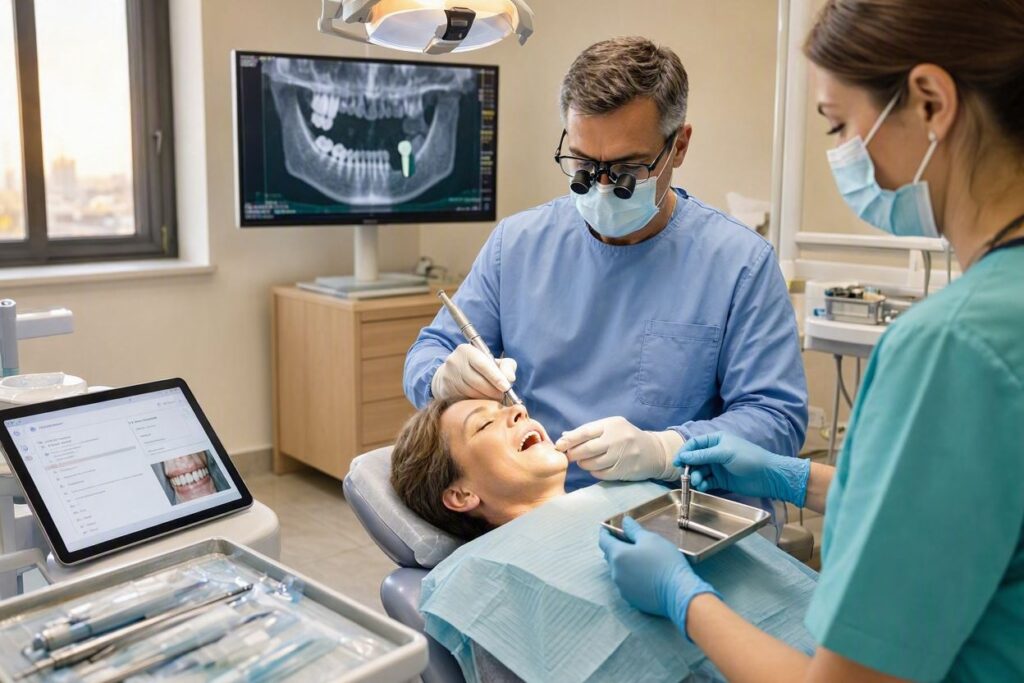
- Surgery: The dentist removes any failing teeth, places the dental implants, and attaches a temporary (often acrylic) bridge or crown to the implants.
- Healing: The implants heal underneath this temporary restoration. The temporary is splinted (connected) to keep the implants stable.
- Final Restoration: After 3-6 months, the temporary is removed, and the final, high-quality porcelain or zirconia teeth are attached.
So, you do get teeth immediately, but they are “temporary” teeth.
The Concept: Immediate Loading
Traditionally, dentists bury the implant under the gum and wait 3-6 months before putting any pressure on it. This is called “delayed loading.”
“Immediate loading” connects a tooth to the implant on the same day as surgery. Is this safe?
When It Works
- Primary Stability: This is the key. The implant must be “locked” into the bone very tightly at the time of surgery. If there is any wobble (micromotion), the bone will not fuse, and the implant will fail. In soft bone, immediate loading is risky.
- The Torque Test: Surgeons measure the insertion torque. A high torque (e.g., 35 Ncm or higher) indicates the bone is gripping the screw tightly. If the torque is low, the surgeon should bury the implant and wait (delayed loading) instead of putting a tooth on it.
The Safety Record
Multiple studies have shown that immediate loading has success rates comparable to traditional implants when strict protocols are followed.
- Traditional Implants: 95-97% success.
- Immediate Loading (Same Day): 93-95% success.
The difference is small, but the risk is slightly higher.
The Risks of One Day Implants
1. Overloading
If you bite down hard on the temporary tooth, you can overload the bone. This is why dentists usually instruct patients on a very soft diet for the first 6-8 weeks.
2. Infection
Any surgery carries a risk of infection. Because the temporary tooth is connected immediately, food can get trapped around the healing site. Strict hygiene is vital.
3. Bone Loss
If the implant is loaded too early and moves, the bone around it will die. This leads to rapid failure.
4. Fracture of the Temporary
Temporary teeth are made of acrylic (plastic). They are not as strong as porcelain. If you eat a steak or a hard nut, you can crack the temporary.
Who Is a Candidate for One Day Implants?
Not everyone qualifies.
| Criteria | Good Candidate | Poor Candidate |
|---|---|---|
| Bone Density | Hard, thick bone | Soft, thin bone |
| Smoking | Non-smoker | Smoker |
| Health | Healthy, controlled diabetes | Uncontrolled diabetes |
| Bite Force | Normal bite | Heavy grinder |
| Number of teeth | Full arch (splinted) | Single tooth in high-stress area |
The Advantages of One Day Implants
Despite the risks, there are reasons it is popular.
- No Denture Period: You never have to walk around without teeth.
- Faster Results: The total treatment time is the same, but you enjoy a smile during the wait.
- Gum Shaping: The temporary crown helps shape the gum tissue during healing, which can lead to a more natural final result.
- Psychological Boost: Waking up with teeth is a massive confidence boost.
The Cost Factor
“Teeth in a Day” is often more expensive because it requires more skill, special components (temporary abutments), and more planning (3D printed surgical guides).
Conclusion
One-day dental implants are a safe and effective option for many patients, boasting success rates nearly as high as traditional methods. The key to safety is patient selection. If you have good bone density and follow the soft diet rules, the risks are manageable. If you have risk factors, a traditional approach is the safer bet.
Additional Resource
For research on immediate loading, visit the National Center for Biotechnology Information at www.ncbi.nlm.nih.gov.