How Do Dentures Supported By Implants Operate?
For decades, traditional dentures have been the standard solution for people who have lost all or most of their teeth. They restore the appearance of a smile and allow for some level of chewing. But anyone who has worn them knows the harsh reality: they can be uncomfortable, unstable, and a source of constant anxiety. The fear of them slipping at the wrong moment, the need for messy adhesives, and the inability to enjoy many foods are common and significant complaints.
Fortunately, modern dentistry offers a superior alternative: implant-supported dentures. This treatment combines the affordability and full-arch restoration of a denture with the rock-solid stability of dental implants. The result is a quality of life that is dramatically improved.
This guide will explain exactly how implant-supported dentures operate, the different types available, what the procedure involves, and why this option has become the gold standard for full-arch tooth replacement.
The Problem with Traditional Dentures
To fully appreciate the genius of implant-supported dentures, it is helpful to understand why conventional ones have so many shortcomings.
A traditional denture is a removable acrylic plate that holds a full set of artificial teeth. It rests on top of your gums. For the upper jaw, a piece of the denture often covers the palate (the roof of your mouth) to create suction, which helps hold it in place. For the lower jaw, the denture simply rests on the ridge of gum and bone, held in place mostly by gravity and the muscles of your cheeks and tongue.
This design has fundamental flaws. As it relies on gum tissue for support, it can be unstable. It can rock, shift, and slip during speaking or chewing. Because there is no stimulation from tooth roots, the underlying jawbone begins to resorb (shrink away) over time. This leads to a continuous cycle where the denture becomes progressively looser, requiring adjustments, relines, or replacement. The denture itself can also accelerate bone loss by putting pressure on the gums.
The Concept: Using Implants as an Anchor
Implant-supported dentures solve these problems by addressing the root cause: the lack of anchorage in the bone.
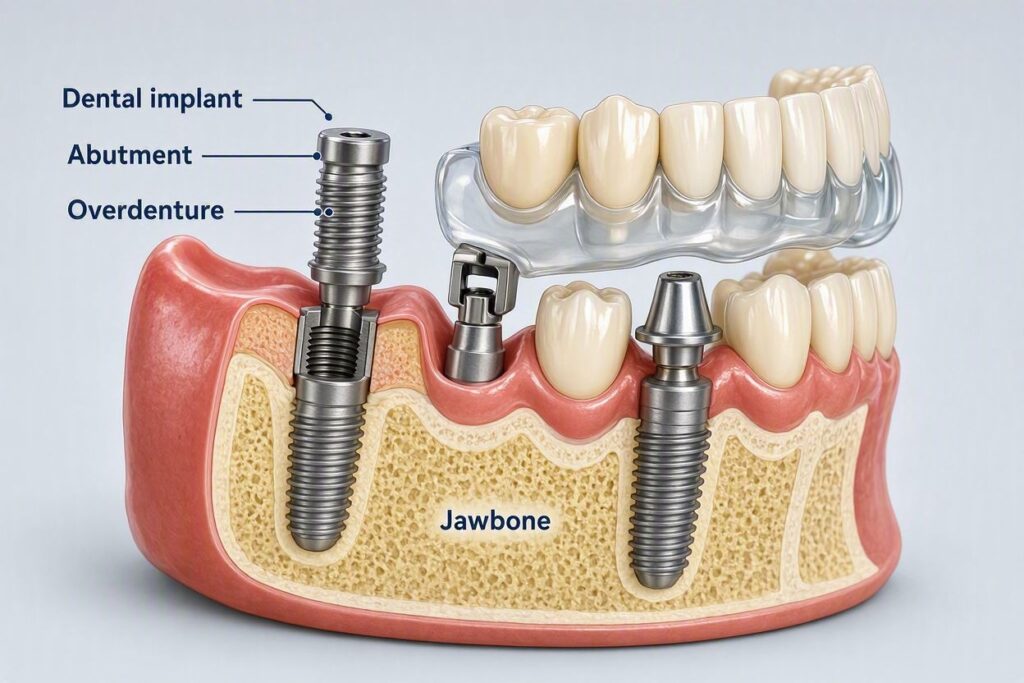
The core principle is simple. Dental implants, which are titanium screws, are surgically placed into the jawbone. Over a period of months, they fuse with the bone in a process called osseointegration. These implants then serve as a new, permanent “root system.”
The denture is then designed with special attachments on its underside that allow it to clip, snap, or screw securely onto these implants. Instead of resting on your gums, the denture is now supported and retained by the implants in the bone. This provides a level of stability that is simply not possible with a conventional denture.
The Two Main Types of Implant-Supported Dentures
Not all implant dentures are the same. They are generally classified into two categories based on whether they are removable or fixed in the mouth.
1. Removable Implant Dentures (Snap-On / Overdentures)
This is the most common and often the most affordable option. The denture is still a removable appliance that you take out at night for cleaning. However, instead of floating on your gums, it is held firmly in place during the day by snapping onto a set of implants.
- How It Works: Typically, two to four implants are placed in the jaw. A special attachment is screwed into each implant. This attachment can be a ball-shaped “male” piece or a socket-like “female” piece. The underside of the denture holds the corresponding piece. When you press the denture down, it clicks securely into place.
- The Feel: A snap-on denture is incredibly stable for chewing and speaking. It will not shift or slide. However, it may still have a very slight “rocking” on the gum tissue at the back of the mouth, as it is still tissue-supported in that area.
- The Benefits: More affordable than a fixed option. Easier to clean because it is removable. Provides excellent stability compared to a traditional denture. Requires fewer implants.
- The Drawbacks: Still needs to be removed and cleaned daily. Over time, the small plastic clips or rings in the denture that attach to the implants will wear out and need to be replaced periodically.
2. Fixed Implant Dentures (Permanent / Hybrid)
This is the closest thing to having a brand-new set of natural, permanent teeth. The denture, which is often called a “hybrid” or “fixed-detachable” prosthesis, is permanently screwed into place. It can only be removed by a dentist.
- How It Works: This option requires more implants, typically four to six per arch. The denture is a custom-fabricated framework of titanium or zirconia with acrylic gums and ceramic or composite teeth. It is secured to the implants with tiny screws.
- The Feel: This feels the most natural. All chewing forces are directed entirely into the implants and bone, not the gums. There is no movement, no rocking, and no need for removal. It is the most secure and comfortable option available.
- The Benefits: The ultimate in stability and chewing power. You can eat almost anything you want. No need for daily removal. The palate is often left open, which improves the taste of food. Can help preserve bone and facial structure.
- The Drawbacks: Significantly more expensive. Requires more surgery and a greater number of implants. Cleaning under the prosthesis requires special floss and water picks, as it cannot be removed at home.
Here is a table comparing the two systems:
| Feature | Removable (Snap-On) Denture | Fixed (Permanent) Denture |
|---|---|---|
| Number of Implants | Usually 2-4 per arch | Usually 4-6 per arch |
| Retention | Snaps onto implants. Removable by the patient. | Screwed onto implants. Removable only by the dentist. |
| Stability | Very good. No slipping, but may have slight movement. | Excellent. Feels like natural teeth. No movement at all. |
| Chewing Power | Greatly improved over traditional dentures. | The best possible. Can handle almost all foods. |
| Cleaning | Removed and cleaned outside the mouth easily. | Must be cleaned in the mouth with special tools. |
| Cost | More affordable. | More expensive due to more implants and lab work. |
| Maintenance | Needs new retention clips every few years. | Needs professional cleaning and occasional removal for inspection. |
The Treatment Process: From Surgery to a New Smile
The journey to an implant-supported denture is a process that requires patience. The timeline can vary, but here is a general overview of what you can expect.
Step 1: Consultation and Planning
This is the foundation of success. Your dentist or a specialist (like a prosthodontist or oral surgeon) will conduct a thorough examination. This includes taking 3D scans (CBCT) of your jaw to assess bone volume and quality. They will discuss your goals, your medical history, and help you decide which type of denture is best for you.
Step 2: Implant Placement Surgery
This is the surgical phase. Under local anesthesia (and often with sedation), the dentist makes incisions in the gums and precisely places the predetermined number of implants into the jawbone. If you are having teeth extracted, this may be done at the same time.
After the implants are placed, the gums are stitched closed, leaving the tops of the implants either exposed or buried under the gum. You will then enter a healing period.
Step 3: The Healing Period (Osseointegration)
This is the most important phase, and it takes time. Over the next 3 to 6 months, the bone will grow and fuse to the surface of the titanium implants. This is what creates the rock-solid foundation.
During this time, you will not be without teeth. Your dentist will provide you with a temporary denture to wear, which is often modified to be very soft and gentle on the healing surgical sites.
Step 4: Uncovering the Implants and Final Impressions
Once the implants have fully integrated, a second, minor procedure may be needed to expose the tops of the implants and attach small healing caps. Once the gums have healed around these caps, your dentist will take precise impressions of your mouth and the implant positions.
Step 5: Creating Your Final Denture
A dental laboratory uses your impressions to custom-fabricate your new denture. The framework is milled to perfectly fit your implants, and the teeth are set in a way that is both aesthetic and functional. This process can take several weeks.
Step 6: Delivery and Adjustment
The big day arrives. For a snap-on denture, you will be shown how to insert, remove, and clean it. For a fixed denture, it will be screwed into place, and the dentist will verify the bite and comfort. You may need a few follow-up visits for minor adjustments as you get used to your new smile.
The Life-Changing Benefits
The operational benefits of implant-supported dentures translate directly into a better life.
- Confidence: The fear of your teeth slipping or falling out is gone. You can speak, laugh, and smile with total confidence.
- Comfort: No more sore gums from a rubbing, unstable denture.
- Improved Nutrition: You can eat a much wider and healthier variety of foods, including crunchy fruits, vegetables, and lean proteins.
- Better Taste: A removable lower denture, and especially a fixed upper denture, does not need to cover the palate. This leaves the roof of your mouth free to sense the temperature and taste of your food.
- Bone Preservation: The implants stimulate the jawbone, which slows or stops the bone loss that occurs with traditional dentures. This helps maintain your facial structure and prevents a “sunken-in” appearance.
- Better Speech: The stability provided by the implants allows you to speak clearly without the slurring or clicking that can occur with loose dentures.
Important Note: Implant-supported dentures are a significant investment, but they are often viewed as a life-changing one. The success rate for the implants themselves is very high, often over 95 percent. The key to their long-term success is maintaining excellent oral hygiene and attending regular follow-up appointments with your dentist.
Conclusion
Implant-supported dentures operate by using the jawbone as their foundation, just like natural teeth do. Dental implants serve as artificial roots that anchor a full-arch prosthesis, providing a level of stability, comfort, and confidence that traditional dentures cannot achieve. Whether you choose a removable snap-on overdenture or a permanent fixed bridge, the result is a dramatic improvement in your quality of life, allowing you to eat, speak, and smile without worry.
By understanding how these systems work, you can have an informed conversation with your dentist about which option is the right one for your needs and budget.
Frequently Asked Questions
How many implants do I need for a snap-on denture?
For a removable snap-on denture, a minimum of two implants is often used in the lower jaw, but four provide much better stability. For the upper jaw, four implants are the standard recommendation because the bone is generally softer.
Can I sleep with my snap-on denture in?
It is not recommended. You should remove your snap-on denture at night to clean it and allow your gum tissues to rest. You can sleep with it occasionally if you choose, but nightly removal is best for oral health.
Is the surgery for implant-supported dentures painful?
The surgery itself is performed under anesthesia, so you will not feel pain during the procedure. Afterward, the recovery is typically associated with some soreness and swelling, which can be managed with medication. Most patients find the recovery is well worth the long-term benefit.
How long do implant-supported dentures last?
The implants themselves can last a lifetime with proper care. The denture (the part with the teeth) will experience wear and tear. A removable snap-on denture may need to be replaced or relined every 5 to 10 years. A fixed hybrid denture can last 10 to 15 years or longer before it may need to be remade.
Additional Resource
For a detailed explanation of different types of dental implants from a trusted source, you can visit the Cleveland Clinic’s health library: https://my.clevelandclinic.org/health/treatments/10903-dental-implants