Does BCBS Pay For Dental Implants?
The journey to restoring your smile with dental implants often begins with a single, practical question: How much will this cost, and will my insurance help? For millions of Americans, that means looking at their Blue Cross Blue Shield (BCBS) plan. It is a question filled with hope and, often, confusion.
BCBS is not a single company but a federation of 33 independent, locally operated companies. This means there is no single, universal answer to whether they will pay for your dental implants. The coverage you have depends entirely on the specific plan purchased by you or your employer, and the state in which you live.
This guide will help you navigate the complexities of BCBS dental insurance. We will explain how it works, what it might cover, what it likely won’t, and how you can find out your exact benefits before you commit to treatment.
Understanding Your BCBS Dental Plan
The first and most important step is to understand the type of plan you have. Your medical BCBS card is different from your dental BCBS card. Dental coverage is often a separate policy. Within dental plans, there are different structures that dictate how much freedom you have in choosing a dentist and how your claims are paid.
Common Types of BCBS Dental Plans
- Dental PPO (Preferred Provider Organization): This is the most common type of plan. It offers you the most flexibility. You can see any dentist, but you will save the most money by choosing a dentist who is “in-network” with the BCBS network. These dentists have agreed to accept negotiated rates for their services.
- Dental HMO (Health Maintenance Organization) / DHMO: These plans typically have lower premiums but require you to select a primary care dentist from a specific network. This dentist manages all your care and must provide referrals for specialists. Coverage for services outside the network is usually not provided except in emergencies.
- Dental Indemnity Plans: These are less common today. They allow you to see any dentist, and the insurance company pays a set percentage of the “usual and customary” fee for a procedure. You are responsible for the difference between the dentist’s fee and what the plan pays.
The type of plan you have will greatly influence your experience with getting an implant. A PPO is often the most straightforward route for a complex procedure like an implant, as it gives you access to specialists.
Does BCBS Cover Dental Implants? The Nuanced Answer
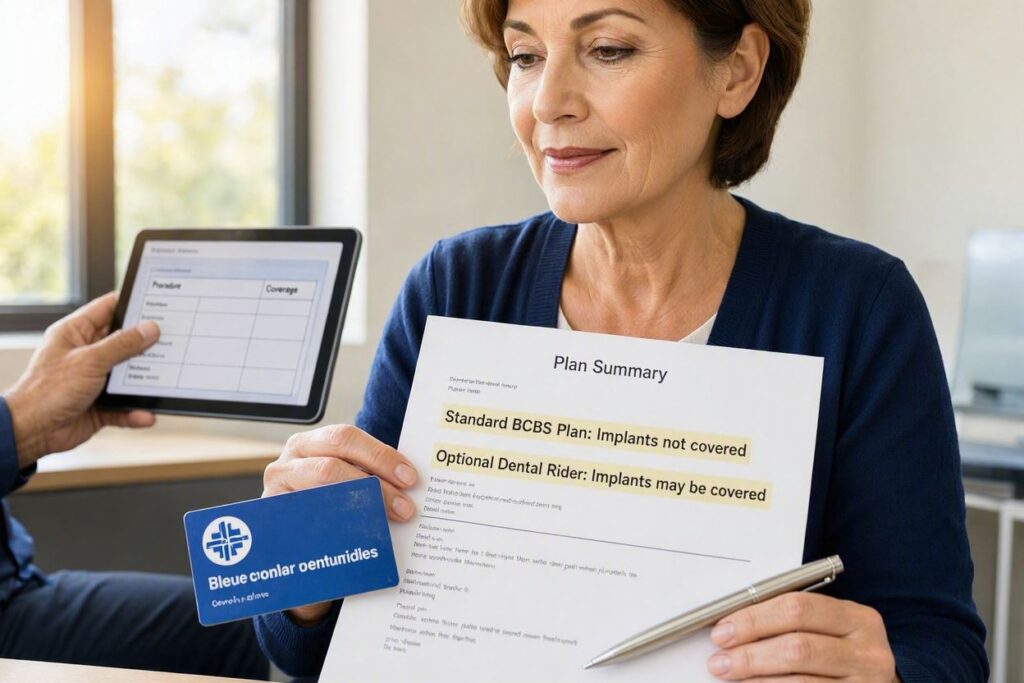
The direct answer is: it depends. Historically, dental insurance plans, including those from BCBS, have classified dental implants as a cosmetic or elective procedure and excluded them from coverage. However, this has been slowly changing.
Today, a growing number of BCBS dental plans offer some level of coverage for implants. This is because the dental and medical communities now recognize implants as the standard of care for tooth replacement, offering significant long-term health benefits over alternatives like dentures and bridges.
When BCBS Might Cover an Implant
- Plans with Implant Coverage: Many newer or more comprehensive PPO plans now include a specific benefit for dental implants. This is often listed as a “Class 4” or “Major” service, similar to a bridge or crown.
- Medical Necessity: Some plans may cover implants if it can be proven they are medically necessary, not just for cosmetic improvement. This could be the case if you cannot function with a traditional denture or if a bridge would damage healthy adjacent teeth.
- Riders or Add-ons: Some employers choose to add an “implant rider” to their dental plan, which adds coverage for implants for an additional premium.
When BCBS Likely Won’t Cover an Implant
- Plan Exclusion: The plan specifically lists “dental implants” or “implant services” as an exclusion.
- Waiting Periods: Your plan may have a waiting period of 6 to 12 months for major services. If you need an implant before this period has passed, it will not be covered.
- Cosmetic Classification: The plan deems the implant to be purely cosmetic, even if you feel it is necessary for your quality of life.
- Alternative Benefit Clause: This is a common practice. The plan may only pay for the least expensive alternative treatment (LEAT). For a missing tooth, this is often a partial denture or a bridge. The plan will pay the amount it would cover for that cheaper option, and you pay the remaining balance for the implant.
It is also important to remember that your medical BCBS plan could potentially cover a portion of the implant process if it is related to a medical condition, such as reconstruction after an accident or cancer surgery. This is a separate and more complex path to explore.
How BCBS Coverage Breaks Down: The “100-80-50” Model
If your plan does cover implants, it will not usually pay for 100 percent of the cost. Dental insurance is designed to be a benefit, not a full payment. It typically follows a cost-sharing model based on the type of service.
Here is a typical breakdown of how a PPO plan with implant coverage might work:
| Service Category | Typical Plan Coverage | Examples of Procedures | Your Responsibility |
|---|---|---|---|
| Class 1: Preventive | 100% Covered | Cleanings, exams, X-rays | Often $0 (after deductible may not apply) |
| Class 2: Basic | 70-80% Covered | Fillings, simple extractions, root canals | 20-30% of the cost + deductible |
| Class 3: Major | 50% Covered | Crowns, bridges, dentures | 50% of the cost + deductible |
| Class 4: Implants | 50% Covered (or less) | Implant placement, abutment, implant crown | 50% (or more) of the cost + deductible |
Decoding the Benefits
- Annual Maximum: This is the most you can get from your insurance in a single year. It is often between $1,000 and $2,500. A single implant with a crown can easily cost $3,000 to $5,000. Your annual maximum will likely be exhausted quickly, leaving you to pay the rest.
- Deductible: This is the amount you pay out-of-pocket before your insurance begins to pay. It is often $50 or $100 per individual.
- Waiting Period: The time you must be enrolled in the plan before you are eligible for major services.
As you can see, even with coverage, the out-of-pocket cost for an implant can be substantial. The key is to have a clear picture of your plan’s specific numbers before you begin.
A Step-by-Step Guide to Finding Your BCBS Implant Coverage
Do not guess. The only way to know for sure if your BCBS plan covers dental implants is to verify it directly. Here is a clear path to do that.
- Find Your Member ID and Plan Information: Locate your dental insurance card. It will have your member ID number and the name of your specific plan or network.
- Log in to Your Online Member Portal: Every BCBS company has a secure website or mobile app for members. Create an account or log in. You can often find a detailed breakdown of your benefits, called an Explanation of Benefits (EOB), or search for procedures by name or code.
- Call the Customer Service Number on Your Card: This is often the most reliable method. The number on the back of your card will connect you directly with a representative of your specific BCBS plan.
- Ask the Right Questions: When you speak with a representative, do not just ask “Do you cover implants?” Be specific. Ask for the procedure codes, which are the language of insurance.
The key dental codes for an implant are:
- D6010: Surgical placement of the implant body.
- D6057: Custom abutment.
- D6058: Abutment supported porcelain/ceramic crown.
- D0367: Cone beam CT scan (often needed for planning).
Ask your representative: “What is my coverage percentage for D6010, D6057, and D6058? What is my annual maximum? Has my deductible been met for the year? Is there a missing tooth clause or an alternative benefit clause that might apply?”
The Power of a Pre-Treatment Estimate
Once you have found a dentist and developed a treatment plan, the dental office can submit a “Pre-Treatment Estimate” or “Pre-determination” to BCBS. This is one of the most valuable tools you have.
Your dentist sends a detailed plan with X-rays and the associated costs to the insurance company. BCBS will then respond with a written breakdown of exactly what they will pay, what the alternative benefit might be, and what your estimated patient portion will be. This allows you to understand your full financial obligation before any work begins, eliminating surprises.
Conclusion
Determining whether your BCBS plan pays for dental implants requires more than a simple yes or no. It depends on the specific plan you have, the reason for the implant, and the fine print of your benefits. While some plans offer substantial coverage, many others will only pay a portion, or may not cover them at all due to exclusions or alternative benefit clauses.
The only path to certainty is to actively investigate your own plan. Use your online portal, call the number on your card, and ask your dentist to submit a pre-treatment estimate. This due diligence is the key to making an informed decision about your health and your finances.
Frequently Asked Questions
Does BCBS medical insurance cover dental implants?
In rare cases, yes, if the implants are part of a medically necessary reconstruction, such as after a traumatic injury or cancer surgery. However, routine dental implants are typically only considered under a dental plan, not a medical one.
What is an alternative benefit clause?
This is a common clause in dental insurance. It means the plan will only pay the amount it would cost for the least expensive treatment option they deem acceptable. For a missing tooth, this is often a bridge or partial denture. They pay that amount, and you pay the balance for the implant.
Can I get a dental plan through BCBS that covers implants?
Yes. If you are shopping for your own plan on the marketplace or through a private broker, many BCBS PPO plans offer implant coverage, often with a waiting period. Be sure to compare the plan’s specifics, including the waiting period, annual maximum, and coverage percentage for “Class 4” or “Major” services.
Does BCBS Federal Employee Program (FEP) cover implants?
Yes, the BCBS Federal Employee Program (FEP) dental plans often include benefits for dental implants. FEP plans are often considered to be among the more comprehensive plans available, with a separate, often high, annual maximum for implant services. You should verify the details of the specific FEP plan you are enrolled in.
Additional Resource
To find the official website for the Blue Cross Blue Shield company in your state and access your member portal, you can visit: https://www.bcbs.com/