How Do You Replace Missing Teeth?
Losing a tooth as an adult can feel unsettling. Maybe it happened unexpectedly during a meal. Perhaps it was the result of an old injury or long-term decay. Whatever the reason, you are now facing a gap in your smile.
The good news is that modern dentistry offers excellent solutions. You do not have to live with a gap forever. Today, replacing a missing tooth is safer, more comfortable, and more natural-looking than ever before.
But with so many choices available, how do you know which path is right for you? This guide walks you through every realistic option. We will look at dental implants, bridges, partial dentures, and even full-arch solutions. We will talk about costs, recovery times, and what each procedure actually feels like.
By the end, you will have a clear map to discuss with your dentist. Let us begin.
Why Replacing a Missing Tooth Matters More Than You Think
You might wonder if replacing a single missing tooth is really necessary. After all, the gap is in the back of your mouth. No one can see it. Is it worth the time and money?
The honest answer is yes. Leaving a gap untreated leads to a cascade of problems over time.
The Hidden Consequences of a Gap
When a tooth goes missing, your remaining teeth start to shift. They drift toward the empty space. This changes your bite. It can make cleaning between teeth difficult, leading to new cavities in unexpected places.
Your jawbone also reacts to tooth loss. The root of a natural tooth stimulates the bone when you chew. Without that stimulation, the bone begins to resorb, or melt away. Over months and years, you may notice changes in your facial structure. Your lower face can appear shorter. Wrinkles around the mouth can become more pronounced.
Chewing also becomes less efficient. You might start favoring one side of your mouth. This can lead to jaw pain, headaches, and even neck stiffness.
Replacing a missing tooth is not just about looks. It is about protecting your long-term oral health, your ability to eat comfortably, and the natural shape of your face.
Your Main Options: The Five Ways to Replace Missing Teeth
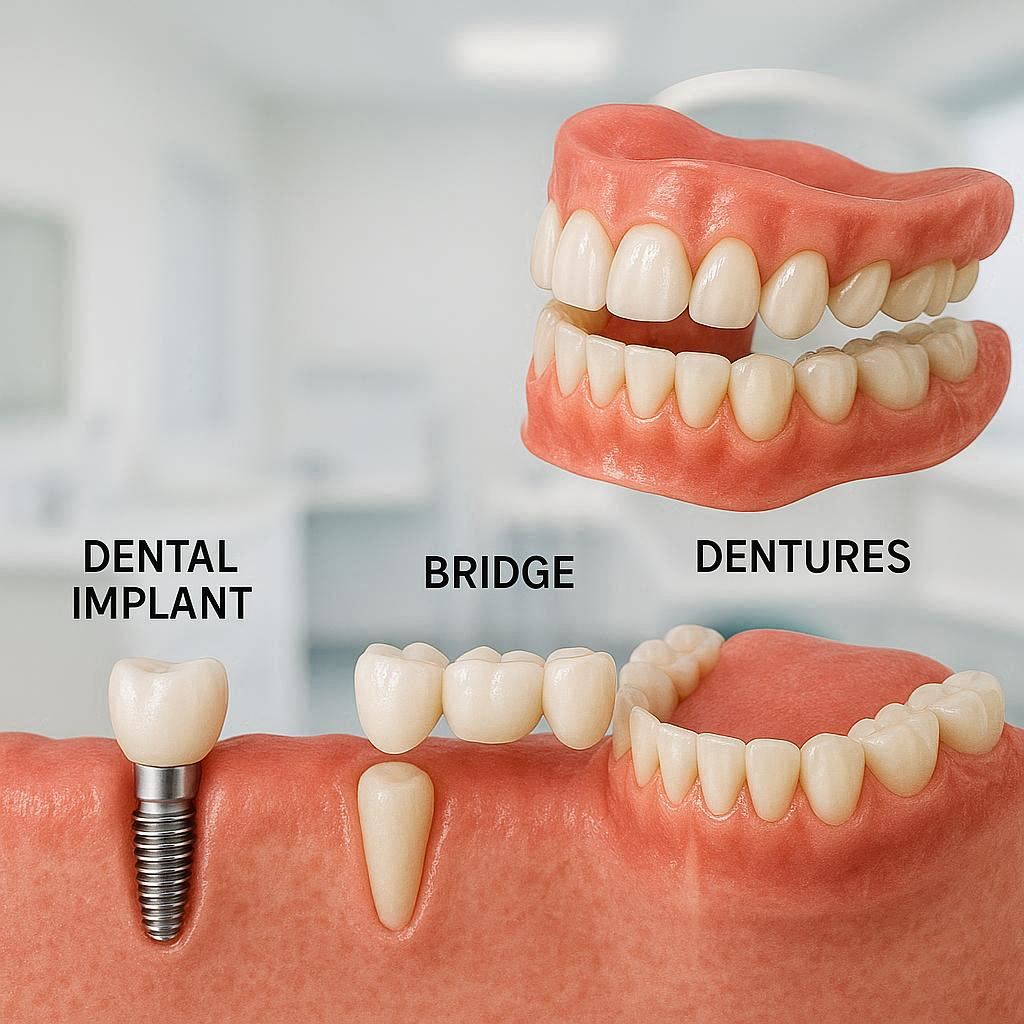
Dentists generally offer five main solutions for missing teeth. Each one has a different price tag, treatment time, and set of trade-offs. Let us look at them side by side.
| Treatment Option | Best For | Average Lifespan | Upfront Cost | Surgery Required? |
|---|---|---|---|---|
| Dental Implant | Single or multiple missing teeth | 20+ years (often lifetime) | High | Yes |
| Fixed Bridge | One or two adjacent missing teeth | 10 to 15 years | Medium | Minimal |
| Removable Partial Denture | Several missing teeth not adjacent | 5 to 8 years | Low | No |
| Resin-Bonded Bridge | Front teeth, low bite force | 5 to 10 years | Low to Medium | Minimal |
| Implant-Supported Bridge | Three or more consecutive missing teeth | 15 to 20+ years | High | Yes |
Now, let us explore each option in detail.
Dental Implants: The Gold Standard for Tooth Replacement
If you ask most dentists what the best long-term solution is, they will likely say dental implants. An implant replaces both the visible crown and the hidden root.
What Is a Dental Implant Exactly?
A dental implant is a small screw, usually made of medical-grade titanium. A dentist surgically places this screw into your jawbone. Over several months, your bone grows tightly around the implant. This process is called osseointegration. Once the implant is solidly fused to the bone, the dentist attaches a custom-made crown on top.
The Step-by-Step Implant Process
The journey from missing tooth to finished implant typically takes several months. Here is what a realistic timeline looks like.
First visit: Consultation and planning. Your dentist takes 3D scans of your jaw. They check your bone density and look for any hidden issues like infections.
Second visit: Implant placement. This is a surgical procedure. You receive local anesthesia, and often sedation if you feel nervous. The dentist makes a small cut in your gum and drills a precise hole into the bone. The implant screw goes in. Then the gum is stitched closed over or around the implant.
Healing phase: Three to six months. You wait while the implant fuses with your bone. During this time, you can wear a temporary partial denture or a temporary crown.
Final visit: Crown placement. Once healing is complete, the dentist uncovers the implant. They attach a small connector called an abutment. Finally, they cement or screw your permanent crown onto the abutment.
Important Note: Some dentists offer “same-day implants” or “teeth in a day.” These are possible only in very specific cases with ideal bone quality. For most people, the traditional multi-month process is safer and more predictable.
Who Is a Good Candidate for Implants?
You are likely a good candidate if:
- You have adequate jawbone density.
- You do not smoke heavily (smoking slows healing).
- You are willing to commit to excellent oral hygiene.
- You do not have uncontrolled diabetes or autoimmune diseases.
If your bone has already resorbed, do not lose hope. Bone grafting procedures can rebuild lost bone. This adds another few months and additional cost, but it makes implants possible for almost everyone.
The Real Costs of Dental Implants
A single dental implant in the United States typically costs between 3,000and6,000. This includes the surgery, the abutment, and the crown. Bone grafting can add 500to3,000.
Most dental insurance plans do not cover implants fully. Some cover a portion of the crown. Many people use payment plans or healthcare credit cards to manage the cost.
Pros and Cons of Implants
Pros:
- Looks and feels like a natural tooth.
- Prevents bone loss in your jaw.
- Does not affect neighboring healthy teeth.
- Can last a lifetime with proper care.
Cons:
- Expensive upfront.
- Requires surgery and several months of treatment.
- Not suitable for everyone without bone grafting.
Fixed Dental Bridges: A Faster Alternative
A fixed bridge literally bridges the gap created by one or more missing teeth. The teeth on either side of the gap, called abutment teeth, serve as anchors.
How a Traditional Bridge Works
Imagine three connected crowns. The two outer crowns fit over your natural teeth on each side of the gap. The middle crown fills the empty space. The entire unit is cemented into place and cannot be removed at home.
To prepare your natural anchor teeth, the dentist shaves them down. This is permanent. Once a tooth is reduced for a bridge, it will always need a crown.
The Bridge Procedure Timeline
A bridge usually requires just two or three visits over a few weeks.
Visit one: The dentist numbs your anchor teeth and reshapes them. They take impressions of your mouth and send them to a dental lab. You leave with a temporary bridge.
Visit two (two to three weeks later): The dentist removes the temporary bridge. They try in the permanent bridge, check the fit, and cement it into place.
How Much Does a Bridge Cost?
A traditional three-unit bridge (two crowns and one false tooth) costs between 2,000and5,000. Insurance often covers a significant portion, sometimes 50 percent.
Pros and Cons of Bridges
Pros:
- Much faster than implants (three weeks vs. six months).
- Less expensive than implants.
- No surgery required.
Cons:
- Requires shaving down healthy teeth.
- Does not prevent bone loss in the gap area.
- Typically lasts 10 to 15 years before needing replacement.
- Can be harder to clean underneath.
Removable Partial Dentures: The Budget-Friendly Option
A partial denture is a removable appliance that replaces one or several missing teeth. It consists of replacement teeth attached to a gum-colored plastic base, often held in place by metal clasps.
What to Expect with a Partial Denture
Getting a partial denture is non-invasive. The dentist takes impressions of your mouth. A dental lab fabricates the appliance. In about three to four weeks, you receive your partial denture.
You will need to remove it every night for cleaning. You should also remove it while sleeping to give your gums a rest.
The Realistic Experience
Partial dentures take time to get used to. They can feel bulky at first. Your speech may sound different for a week or two. Some people find the metal clasps noticeable when they smile.
Eating with a partial denture is possible, but you will need to avoid sticky or very hard foods. The appliance can break if dropped on a hard surface.
Cost of Partial Dentures
A removable partial denture is the most affordable option. Prices range from 500to2,000. Many insurance plans cover a large portion of this cost.
Pros and Cons of Partial Dentures
Pros:
- Most affordable option.
- No surgery and no drilling on healthy teeth.
- Quick to make (three to four weeks).
Cons:
- Can feel uncomfortable or bulky.
- Metal clasps may be visible.
- Does not stop bone loss.
- Needs replacement every five to eight years.
- Can affect taste and speech initially.
Resin-Bonded Bridges: A Gentle Option for Front Teeth
Also called a Maryland bridge, this is a conservative alternative to traditional bridges. It is most often used for missing front teeth that do not endure heavy chewing forces.
How a Resin-Bonded Bridge Works
This bridge has a false tooth with small metal or ceramic wings on each side. Instead of shaving down the neighboring teeth, the dentist bonds these wings to the back surfaces of the adjacent teeth using strong resin cement.
The procedure is minimally invasive. The neighboring teeth remain almost completely untouched.
The Catch
Resin-bonded bridges are not very strong. They can become loose if you bite into hard foods like apples or crusty bread. They work beautifully for a missing upper lateral incisor (the small tooth next to your front tooth) but poorly for a missing premolar or molar.
Cost and Lifespan
A resin-bonded bridge costs between 1,500and3,000. They typically last five to ten years before needing rebonding or replacement.
Pros and Cons
Pros:
- Preserves healthy tooth structure.
- Less expensive than implants.
- Quick to make (two visits).
Cons:
- Only suitable for front teeth with low bite force.
- Prone to coming loose.
- Does not prevent bone loss.
Implant-Supported Bridges: The Heavy-Duty Solution
What if you have lost three or four consecutive teeth? Placing individual implants for each gap is possible but very expensive. An implant-supported bridge offers a smarter approach.
How It Works
Instead of one implant per missing tooth, the dentist places two or three implants in the jaw. These implants support a bridge that carries all the replacement teeth. For example, you might lose four front teeth. Two implants can support a four-tooth bridge.
The Advantages
This approach reduces the number of implants needed, lowering the total cost. Yet it still provides the bone-preserving benefits of implants. It feels much more stable than a removable partial denture.
Cost and Treatment Time
An implant-supported bridge costs between 6,000and15,000 for three to four teeth. The treatment timeline is similar to single implants: four to eight months from surgery to final bridge.
Full-Arch Replacements: When All Teeth Are Missing
If you have lost all your upper or lower teeth, you have two main paths: traditional dentures or implant-supported dentures.
Traditional Complete Dentures
Complete dentures replace an entire arch of missing teeth. They rest directly on your gums. Modern dentures look natural, but they have limitations. They can shift while eating or speaking. They cover the roof of your mouth, affecting taste. Most importantly, they do nothing to stop jawbone resorption. Over years, dentures become loose as the bone shrinks.
Implant-Supported Dentures
This solution uses two to six implants to snap a denture securely into place. There are two types.
Removable implant dentures: You can snap the denture in and out for cleaning. The denture stays firmly in place during eating and speaking, but you remove it at night.
Fixed implant dentures (All-on-4 or All-on-X): A permanent bridge is screwed onto four or more implants. You cannot remove it at home. It feels and functions much like natural teeth.
Which Full-Arch Solution Is Better?
If your budget allows, fixed implant dentures are life-changing. People report being able to eat apples, steak, and corn on the cob again. Removable implant dentures are a good middle ground. Traditional dentures are the most affordable but least stable.
Cost Comparison Table for All Tooth Replacement Options
| Treatment | Low End | High End | Insurance Coverage |
|---|---|---|---|
| Single Dental Implant | $3,000 | $6,000 | Low to none |
| Three-Unit Fixed Bridge | $2,000 | $5,000 | Moderate (often 50%) |
| Removable Partial Denture | $500 | $2,000 | High (often 50-80%) |
| Resin-Bonded Bridge | $1,500 | $3,000 | Moderate |
| Full Traditional Dentures (per arch) | $600 | $2,500 | High |
| Implant-Supported Denture (removable) | $4,000 | $10,000 | Low |
| All-on-4 Fixed Bridge (per arch) | $15,000 | $30,000 | Very low |
How to Choose the Right Tooth Replacement for You
No single answer works for everyone. Your choice depends on several personal factors.
Ask Yourself These Questions
What is your budget right now? If money is tight, a partial denture or bridge may be your starting point. You can always upgrade to an implant later.
How long do you plan to keep this solution? If you want a “one and done” solution, save for an implant. If you are okay with replacing the restoration every 10 to 15 years, a bridge is reasonable.
Are you comfortable with surgery? Some people have medical anxiety or conditions that make surgery risky. Bridges and dentures avoid surgery entirely.
Where is the missing tooth located? Front teeth have different demands than back molars. A resin-bonded bridge works well up front but will fail quickly in the back.
Do you smoke or have diabetes? These factors affect implant success rates. Be honest with your dentist. They may recommend a bridge instead.
The Importance of Seeing a Dentist First
This guide gives you general knowledge. It is not medical advice. Only a dentist can examine your specific mouth, take X-rays, and recommend the best option.
During your consultation, ask these questions:
- “What would you choose if you were in my situation?”
- “What are the success rates for each option in my case?”
- “Can you show me before-and-after photos of similar cases?”
- “What happens if I do nothing for one year?”
A good dentist will explain all options, including the option of doing nothing. They will not pressure you into the most expensive treatment.
Caring for Your New Tooth Replacement
Whatever option you choose, long-term success depends on hygiene.
For Implants and Bridges
You cannot treat an implant or bridge like a natural tooth. Bacteria can hide around the edges. You will need special tools like floss threaders, superfloss, or water flossers. Your dentist may also recommend interdental brushes.
For Removable Dentures
Clean your denture daily with a soft brush and mild soap. Never use regular toothpaste, which is too abrasive. Soak it in water or cleaning solution overnight. And remember to brush your gums and remaining natural teeth as well.
Follow-Up Appointments Matter
See your dentist at least once per year to check your replacement teeth. A bridge that develops decay underneath can fail. An implant with gum inflammation can develop peri-implantitis, a form of bone loss around the implant.
Common Myths About Tooth Replacement
Let us clear up some misinformation.
Myth: “Once you get an implant, you never have to worry about it again.”
Truth: Implants do not get cavities, but they can get gum disease. You must clean around them just like natural teeth.
Myth: “Bridges are outdated; everyone should get implants.”
Truth: Bridges remain an excellent, evidence-based option for many people, especially those who cannot undergo surgery.
Myth: “Dentures are only for old people.”
Truth: People of any age can need dentures due to accidents, genetic conditions, or extensive decay.
Myth: “Replacing a tooth is purely cosmetic.”
Truth: As we discussed earlier, missing teeth lead to bone loss, shifting teeth, and bite problems. Replacement is a health issue, not just a beauty issue.
What If You Cannot Afford Any Option Right Now?
Do not panic. You have temporary solutions while you save money.
Ask About Payment Plans
Many dental offices offer in-house financing or work with third-party companies like CareCredit. You can spread the cost over 12 to 24 months with little or no interest.
Consider a Dental School
Teaching clinics at dental schools offer reduced fees. A dental student performs the work under the close supervision of experienced faculty. You can save 30 to 50 percent.
Look Into Dental Tourism
Some people travel to Mexico, Costa Rica, or Thailand for dental implants. Prices can be half of U.S. costs. Research the clinic thoroughly. Factor in travel costs and the difficulty of follow-up care if something goes wrong.
Start with a Partial Denture as a “Placeholder”
A cheap partial denture costs a few hundred dollars. It will not stop bone loss, but it will prevent your teeth from shifting. In a year or two, when you have saved enough, you can replace it with an implant.
A Note on Pain and Recovery
Fear of pain stops many people from replacing missing teeth. Let us be realistic about what each option feels like.
Dental implants: The surgery itself is painless due to anesthesia. Afterward, expect soreness for three to seven days. Most people manage with over-the-counter ibuprofen. You will eat soft foods for about a week.
Bridges: Preparing the anchor teeth causes some vibration and pressure. You may have mild sensitivity in the reshaped teeth for a few days.
Partial dentures: No pain from the procedure. Some sore spots on your gums are common during the first week. Your dentist can adjust the denture to fix these.
The most common emotion people report after finishing treatment is relief. They wish they had done it sooner.
Conclusion
Replacing missing teeth is a journey with several valid paths. Dental implants offer the closest experience to natural teeth but require time and money. Fixed bridges provide a faster, less expensive option at the cost of altering healthy teeth. Removable partial dentures are affordable and non-invasive but less comfortable and stable. For those missing all teeth, implant-supported dentures transform quality of life, while traditional dentures remain a budget-friendly fallback.
Your best choice depends on your budget, your health, your comfort with surgery, and where the gap is located. See a dentist for a personalized evaluation. Whatever you decide, know that taking action now protects your smile, your ability to eat, and the long-term health of your jawbone.
Frequently Asked Questions (FAQ)
1. Is it necessary to replace a missing back molar?
Yes, if possible. Back molars do most of your chewing work. Leaving a missing molar causes teeth behind the gap to tilt forward, and teeth above the gap to drop down. This leads to bite collapse and jaw pain over time.
2. Can I get an implant years after losing a tooth?
Often yes, but you may need a bone graft first. The jawbone resorbs over time. After several years, there may not be enough bone to hold an implant. A graft rebuilds the bone, adds six months to treatment, but makes the implant possible.
3. How painful is dental implant surgery?
Most people rate the pain as 2 to 4 out of 10 during recovery. The surgery itself is not painful because of local anesthesia. Post-surgery soreness feels like having a tooth extracted. Over-the-counter pain relievers usually suffice.
4. Will my insurance cover tooth replacement?
Most dental insurance plans cover a portion of bridges and dentures, often 50 percent. Implants are rarely covered beyond a small allowance for the crown. Call your insurance provider for your specific coverage details.
5. How long does a dental bridge last?
A well-made bridge lasts 10 to 15 years. Some last 20 years with meticulous hygiene. Eventually, the cement can wash out, or decay can develop under the crowns. Regular dental checkups catch these problems early.
6. What is the cheapest way to replace a missing tooth?
A removable partial denture is the least expensive, starting around 500.Aflipper(averybasicacrylicpartial)cancostaslittleas300. These are temporary solutions but work while you save for a permanent option.
7. Can I replace a missing tooth naturally?
No. Natural remedies do not regrow teeth. Some people look into “tooth regeneration” research, but this is still experimental and not available to the public. The only proven methods are implants, bridges, and dentures.
8. What happens if I do nothing for five years?
You risk bone loss in the gap area, tilting of adjacent teeth, over-eruption of the opposing tooth, new cavities in hard-to-clean areas, and changes in your bite that can cause jaw pain and headaches.
9. Are same-day implants real?
Yes, but only for carefully selected patients. Same-day implants require ideal bone quality and quantity. You also need a temporary crown that does not touch your opposing teeth. Most people are not candidates for true same-day implants.
10. Which option looks the most natural?
A single dental implant with a high-quality ceramic crown looks identical to a natural tooth. An implant-supported bridge also looks very natural. Traditional bridges can look natural if the dentist uses good materials. Partial dentures with metal clasps are the least natural-looking.
Additional Resource
For more detailed, dentist-reviewed information on tooth replacement options, costs by region, and patient stories, visit the American College of Prosthodontists patient education page:
Go to: gotoapro.org (Search “Tooth Replacement Options”)
Disclaimer: This article is for informational purposes only and does not constitute medical advice. Always consult with a licensed dentist in your area for a proper diagnosis and treatment plan specific to your oral health condition.