How Long to Use Chlorhexidine Gluconate After Implant Surgery?
The small bottle of prescription mouthwash you received after your dental implant surgery is not a suggestion. It is a powerful, targeted chemical agent prescribed to control the bacterial population in your mouth during the critical first phase of wound healing. Chlorhexidine gluconate, often at a 0.12% concentration, is the gold standard antimicrobial oral rinse in dentistry. But it is a potent drug, not a cosmetic mouthwash. Using it too long causes side effects. Stopping it too early risks a devastating surgical site infection. The question of “how long” to use it is, therefore, a precise therapeutic decision. The standard prescription is typically for 7 to 14 days, starting the day after surgery. This article will provide a definitive guide to the correct protocol, the critical reasons behind it, the exact technique for using it safely around a fresh implant, and the side effects that require you to stop. You will understand why this bright blue or green liquid is a non-negotiable part of your post-operative care.
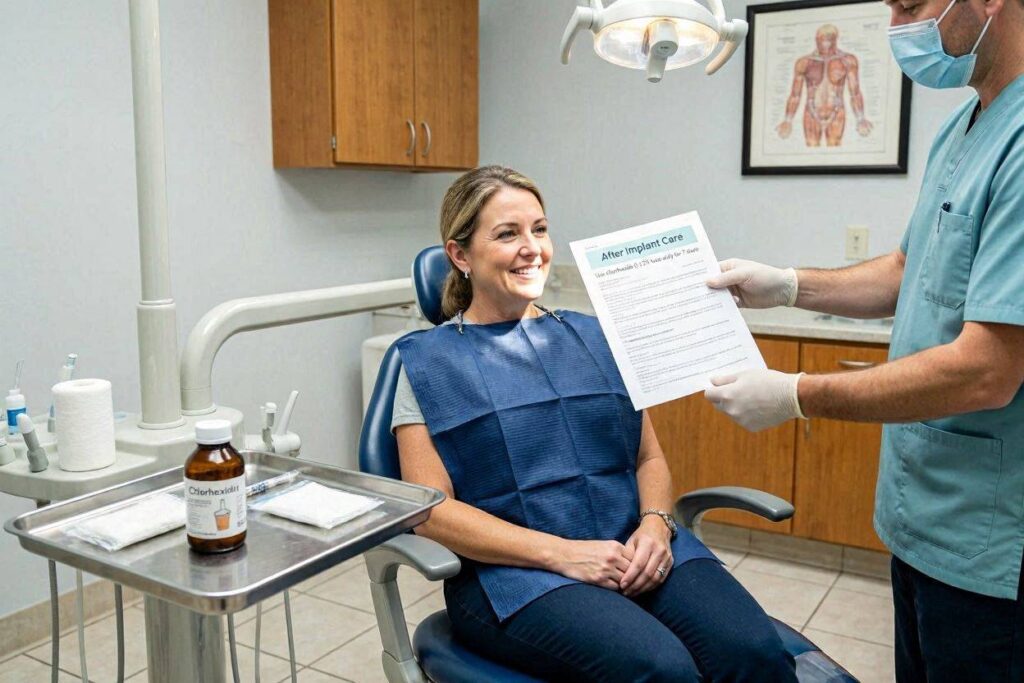
What Is Chlorhexidine Gluconate and Why Is It Prescribed?
Chlorhexidine gluconate is a bisbiguanide antiseptic with a unique property: substantivity. Unlike a saline rinse or even a strong antibiotic mouthwash that washes away quickly, chlorhexidine binds to the oral tissues, the teeth, and the implant surfaces. It is then slowly released over 8 to 12 hours, providing a sustained, bactericidal blanket. It works by disrupting the bacterial cell membrane, killing a broad spectrum of Gram-positive and Gram-negative bacteria and fungi. After implant surgery, your mouth is a vulnerable wound. The sutured gum tissue is an open door. The blood clot around the healing cap or cover screw is a protein-rich feast for bacteria. You cannot mechanically brush the surgical site effectively for the first week. Chlorhexidine bridges this hygiene gap. It chemically suppresses the bacterial load, preventing the biofilm from colonizing the fibrin clot and the surgical wound margins. It is the most effective topical prophylactic against post-operative peri-implant infection.
The 0.12% vs. 0.2% Concentration
In the United States and South Africa, the standard prescription formulation is 0.12% chlorhexidine gluconate. In Europe, a 0.2% formulation is common. The 0.12% is equally effective for post-surgical prophylaxis when used in a sufficient volume (typically 15ml) and for the correct contact time (30 seconds). The 0.2% formulation has a higher alcohol content in some brands, which can cause more stinging and is sometimes not preferred for very fresh, raw wounds. Your dentist will prescribe the concentration they feel is most appropriate. Use the exact one given to you.
The Prescribed Duration: The 7 to 14-Day Protocol
The most widely prescribed and evidence-based protocol is to use chlorhexidine gluconate 0.12% rinse twice daily for 7 to 14 days after implant surgery. The initiation is usually the day after surgery. You do not use it on the day of the surgery itself, because you must allow the initial blood clot to fully stabilize without any chemical or mechanical disturbance. The typical instructions are:
- Start: The morning after your surgery.
- Frequency: Twice daily, typically after breakfast and before bed, after you have done any gentle mechanical cleaning of your other teeth.
- Duration: 10 to 14 days is the most common prescription. Some surgeons extend this to 3 weeks for complex cases with extensive grafting or for patients at higher risk of infection.
- Stop Date: The prescription is not indefinite. It has a clear stop date.
Why Not Longer Than 2-3 Weeks?
Chlorhexidine is a double-edged sword. Its side effects are time-dependent. Prolonged use beyond 3-4 weeks leads to significant, often distressing, and sometimes partially irreversible side effects. The most notorious is extrinsic tooth staining. Chlorhexidine binds to dietary chromogens, causing a yellowish-brown or even black stain on the teeth, the tongue, and the surfaces of any composite or acrylic restorations. It can cause a transient alteration in taste perception (dysgeusia)—a persistent metallic or salty taste that makes food unappetizing. It can increase the formation of supragingival calculus. Rarely, it can cause a mucosal desquamation, where the inner lining of the cheeks peels off. The 14-day protocol provides the maximum infection-prevention benefit while staying within the window before these side effects become clinically significant and bothersome.
The Correct Rinsing Technique: Do Not Swish
The technique for using chlorhexidine around a fresh implant is not the vigorous “swish and spit” used for a regular mouthwash. The turbulence from aggressive swishing can dislodge the fragile blood clot, the exact biological dressing you are trying to protect. The correct technique is a passive “hold and tilt.”
- Pour the prescribed amount (usually 15ml or half a cap) into the measuring cup.
- Place the liquid gently into your mouth, directly over the surgical area.
- Hold it there. Gently tilt your head side to side, allowing the liquid to bathe the wound passively.
- Do not force the liquid between your teeth with air pressure, and do not swish it around energetically.
- After 30 to 60 seconds, lean over the sink, open your mouth, and let the liquid simply fall out. Do not purse your lips and spit forcefully.
- Do not rinse your mouth with water afterwards. You want the chlorhexidine to remain bound to the tissues for its prolonged effect. Do not eat or drink for at least 30 minutes.
When to Stop Early: Side Effects and Sensitivities
If you experience a true allergic reaction—which is rare but can present as hives, swelling of the lips or tongue, or difficulty breathing—stop immediately and seek emergency medical care. More commonly, a patient may develop a burning sensation or a severe, sloughing reaction of the oral mucosa. This is a chemical mucositis. Stop the rinse and contact your surgeon. A mild staining of the tongue and teeth is expected and is not a reason to stop early; it will be polished off at your post-operative visit. A change in taste is also expected and will resolve within a few days of stopping the rinse. The critical rule is: do not stop the chlorhexidine prematurely just because you don’t like the taste or you see a small amount of temporary staining. Premature cessation opens the door to a post-operative infection, which is far more serious and difficult to manage than a cleanable stain.
Chlorhexidine as a Gel or Spray
For some patients or specific surgical sites, your surgeon may prescribe chlorhexidine in a gel form. This is applied directly to the surgical site with a clean cotton swab, which avoids the systemic taste and allows for highly targeted, prolonged contact. It is particularly useful for a single implant site where the rest of the mouth can be cleaned normally. A chlorhexidine spray can also be targeted directly. The duration of use for the gel is the same: 7-14 days, applied 1-2 times a day. The advantage is a lower incidence of generalized staining.
Chlorhexidine and the Healing Abutment
Once a healing abutment is in place, and especially after the sutures are removed, plaque begins to accumulate on the healing cap and around the gum margin. Chlorhexidine is highly effective in keeping this biofilm at bay during the early soft tissue maturation phase. However, the transition to gentle mechanical cleaning with a single-tufted, extra-soft brush must begin around the second week, after the gum has sealed. The chlorhexidine is then the chemical adjunct to your mechanical cleaning, and when the bottle runs out or the 14-day mark is reached, you transition to warm salt water rinses and meticulous, gentle brushing.
Important Note: Chlorhexidine gluconate is deactivated by sodium lauryl sulfate (SLS), the foaming agent found in most standard toothpastes. If you are instructed to brush your other teeth, and then rinse with chlorhexidine, you must thoroughly rinse out all traces of toothpaste with water before applying the chlorhexidine, or wait at least 30 minutes. Using them back-to-back renders the chlorhexidine much less effective.
Conclusion
The correct duration for chlorhexidine gluconate 0.12% use after dental implant surgery is typically a strict 7 to 14 days, used twice daily with a gentle, non-swishing “hold and tilt” technique, starting the day after the procedure. This targeted, short-term protocol provides a critical chemical antimicrobial barrier during the vulnerable healing phase when mechanical brushing is impossible, while avoiding the dose-dependent side effects of staining and taste alteration. The medication should be discontinued only at the prescribed time or if a significant allergic or mucositic reaction occurs, with the transition made to meticulous mechanical hygiene and saline rinses.
FAQ
1. Can I use an over-the-counter mouthwash instead of chlorhexidine?
No. Cosmetic mouthwashes do not have the substantivity or the broad-spectrum bactericidal power of chlorhexidine. They cannot provide the sustained, 12-hour chemical barrier needed to protect an implant surgical wound. Only use what your surgeon prescribes.
2. My teeth are staining badly from the chlorhexidine. Should I stop?
No, do not stop early without consulting your surgeon. The stain is a cosmetic side effect, not an allergy or a sign of harm. It will be professionally polished off at your follow-up visit. The risk of infection from stopping early far outweighs the reversible stain.
3. What if I forget a dose?
Take the missed dose as soon as you remember, but if it is close to the time for your next dose, skip the missed one. Do not double-dose. The twice-daily protocol maintains an effective sustained concentration in the oral environment.
Additional Resource
For authoritative information on post-operative oral care and medications, visit the American Association of Oral and Maxillofacial Surgeons: https://www.aaoms.org/