What Materials are Used in Dental Implant
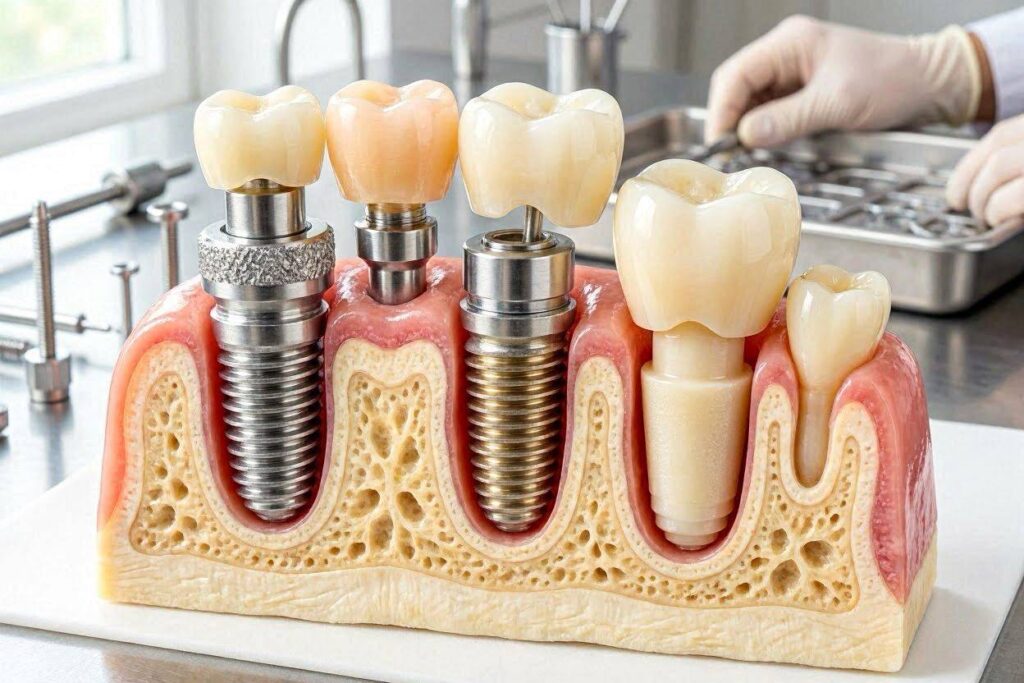
A dental implant is not a single piece of metal. It is a system of components, each fabricated from a material precisely selected for its specific biological, mechanical, and aesthetic role. The material that touches the bone must do one thing: osseointegrate without causing a foreign body reaction. The material that passes through the gum must support a soft tissue seal and, in the aesthetic zone, not cast a dark shadow. The material of the crown must withstand years of chewing force while reflecting light like a natural tooth. The success or failure of an implant can hinge on a material choice made long before the first incision. This article is a definitive exploration of the materials used in dental implants. We will examine the implant fixture, the abutment, and the crown, explaining why each material is chosen, its strengths and weaknesses, and where the future of implant biomaterials is heading.
The Implant Fixture: The Root in the Bone
The implant fixture is the component surgically placed into the jawbone. Its material is the single most critical decision for biocompatibility. The body’s acceptance of this material determines the entire outcome.
Commercially Pure Titanium (CP Ti)
Commercially pure titanium, specifically Grade 4 CP Ti, is the gold standard and the most widely used implant fixture material in the world. Its dominance is not accidental. When titanium is exposed to air or bodily fluids, it instantly forms a stable, dense layer of titanium dioxide (TiO₂) on its surface. This oxide layer is a ceramic, not a metal. It is biologically inert. The body’s immune system does not recognize it as a foreign invader. More remarkably, osteoblasts—bone-forming cells—actively adhere to and proliferate on this titanium dioxide surface. They deposit bone matrix directly onto it. Titanium also has excellent corrosion resistance in the saline environment of the body, a relatively low modulus of elasticity (closer to bone than other metals, reducing stress shielding), and is non-ferromagnetic, making it safe for MRI imaging. CP Ti’s track record of over 50 years of successful clinical use is the foundation of modern implantology.
Titanium Alloy (Ti-6Al-4V ELI)
This alloy is composed of titanium with 6% aluminum and 4% vanadium. The ELI designation stands for Extra Low Interstitials, meaning it is an extremely pure, high-grade formulation. This alloy has significantly higher tensile strength and fatigue resistance than CP Ti. Why use it? For small-diameter implants. A standard-diameter CP Ti implant (4.0mm) has plenty of inherent strength for posterior chewing forces. But a narrow 3.0mm diameter implant, used to replace a small lower incisor, has a much thinner cross-section. Under the same chewing load, the stress on the metal is higher. Ti-6Al-4V alloy handles this stress safely without the risk of fracture. It forms the same titanium dioxide surface layer, so its osseointegration is clinically equivalent to CP Ti. The aluminum and vanadium ions remain trapped within the stable oxide matrix, and decades of data show no systemic toxicity.
Zirconia (Y-TZP Ceramic)
Yttria-stabilized tetragonal zirconia polycrystal (Y-TZP) is the ceramic, metal-free alternative for implant fixtures. Zirconia is a high-performance technical ceramic, known for its extreme compressive strength, toughness, and chemical inertness. A zirconia implant is tooth-colored, a brilliant white. This is its defining aesthetic advantage. In a patient with thin, translucent gum tissue, a titanium implant can show through as a dark grey shadow. A zirconia implant eliminates this shadow entirely; the tissue remains a vibrant, healthy pink. Zirconia also has very low plaque affinity, meaning bacteria adhere to it less readily than to titanium. It is the material of choice for patients with a documented or psychological need for a metal-free restoration. The limitations are that zirconia is brittle—it has low tensile strength and can fracture under bending forces—and the long-term clinical data, while now extending to 15+ years, is not as vast as for titanium. Zirconia implants are almost always a one-piece design (implant and abutment fused), limiting prosthetic flexibility.
Material Comparison Table: Implant Fixtures
| Material | Color | Strength | Biocompatibility | Best Clinical Use |
|---|---|---|---|---|
| CP Titanium (Grade 4) | Metallic grey | Good | Excellent, 50+ year track record | Standard and wide implants in all zones |
| Ti-6Al-4V Alloy | Metallic grey | High, superior fatigue resistance | Excellent | Narrow diameter implants, high load areas |
| Zirconia (Y-TZP) | White | High compressive, brittle in tension | Excellent, lowest plaque affinity | Aesthetic zone, thin biotype, metal-free patients |
The Abutment: The Transmucosal Connector
The abutment is the intermediate piece that screws into the fixture and protrudes through the gum. It must satisfy three masters: mechanical stability, a bacterial seal, and in many cases, aesthetic translucency.
Titanium Abutments
Titanium abutments are the standard in posterior, non-aesthetic zones. A titanium abutment on a titanium fixture creates a precise, intimate metal-to-metal connection with a virtually hermetic seal. Titanium is strong, and the abutment screw can be torqued to a high, stable value. The soft tissue can form a healthy hemidesmosomal attachment to the polished titanium collar. The only disadvantage is its dark color, which can show through thin tissue.
Zirconia Abutments
Zirconia is the premium material for anterior aesthetic abutments. A custom-milled white zirconia abutment, placed on a titanium fixture, solves the grey-gum problem. Light passes through the gum, hits the white zirconia, and reflects back a natural, healthy pink. The soft tissue seal around a well-polished zirconia abutment is excellent. The historical concern of a zirconia-to-titanium interface fracture has been largely solved with modern precision milling and hybrid designs that incorporate a titanium insert at the connection level.
Titanium-Base (Ti-Base) Hybrid Abutments
This is a very popular modern solution. A stock or custom titanium base screws directly into the implant. A custom-ceramic core (zirconia or lithium disilicate) is then bonded onto the Ti-base. This gives the strength and precision of a metal connection with the aesthetics of a white ceramic emergence profile. It is the best of both worlds.
The Prosthesis: The Visible Crown and Bridge
The material of the final crown or bridge determines the aesthetics, wear resistance, and functional longevity of the restoration.
Monolithic Zirconia
This is a crown or bridge milled from a single, solid block of zirconia. It is the strongest ceramic option, with a flexural strength over 1,000 MPa. It is virtually unbreakable under normal chewing forces. Modern multi-layered, high-translucency zirconia blocks have excellent aesthetics for most patients. It is ideal for posterior crowns, full-arch bridges, and patients with heavy bite forces or bruxism.
Lithium Disilicate (IPS e.max)
This glass-ceramic is the gold standard for anterior single-tooth aesthetics and premolar crowns. It offers a translucency, opalescence, and color depth that very closely mimics natural tooth enamel. It can be milled from a block or heat-pressed as a layered restoration. Its strength (400 MPa) is excellent for a single crown and three-unit anterior bridges, but it is not the material of choice for a full-arch posterior bridge.
Porcelain-Fused-to-Metal (PFM)
A metal coping, made of a base metal or noble alloy, with hand-layered porcelain baked on top. PFM is a strong, time-tested, economical material. It works well for implant bridges in non-aesthetic zones. Its aesthetic weakness is the dark metal line at the margin if the gum recedes.
Acrylic and Composite Hybrid
Used for the teeth on a full-arch fixed titanium framework. High-impact acrylic denture teeth bonded to the bridge are lightweight, easily adjustable, and cost-effective. Over a decade, acrylic teeth will wear and can debond, requiring replacement. This is often the material for the immediate, transitional full-arch prosthesis.
Surface Modifications: The Material at the Nanoscale
The raw material is just the starting point. The surface of the implant fixture is not left as smooth, machined metal. It is physically and chemically altered to create a biologically active surface.
Sandblasted and Acid-Etched (SLA)
This is the industry standard. The titanium is blasted with large-grit aluminum oxide or calcium phosphate particles, creating a macro-roughness. It is then etched with a strong acid mixture, creating a micro-roughness with pits and valleys of 1-2 microns. This complex, hierarchical roughness dramatically increases the surface area for osteoblast attachment and bone interlocking.
Hydrophilic Surfaces
A standard SLA surface is hydrophobic—it repels water and thus blood. A hydrophilic surface is chemically treated (e.g., rinsed in nitrogen and stored in isotonic saline) to be highly attractive to water. When the implant is placed, blood and its proteins instantly wet the entire surface. This accelerates the initial clotting cascade and osteoblast migration. Implants with a hydrophilic surface, such as Straumann’s SLActive, have been shown to reduce the osseointegration time from 6-8 weeks to 3-4 weeks.
Anodized and Calcium-Coated Surfaces
Anodization is an electrochemical process that thickens the titanium dioxide layer and creates a porous, tubular structure. A calcium phosphate coating (hydroxyapatite) is a biomimetic layer that chemically resembles natural bone mineral, actively stimulating bone formation. These are highly osteoconductive surfaces used by many manufacturers.
Important Note: When a patient has a genuine metal allergy, the diagnostic gold standard is a patch test by an allergist. A patient with a confirmed Type IV hypersensitivity to titanium or its alloying elements should not receive a titanium implant. Zirconia is the indicated, safe, and effective alternative.
Conclusion
Modern dental implants are fabricated from three primary, highly biocompatible materials: commercially pure titanium and its stronger alloy for the fixture, chosen for their unparalleled osseointegration; tooth-colored zirconia for metal-free and aesthetic zone fixtures and abutments; and high-strength ceramics like lithium disilicate and monolithic zirconia for the visible crown. The choice of material is a precise engineering and biological decision, tailored to the location in the mouth, the chewing forces, the patient’s gum biotype, and any metal sensitivities, ensuring a restoration that is both durable and beautiful.
FAQ
1. Can I have an MRI if I have a titanium dental implant?
Yes, absolutely. Titanium and zirconia are non-ferromagnetic. They will not heat up or move in an MRI machine. However, they can cause a small artifact (a dark spot or distortion) in the immediate vicinity of the implant on the scan, which the radiologist is trained to read around.
2. Is one material more hygienic than another for implants?
Zirconia exhibits slightly lower plaque adhesion in some laboratory studies. However, the most important factor for long-term hygiene is not the material itself but the smoothness of the surface finish, the contour of the restoration, and, overwhelmingly, the patient’s daily cleaning and professional maintenance.
3. What is the cheapest implant material?
A standard, stock titanium abutment and a monolithic zirconia crown on a CP titanium fixture represent the most economical, high-quality standard combination. PFM crowns are marginally less expensive but carry the aesthetic risk of a metal margin. The long-term value of a more aesthetic material in a visible zone is an investment worth making.
Additional Resource
For scientific resources on dental implant materials and biocompatibility, visit the Academy of Osseointegration: https://osseo.org/