How Do Teeth Implants Work
Losing a tooth can feel embarrassing. It can make eating difficult. It might even change the shape of your face over time. For decades, the only solutions were dentures or bridges. But today, we have something much more permanent.
You have probably heard the term “dental implant.” But how do teeth implants work exactly? Is it painful? How long do they last?
Let’s clear the air right now. This is not science fiction. It is routine dental surgery.
In this guide, I will walk you through everything. I will use simple language. I will avoid confusing medical terms. By the end, you will know if implants are the right choice for you. You will also understand the process from start to finish.
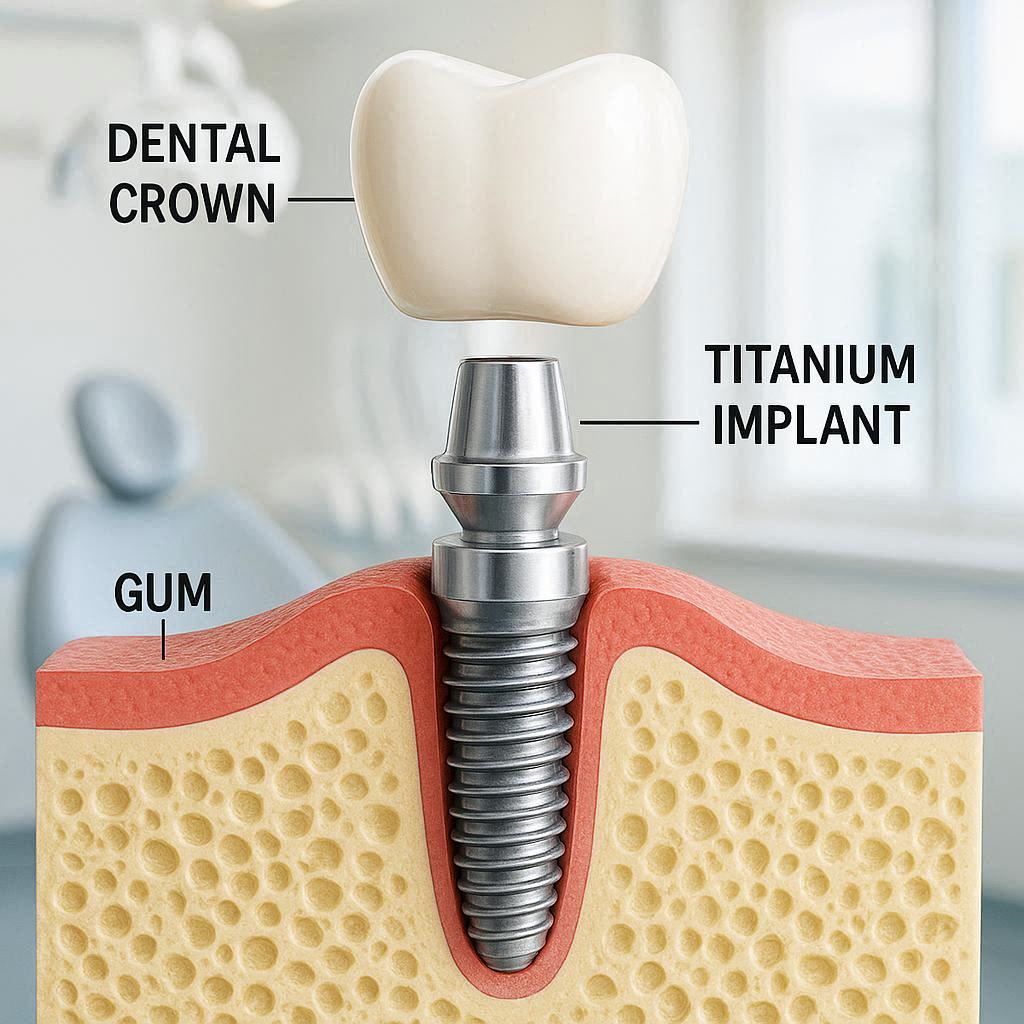
What Exactly Is a Dental Implant?
Before we explain the process, you need to understand the parts. A dental implant is not just the fake tooth you see in the mirror.
A complete implant has three main components:
- The Fixture (Post): This is a small screw. It is usually made of titanium. The surgeon places this screw into your jawbone. It acts like the natural root of your tooth.
- The Abutment: This is a connector piece. It sits on top of the post. It sticks out just above the gum line.
- The Crown: This is the visible, white part. It looks like a natural tooth. We attach it to the abutment.
Think of it like building a house. The post is the concrete foundation. The abutment is the floor joist. The crown is the beautiful room where you live.
Important Note: Not all implants are the same. Some are for single teeth. Others support bridges or full dentures. But the basic “how do teeth implants work” principle remains identical.
How Do Teeth Implants Work? The Biological Secret (Osseointegration)
This is the most important paragraph in this article.
How do teeth implants work without falling out? Glue? No. Suction? No.
The secret is a process called osseointegration.
That is a fancy word. But it has a simple meaning. “Osseo” means bone. “Integration” means joining.
Titanium has a superpower. Your body does not reject it. Instead, your jawbone grows tightly around the titanium screw. The bone cells actually fuse to the surface of the metal.
Imagine pouring concrete around a steel pole. Once the concrete hardens, you cannot pull the pole out. That is what happens inside your mouth. The bone becomes one with the implant.
Because of this fusion, implants are incredibly strong. They can withstand the same chewing force as natural teeth. Natural teeth move slightly in their sockets. Implants do not move. They are rock solid.
Who Is a Good Candidate for Implants?
Let’s be honest. Not everyone is a perfect candidate right away. But most people can become candidates with a little preparation.
Ideal candidates usually have:
- One or more missing teeth.
- A fully grown jawbone (usually over 18 years old).
- Enough bone density to hold the screw.
- Healthy gums (no active gum disease).
- A commitment to daily brushing and flossing.
- No heavy smoking (smoking slows healing).
What if you lack bone?
This is a common fear. If you lost a tooth years ago, your jawbone may have melted away (resorption). Without a tooth root, the bone shrinks.
But do not worry. Surgeons can perform a bone graft. They take bone powder from a donor or from another part of your mouth. They place it into the weak area. It takes a few months to heal. Then you have enough bone for the implant.
What about diabetes or heart conditions?
Many people with controlled diabetes get implants successfully. The key is “controlled.” You must be stable. Always tell your dentist your full medical history.
The Step-by-Step Procedure (What Really Happens)
Now we get to the heart of the question: how do teeth implants work in a real surgery?
I will break this down into phases. Do not skip the recovery parts. They are just as important as the surgery.
Phase 1: The Consultation and Planning (1–2 hours)
No one puts a screw in your mouth on the first visit.
First, the dentist takes a 3D CT scan of your skull. This is not scary. It is a machine that spins around your head for 30 seconds.
The scan shows everything:
- The exact height of your bone.
- The width of your bone.
- The location of nerves and sinuses.
The dentist uses software to plan the surgery digitally. They know exactly where to place the screw before you even sit in the chair.
Phase 2: Tooth Extraction (If Needed)
Do you still have a damaged tooth in that spot? The surgeon removes it first.
They use local anesthesia. You are awake but feel zero pain. You will feel pressure—like someone pushing on your arm—but no sharp pain.
After extraction, you may need to wait. If there was an infection, you wait 2–3 months for the bone to heal. If the bone is healthy, you might get the implant on the same day.
Phase 3: Placing the Implant Post (Surgery Day)
This sounds scary. I promise it is less intense than a tooth extraction.
Step 1: Numbing.
The surgeon injects local anesthetic. Your entire gum, jaw, and cheek go numb. If you are very nervous, you can request sedation (gas or IV). You will feel sleepy and relaxed.
Step 2: The Incision.
The surgeon makes a tiny cut in your gum. They fold the gum back to expose the bone. You feel nothing.
Step 3: Drilling.
Using the CT scan as a map, the surgeon drills a precise hole. They use a series of wider and wider drills. It is very gentle. They constantly spray cool water to prevent overheating the bone.
Step 4: Inserting the Screw.
The surgeon twists the titanium post into the hole. It fits very snugly. Sometimes the threads are self-tapping. Once the post is flush with the bone, the surgeon places a healing cap on top.
Step 5: Stitching.
The surgeon stitches the gum closed. Most stitches are dissolvable. You do not have to return to have them removed.
How long does this take?
- One implant: 30 to 60 minutes.
- Multiple implants: 2 to 3 hours.
Phase 4: Osseointegration (The Waiting Game)
This is the longest phase. It is also the most critical.
You go home with a gap in your smile. There is no tooth yet. The implant is sleeping under your gum.
You must wait for the bone to grow. This takes 3 to 6 months.
During this time:
- Eat soft foods on the opposite side.
- Brush gently around the area.
- Do not put pressure on the implant.
Why wait? If you attach a tooth too early, the bone might not fuse properly. The implant would wobble and fail. Patience is the secret to success.
Phase 5: Uncovering the Implant (Minor Visit)
Once the bone is fused, you return to the dentist. This visit takes 15 minutes.
The surgeon numbs the gum. They make a tiny hole to expose the top of the implant. Then they screw on the abutment (the metal post that sticks out).
You will see a small metal button in your gum line. Do not panic. This is normal. The gum will heal around it in 2 weeks.
Phase 6: Placing the Crown (The Final Step)
This is the fun part. You finally get your tooth.
First, the dentist takes an impression. They can use digital scanning or gooey putty. They send this mold to a lab.
A technician designs your new crown. They match the color, shape, and size to your natural teeth. This takes 2 to 3 weeks.
When the crown arrives, you return for a final 30-minute visit. The dentist screws or cements the crown onto the abutment. You look in the mirror. You have a brand new, permanent tooth.
How Do Teeth Implants Work for Full Mouths?
What if you have no teeth at all? Do you need 28 separate screws?
No. That would be too much surgery.
For a full arch (top or bottom), dentists use 4 to 6 implants to support a fixed bridge or a full denture. This is often called “All-on-4” or “All-on-6.”
How it works:
- The surgeon places 4 screws strategically.
- Two in the front (straight).
- Two in the back (angled to avoid the sinuses and nerves).
- A bar or a full bridge snaps onto those screws.
You walk out with a full set of teeth. They do not come out for cleaning. You brush them like natural teeth.
Realistic warning: Full mouth implants are expensive. They require significant surgery. But patients report that the quality of life improvement is worth every penny.
Pain, Recovery, and Realistic Expectations
Let’s talk about pain. You want the truth, not marketing fluff.
During surgery: Zero pain. The anesthetic works completely. You only feel vibration and pressure.
After surgery (first 48 hours): Moderate discomfort. Your jaw will feel sore, like you did a heavy workout. Your gums will swell.
What helps:
- Ice packs on the cheek (20 minutes on, 20 off).
- Over-the-counter ibuprofen (Advil) or prescription painkillers.
- Sleeping with your head elevated.
Days 3 to 7: The soreness drops to a mild ache. Swelling decreases. You can return to desk work the next day. Avoid heavy lifting for one week.
Weeks 2 to 4: You forget the implant is there. You eat normally (but avoid nuts and hard candy until the crown is on).
The 6-month mark: You cannot tell the difference between your implant and real teeth.
Common side effects (normal):
- Minor bleeding (first 24 hours).
- Bruising on the face or neck (rare but harmless).
- A temporary numb chin (if the nerve was nearby).
Signs of trouble (call your dentist immediately):
- Pain that gets worse after day 3.
- Fever or chills.
- The implant feels loose (this is almost impossible if fused correctly).
Cost Breakdown: What You Actually Pay
I will not lie to you. Implants are not cheap. But understanding the costs helps you plan.
Here is a realistic table of average prices in the US (without insurance):
| Procedure | Average Cost (Per Tooth) | Notes |
|---|---|---|
| Consultation & CT Scan | 150–500 | Sometimes free if you proceed |
| Extraction (if needed) | 200–600 | Surgical extraction costs more |
| Bone Graft (if needed) | 300–1,200 | Varies by graft size |
| Implant Post (screw) | 1,500–2,500 | Includes surgical placement |
| Abutment | 300–500 | The connector piece |
| Crown | 1,000–3,000 | Porcelain or zirconia |
| Total Single Tooth | 3,000–3,000–7,000 | Without insurance |
| All-on-4 (Full Arch) | 15,000–15,000–30,000 | Per jaw (top or bottom) |
Does insurance help?
Traditional dental insurance rarely covers the implant post. But it may cover the crown. Some medical insurance covers implants if you lost teeth due to an accident or medical condition. Always ask for a pre-authorization.
Financing options:
- CareCredit (medical credit card).
- Dental schools (30–50% cheaper, done by supervised students).
- In-house payment plans (many private practices offer 12–24 month plans).
Pros and Cons: The Honest List
You need a balanced view. Let’s compare implants to bridges and dentures.
Advantages of Implants
- Preserve bone: The jawbone stays strong because the root stimulates it.
- Save natural teeth: Bridges require shaving down healthy adjacent teeth. Implants do not touch neighbors.
- Comfort: No slipping, clicking, or adhesives.
- Longevity: With proper care, 95% of implants last 25+ years (many last a lifetime).
- Eat anything: Bite into apples, corn on the cob, steak. No restrictions.
Disadvantages of Implants
- Cost: The upfront price is higher than a bridge or denture.
- Time: The process takes 4 to 9 months total.
- Surgery: You need a minor surgical procedure (not just a dental filling).
- Requires bone: If you have severe bone loss, you need a graft first.
Quick Comparison Table
| Feature | Dental Implant | Traditional Bridge | Removable Denture |
|---|---|---|---|
| Looks like a real tooth | Excellent | Good | Fair |
| Prevents bone loss | Yes | No | No |
| Requires drilling neighbors | No | Yes | No |
| Removable | No | No | Yes |
| Average lifespan | 20+ years | 10–15 years | 5–8 years |
| Upfront cost | High | Medium | Low |
Daily Life with Implants: Cleaning and Maintenance
You do not need special cleaners or tools. But you cannot be lazy.
How to clean a single implant:
- Brush twice a day (use a soft toothbrush).
- Floss once a day. Use “super floss” (thicker floss with a stiff end).
- Use a water flosser (like Waterpik) to spray around the abutment.
What about the crown?
The crown itself will never decay (it is made of ceramic). But the gum around it can get infected. That infection is called peri-implantitis. It is like gum disease for implants. It causes bone loss. It can make the implant fail.
Signs of peri-implantitis:
- Red, swollen gums around the implant.
- Bleeding when you brush.
- Bad taste in your mouth.
- The gum pulling away from the implant.
Prevention: See your dentist every 6 months. They will check the tightness of the screw and measure the gum pockets. This is a 10-minute checkup.
How Do Teeth Implants Work with Dentures?
You can also use implants to stabilize regular dentures. This is a game-changer for denture wearers.
Traditional dentures float on your gums. They rub. They cause sores. They fly out when you sneeze.
Implant-retained dentures solve this. You get 2 to 4 implants in the jaw. The denture has special clips or a bar that snaps onto those implants.
Result: The denture stays locked in place. You can eat, talk, and laugh without fear. Yet you can still remove the denture at night to clean it.
Risks and Failure Rates (Honest Section)
I have to cover failures. Pretending they don’t happen is dishonest.
The success rate for lower jaw implants is about 98% . The success rate for upper jaw implants is about 95% .
Why do implants fail?
- Smoking: Nicotine constricts blood vessels. Poor blood flow means poor healing.
- Poor oral hygiene: If you do not clean the implant, bacteria eat the bone.
- Uncontrolled diabetes: High blood sugar slows healing.
- Overloading: Putting a crown on too soon.
- Occlusion issues: Your bite is uneven, putting too much pressure on one implant.
What happens if an implant fails?
The surgeon removes it (it unscrews like a loose bolt). You let the bone heal for 2 months. Then you try again, often with a wider implant or a bone graft. Many failed implants are successfully replaced.
Quote from a real oral surgeon: “I tell my patients: the implant itself rarely fails. The person attached to the implant fails. Commit to cleaning, and you will be fine.”
Frequently Asked Questions (FAQ)
Q: How do teeth implants work differently than dentures?
A: Dentures rest on top of your gums. Implants fuse into your jawbone. Implants become part of your body. Dentures are just appliances you wear.
Q: Is the surgery painful?
A: No. You feel pressure but not pain during surgery. The recovery is similar to having a tooth pulled. Most patients say it was much easier than they feared.
Q: Can I get an implant years after losing a tooth?
A: Yes. But you may need a bone graft first. The jawbone shrinks without a root. A graft rebuilds that bone.
Q: How long do implants last?
A: The screw should last your entire life if you keep the bone healthy. The crown may wear down after 15–20 years. You can replace just the crown without touching the screw.
Q: Can my body reject the titanium?
A: True rejection is extremely rare (less than 1%). Titanium is biocompatible. If an implant fails, it is usually due to infection or overloading, not an allergic reaction.
Q: How do teeth implants work for smokers?
A: Smokers have a much higher failure rate (up to 15%). If you cannot quit smoking, implants are riskier. Some dentists still place them, but you must be very diligent with cleaning.
Q: Do implants require special cleaning?
A: No special tools. But you cannot skip flossing. The gum-implant junction is weaker than natural teeth. Bacteria can sneak in faster.
Q: Are dental implants covered by Medicare or Medicaid?
A: Generally, no. Medicare does not cover dental implants. Some Medicaid programs cover them for children or disabled adults, but rarely for routine adult tooth loss.
Additional Resources
If you want to read more from a trusted, non-commercial source, visit the American Academy of Implant Dentistry (AAID) patient education section.
👉 Click here for the official AAID patient guide to dental implants
This resource includes:
- A directory of qualified implant dentists near you.
- Videos showing the actual surgery.
- Answers to specific medical conditions.
Final Conclusion (Summary in Three Lines)
Dental implants replace missing teeth by fusing a titanium screw into your jawbone, mimicking a natural root. The process requires surgery, a 3-to-6-month healing period, and a final crown placement, but the result is a permanent, natural-feeling tooth. While costly and time-intensive, implants offer superior comfort, bone preservation, and longevity compared to bridges or dentures.
Disclaimer: This article is for informational purposes only and does not constitute medical advice. Dental implant outcomes vary based on individual health, anatomy, and adherence to post-operative care. Always consult a licensed dentist or oral surgeon to determine if implants are right for your specific situation. The author and publisher are not liable for any decisions made based on this content.