How Much Does a Dental Implant Cost in NJ?
New Jersey is a state of sharp contrasts. It has the dense, high-cost urban corridors of Hudson and Bergen counties, directly in the orbit of New York City’s economy. It has the sprawling, affluent suburbs of Morris and Somerset counties. And it has the quieter, more rural stretches of the Pine Barrens and the Delaware Bay shore. This diverse economic landscape means there is no single answer to the cost of a dental implant in NJ. The fee is a reflection of the local commercial real estate, the laboratory’s pricing tier, and the specialist’s training. A prosthodontist on the Gold Coast of Hoboken will have a different overhead than a general dentist in Vineland. This guide dissects the cost of a dental implant in New Jersey with precision. It gives you the real price ranges, the geographic variations, the critical difference between a specialist’s fee and a general dentist’s fee, and the concrete steps you can take to maximize your insurance benefit in one of the country’s most expensive healthcare markets.
The Realistic Cost Range in New Jersey
For a single, straightforward dental implant—meaning the surgical placement of the titanium post and the delivery of the final visible crown, with no additional bone grafting—a New Jersey resident should expect to pay between $4,000 and $6,500. This is the all-in, out-the-door price for a case completed in a private practice setting. This range places New Jersey firmly in the upper tier of U.S. implant pricing, comparable to the New York metropolitan area and Southern California. The fee is driven by the state’s high cost of living, elevated dental laboratory fees, and the concentration of highly trained, board-certified specialists who command a professional fee commensurate with their expertise. If the tooth has been missing for years and the jawbone has atrophied, requiring a bone graft or a sinus lift, the total cost can rise to $7,000 to $10,000 or more. A full-arch All-on-4 restoration in a NJ practice will range from $25,000 to $40,000 per arch.
The Geographic Divide: North, Central, and South Jersey
The single biggest variable in your implant quote will be the zip code of the practice.
North Jersey and the Gold Coast
This region—Bergen, Hudson, Essex, and Passaic counties—is an extension of the New York City economic engine. Commercial rents are stratospheric, and the patient base includes a concentration of high-income earners who demand and can afford premium aesthetic dentistry. A single implant in a boutique prosthodontic practice in Ridgewood, Montclair, or Jersey City will reliably fall at the top of the scale, from $5,000 to $6,500. The laboratories used are often the same elite, high-cost labs that serve Manhattan’s Park Avenue dentists.
Central Jersey
The suburban counties of Middlesex, Somerset, Mercer, and Monmouth represent a broad middle market. There is robust competition, a mix of excellent general dentists and specialists, and a slightly less crushing overhead. Prices here are moderate, with a single implant and crown ranging from $4,000 to $5,500. This region contains the university corridor (Rutgers in New Brunswick), which offers an additional, significant discount pathway through the dental school clinic.
South Jersey and the Shore
The counties further from the Philadelphia and New York commuter sheds—Atlantic, Cape May, Cumberland, and Salem—generally have a lower cost of living and lower dental fees. A single implant in a practice in Cherry Hill, Voorhees, or Vineland can range from $3,500 to $4,800. This is the most affordable region in the state for private practice care, without sacrificing the quality of a licensed NJ dentist.
General Dentist vs. Specialist: The Fee Differential
In New Jersey, a general dentist can legally place a dental implant. Many do, and many do so with excellent skill after completing intensive continuing education. A board-certified specialist—a periodontist (gum and bone specialist), an oral and maxillofacial surgeon, or a prosthodontist (restorative specialist)—has completed an additional three to six years of hospital-based surgical residency. This specialist training is reflected in their fee. A periodontist or oral surgeon may charge $500 to $1,000 more for the surgical phase than a general dentist. The logic for paying this premium is in the management of complexity and complications. A specialist has managed hundreds of cases of difficult bone anatomy, immediate implant placements, and surgical complications. They bring a depth of experience to the unexpected. For a straightforward, single implant with abundant bone, a well-trained general dentist is a perfectly sound choice. For a complex case involving a sinus lift, a block bone graft, or the replacement of a failed previous implant, the specialist’s fee is a wise investment.
The Critical Choice of the Restorative Dentist
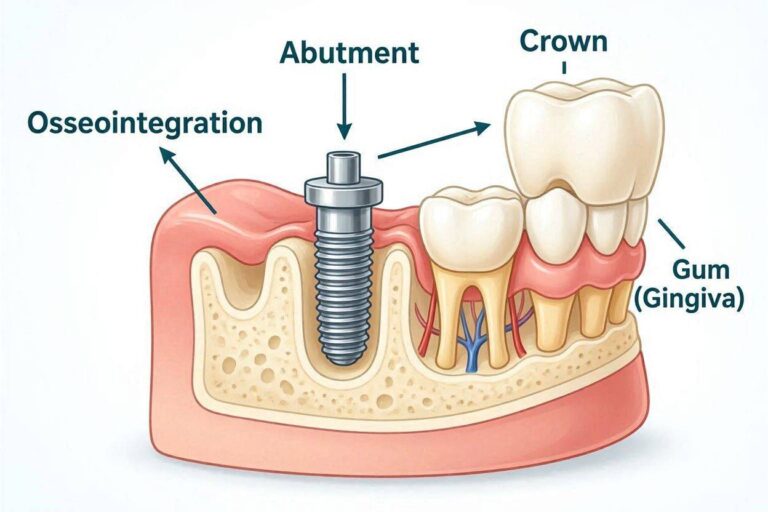
A common and highly effective model in New Jersey is the split-treatment approach. You have the surgical phase (the implant placement) performed by an oral surgeon or periodontist. You then return to your general dentist or a prosthodontist for the restorative phase (the custom abutment and crown). The restorative dentist is the architect of your final smile. Their skill in selecting the crown material, matching the shade, contouring the emergence profile from the gum, and adjusting the bite determines whether the implant looks and feels like a natural tooth or a dental appliance. The restorative fee for the abutment and crown ranges from $1,800 to $3,000 in NJ, depending on the crown material and the dentist’s aesthetic expertise.
A Detailed Fee Breakdown Table
| Procedure Component | Cost Range in NJ | Notes |
|---|---|---|
| Consultation & 3D CBCT Scan | $350 – $650 | Often credited toward total fee if you proceed |
| Single Implant Surgical Placement | $1,800 – $3,000 | Includes local anesthesia & all surgical disposables |
| Implant Fixture (Premium: Straumann/Nobel) | Included in surgical fee | Higher package price reflects premium brand |
| Implant Fixture (Value: Osstem/MIS) | Included in surgical fee | Available at some practices, lowers package by ~$500 |
| Abutment + PFM Crown | $1,800 – $2,400 | Functional, economical, metal base |
| Abutment + Full Zirconia Crown | $2,300 – $3,000 | Highest aesthetics, metal-free |
| Simple Bone Graft (Socket) | $500 – $1,200 | At time of extraction |
| Major Bone Graft (Ridge Augmentation) | $1,500 – $3,500 | Complex, extensive bone rebuilding |
| Sinus Lift (Lateral Window) | $2,500 – $4,500 | For upper molar implant placement |
The Rutgers School of Dental Medicine Option
New Jersey is home to one of the most respected dental schools in the country, the Rutgers School of Dental Medicine in Newark. This is the single most effective pathway to a dramatically reduced implant cost within the state’s borders. The implant surgery is performed by a resident dentist who is a licensed graduate, training to become a specialist, under the direct, in-room supervision of a board-certified attending periodontist, oral surgeon, or prosthodontist. The care is meticulous, protocol-driven, and uses premium implant brands. The trade-off is time. Appointments are longer, and there is a waiting list for surgery. The cost at the Rutgers clinic is 40% to 50% lower than a private practice, placing a complete single implant with crown in the $2,000 to $3,500 range. For a patient on a fixed income or facing a large treatment plan, this is the path to affordable, world-class care without leaving New Jersey.
Maximizing Dental Insurance in NJ
New Jersey dental insurance plans operate on a PPO or DHMO model, with a hard annual maximum that is almost always between $1,500 and $2,500. An implant will exhaust that maximum almost immediately. The key strategy is temporal splitting. The implant process is naturally divided into two phases separated by months. Phase one is the extraction and surgical implant placement. Phase two is the abutment and crown. If you schedule phase one in September of one year, the insurance pays up to its annual maximum for that year. You then schedule phase two in January of the next year, and the insurance pays up to its new annual maximum. You have effectively doubled the plan’s contribution. You must obtain a pre-treatment estimate and pre-authorization in writing from your insurance company for both phases before you begin. Some plans have a missing tooth clause, refusing to cover an implant for a tooth that was extracted before the policy’s start date. Read your plan’s fine print on this specifically.
In-House Membership and Cash Discounts
An increasing number of NJ private practices, particularly those frustrated with the administrative burden of insurance, offer in-house membership plans. You pay an annual fee directly to the practice, and you receive a defined list of services at significantly reduced rates. A membership plan might offer a 20% to 30% reduction on implant-related surgical and restorative fees. A simple, polite question during your consultation can unlock a cash discount. “I am paying out-of-pocket for this. Do you offer a cash-pay discount for payment in full at the time of service?” The practice saves on billing costs, and that saving can be 5% to 10% of the total fee. This is a straightforward, professional transaction.
Conclusion
In New Jersey, a single dental implant with a crown costs between $4,000 and $6,500 in a private practice setting, with prices peaking in the high-overhead North Jersey counties and moderating in the southern part of the state. The choice between a board-certified specialist and a general dentist, the tier of the dental laboratory, and the strategic timing of insurance benefits across two calendar years are the primary factors in managing the final cost. The Rutgers Dental School clinic offers an exceptional, supervised, lower-cost alternative for those with scheduling flexibility.
Frequently Asked Questions
Is the cost of an implant in NJ higher than in Pennsylvania?
In the border regions, the difference is minimal, but generally, North NJ fees are in direct parity with Manhattan, making them higher than suburban Philadelphia. South NJ fees are competitive with and often similar to those of the Philadelphia suburbs. The cost difference is driven by local overhead, not by a state mandate.
Does NJ Medicaid cover dental implants?
NJ FamilyCare, the state’s Medicaid program, provides limited adult dental benefits. Coverage for implants is extremely rare and is typically restricted to cases of documented medical necessity or trauma, and even then requires extensive pre-authorization. Routine elective implants are not a covered benefit.
Can I use a Health Savings Account (HSA) or Flexible Spending Account (FSA) to pay for an implant?
Yes. A dental implant is a qualified medical expense under IRS rules. You can use your HSA or FSA pre-tax dollars to pay for the entire treatment, including the consultation, surgery, and crown. This provides an effective discount equal to your marginal tax rate.
Why is there such a wide range in cost between different NJ practices?
The range is explained by three factors. First, the specialist’s level of training and board certification. Second, the geographic location and the practice’s overhead. Third, the quality of the dental laboratory and the material of the final crown. A full zirconia crown from a high-end NJ lab costs the practice significantly more than an imported PFM crown.
Additional Resource:
To find a board-certified specialist near you, visit the New Jersey Society of Periodontists directory at www.njperio.org.
Disclaimer: All prices provided are approximate ranges for the New Jersey market and are not a quote for any specific treatment. A personal consultation with a licensed NJ dentist is required for an accurate diagnosis and treatment plan. This article is for educational purposes only.