How Much Does Each Dental Implant Cost?
The cost of a single dental implant is one of the most searched questions by patients considering tooth replacement. Providing a single, simple answer is difficult because implant treatment is highly individualized. However, patients deserve clear, realistic price information to plan their treatment. This article provides a thorough breakdown of single-tooth implant costs, the factors that create price variation, geographic differences, insurance and financing considerations, and a realistic assessment of the long-term value.
The National Cost Range for a Single Implant
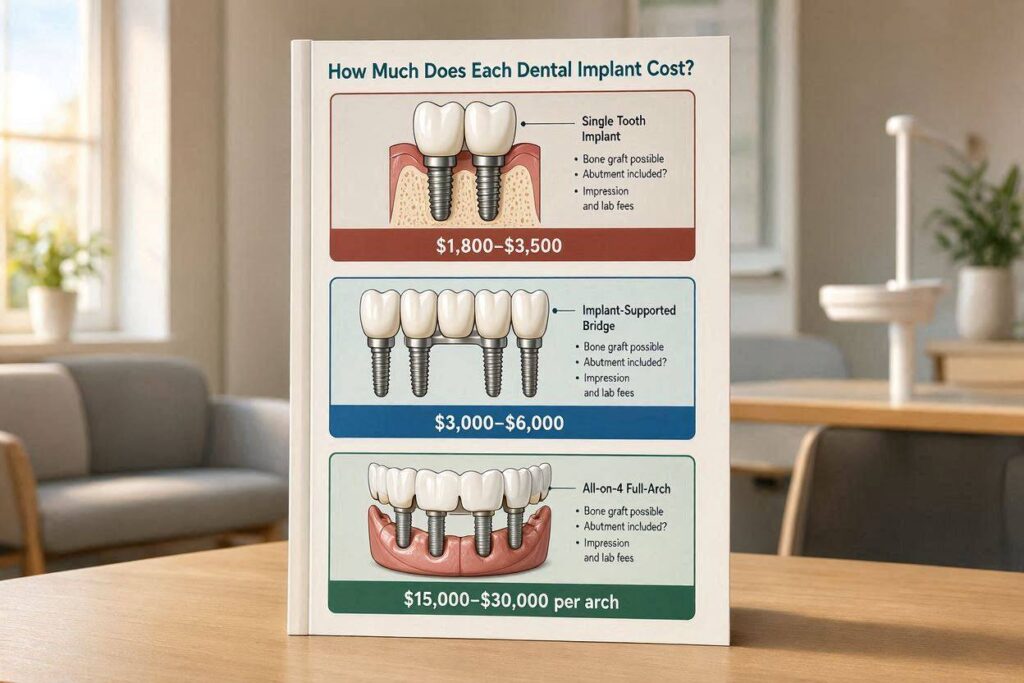
A complete single-tooth dental implant, including the surgical placement, abutment, and crown, typically costs between $3,000 and $6,000 in the United States. This range represents the total fee from start to finish for an uncomplicated case.
The Meaning of All-Inclusive Pricing
Some practices quote an all-inclusive fee that covers everything: consultation, imaging, implant placement, abutment, crown, and follow-up care. Other practices quote fees separately for each phase. When comparing prices, patients must understand exactly what is included.
An apparently lower fee may not include the abutment and crown, which are essential components of the completed restoration. A fee that seems higher may include sedation, bone grafting if needed, and extended warranty coverage. Request a written treatment plan detailing all included services.
Breakdown of Typical Component Costs
| Component | Typical Cost Range |
|---|---|
| Initial Consultation and Examination | $100 – $300 |
| Cone Beam CT Scan | $200 – $600 |
| Implant Fixture and Surgical Placement | $1,600 – $3,200 |
| Abutment (Stock) | $300 – $600 |
| Abutment (Custom) | $500 – $900 |
| Implant Crown (PFM or Ceramic) | $1,200 – $2,800 |
| Total Uncomplicated Single Implant | $3,400 – $6,900 |
These figures are averages. Individual quotes vary based on the factors discussed below.
Factors That Influence the Cost of Each Implant
The variation from patient to patient and practice to practice reflects real differences in treatment.
Geographic Location
Implant fees reflect local economic conditions. Practices in high-cost metropolitan areas charge more to cover higher rent, staff wages, and other overhead. Practices in rural areas or smaller cities, where overhead is lower, often charge less.
| Region | Typical Single Implant Cost |
|---|---|
| Northeast Urban Corridor | $4,500 – $7,000 |
| West Coast Metropolitan | $4,000 – $6,500 |
| Southeast and South Central | $3,000 – $5,000 |
| Midwest | $3,200 – $5,200 |
| Rural Areas | $2,800 – $4,500 |
Provider Type and Expertise
The training and experience of the provider influence fees. An oral and maxillofacial surgeon or periodontist typically charges more for implant placement than a general dentist. This premium reflects additional years of specialized residency training and the ability to manage complex cases.
Within each category, experience level and reputation affect fees. A provider who places hundreds of implants annually and has advanced training in complex bone grafting commands higher fees than a provider newer to implant dentistry.
Implant System and Laboratory Selection
Premium implant systems with extensive research backing and long-term data cost more than value-priced systems. The laboratory fabricating the abutment and crown also affects cost. A master ceramist creating a customized, highly aesthetic crown charges more than a high-volume laboratory producing standard restorations.
Case Complexity and Adjunctive Procedures
The single largest variable in implant cost is the need for additional procedures. A patient with adequate bone, healthy gums, and a straightforward implant site pays the base fee. A patient requiring bone grafting, a sinus lift, or soft tissue augmentation pays significantly more.
| Adjunctive Procedure | Additional Cost Range |
|---|---|
| Socket Preservation Graft | $300 – $800 |
| Minor Guided Bone Regeneration | $500 – $1,500 |
| Major Block Bone Graft | $2,000 – $4,500 |
| Sinus Lift | $2,000 – $5,000 |
| Soft Tissue Graft | $600 – $1,500 |
| Tooth Extraction (Simple) | $150 – $400 |
| Tooth Extraction (Surgical) | $400 – $1,200 |
Sedation and Anesthesia
Most implant surgery uses local anesthesia, which is included in the surgical fee. Patients who request or require additional sedation incur additional costs.
| Sedation Type | Additional Cost Range |
|---|---|
| Nitrous Oxide (Laughing Gas) | $100 – $300 |
| Oral Conscious Sedation | $200 – $500 |
| IV Sedation | $400 – $1,000+ |
Insurance and Payment Method
Patients with dental insurance that covers implants pay less out of pocket, though annual maximums limit the benefit. Patients paying cash may receive a discount from some practices. Patients using third-party financing pay the full fee plus interest unless a promotional interest-free period applies.
The Hidden Costs of Bargain Implants
The temptation to seek the lowest possible price can lead to poor outcomes.
The True Cost of Implant Failure
A failed implant must be removed, the site must heal, and a new implant must be placed. The cost of revision often exceeds the cost of proper treatment initially. The patient endures additional surgery, extended treatment time, and the emotional toll of failure.
The Value of Long-Term Success
An implant placed by an experienced provider using a premium system and a quality laboratory has a very high probability of lasting decades. Amortized over 20 or 30 years, the annual cost is modest. The value lies not in the initial price but in the years of reliable function.
Why Implants Cost More Than Other Tooth Replacement Options
Comparing implant costs to alternatives provides context.
Bridges
A three-unit fixed bridge replaces one missing tooth by crowning the adjacent teeth. The initial cost ranges from $3,500 to $5,000, comparable to an implant. However, bridges require replacement every 10 to 15 years, and the preparation of adjacent healthy teeth carries biological costs. Over 20 to 30 years, the implant is typically more economical.
Partial Dentures
A removable partial denture costs $1,500 to $3,000 initially, less than an implant. However, partial dentures accelerate bone loss in the edentulous area, may damage abutment teeth through clasping, and require replacement every five to ten years. The long-term costs and biological consequences often make implants the better value.
No Treatment
Leaving a missing tooth unreplaced costs nothing initially but leads to adjacent tooth drift, opposing tooth supra-eruption, bone resorption, and altered occlusion. These changes may require extensive treatment to correct later. The cost of managing the sequelae of untreated tooth loss frequently exceeds the cost of timely implant placement.
Strategies to Reduce Implant Costs Without Sacrificing Quality
Patients can take steps to manage costs while receiving excellent care.
Dental Schools and Residency Programs
Dental schools and advanced education residency programs offer implant treatment at reduced fees. Treatment is provided by students or residents under close faculty supervision. Fees are typically 30 to 60 percent lower than private practice. The trade-off is longer appointments and extended treatment timelines.
Geographic Arbitrage
Traveling from a high-cost metropolitan area to a reputable practice in a lower-cost region can yield substantial savings. The difference in implant fees often covers travel expenses while still saving money. Research the provider thoroughly.
Dental Tourism with Caution
Some patients travel internationally for lower-cost implants. Savings of 50 to 70 percent are possible. However, the risks of unregulated materials, variable quality standards, and inaccessible follow-up care must be weighed carefully. Complications from overseas treatment often cost more to correct domestically than the initial savings.
Insurance Optimization
If you have dental insurance with implant coverage, timing treatment across plan years maximizes benefits. Place the implant late in one year and complete the crown early in the next year to access two annual maximums.
Payment Plans and Financing
Spreading the cost over time makes treatment accessible without a large upfront payment. Third-party healthcare financing offers terms from six to 60 months. In-house payment plans divide the fee into installments aligned with treatment phases.
Conclusion
A single dental implant in the United States typically costs between $3,000 and $6,000 for a complete restoration, with geographic location, provider expertise, implant system, laboratory quality, and case complexity creating variation. Adjunctive procedures such as bone grafting or sinus lifts can add thousands to the total. While the initial cost exceeds that of bridges or partial dentures, the implant’s longevity, bone preservation, and independence from adjacent teeth often make it the most cost-effective option over decades. Patients should request detailed written treatment plans, verify exactly what is included, and explore financing and insurance strategies to manage costs.
Frequently Asked Questions
Why do implant costs vary so much from one dentist to another?
Variation reflects differences in provider training and experience, implant system and laboratory quality, practice overhead based on location, and the comprehensiveness of the quoted fee. Always compare what is included.
Does dental insurance cover the full cost of an implant?
No standard dental insurance plan covers the full cost. Typical plans cover 50 percent of major services up to an annual maximum of $1,500 to $2,500, leaving significant patient responsibility.
Can I get a single implant and save money by skipping the crown?
No. The implant replaces the root only. The crown is the visible tooth portion and is essential for function and aesthetics. An implant without a crown is an incomplete treatment.
How can I afford an implant on a limited budget?
Consider dental schools, payment plans, treatment staging across calendar years for insurance benefits, and geographic arbitrage. Prioritize the implant’s long-term value over short-term savings that compromise quality.
Additional Resource
For information on dental implant costs and financing, visit the American Academy of Implant Dentistry at www.aaid.com. The AAID provides patient education on implant treatment and cost considerations.