How Quickly Does Teeth Whitening Work?
The desire for whiter teeth is often triggered by a specific deadline. Perhaps a wedding is two weeks away, a job interview looms, or a long-awaited reunion is on the calendar. You stare at your smile in the mirror and a single urgent question crystallizes: just how quickly does teeth whitening work? Can a single treatment transform your shade overnight, or is this a slow, weeks-long journey requiring patience you simply do not have?
The speed of teeth whitening is not a single fixed number. It is a variable determined by the concentration of the whitening agent, the method of delivery, the type of stain you are fighting, and the natural biology of your enamel. In the fastest professional scenario, a perceptible shade change occurs in under one hour. With the slowest, gentlest at-home methods, a visible difference may take two weeks to emerge clearly. This article maps out realistic timelines for every major whitening modality, explains the biological reasons for the variation in speed, and helps you match the method to your calendar so that you can set an evidence-based expectation rather than a wishful one.
The Biology of Whitening Speed: Why Teeth Don’t Change Instantly
Before analyzing methods, it is crucial to understand the biological bottleneck that limits whitening speed. The active bleaching molecule, most commonly hydrogen peroxide, must complete a multi-step physical journey. First, the peroxide gel must diffuse through the acquired pellicle (the protein biofilm coating the enamel). Then, it must navigate the microscopic porosities between the tightly packed enamel rods. Finally, it reaches the dentin-enamel junction and the dentinal tubules where the majority of intrinsic chromophore molecules reside.
Each step involves mass transport, not instantaneous magic. The rate-limiting step is the diffusion coefficient of hydrogen peroxide through mineralized tissue. This coefficient is fixed by the laws of physics and the porosity of your specific enamel. Some individuals have highly mineralized, dense, impermeable enamel that resists rapid peroxide penetration. Their whitening will be slower, regardless of the method. Others have more porous, less densely packed enamel that allows free radicals to surge through quickly, producing rapid, dramatic results but also a higher likelihood of sensitivity. You cannot change your enamel’s innate permeability; you can only choose a method that aligns with it.
The second critical variable is the type of chromophore being oxidized. Fresh, superficial extrinsic stains from coffee or red wine—tannin-based molecules loosely bound to the pellicle—yield their bonds quickly to low concentrations of peroxide. Deep, intrinsic, age-related yellowing caused by decades of accumulated Maillard reaction pigments within the dentin matrix requires prolonged, sustained, or repeated high-concentration oxidative assault to break down. A young person with superficial coffee stains will see results dramatically faster than a sixty-year-old with amber, translucent, deeply embedded dentin pigmentation, using the exact same product.
In-Office Chairside Whitening: The 60-90 Minute Transformation
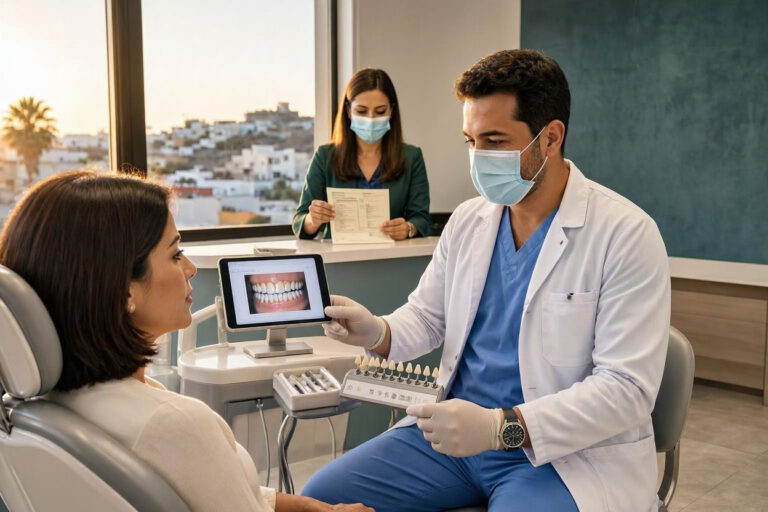
For sheer velocity, nothing currently surpasses professionally administered in-office power bleaching. This method delivers the highest legally permissible concentrations of hydrogen peroxide (typically 25% to 40%) directly onto carefully isolated teeth, often accelerated by a specialized LED, plasma arc, or halogen curing light.
Timeline Breakdown:
- Minute 0-15: Pre-procedural preparation includes gingival barrier placement, cheek retraction, and shade documentation. No color change occurs yet.
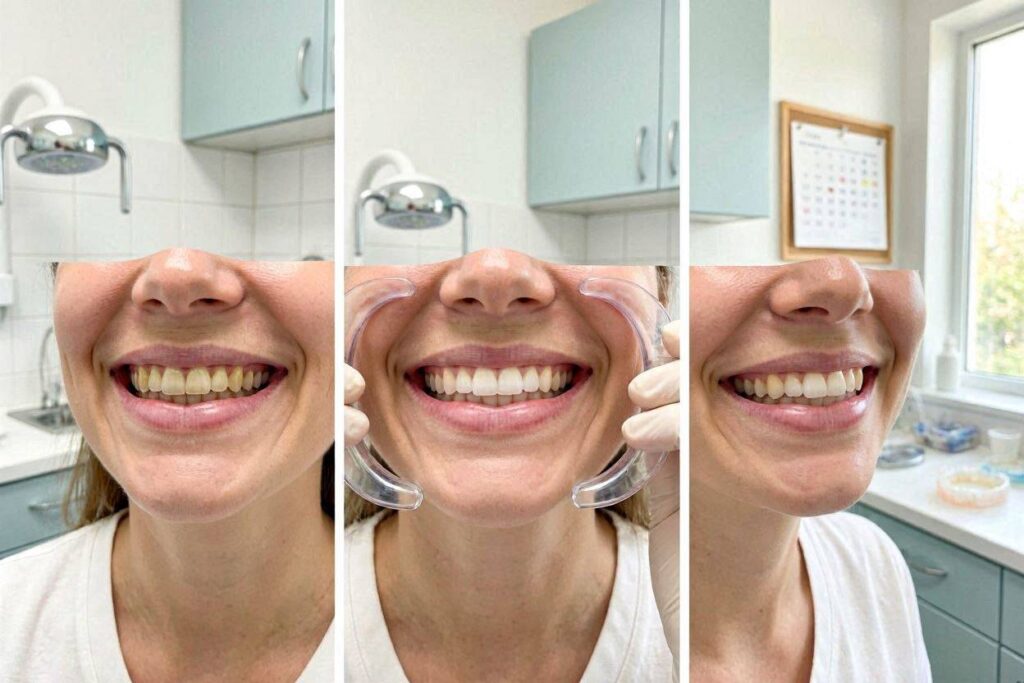
- Minute 15-35: First application cycle. The high-concentration gel saturates the enamel. The light, if used, provides thermal energy that roughly doubles the kinetic rate of the oxidation reaction for each 10°C temperature rise. By the end of this first 15-20 minute cycle, a shade shift of 3 to 5 tabs on the Vita Classical shade guide is typical.
- Minute 35-55: Second application cycle. Fresh gel replenishes the peroxide reservoir. The oxidation continues. A further 1 to 2 shade tabs of lightening occur.
- Minute 55-75: Third and final cycle. The shade progression plateaus as the dentin chromophores accessible to this rapid pulse are largely exhausted. Total session shade change typically ranges from 5 to 8 tabs brighter.
- Minute 75-90: Immediate desensitization, fluoride varnish application, and post-operative photography.
Net Speed: A dramatic, undeniable whitening occurs in roughly one and a half hours of chair time. However, the color observed immediately post-treatment is artificially enhanced by temporary enamel dehydration. The true, stable, hydrated shade will settle over the next 48 hours and may “rebound” darker by 1 to 2 shade tabs. Therefore, for an event, schedule in-office whitening at least 3 days, not the day before, to allow for color stabilization and sensitivity resolution.
Custom Take-Home Trays (Dentist-Prescribed): 7-14 Days
This method offers a middle ground between the instant punch of in-office power bleaching and the slow drip of over-the-counter strips. Your dentist takes impressions and fabricates custom-fitted, soft, flexible trays that precisely hug your dental anatomy, minimizing gel contact with the gums and ensuring an even, thin layer of peroxide against the enamel. The gel is typically 10% to 16% carbamide peroxide (equivalent to roughly 3.5% to 5.5% hydrogen peroxide released over time).
Timeline by Protocol:
- Daytime Protocol (1-2 hours daily wear): With 15% carbamide peroxide worn for 1-2 hours daily, noticeable lightening typically appears by day 3 or 4. A full 10-14 day cycle achieves the maximum cosmetic endpoint for this concentration. The daily sessions are shorter, so the cumulative dose builds more slowly.
- Overnight Protocol (6-8 hours nightly wear): With 10% carbamide peroxide worn while sleeping, the sustained, prolonged low-concentration oxidative bath achieves visible results often by day 2 or 3. The total treatment course is typically 7-10 nights. The speed feels psychologically accelerated because you are unconscious for the process and wake up to incremental improvements.
The custom tray approach is inherently faster than strips at equivalent concentrations because the tray’s occlusive seal prevents salivary dilution and peroxide washout, maintaining a constant, undiluted peroxide pool against the enamel for the entire wear period.
Over-the-Counter Whitening Strips: 5-14 Days
Polyethylene strips coated with a pre-measured layer of hydrogen peroxide gel are the most accessible accelerated method. These strips typically contain 6% to 10% hydrogen peroxide, a concentration significantly higher than what is released from overnight carbamide peroxide trays, but delivered in a thin, unsealed film.
Timeline Reality:
- High-Strength Strips (e.g., 10% H2O2, 30-min wear): Many users report a visible difference after just 2 to 3 daily applications. A full 7-10 day course produces a shade improvement comparable to a 10-day custom tray protocol, though often with more irregular whitening near the interproximal areas where the strip doesn’t conform perfectly. Speed is high, but uniformity may suffer.
- Gentle Strips (e.g., 3-5% H2O2, 15-30 min wear): These are designed for sensitive teeth. Visible results take longer, typically 7-10 days to become apparent, with a full 14-day course required to reach a moderate shade change. The slower speed is the price paid for reduced neural irritation.
Strips work quickly on the flat facial surfaces of the central incisors but may leave the curved canines and premolars lagging behind in shade, creating a subtle but noticeable “two-tone” effect if the course is terminated too early.
Whitening Pens and Paint-On Gels: 7-21 Days
Whitening pens dispense a film of peroxide gel directly onto the tooth surface via a brush or rollerball tip. The gel is intended to air-dry into a thin, adherent film and remain in place. These products contain moderate concentrations of hydrogen peroxide (3% to 6%).
The primary speed limitation of pens is contact time. Unlike a tray or strip that holds the gel reservoir in place against the tooth, a paint-on film is vulnerable to immediate dilution and washout by saliva and tongue movement. Even “rapid-drying” formulations achieve an effective undiluted contact time measured in minutes, not hours. The actual peroxide dwell time is low. Consequently, pen users typically require 2 to 3 weeks of twice-daily application to achieve a result comparable to one week of strip use. The speed is modest, and the method is best suited for maintenance touch-ups rather than primary rapid whitening.
Charcoal, Baking Soda, and Abrasive Methods: Instant Optical, Zero Chemical
A critical distinction must be drawn between chemical whitening speed and mechanical cleaning speed. Abrasive methods like brushing with activated charcoal, baking soda, or clay powders produce an instant visual change—but it is an illusion of whitening. The abrasive scrub removes the superficial, stain-laden biofilm and pellicle in the first 30 seconds of brushing, revealing the clean, unstained enamel underneath. The tooth appears brighter immediately.
However, this is stain removal, not whitening. The underlying enamel shade is unchanged. The effect plateaus after the first use; subsequent daily scrubbing does not progressively lighten the tooth to ever-increasing levels of whiteness. Once the pellicle is gone, it is gone. Further scrubbing only abrades enamel. True chemical oxidation progressively bleaches chromophores over days and weeks, reaching a deeper final shade. Mechanical cleaning provides a one-time, superficial, instant brightness boost that should not be mistaken for the cumulative whitening curve.
The Initial Plateau and the “Chasing the White” Trap
A universal psychological phenomenon in teeth whitening is the initial plateau trap. During the first 3-4 days of any chemical method, the shade change is rapid and visually thrilling. The large, easy-to-oxidize surface chromophores are destroyed quickly. Then, around day 5-7, the daily visible improvement slows dramatically. The curve flattens. The remaining stains are deep, densely cross-linked, and resistant.
Many users misinterpret this natural kinetic plateau as the product “stopping working” and prematurely abandon the treatment, or worse, double the application frequency and concentration to “break through.” The product is still working; the rate of color change has simply moved from the fast, dramatic extrinsic phase to the slow, steady intrinsic phase. The full recommended cycle length (10-14 days for most methods) is designed to ride through this plateau and achieve the stable dentin shade endpoint. Patience during days 5-10 is the key differentiator between a mediocre result and a complete whitening outcome.
Speed-Boosting Strategies That Are Safe and Realistic
While you cannot fundamentally alter the diffusion kinetics of peroxide through your enamel, you can optimize the treatment environment to maximize speed within the safe limits of the product.
Pre-Whitening Enamel Conditioning:
For one week before starting whitening, brush with a toothpaste containing nano-hydroxyapatite or fluoride. This fills in micro-porosities and surface defects in the enamel, creating a smoother, more homogenous surface that allows the peroxide gel to form a uniform, intimate contact layer without air pockets. A uniform contact layer delivers peroxide evenly and quickly.
Optimal Contact Pressure:
When using strips or trays, press them firmly (but not painfully) into place and then run a fingertip over the facial surface of the tray or strip, smoothing out any visible air bubbles. An air bubble is a zone of zero whitening. Eliminating bubbles ensures every square millimeter of enamel is undergoing oxidation from the first minute.
In-Session Saliva Management:
Saliva contains the enzyme catalase, which breaks down hydrogen peroxide into water and oxygen before it can penetrate the tooth. A mouth awash with saliva during a strip session is self-sabotaging the whitening speed. Use a dry-angle (a small absorbent triangular pad) tucked into the cheek vestibule to wick away saliva during the 30-minute session, keeping the strip environment relatively dry. Do not swallow constantly and flood the strip.
Post-Treatment Temperature Management:
The oxidation reaction rate is temperature-dependent. While you should never dangerously heat a peroxide gel, you can maintain the natural warmth of the oral cavity by keeping your mouth closed and breathing through your nose during the session. Mouth breathing cools the teeth and slows the reaction marginally.
The Laser Misconception: Speed vs. Hype
Marketing for “laser whitening” often promises results in 20 minutes, suggesting a quantum leap in speed over standard LED or chemical methods. In reality, the true dental laser (such as an argon or diode laser) is not interacting directly with the stain molecules. The laser energy is absorbed by a chromophore in the gel (often a red pigment) or by the water in the enamel, causing a rapid, localized thermal spike. This heat accelerates the peroxide decomposition, providing a burst of free radicals.
The speed advantage is real but not exponential. Laser-accelerated whitening achieves in one 20-minute cycle roughly what a standard LED light achieves in two 15-minute cycles. The total chair time saved may be 10 to 15 minutes. Laser is faster in the strict chronometric sense, but the biological whitening ceiling imposed by the dentin chromophore chemistry cannot be circumvented by any light source. The maximum achievable whiteness at the end of the session is the same.
Comparative Table: Speed of Different Whitening Methods
| Whitening Method | Active Agent & Concentration | Time to Visible Change | Time to Maximum Result | Key Speed Modifier |
|---|---|---|---|---|
| In-Office Power Bleaching | 25-40% H2O2 | Immediate (within 60 mins) | 1 session (1-1.5 hrs) | Light/heat acceleration; dehydration |
| Dentist Custom Trays | 10-16% Carbamide Peroxide | 2-4 days | 7-14 days | Overnight sustained release |
| Whitening Strips (High Str.) | 10% H2O2 | 2-3 days | 7-10 days | Saliva dilution in unsealed system |
| Whitening Strips (Gentle) | 3-5% H2O2 | 7-10 days | 14-21 days | Low concentration for sensitivity |
| Whitening Pen | 3-6% H2O2 | 7-10 days | 14-21 days | Poor dwell time; saliva washout |
| Baking Soda / Charcoal | None (Mechanical) | Instant (optical pellicle removal) | Immediate plateau; no further gain | No chemical bleaching action |
Conclusion
- The fastest legitimate whitening occurs with in-office power bleaching, producing a dramatic 5-8 shade jump in approximately 60-90 minutes of chair time, though the immediate result is artificially amplified by dehydration and settles over 48 hours.
- At-home chemical methods like strips and custom trays achieve noticeable improvement in 2-4 days and a stable maximum cosmetic result in 7-14 days, with the speed governed by peroxide concentration, enamel porosity, and effective contact time unimpeded by saliva.
- Mechanical methods like baking soda or charcoal create an instant brightness by removing superficial biofilm but produce no progressive, cumulative chemical bleaching; their “speed” is an optical cleaning illusion that plateaus after the first use.
Frequently Asked Questions
Can I whiten my teeth in one day?
Yes, but only via a professional in-office chairside session. You will leave the clinic with objectively whiter teeth. No over-the-counter method can deliver a full shade change in a single 24-hour period, as safe at-home peroxide concentrations require multiple cumulative exposures.
Why don’t my teeth whiten as fast as my friend’s teeth?
Your enamel’s permeability and your stain type differ. Dense, highly mineralized enamel resists peroxide diffusion, slowing the rate. Deep intrinsic tetracycline or fluorosis staining requires exponentially more oxidative energy to break down than simple extrinsic coffee stains, resulting in a slower perceived change.
Does whitening toothpaste work faster than gel?
No. Whitening toothpaste relies on mechanical abrasion of surface stains, which produces a one-time instant brightness after the first brush but does not chemically oxidize intrinsic chromophores. It cannot progressively whiten teeth deeper over time like peroxide gel does.
Will sitting with strips for 2 hours instead of 30 minutes speed things up?
This is dangerous and not recommended. The peroxide in strips is designed to be chemically active for a specific duration. Prolonging contact saturates the enamel and dramatically increases the peroxide flux into the pulp chamber, causing intense, possibly prolonged pain without proportionally faster whitening.
How long should I wait between whitening cycles for the fastest cumulative result?
The minimum safe interval between complete treatment cycles is 2 weeks. This allows the pulpal inflammation to fully resolve and the enamel pellicle to remineralize. Overlapping cycles without a rest period increases sensitivity and risk of adverse reaction without speeding up the final color attainment.
Additional Resource:
For an overview of the clinical effectiveness and safety timelines of various whitening modalities, consult the British Dental Association’s patient information on tooth whitening. <a href=”https://bda.org/patient/teeth-whitening” target=”_blank” rel=”noopener noreferrer”>BDA: Teeth Whitening</a>
Disclaimer: This article is for informational and educational purposes only and does not constitute medical or dental advice. Whitening timelines vary based on individual dental anatomy, stain type, and product formulation. You should consult with a qualified dental professional to determine the most appropriate and realistic whitening timeline for your specific oral health condition and aesthetic goals.