How To Choose An Implant Dentist?
Selecting the clinician who will place and restore your dental implant is the single most consequential decision in the implant process. The skill, training, and judgment of the implant dentist directly determine the success, longevity, and aesthetic quality of the result. This is not a commodity purchase. An implant is a surgical medical device and a custom prosthetic restoration. The provider you choose should be evaluated with the same rigor you would apply to selecting a surgeon for any other part of your body. This guide provides a comprehensive, systematic framework for choosing an implant dentist. We will cover the credentials that matter, the questions to ask during the consultation, the red flags to avoid, and the practice models that exist.
The Foundational Question: Who Will Perform Each Phase?
Implant treatment consists of a surgical phase (placing the implant body into the bone) and a restorative phase (attaching the abutment and fabricating the crown, bridge, or denture). The first decision point is whether one clinician will perform both phases or whether a team approach will be used.
The Single-Provider Model
A general dentist with advanced implant training or a specialist (periodontist or prosthodontist) performs both the surgery and the restoration. The advantages are continuity of care, a single point of responsibility, and seamless communication between the surgical and restorative phases. This model works well for straightforward cases and for patients who value the convenience of a single location.
The Team Model
An oral surgeon or periodontist performs the surgical placement, and a restorative dentist (general dentist or prosthodontist) fabricates and delivers the crown. The team model brings two specialized perspectives to the case. The surgeon focuses on the bone, soft tissue, and surgical precision. The restorative dentist focuses on the aesthetic and functional outcome. This model is particularly valuable for complex cases, full-arch reconstructions, and cases in the aesthetic zone.
Ask any prospective provider: “Do you perform both the surgery and the restoration, or do you work with a surgical specialist?” There is no universally correct answer; both models can produce excellent results. The key is that the provider is transparent about the workflow and that each clinician involved has the appropriate expertise.
Credentials That Matter
Implant dentistry is not a recognized dental specialty in the United States. Any licensed dentist may legally place and restore implants. Therefore, you must look beyond the basic dental degree to evaluate specific training and credentialing.
Surgical Specialists
- Oral and Maxillofacial Surgeon: Has completed a four- to six-year hospital-based surgical residency after dental school, including rotations in anesthesia, internal medicine, and general surgery. Board certification by the American Board of Oral and Maxillofacial Surgery (ABOMS) is the highest credential. Oral surgeons are the definitive specialists for complex surgical cases, significant bone grafting, and sedation.
- Periodontist: Has completed a three-year residency in periodontology and implant surgery. Board certification by the American Board of Periodontology (ABP) signifies advanced expertise. Periodontists specialize in the soft tissue and bone interface and are excellent choices for implants in the aesthetic zone and for patients with a history of gum disease.
Restorative Specialists
- Prosthodontist: Has completed a three-year residency in prosthodontics, the specialty of restoring and replacing teeth. Board certification by the American Board of Prosthodontics (ABP) is the highest credential. Prosthodontists are the master architects of complex implant cases, particularly full-mouth reconstructions and implant-supported dentures.
Credentialing Organizations for General Dentists
A general dentist who places implants should have substantial, verifiable post-graduate training. Look for the following credentials.
- Diplomate, American Academy of Implant Dentistry (D-AAID): This is the highest credential in implant dentistry available to general dentists and specialists. It requires a comprehensive written and oral examination and the submission of completed implant cases for peer review. An AAID Diplomate has demonstrated proficiency in both the surgical and restorative phases.
- Fellow, American Academy of Implant Dentistry (FAAID): A significant credential indicating advanced training and experience, below the Diplomate level.
- Fellow or Diplomate, International Congress of Oral Implantologists (ICOI): The ICOI offers a tiered credentialing system. The requirements are less rigorous than the AAID, but the credential still indicates a commitment to implant education.
Hospital Privileges
A dentist who has hospital privileges to perform implant surgery has undergone a credentialing process by the hospital’s medical staff. This is an external validation of their training and competence. It is not a guarantee of quality, but it is a positive indicator, particularly for complex cases.
The Consultation: Questions to Ask
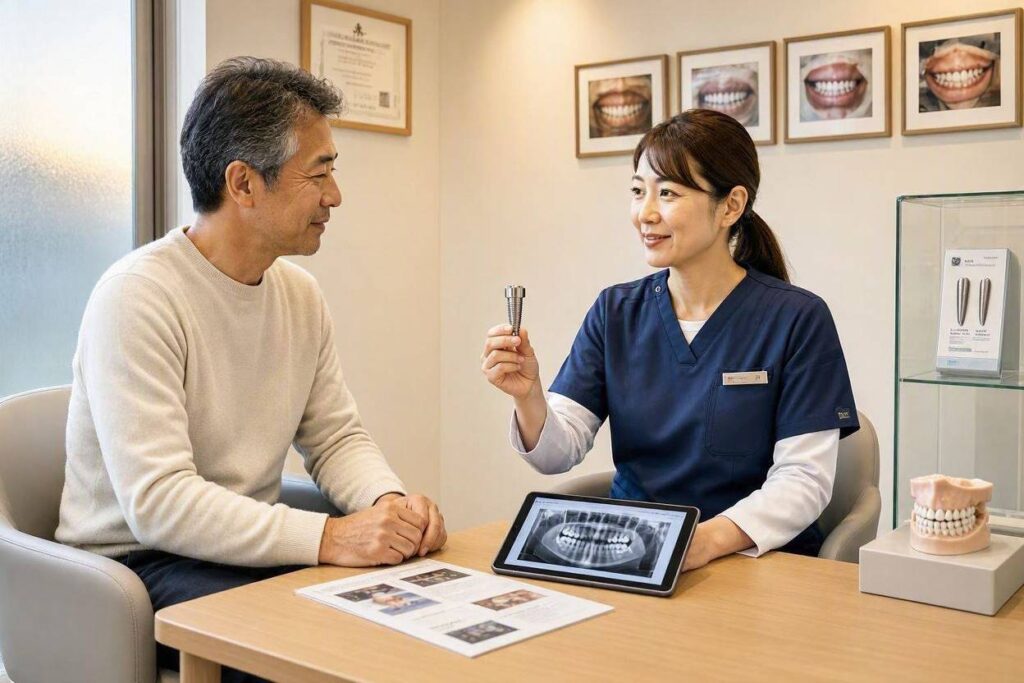
The consultation is your opportunity to evaluate the dentist’s expertise, communication style, and treatment philosophy. A thorough consultation should be unrushed and should welcome your questions. The dentist should review your medical and dental history, perform a clinical examination, and review any X-rays or a CBCT scan. A written treatment plan with procedure codes and fees should be provided.
Essential Questions
- “What is your specific training in implant dentistry?” Listen for a completed specialty residency (oral surgery, periodontics, prosthodontics) or a rigorous, multi-year implant credentialing program (AAID Diplomate). A weekend course or a manufacturer’s one-day seminar is not sufficient training for routine implant placement.
- “How many implant cases similar to mine have you completed?” The answer should be a confident, specific number. “Many” or “I’ve been doing this for years” is not an adequate answer. Ask for a range: “Approximately how many single-implant cases do you place per year? How many full-arch cases?”
- “Do you use a CBCT scan for planning, and do you use a surgical guide?” Three-dimensional planning with a CBCT is the standard of care. A surgical guide, fabricated from the CBCT data, transfers the virtual plan to the surgical site. The dentist should answer yes to both, except in the most straightforward cases where a CBCT may still be recommended but a surgical guide may not be strictly necessary.
- “What is your complication rate, and how do you manage failures?” A competent clinician openly discusses risks. They should have a clear protocol for managing implant failure, including removal, grafting, and replacement. A dentist who says they have never had a failure has either placed very few implants or is being untruthful.
- “May I see before-and-after photographs of your own patients with cases similar to mine?” Evaluate the aesthetics of their work. The photographs should be of their actual patients, not stock photos from an implant manufacturer. Look at the gum tissue health, the tooth contours, and the overall harmony of the smile. If the dentist cannot or will not provide photographs, this is a concern.
- “What type of implant system do you use, and why?” There are many reputable implant manufacturers. The dentist should be able to name the system they use and explain the clinical rationale for their choice. Avoid a dentist who uses a single, obscure implant system simply because it is the cheapest available. The implant system should be well-researched with a long track record and readily available components.
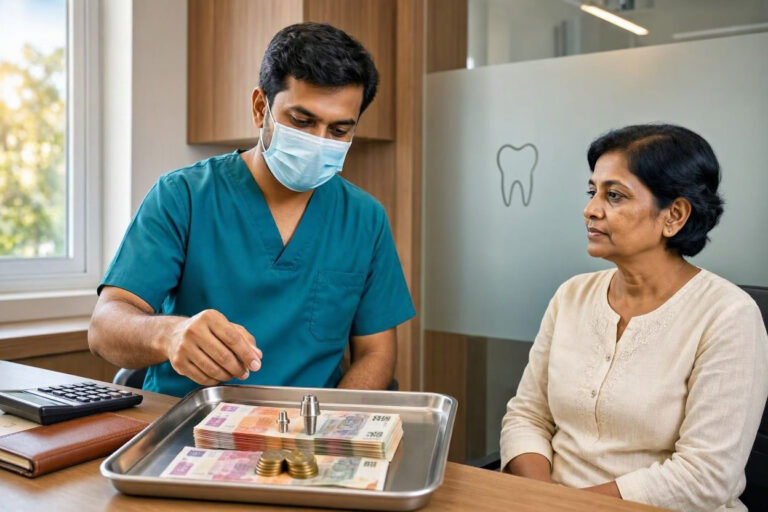
- “What is the total, all-inclusive cost, and what does it cover?” The treatment plan should be a detailed, written document with ADA procedure codes and fees. It should specify whether the diagnostic workup, the surgical guide, the implant, the abutment, the crown, any necessary grafting, and any follow-up visits are included. Ask about the cost of managing a complication or a failure. Understand the financial commitment completely before proceeding.
Red Flags to Avoid
Certain signs during the consultation or in the practice’s marketing should raise caution.
- The “Too Good to Be True” Low Price: Advertisements for “$999 Implants” or similar extreme discounts are almost always bait-and-switch tactics. The low price typically covers only the implant body, excluding the diagnostic workup, the CBCT, the surgical guide, the abutment, the crown, and any grafting. Read the fine print. A responsible implant dentist provides an all-inclusive fee.
- High-Pressure Sales Tactics: A consultation that feels like a sales presentation, with limited time offers, discounts for signing up on the same day, or pressure to commit to a full-mouth reconstruction before a thorough diagnostic workup, is a major red flag. Implant treatment is elective and should be a carefully considered decision.
- No CBCT or Surgical Guide: A dentist who places implants using only a two-dimensional panoramic X-ray, without a CBCT, is not practicing to the current standard of care for most cases. There are exceptions for straightforward cases with abundant bone, but a CBCT should be the default.
- Unwillingness to Provide Credentials or Patient Photographs: A competent dentist is proud of their training and their work. A refusal to share this information is concerning.
- Guaranteeing a “Lifetime” Implant: Implants have excellent long-term survival, but no medical device is guaranteed for life. A responsible clinician discusses realistic expectations and the importance of maintenance.
The Value of a Second Opinion
If you are uncertain about a treatment plan or the proposed cost, seek a second opinion. A different implant dentist can review your records, confirm the diagnosis, and offer an alternative treatment philosophy. A second opinion is not an insult to the first dentist; it is a responsible patient behavior. The cost of a consultation and a limited exam is a small investment to confirm a treatment plan that will cost thousands of dollars and affect your health for decades.
Conclusion
Choosing an implant dentist requires evaluating their specific training—ideally a surgical specialty residency (oral surgery or periodontics) or a rigorous credential like AAID Diplomate—their use of CBCT-guided planning and surgical guides, and their transparency in providing a written, all-inclusive treatment plan with patient-specific before-and-after photographs. The consultation should be a thorough, unrushed, educational experience without high-pressure sales tactics. The decision between a single provider and a surgical-restorative team depends on case complexity and personal preference, with both models capable of excellent outcomes when the clinicians are appropriately credentialed.
Frequently Asked Questions
Is a specialist always better than a general dentist for implants?
Not necessarily. A general dentist who has completed extensive implant training, holds an AAID Diplomate credential, and has placed hundreds of implants can produce excellent results for straightforward cases. A specialist—oral surgeon, periodontist, or prosthodontist—has completed a multi-year residency and is the appropriate choice for complex cases involving significant bone grafting, full-arch reconstruction, or medical comorbidities. The training and experience of the individual clinician matter more than the title.
How important is the implant brand?
The major implant manufacturers—Straumann, Nobel Biocare, Astra Tech, BioHorizons, Zimmer Biomet, and others—all produce high-quality, well-researched implants with decades of data. The specific brand is less important than the clinician’s familiarity with the system and the availability of components for future maintenance and repair. Avoid an obscure, no-name implant system that may not have replacement parts available in ten years.
Should I travel to a different city for a better implant dentist?
For a straightforward single implant, a well-trained local provider is usually sufficient. For a complex full-arch case or a case in the aesthetic zone, it may be worth traveling to a recognized expert. The inconvenience of travel for a few appointments over several months is weighed against the lifelong result. A prosthodontist or an oral surgeon at a university-based practice or a reputable private specialty center is a reasonable destination for complex care.
What if I am not comfortable with the dentist after the consultation?
Trust your instinct. The implant process involves surgery and multiple appointments over months. You must feel comfortable with the clinician, confident in their ability, and able to communicate openly. If the consultation leaves you feeling uneasy, pressured, or uninformed, seek another opinion. There are many qualified implant dentists, and you have the right to choose one with whom you have a good rapport.
Additional Resource
The American Academy of Implant Dentistry provides a “Find an Implant Dentist” search tool at aaid.com. You can search for AAID-credentialed dentists in your area, filtering by General Dentist, Oral Surgeon, Periodontist, or Prosthodontist. The AAID Fellow and Diplomate credentials indicate a verified level of implant training and experience beyond the basic dental degree.