Is Mercury In Posts Of Dental Implants?
The topic of mercury in dentistry is a source of significant anxiety for many patients. For decades, dental amalgam (silver fillings) has contained mercury, leading to concerns about toxicity and long-term health effects. This concern is valid and has been the subject of much debate.
When patients begin researching dental implants, they often wonder if the same concern applies. It is a logical question: “If mercury is in fillings, is it also in the posts of dental implants?”
The answer is a definitive and reassuring no. Dental implants do not contain mercury. This guide will explain the materials used in dental implants, why mercury is not one of them, and address the broader context of mercury in dentistry to put your mind at ease.
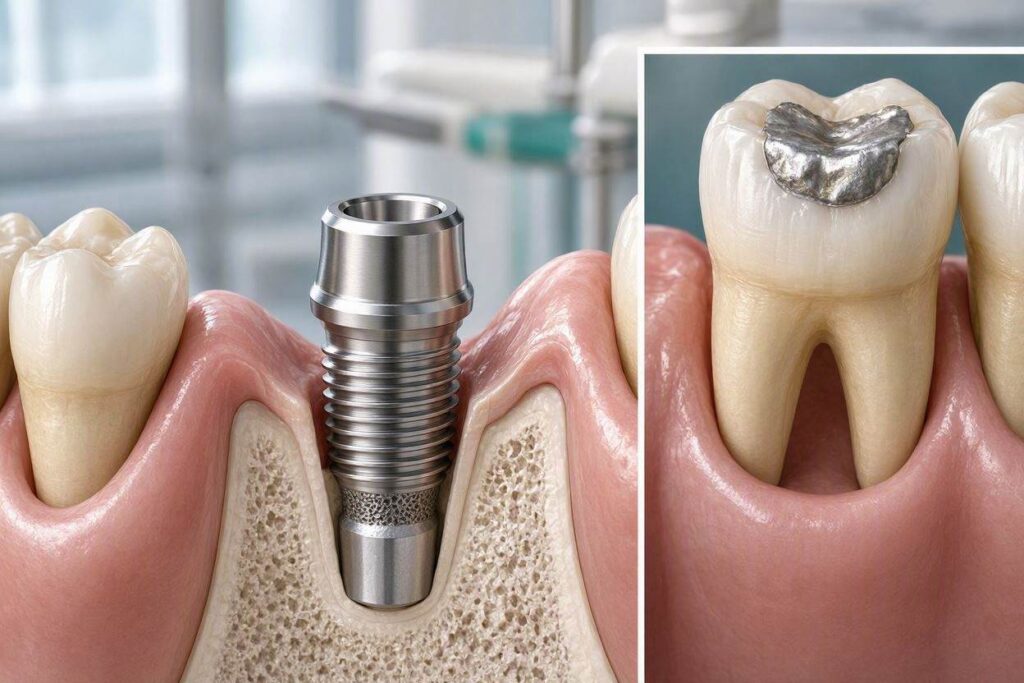
The Simple Answer: No Mercury
A dental implant is a precision medical device. It is designed to be placed in your jawbone, where it will remain for decades. The materials used must be:
- Biocompatible: The body must accept them without an immune response.
- Strong: They must withstand the forces of chewing.
- Corrosion-Resistant: They must not break down in the moist environment of the mouth.
Mercury does not meet these criteria for an implant. Mercury is a liquid metal at room temperature. It is not a solid structural material. It would be utterly useless as a material for a dental implant post.
The primary material used for dental implant fixtures is titanium (or a titanium alloy). The alternative is zirconia (a ceramic). Neither of these materials contains mercury.
The Materials Used in Dental Implants
To be absolutely clear, let’s list the materials used in each component of an implant system.
1. The Implant Fixture (The Post)
- Titanium: Commercially pure titanium or a titanium alloy (titanium, aluminum, and vanadium).
- Zirconia: A white ceramic material (zirconium dioxide).
2. The Abutment (The Connector)
- Titanium: The most common choice.
- Zirconia: For aesthetic cases.
- Gold Alloy: A mixture of gold, platinum, and other noble metals.
3. The Crown (The Visible Tooth)
- Porcelain: A type of ceramic.
- Zirconia: A very strong ceramic.
- E-max: Lithium disilicate glass-ceramic.
- Gold Alloy: For back teeth.
Mercury is not used in any of these components.
The Source of the Confusion: Dental Amalgam
The concern about mercury in dentistry comes from a completely different material: dental amalgam.
Dental amalgam, commonly known as “silver fillings,” is a material used to fill cavities. It is a mixture of metals, including:
- Silver
- Tin
- Copper
- Mercury (approximately 50% by weight)
The mercury in amalgam is what binds the other metals together to form a hard, durable filling.
The Debate:
- Safety Organizations: The American Dental Association (ADA) and the U.S. Food and Drug Administration (FDA) maintain that dental amalgam is a safe and effective material for fillings for most people. They argue that the mercury is “locked” into the filling and releases only trace amounts of vapor.
- Concerns: Some patients and advocacy groups are concerned about the potential health effects of mercury exposure, even at low levels. They choose to avoid amalgam fillings and opt for composite (tooth-colored) fillings instead.
Regardless of where you stand on the amalgam debate, it is crucial to understand that amalgam is not used in dental implants. They are entirely separate materials for entirely separate purposes.
The Safety of Titanium and Zirconia
The materials used in implants have a long and proven track record of safety.
Titanium:
- Titanium has been used in medical implants (like hip and knee replacements) for over 50 years.
- It is widely considered one of the most biocompatible materials in existence.
- The human body does not recognize titanium as a foreign invader. It does not trigger an allergic or toxic response.
- Bone cells actually grow onto the surface of titanium (osseointegration), which is the foundation of implant success.
Zirconia:
- Zirconia is a ceramic that has been used in medical applications (like artificial joints) for decades.
- It is metal-free, which makes it an excellent option for patients with metal sensitivities.
- It is also highly biocompatible.
Neither material is toxic. Neither material is absorbed into the bloodstream.
What About Titanium Allergies?
While true titanium allergies are extremely rare, some patients worry about a reaction to the metal. In these cases, a zirconia implant is the solution. Zirconia is a ceramic and contains no metal at all. This eliminates the risk of a metal allergy.
The Bottom Line
If you are considering a dental implant and you are worried about mercury, you can set that worry aside. Dental implants do not contain mercury. They are made of biocompatible materials like titanium and zirconia, which have been proven safe and effective for decades. The mercury concern in dentistry is related to silver fillings, not implants. Talk to your dentist if you have any lingering concerns. They can show you the exact materials they plan to use for your treatment.
Frequently Asked Questions (FAQ)
Q: Do zirconia implants contain metal?
A: No. Zirconia is a ceramic material. It is completely metal-free. This makes it an excellent choice for patients with metal allergies or sensitivities.
Q: Is titanium safe in the human body?
A: Yes. Titanium is one of the most biocompatible materials known to science. It has been used safely in millions of medical and dental procedures worldwide for over half a century.
Q: Can I have an MRI with a titanium implant?
A: Yes. Titanium is non-ferromagnetic. It is not attracted to magnets. An MRI is safe with a titanium dental implant.
Q: Why do some people think implants contain mercury?
A: The confusion likely stems from the use of mercury in dental amalgam (silver fillings). This is a completely different material used for a different purpose. The two are often confused in the minds of patients.
Q: What is the safest material for a dental implant?
A: Both titanium and zirconia are considered safe and biocompatible. Titanium is the most widely used and researched. Zirconia offers a metal-free alternative. Both have excellent track records for safety.
Additional Resource:
For official information on the safety of dental materials, you can visit the U.S. Food and Drug Administration (FDA) page on dental implants: https://www.fda.gov/