Is Receiving Dental Implants Going To Help TMJ?
You suffer from temporomandibular joint disorder. Your jaw clicks, pops, locks, or aches. You may have headaches, facial pain, or difficulty chewing. You also have missing teeth, and you are considering dental implants. You wonder whether replacing those missing teeth with implants will improve your TMJ symptoms, or whether the implants might make things worse.
The relationship between dental implants and temporomandibular joint disorder is complex and not fully understood. The answer depends on why you have TMJ problems in the first place, how your missing teeth have affected your bite, and how the implant restoration is designed and executed. This guide explains what is known, what is plausible, and what you should discuss with your dentist before proceeding.
Understanding Temporomandibular Joint Disorder
Before exploring the connection to dental implants, it is essential to understand what TMJ disorder is and what causes it.
The Anatomy of the Problem
The temporomandibular joints are the hinges that connect your lower jaw to your skull, located just in front of each ear. These joints, along with the associated muscles, ligaments, and the dental occlusion, form a complex system that allows you to speak, chew, and yawn. When any part of this system malfunctions, the result is pain, dysfunction, or both.
TMJ disorders are not a single condition. They encompass a range of problems, including myofascial pain involving the jaw muscles, internal derangement of the joint where the disc that cushions the joint is displaced, and degenerative joint disease such as arthritis affecting the joint surfaces.
Common Causes and Contributing Factors
The causes of TMJ disorders are often multifactorial. Bruxism, the habit of grinding or clenching the teeth, places excessive force on the joints and muscles. Trauma to the jaw, such as a blow to the face or a whiplash injury, can damage the joint structures. Malocclusion, a poor bite where the teeth do not meet properly, can create imbalanced forces that strain the joints and muscles. Stress contributes to muscle tension and clenching. Missing teeth can alter the bite, leading to compensatory chewing patterns and uneven loading of the remaining teeth and the joints.
How Missing Teeth Affect the TMJ
The loss of teeth, particularly multiple teeth or teeth in key positions, can have a significant impact on the stomatognathic system.
Altered Bite and Chewing Patterns
When you lose a tooth, the opposing tooth no longer has anything to bite against. It may supraerupt, moving out of its socket because there is no opposing force to keep it in place. Adjacent teeth may drift into the space, tilting and rotating. The result is a disruption of the occlusal scheme, the way your teeth fit together.
Your body adapts to these changes by altering your chewing patterns. You may favor one side of your mouth. You may chew in a way that avoids the gap. These compensations place asymmetrical forces on the jaw muscles and joints. Over time, this can contribute to muscle fatigue, pain, and joint dysfunction.
Loss of Vertical Dimension
When multiple posterior teeth are lost, the vertical dimension of occlusion, the height of the lower face when the teeth are together, can decrease. The jaw overcloses, and the condyle, the part of the lower jaw that articulates with the skull, may be displaced posteriorly within the joint fossa. This can compress the sensitive tissues behind the condyle and contribute to joint pain and internal derangement.
The Role of Occlusal Stability
A full complement of teeth provides occlusal stability. The teeth interdigitate in a way that distributes chewing forces evenly and stabilizes the jaw position. When teeth are missing, this stability is compromised. The remaining teeth bear a disproportionate share of the load, and the jaw position may become less stable, shifting slightly from one closure to the next. This instability can aggravate TMJ symptoms.
Can Dental Implants Improve TMJ Symptoms?
Dental implants can potentially improve TMJ symptoms by addressing the underlying occlusal problems caused by missing teeth. However, this is not guaranteed, and implants can also worsen symptoms if not properly planned and executed.
Restoring Occlusal Stability
When dental implants replace missing teeth, they restore the occlusal table, the chewing surface. The opposing tooth regains a contact. The adjacent teeth are prevented from drifting further. The implant crown is designed to fit harmoniously within the existing bite, distributing forces appropriately.
For a patient whose TMJ symptoms are primarily caused by the occlusal instability resulting from tooth loss, restoring that stability with implants can lead to a significant reduction in symptoms. The jaw muscles can function more symmetrically. The joints are loaded more evenly. The compensatory chewing patterns that were straining the system can be abandoned.
Reestablishing Vertical Dimension
When implants are used as part of a full-arch or extensive reconstruction, the vertical dimension of occlusion can be restored to its proper height. This allows the condyle to return to a more physiologic position within the joint fossa, relieving compression of the posterior tissues. Many patients with TMJ symptoms related to loss of vertical dimension experience relief when their bite height is restored.
The Importance of Proper Occlusal Design
The key word is “proper.” An implant crown that is too high, too low, or improperly contoured can introduce new occlusal problems. A crown that hits too hard in centric occlusion or that creates interferences during excursive movements, the side-to-side and forward movements of the jaw, can trigger or aggravate TMJ symptoms.
The implant crown must be carefully adjusted to harmonize with the patient’s existing occlusion. In some cases, the entire occlusion may need to be equilibrated, with adjustments made to multiple teeth to create a harmonious bite. This requires a dentist with training in occlusion and an understanding of TMJ disorders.
When Implants Might Worsen TMJ Symptoms
Under certain circumstances, dental implant treatment can exacerbate TMJ problems. Understanding these risks helps you choose the right provider and treatment plan.
Poorly Planned Implant Position
An implant placed in the wrong position, too far toward the cheek, too far toward the tongue, or at an incorrect angle, forces the restorative dentist to fabricate a crown that does not fit properly within the occlusal scheme. The crown may be contoured in a way that creates interferences or directs forces unfavorably. This can lead to muscle guarding, joint strain, and TMJ symptoms.
Excessive Occlusal Loading
If the implant crown is left too high, even by a fraction of a millimeter, the patient will hit it prematurely during closure. The body’s protective response is to avoid the high spot, altering the chewing pattern and creating muscle tension. Over time, this can lead to TMJ pain. Regular occlusal adjustment and careful attention to the bite during crown delivery are essential to prevent this.
Aggravation of Pre-Existing Bruxism
Patients who grind or clench their teeth are at risk for implant complications, including screw loosening, crown fracture, and peri-implant bone loss. They are also at risk for TMJ symptoms. Placing implants does not cure bruxism. If the underlying grinding habit is not addressed with a night guard or other therapy, the forces generated by bruxism can overload the implants and strain the TMJ, potentially worsening symptoms.
The Stress of Surgery
The surgical placement of implants involves opening the mouth wide for an extended period and applying pressure to the jaw. For a patient with pre-existing TMJ dysfunction, this can cause a flare-up of symptoms. The dentist should be aware of your TMJ history and take precautions, such as allowing frequent breaks to close your mouth during the procedure and using a bite block to support the jaw.
The Importance of a Comprehensive Evaluation
Before proceeding with dental implants, particularly if you have TMJ symptoms, a thorough evaluation is essential.
TMJ-Specific History and Examination
Your dentist should take a detailed history of your TMJ symptoms, including when they began, what makes them worse or better, and any previous treatment. The examination should include palpation of the jaw muscles and joints, measurement of your jaw opening and movement, and assessment of joint sounds such as clicking or crepitus.
Occlusal Analysis
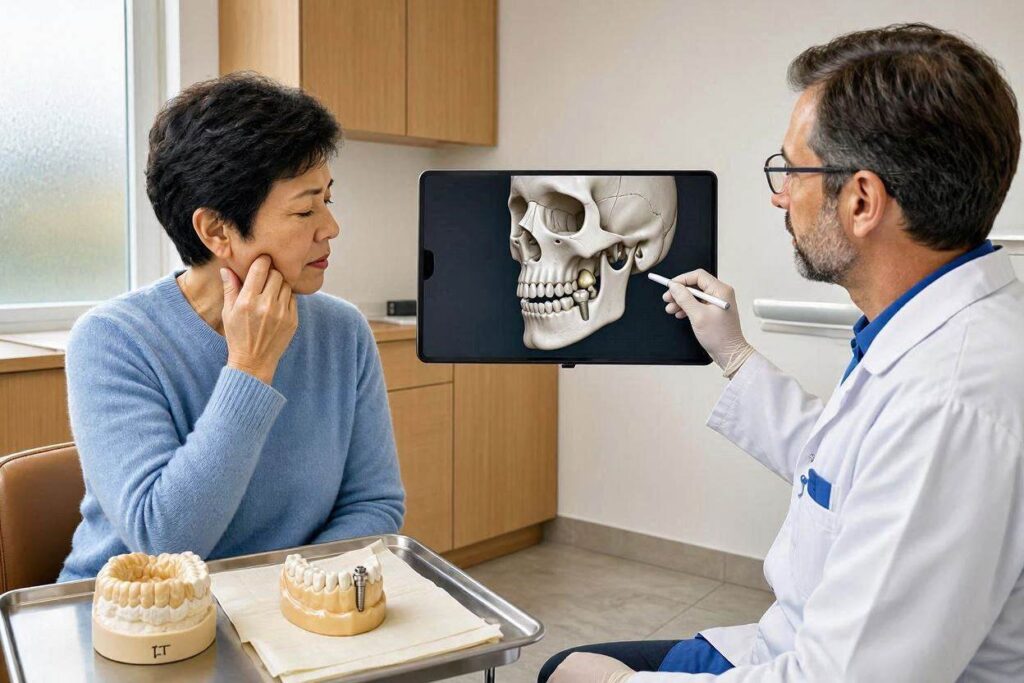
A comprehensive occlusal analysis examines how your teeth fit together in all movements. This may involve mounted study casts on an articulator, a device that simulates jaw movement, or digital occlusal analysis using computerized scanning. The goal is to identify any occlusal factors that may be contributing to your TMJ symptoms.
Imaging
In addition to the cone beam CT scan used for implant planning, your dentist may recommend specific TMJ imaging, such as a panoramic radiograph to screen for gross joint pathology or magnetic resonance imaging to evaluate the disc position if internal derangement is suspected. The CBCT itself provides valuable information about the bony structures of the joint.
Coordinated Treatment: Implants and TMJ Therapy
For patients with significant TMJ dysfunction, implant treatment may need to be coordinated with specific TMJ therapy.
Phase One: TMJ Stabilization
Before implants are placed, the TMJ symptoms should be addressed and stabilized. This may involve an occlusal splint, a custom-fabricated appliance that is worn over the teeth to provide a stable, balanced bite and to relax the jaw muscles. Splint therapy can relieve muscle tension, reduce joint inflammation, and establish a therapeutic jaw position.
The patient wears the splint for a period, typically weeks to months, until symptoms are controlled. The jaw position established by the splint can then be used as the reference position for implant treatment planning.
Phase Two: Definitive Treatment
Once the TMJ is stable, definitive treatment proceeds. This may include implants, crowns, bridges, or full-arch restorations designed to the jaw position established during splint therapy. The goal is to create an occlusion that maintains the TMJ stability achieved in phase one.
The Role of the Prosthodontist
Prosthodontists are specialists in restoring and replacing teeth and in managing occlusion. They are particularly well-suited to handle complex cases involving both implants and TMJ dysfunction. If your case involves significant TMJ symptoms along with the need for implants, a prosthodontist can coordinate the comprehensive care you need.
Conclusion
Receiving dental implants can help TMJ symptoms when the symptoms are caused or aggravated by the occlusal instability, altered chewing patterns, and loss of vertical dimension resulting from missing teeth. By restoring a stable, harmonious occlusion, implants can allow the jaw muscles and joints to function more normally, potentially reducing pain and dysfunction. However, improperly planned or executed implant treatment can worsen TMJ symptoms by introducing occlusal interferences, excessive loading, or aggravating pre-existing bruxism. A comprehensive TMJ evaluation, careful occlusal planning, and coordination with TMJ therapy when necessary are essential for achieving a positive outcome.
Frequently Asked Questions
Should I get implants if I have TMJ?
You can, but your TMJ symptoms should be evaluated and stabilized before implant treatment. The implants must be planned and executed with careful attention to occlusion to avoid aggravating your symptoms.
Can dental implants cause TMJ?
Implants themselves do not cause TMJ disorders, but an improperly designed implant crown that creates occlusal interferences can contribute to TMJ symptoms. Choosing a dentist with training in occlusion minimizes this risk.
Will a night guard protect my implants and my TMJ?
Yes, a custom night guard can protect both your implants and your natural teeth from the forces of bruxism, reducing the risk of implant complications and TMJ flare-ups.
How long after implant surgery should I wait if I have TMJ pain?
Post-surgical TMJ pain related to the procedure should improve as swelling and muscle soreness resolve. If TMJ pain persists beyond a few weeks, consult your dentist. The implant itself, once healed, should not cause TMJ pain.
What type of dentist should I see for implants if I have TMJ problems?
A prosthodontist is the specialist best equipped to manage both implant restoration and occlusal issues related to TMJ. For complex surgical needs, an oral surgeon or periodontist with experience in TMJ cases may be appropriate.
Additional Resource:
For information on TMJ disorders and their treatment, visit the American Academy of Orofacial Pain at https://www.aaop.org.