What Is A Dental Implant Technician?
You hear the term in your dentist’s office, or you see it in an article about implant treatment. A dental implant technician, sometimes called a dental laboratory technician specializing in implants, plays a crucial but often invisible role in your implant journey. You may never meet this person, but the quality of their work directly affects the appearance, function, and longevity of your implant restoration.
This guide explains what a dental implant technician is, what they do, how they are trained, and why their work matters to you as a patient. We will distinguish between different types of dental technicians, explore the technology they use, and explain how the collaboration between the dentist and the technician produces the crown, bridge, or denture that you will wear for decades.
The Role of the Dental Implant Technician
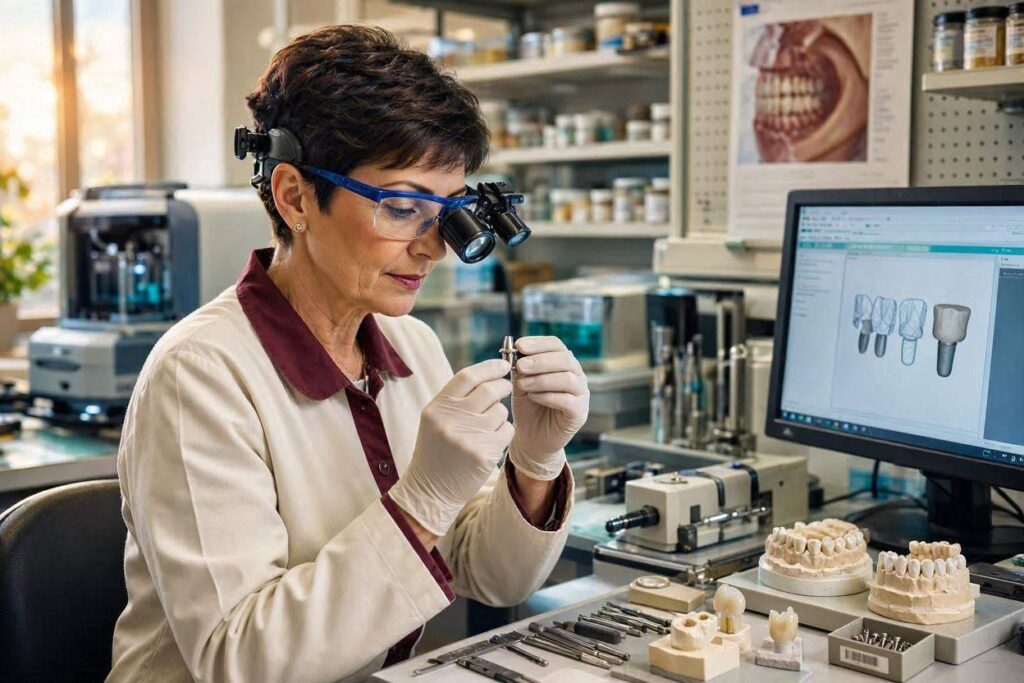
A dental implant technician is a skilled professional who fabricates the prosthetic components that attach to dental implants. They work in a dental laboratory, not in the dental office, and they rarely interact directly with patients. Instead, they collaborate with the restorative dentist who provides them with prescriptions, impressions, and specifications for each case.
What the Technician Fabricates
The dental implant technician creates several types of restorations. Custom abutments are the connectors that attach to the implant body and emerge through the gum. Implant-supported crowns are the visible teeth for single-tooth implants. Implant-supported bridges replace multiple missing teeth. Full-arch implant prostheses, such as All-on-Four hybrid dentures, replace an entire arch of teeth. Bar overdentures are frameworks that connect multiple implants and provide retention for a removable denture.
Each of these restorations is a custom medical device, designed and fabricated for a single individual. No two are exactly alike.
The Difference Between a Dental Technician and a Dental Implant Technician
All dental implant technicians are dental technicians, but not all dental technicians specialize in implants. A general dental laboratory technician may fabricate crowns, bridges, dentures, and other restorations for natural teeth. An implant technician has additional training and experience in the specific components, materials, and techniques required for implant restorations. They understand the interface between the implant fixture and the abutment, the biomechanics of implant-supported prostheses, and the aesthetic requirements of implant restorations in the smile zone.
The Training Pathway
Becoming a competent dental implant technician requires education, hands-on training, and years of experience.
Formal Education
Dental laboratory technology programs are offered at community colleges, technical schools, and some universities. These programs typically last two years and award an associate degree or a certificate. The curriculum covers dental anatomy, dental materials science, partial and complete denture fabrication, crown and bridge fabrication, and, increasingly, digital dentistry including computer-aided design and manufacturing.
Some programs offer specific coursework in implant prosthetics. Others provide a foundation in general dental technology, and the implant specialization is acquired through on-the-job training and continuing education after graduation.
Certification
The National Board for Certification in Dental Laboratory Technology offers the Certified Dental Technician credential. Technicians can become certified in specific areas, including complete dentures, partial dentures, crown and bridge, ceramics, orthodontics, and implants. The implant certification examination tests knowledge and skills specific to implant-supported restorations.
A Certified Dental Technician in implants has demonstrated competence through a rigorous examination process. The CDT credential is a mark of professionalism and commitment to quality. Not all skilled implant technicians are certified, but certification provides an external validation of competence.
On-the-Job Training and Apprenticeship
Many dental implant technicians learn their craft through years of working in a dental laboratory under the mentorship of experienced technicians. An apprentice technician begins with simple tasks, such as pouring models from impressions, and gradually progresses to more complex procedures. It takes several years of full-time work to become proficient in implant prosthetics, and the learning never truly stops as materials and technology evolve.
The Technician’s Workflow
Understanding the steps a technician follows to create an implant restoration illuminates the precision and artistry involved.
Step One: Receiving the Case
The dentist sends the laboratory a prescription that specifies the type of restoration, the implant system, the materials to be used, the shade and contour of the restoration, and any special instructions. The laboratory also receives an impression or a digital scan of the patient’s mouth, including the implant position, the adjacent teeth, and the opposing arch.
If a traditional impression is sent, it includes an implant impression coping, a component that transfers the exact position and angle of the implant from the mouth to the model. The technician pours a stone model around the impression coping, creating a precise replica of the patient’s implant and surrounding teeth.
Step Two: Model Fabrication and Articulation
The technician creates a working model with a removable soft tissue replica around the implant site. This soft tissue model simulates the gum tissue and allows the technician to design the emergence profile of the abutment and crown correctly.
The upper and lower models are mounted on an articulator, a mechanical device that simulates jaw movement. This allows the technician to check the occlusion, ensuring that the restoration will not interfere with the patient’s bite during any jaw movement.
Step Three: Abutment Design and Fabrication
If a custom abutment is prescribed, the technician designs it to support the crown and to create an ideal emergence profile through the gum. The abutment may be milled from a solid block of titanium or zirconia using computer-aided manufacturing, or it may be waxed and cast using traditional lost-wax techniques.
The abutment must fit precisely into the implant’s internal connection. Even a few microns of discrepancy can create a gap where bacteria can colonize or where the abutment screw can loosen. Precision is non-negotiable.
Step Four: Crown or Prosthesis Fabrication
The technician builds the crown or prosthesis on top of the abutment, or as an integrated abutment-crown unit depending on the design. The crown is built up in layers of ceramic to replicate the translucency, color, and texture of natural teeth. The technician uses a shade guide and photographs provided by the dentist to match the restoration to the patient’s adjacent teeth.
For full-arch prostheses, the technician fabricates the framework, usually from titanium or zirconia, and then applies acrylic or composite denture teeth and gum-colored material. These prostheses are complex and require many hours of skilled labor.
Step Five: Finishing and Quality Control
The completed restoration is polished, cleaned, and inspected under magnification. The technician checks the fit of the abutment to the implant analog on the model. The margins, where the crown meets the abutment or where the abutment meets the implant, are examined for gaps. The occlusion is verified on the articulator. Any flaws are corrected before the restoration is sent to the dentist.
The Technology of the Modern Implant Laboratory
The dental laboratory has been transformed by digital technology, and the implant technician’s work has changed accordingly.
Computer-Aided Design and Manufacturing
Many implant restorations are now designed on a computer screen and milled from solid blocks of material. The technician uses CAD software to design the abutment and crown. The design file is sent to a milling machine that carves the restoration from titanium, zirconia, or a machinable ceramic. Some laboratories also use 3D printing for certain components, such as models and surgical guides.
CAD and CAM technology has improved precision and reduced turnaround time. It has not eliminated the need for skilled technicians. The technician must still understand dental anatomy, occlusion, and materials to design a restoration that functions properly and looks natural. The computer is a tool, not a replacement for expertise.
The Hybrid Workflow
Many laboratories use a hybrid workflow that combines digital and traditional techniques. The implant position is captured with a digital intraoral scan. The abutment and crown framework are designed digitally and milled. The ceramic layering is then applied by hand by a skilled ceramist who builds up the enamel layers to create a lifelike appearance. This combination of digital precision and handcrafted artistry represents the current state of the art in implant prosthetics.
The Dentist-Technician Relationship
The quality of your implant restoration depends on the collaboration between your restorative dentist and the dental implant technician.
Communication and Prescription Detail
The dentist must provide the technician with clear instructions. The prescription should specify the implant system and platform, the type of abutment, the material for the crown, the shade, the desired contours, and any special considerations such as the need for screw retention versus cement retention. Photographs of the patient’s teeth and face help the technician match the restoration to the patient’s natural dentition and facial aesthetics.
The technician, in turn, communicates with the dentist about any concerns or questions. If the implant position is challenging, if the available space is limited, or if the dentist’s instructions are unclear, a good technician will call and discuss the case rather than guessing.
The Choice of Laboratory Matters
Dentists choose their laboratories based on quality, consistency, communication, and turnaround time. Some dentists work with large national laboratories that offer competitive pricing and fast turnaround. Others work with smaller, boutique laboratories that specialize in high-end aesthetic work. The laboratory fee is a component of what you pay for your implant crown or prosthesis. A higher laboratory fee often reflects greater technician skill, better materials, and more time spent on your restoration.
Can a Dental Implant Technician Work Directly with Patients?
In the United States, dental technicians cannot work directly with patients. They must work under the prescription and supervision of a licensed dentist. The dentist is legally and ethically responsible for the restoration that the technician fabricates.
Some patients seek lower-cost implant restorations by going directly to a dental laboratory, particularly in the context of dental tourism. This is risky. The technician lacks the training to evaluate the patient’s oral health, take impressions, or adjust the restoration in the mouth. Restorations made without proper dental supervision often do not fit correctly and can cause damage to the implants, the opposing teeth, and the gum tissue.
Conclusion
A dental implant technician is a highly skilled dental laboratory professional who fabricates the custom abutments, crowns, bridges, and full-arch prostheses that attach to dental implants. They work behind the scenes, following the prescription of the restorative dentist, using a combination of digital technology and handcrafted artistry to create restorations that are precise, functional, and aesthetic. Their training involves formal education, certification, and years of on-the-job experience. While you may never meet your implant technician, the quality of their work is visible every time you smile and functional every time you chew.
Frequently Asked Questions
Is a dental implant technician the same as a dental assistant?
No. A dental assistant works chairside in the dental office, helping the dentist during procedures. A dental implant technician works in a dental laboratory, fabricating restorations. They have different training and different roles.
Can I choose the laboratory that makes my implant crown?
You can express a preference, but the dentist ultimately selects the laboratory. The dentist is responsible for the quality of the restoration and works with laboratories they trust. If you have concerns about the materials or the laboratory, discuss them with your dentist.
How long does it take for a technician to make an implant crown?
A custom abutment and crown typically take one to three weeks from the time the laboratory receives the impression or scan. Complex full-arch prostheses take longer, often four to eight weeks.
What materials do dental implant technicians use?
Titanium and zirconia for custom abutments, and porcelain, lithium disilicate, zirconia, and porcelain-fused-to-metal for crowns and bridges. Full-arch prostheses may involve titanium or zirconia frameworks with acrylic or composite teeth and gum material.
How can I tell if my implant restoration was made by a skilled technician?
A well-made restoration fits precisely, with no gaps at the gum line, matches the adjacent teeth in color and shape, and feels comfortable when you bite. Your dentist should evaluate the restoration before it is placed and should not accept substandard work from the laboratory.
Additional Resource:
For information on certified dental technicians and the certification process, visit the National Board for Certification in Dental Laboratory Technology at https://www.nbccert.org.