Symptoms Of Nerve Damage From Dental Implants
You did your research. You found a good surgeon. You sat in the chair, took a deep breath, and decided to finally replace that missing tooth with a dental implant. For most people, this journey ends with a confident smile and a perfectly functioning tooth.
But for a small number of patients, something feels different after the anesthesia wears off.
Maybe it is a strange tingling on your lip when you drink coffee. Maybe it is a feeling that your chin has fallen asleep, like when your foot does after sitting too long. Or maybe, worst of all, you feel nothing at all in a spot where you used to feel everything.
Nerve damage from dental implants is rare. Let us say that clearly from the start. Most implants heal without any neurological issues. But when it happens, it can be unsettling, frustrating, and sometimes permanent.
This guide is not here to scare you. It is here to inform you. You will learn the specific symptoms of nerve damage from dental implants, which nerves are involved, how to tell if the problem is serious, and what you can do about it.
Whether you are researching before your implant surgery or you are already experiencing strange sensations afterward, you have come to the right place.
First, A Quick Reality Check: How Common Is This?
Before we dive into symptoms, let us set realistic expectations.
The nerves most at risk during dental implant surgery are the inferior alveolar nerve (IAN) and the mental nerve. These nerves run through your lower jaw and provide feeling to your lower lip, chin, and gums.
According to clinical studies, temporary nerve injury after lower jaw implant surgery occurs in roughly 1% to 8% of cases. Permanent nerve damage is much rarer—between 0.1% and 0.5% of cases.
Important note: These numbers vary depending on the surgeon’s experience, imaging technology used, and the complexity of your jaw anatomy. The risk is higher for people with thin jawbones or when multiple implants are placed close together.
Most nerve injuries heal on their own within three to six months. But some do not. Recognizing symptoms early gives you the best chance for a positive outcome.
The Two Major Nerves At Risk (And What They Do)
To understand the symptoms, you need a simple map of your jaw’s nervous system. Do not worry—this is not medical school. You just need to know two names.
The Inferior Alveolar Nerve (IAN)
This is the main nerve running through a tunnel in your lower jawbone. Think of it like an underground subway line. It provides sensation to:
- Your lower teeth
- Your lower lip (on the same side)
- Your chin
- Your gum tissue near the lower teeth
When this nerve gets injured, the symptoms show up in those exact areas.
The Mental Nerve
This nerve is actually a branch of the inferior alveolar nerve. It exits your jaw through a small hole called the mental foramen (usually near your premolars). The mental nerve supplies feeling to:
- Your chin
- Your lower lip
- The gums in the front of your lower jaw
Damage to the mental nerve produces very similar symptoms to IAN damage, but usually more concentrated on the chin and front lip area.
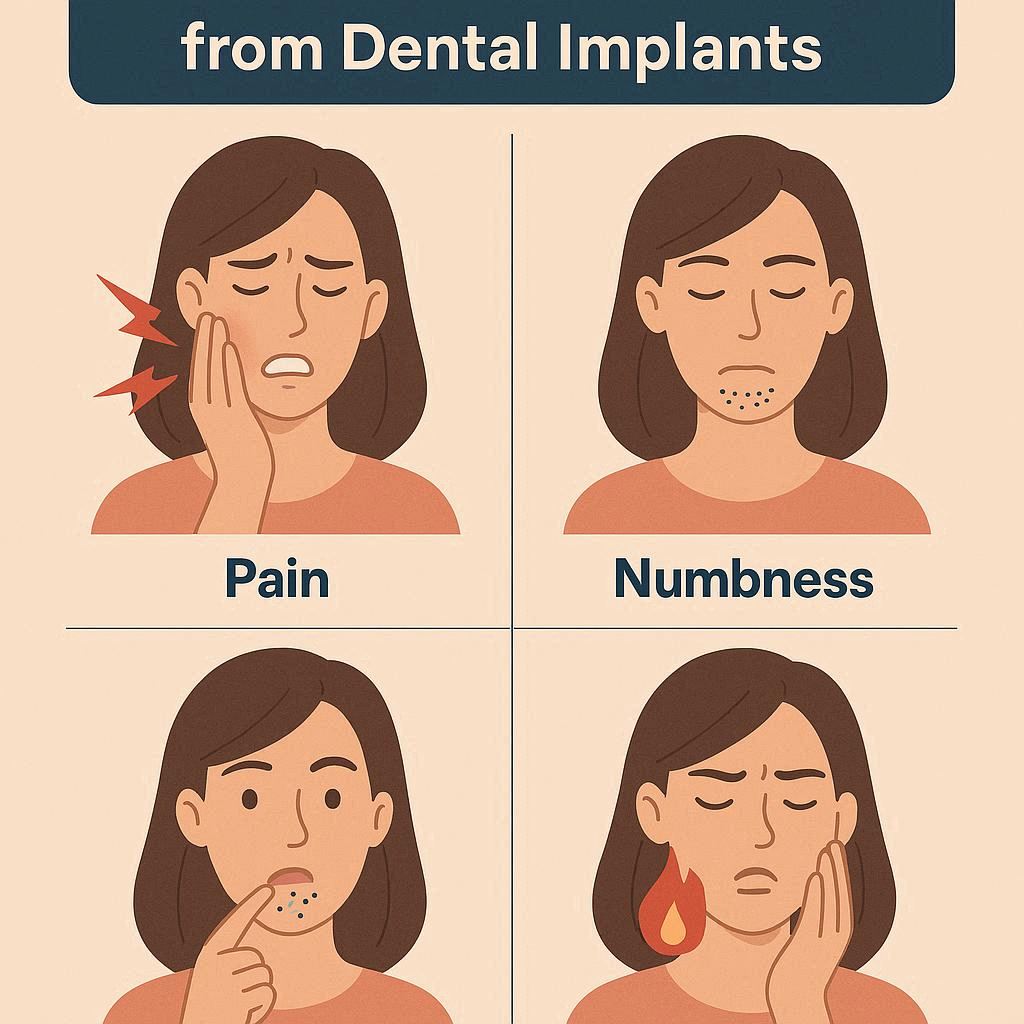
The Full List: Symptoms Of Nerve Damage From Dental Implants
Now we get to the heart of the article. Symptoms can range from mildly annoying to significantly disruptive. They can appear immediately after surgery or develop gradually as swelling puts pressure on a nerve.
Here is the complete breakdown.
1. Numbness (Anesthesia)
This is the most common and most recognizable symptom.
Imagine putting a strong topical anesthetic on your lip or chin. You can touch the area, but you cannot really feel the touch. You might bite your lip without realizing it. Food can spill from that side of your mouth because you do not feel it there.
What it feels like: The area feels “dead.” You can press your fingernail into your lip, and you register pressure but not fine touch or temperature.
Where it happens: Usually the lower lip, chin, or both on the same side as the implant.
Timeframe: Mild numbness that resolves in a few days or weeks is common. Numbness lasting beyond six months is usually permanent.
2. Tingling Or Pins And Needles (Paresthesia)
This symptom feels exactly like when your foot “falls asleep” and then starts waking up. You get that uncomfortable, prickling sensation.
What it feels like: Tiny electric pulses, static, or crawling insects under the skin. It is not painful for most people, but it is annoying.
Where it happens: Same distribution—lower lip, chin, gum, or sometimes the cheek.
What it means: This can be a sign that a compressed nerve is starting to recover. Tingling often precedes the return of normal sensation. However, chronic tingling that never goes away is also a form of permanent nerve damage.
3. Burning Pain (Dysesthesia)
This is where things get more serious. Burning pain is less common than numbness or tingling, but it is much harder to live with.
What it feels like: A persistent burning sensation, like you touched a hot surface. It can be mild or severe. Sometimes it feels like a bad sunburn deep under the skin.
Where it happens: Lip, chin, gums, or a combination.
Why it happens: When a nerve is damaged, it can send faulty signals to your brain. Your brain interprets these random signals as pain, heat, or burning, even though nothing is actually burning your skin.
Important note: Burning pain from nerve damage often gets worse at night or when you are tired. It can also flare up with cold weather or stress.
4. Electric Shock Sensations
Some patients describe sudden, brief jolts of electricity shooting through their lip or chin.
What it feels like: A quick zap, like touching a live wire. It lasts only a second or two, but it can be startling.
Where it happens: Usually triggered by touching the area, brushing your teeth, or even a gust of cold air.
What it means: This suggests nerve irritation rather than complete severing. It often improves over time.
5. Loss Of Taste Or Altered Taste
Wait—can a lower jaw implant affect taste? Not directly. The nerve that controls taste (chorda tympani) is in your upper jaw, near your ear.
However, some patients report metallic tastes or altered flavor perception after implant surgery. This is usually temporary and related to medications (antibiotics, painkillers) or post-surgical inflammation rather than actual nerve damage.
If you lose taste after a lower implant, it is rarely due to nerve injury. If you lose taste after an upper implant near your sinuses, talk to your surgeon, but understand that true taste nerve damage from implants is extremely rare.
6. Drooling Or Difficulty Controlling Liquids
This symptom surprises many people.
When your lower lip is numb, you cannot feel liquid touching it. You might try to drink from a cup, and water dribbles down your chin without you noticing until you feel it on your neck.
What it feels like: Not a motor problem (your lips can still move). It is a sensory problem. You simply do not get the feedback that liquid is escaping.
What to do: Use a straw for the first few weeks after surgery, even if you do not have numbness. It prevents this issue entirely.
7. Biting Your Lip Or Cheek Without Feeling It
This is both a symptom and a complication.
Because you cannot feel pain or touch in the numb area, you might accidentally bite down on your lower lip while chewing. You will not realize it until you taste blood or see the injury in a mirror.
What happens: Swelling, bruising, or open sores on the inside of your lip. These injuries can become infected if you keep biting the same spot.
Prevention: Look in a mirror while you eat for the first week after surgery. Chew on the opposite side. Be mindful.
8. Hypersensitivity (Hyperesthesia)
This is the opposite of numbness. Instead of feeling too little, you feel too much.
What it feels like: The lightest touch—a gentle breeze, a strand of hair, the brush of a sleeve—feels painful or intensely unpleasant. Brushing your teeth feels like sandpaper on raw skin.
Where it happens: Lip, chin, or gum tissue.
What it means: Hypersensitivity is a sign of nerve irritation or partial damage. It can improve as the nerve heals. In some cases, it becomes permanent and requires management with medication or desensitization therapy.
9. Asymmetrical Smile Or Lip Movement (Rare)
This is the symptom that concerns people the most because it is visible.
True nerve damage that affects movement is almost impossible during a routine dental implant. The nerve that moves your lips and face (the facial nerve) is nowhere near the implant site in your jawbone.
However, there are two exceptions:
- Anesthesia injection: A needle can theoretically hit a small motor branch, causing temporary weakness.
- Swelling: Severe post-operative swelling can press on facial muscles, making your smile look lopsided until the swelling goes down.
If your lip feels numb and you cannot move it properly, you need immediate follow-up. But again, this combination is exceptionally rare with standard implants.
10. Changes In How Your Lip Moves When You Talk
This one is subtle.
Patients with lower lip numbness often notice that they over-compensate when speaking. They move their lips more forcefully or differently because they cannot feel the normal light contact between their upper and lower lips.
What you might notice: You feel like you are slurring slightly, or people ask if you have been to the dentist. It is not a true speech impediment—just an adaptation to reduced sensation.
What helps: Practicing in front of a mirror. Your brain usually adapts within a few weeks.
A Comparative Table: Mild vs. Severe Symptoms
Not all symptoms are created equal. Some are annoying but likely to heal. Others require urgent attention.
| Symptom | Typical Severity | Likely to Heal? | When To Worry |
|---|---|---|---|
| Mild tingling (pins and needles) | Mild to moderate | Yes, usually within weeks | If it lasts > 3 months |
| Numbness smaller than a coin | Mild | Often, but not guaranteed | If it expands in size |
| Numbness covering entire lip | Moderate to severe | Less likely to fully heal | Within first 2 weeks |
| Burning pain | Moderate to severe | Variable; often improves slowly | Immediately if severe |
| Electric shock sensations | Mild to moderate | Usually improves | If shocks increase in frequency |
| Biting lip without feeling | Moderate (due to injury risk) | Numbness may persist | When you cause bleeding sores |
| Hypersensitivity (pain from light touch) | Moderate to severe | Improves in many cases | If it prevents eating or sleeping |
| Complete loss of all sensation | Severe | Unlikely to fully recover | Immediate evaluation |
How Symptoms Appear Over Time (The Timeline)
Symptoms do not always show up all at once. Understanding the timeline helps you know what is normal and what is not.
Immediate (Right After Surgery, While Still Numb From Anesthesia)
You cannot judge anything yet. Local anesthetics like lidocaine cause intentional numbness that lasts 2 to 4 hours. Every patient feels numb right after implant surgery.
Do not panic during this window. Wait for the anesthetic to fully wear off before assessing nerve damage.
24 To 72 Hours After Surgery
This is when you get your first real information.
The anesthetic is gone. Swelling is peaking. You might feel:
- Normal surgical pain (aching, throbbing in the bone)
- Some tingling or “electric” feelings from nerve irritation due to swelling
- Mild numbness along your lip that slowly improves
Normal vs. possible problem: If your entire lower lip and chin are completely numb 48 hours after surgery—with no sensation at all—that is a red flag. Call your surgeon.
One Week After Surgery
Swelling is going down. Pain is decreasing.
Good sign: Numbness is shrinking. You feel more tingling (which can be a sign of healing). You can feel sharp touch in some spots.
Concerning sign: No change. The numb area is the same size as day two. You cannot feel anything—even deep pressure.
Two To Four Weeks After Surgery
This is a critical period.
Most temporary nerve injuries show clear improvement by the four-week mark. You should notice that the numb area is smaller. You might still have tingling or odd sensations, but the “dead” feeling should be fading.
If you have zero improvement after one month, the likelihood of permanent damage increases significantly.
Three To Six Months After Surgery
Nerve healing is slow. It happens at about 1 millimeter per day. If the injury is mild to moderate, you will continue to see gradual improvement during this window.
What recovery looks like: Numbness turns into tingling. Tingling turns into normal but slightly dull sensation. Eventually, you get back to 90% or 95% of normal feeling.
What permanent damage looks like: The symptoms plateau. You stop improving. What you have at six months is very likely what you will have for life.
Beyond Six Months
At this point, the nerve has completed most of its healing. Additional improvement after six months is possible but usually minor.
Permanent symptoms may include:
- A small patch of numbness (often the patient adapts completely)
- Chronic tingling (annoying but manageable)
- Burning pain (requires medical management)
Don’t Confuse These: Other Causes Of Strange Sensations
Not every weird feeling after a dental implant is nerve damage. Here are common mimics.
1. Normal Healing Pain
Surgical pain feels like a deep ache or throbbing. It is located in the bone and gum. It responds to ibuprofen or acetaminophen. It gets better every day.
Nerve pain feels like burning, shocking, or tingling. It does not respond well to normal painkillers.
2. Dry Socket
If the blood clot falls out of the extraction site (if your implant required an extraction first), you can get a dry socket. This causes severe, boring pain that radiates to your ear or temple. It does not cause numbness or tingling in your lip.
3. Sinus Issues (Upper Implants)
Upper implants near the sinus cavity can cause sinus pressure, headaches, or a feeling of fullness in your cheek. These are not nerve damage symptoms. They feel like a bad sinus infection.
4. Jaw Muscle Spasms
Some patients develop muscle spasms from holding their mouth open during surgery. This can feel like tightness, pulling, or strange tension in the jaw. It is not nerve damage. Massage, heat, and gentle stretching usually resolve it.
5. Referred Pain From Adjacent Teeth
Sometimes a neighboring tooth develops pulpitis (inflammation) after an implant procedure. This feels like a regular toothache—sharp, throbbing, and worsened by hot or cold. It does not involve lip numbness.
What Actually Causes The Nerve Damage? (A Simple Explanation)
You do not need to be a surgeon to understand the mechanisms. There are four main ways a dental implant can injure a nerve.
Mechanical Compression
This is the most common cause.
The implant itself is a screw. If the surgeon drills the hole too deep or places an implant that is too long, the tip of the implant presses directly on the nerve inside the bone. It is like stepping on a garden hose—the nerve still exists, but signals cannot get through.
Outcome: Compression often causes numbness. If the implant is removed or unscrewed slightly, the nerve can recover.
Direct Severing (Transection)
This is the most damaging cause.
The surgical drill or the implant itself cuts through the nerve fibers. This is like cutting an electrical wire. The ends pull apart, and signals cannot cross the gap.
Outcome: Severing usually causes permanent numbness. Partial cuts can sometimes heal, but complete cuts rarely do.
Stretching (Neuropraxia)
During surgery, the surgeon must retract (pull back) the gum tissue. This can stretch the mental nerve or inferior alveolar nerve. Stretching damages the nerve’s insulation but not the core fibers.
Outcome: This is the most survivable injury. Think of it like bending a garden hose sharply—it kinks, but once you straighten it, flow returns. Most stretch injuries heal completely within weeks.
Inflammation And Swelling
Even a perfect surgery causes swelling. The nerve runs through snug tunnels in the bone. When the surrounding tissues swell, they squeeze the nerve.
Outcome: This is temporary. As swelling resolves (usually within 7 to 10 days), the nerve symptoms resolve too.
What To Do If You Recognize These Symptoms
You suspect you have nerve damage. Now what? Follow this action plan.
Step One: Do Not Panic (But Do Not Wait Either)
Most nerve injuries heal. But the ones that need intervention (like implant removal) benefit from early action.
Waiting “to see what happens” for six months is the wrong approach.
Step Two: Contact Your Surgeon Immediately
Call the office. Say this: “I had an implant on [date]. The anesthesia has worn off, and I have [describe your symptom: numbness, tingling, burning] on my [lip/chin/gum]. I am concerned about possible nerve injury.”
Ask for:
- An urgent appointment (within days, not weeks)
- A detailed sensory examination
- Referral to an oral surgeon who specializes in nerve repair (if needed)
Step Three: Document Everything
Keep a daily log. Rate your symptoms on a scale of 0 to 10. Draw the numb area on a face diagram. Note any changes—improvements or worsening.
This log is invaluable to your surgeon. It shows the trajectory of your injury.
Step Four: Request Imaging
A panoramic X-ray (OPG) can show if the implant is too close to the nerve canal. But for precise evaluation, a CBCT scan (cone beam CT) is far superior.
What the CBCT shows: The exact position of the implant tip relative to the nerve canal. If the implant is inside the canal or compressing the nerve, that is visible.
Step Five: Consider Early Intervention
If imaging confirms that the implant is compressing or penetrating the nerve, many surgeons recommend:
- Implant removal (within 36 to 48 hours for best results)
- Implant shortening (unscrewing it slightly)
- Corticosteroids to reduce nerve inflammation
Important note: The window for effective surgical intervention is short—measured in days, not weeks. After about one week, the nerve begins scarring, and removing the implant may not restore sensation.
Step Six: Accept Observation For Mild Cases
If your symptoms are mild (small patch of numbness, mild tingling, no burning pain) and imaging shows the implant is not touching the nerve, most surgeons advise:
- Waiting (3 to 6 months of natural healing)
- Vitamin B12 or alpha-lipoic acid supplements (limited evidence but low risk)
- Gentle massage of the area
- Avoiding further trauma (no new dental work on that side)
Treatment Options For Confirmed Nerve Damage
If you are past the acute window (more than a few days) or if the injury is mild, here is what modern dentistry offers.
Conservative Management (Most Common)
Most nerve injuries do not require surgery. Your body knows how to heal nerves, albeit slowly.
What this includes:
- Regular monitoring (exams every 4 to 8 weeks)
- Sensory testing to track improvement
- Pain management for burning or hypersensitivity (gabapentin, pregabalin, amitriptyline)
- Protective strategies (lip balm, avoiding lip biting, using a straw)
Success rate: High for mild to moderate injuries. Over 80% of patients with neuropraxia (stretch injury) recover fully within 6 months.
Medications For Nerve Pain
Burning pain and hypersensitivity often respond better to nerve-specific medications than to normal painkillers.
| Medication | What It Helps | Common Side Effects |
|---|---|---|
| Gabapentin (Neurontin) | Burning, electric shocks | Drowsiness, dizziness, weight gain |
| Pregabalin (Lyrica) | Same as gabapentin (stronger) | Drowsiness, fluid retention |
| Amitriptyline (low dose) | Burning, nighttime pain | Dry mouth, sedation, constipation |
| Topical lidocaine | Hypersensitivity of lip | None significant (local use only) |
Important note: These medications do not heal the nerve. They simply manage the pain while the nerve heals on its own. Do not expect instant results—they take weeks to work fully.
Microsurgical Nerve Repair
This is a specialized field. Only a handful of oral surgeons in most countries perform it.
When it is considered:
- Complete numbness after 6 months with no improvement
- Severe, disabling burning pain
- Imaging confirms a severed nerve
Procedures include:
- Neurorrhaphy: Sewing the cut nerve ends back together
- Nerve graft: Taking a donor nerve (often from the leg) to bridge a gap
- Neurolysis: Freeing a nerve trapped in scar tissue
Success rates: Mixed. Younger patients and those with shorter gaps between nerve ends do better. Many patients see partial (50% to 80%) improvement rather than full recovery.
Low-Level Laser Therapy (LLLT)
Some studies suggest that red or near-infrared laser light can accelerate nerve healing.
What the evidence says: Promising but not definitive. It is not a miracle cure. Most insurance does not cover it. However, it has virtually no side effects, so many patients try it.
Typical protocol: 10 to 15 sessions over 4 to 6 weeks.
Recovery: What Realistic Improvement Looks Like
Hollywood would have you believe that nerves either heal completely or stay dead forever. Reality is more nuanced.
The Best Case Scenario (70% of mild injuries)
At 2 weeks: Tingling and mild numbness. You notice the numb area is shrinking.
At 1 month: Sensation is about 50% back. You can feel sharp touch but dull touch is still fuzzy.
At 3 months: You are at 80% to 90% of normal. You only notice the numbness when you think about it.
At 6 months: You are back to normal, or you have a tiny “blind spot” the size of a pencil eraser that you never notice.
The Moderate Scenario (20% of injuries)
At 6 months: You have 50% to 70% of normal sensation. You can feel pressure and pain but not fine touch (like a strand of hair). You have learned to live with it. You use a straw and avoid biting your lip.
At 1 year: No further improvement. Your brain has adapted so well that you rarely think about it.
The Severe Scenario (10% of injuries)
At 6 months: You have less than 30% of normal sensation. Your lip feels like a foreign object. You struggle to keep food in your mouth. You have intermittent burning pain.
At 1 year: You have adapted to the numbness, but the burning pain remains. You need ongoing medication or nerve block injections.
Real talk: Complete recovery from severe nerve damage is unlikely. But many patients with even severe injuries say they would still get the implant again because tooth replacement improved their quality of life more than the numbness reduced it.
Preventing Nerve Damage: What To Ask Before Your Implant
The best treatment is prevention. If you are reading this before your surgery, here is your checklist.
Ask Your Surgeon These Questions
- “Will you take a CBCT scan before my surgery?” (If no, consider a different surgeon.)
- “What is your personal complication rate for nerve injury?” (A good surgeon knows this number.)
- “How do you determine the safe length for my implant?” (They should measure from the bone crest to the nerve canal, then subtract 2mm for safety.)
- “What will you do if you suspect nerve damage during surgery?” (Correct answer: Stop, evaluate, possibly abort or shorten the implant.)
Technological Safeguards
Modern implant surgery offers powerful tools to protect your nerves.
| Technology | What It Does | How It Prevents Nerve Damage |
|---|---|---|
| CBCT scan | 3D image of your jaw and nerve canal | Shows exact nerve location before drilling |
| Surgical guide | 3D-printed stent that fits over your teeth | Directs drill to predetermined safe position |
| Nerve monitoring | Electrodes that detect nerve proximity | Alerts surgeon when drill is near nerve |
| Short implants | Implants shorter than 10mm | Avoids deep areas where nerve runs |
The gold standard is CBCT + surgical guide + short implant (if appropriate). Any surgeon who uses all three is taking your nerve safety seriously.
Living With Permanent Nerve Damage (If It Happens To You)
Let us address the elephant in the room. What if your symptoms do not go away? What if you are the unlucky one?
First, acknowledge that it is disappointing. Allow yourself to feel frustrated. Then, move into problem-solving mode.
Adaptations That Actually Work
For lip numbness:
- Use a straw for all drinks (even water)
- Look in a mirror while eating for the first few months
- Apply lip balm frequently (you cannot feel chapped lips)
- Check your lip in a mirror after eating (food residue hides in numb areas)
For burning pain:
- Avoid triggers (cold wind, spicy foods, alcohol)
- Wear a soft scarf over your lower face in winter
- Try desensitization (gently rubbing the area with different textures)
- See a pain management specialist (not just a dentist)
For drooling or speech issues:
- Practice exaggerated mouth movements in front of a mirror
- Consider speech therapy (yes, it helps with sensory-based speech problems)
- Keep tissues handy—no shame in this
The Psychological Impact (Often Ignored)
Chronic numbness or nerve pain is invisible. No one sees it. But it is real.
Many patients report:
- Anxiety about eating in public (worried about spilling food)
- Self-consciousness about their smile or speech
- Frustration when dentists dismiss their symptoms
- Sleep disruption from burning pain
What helps:
- Finding a support group (online or in-person)
- Working with a therapist who understands chronic medical issues
- Being honest with friends and family about what you are experiencing
Reminder: Your feelings are valid. Nerve damage is a real complication, not “all in your head.” Seek care from providers who take you seriously.
Frequently Asked Questions (FAQ)
1. How long after dental implant surgery do nerve damage symptoms appear?
Most symptoms appear immediately after the anesthesia wears off (4 to 6 hours post-surgery). However, some symptoms—especially burning pain or hypersensitivity—can develop gradually over 2 to 4 weeks as scar tissue forms or swelling changes.
2. Can nerve damage from dental implants heal on its own?
Yes, in most cases. Approximately 70% to 85% of temporary nerve injuries heal without any specific treatment. Healing takes 3 to 6 months. Complete healing (100% return of normal sensation) is less common, but most patients achieve 80% to 95% recovery.
3. When should I see a doctor for dental implant nerve damage?
See your surgeon immediately (within 48 hours) if:
- Your entire lower lip and chin are completely numb
- You have severe burning pain that prevents sleep
- You cannot control drooling or you keep biting your lip
- Symptoms get worse after the first week
For mild tingling or a small numb spot, you can wait for your scheduled follow-up, but mention it to your surgeon.
4. Can a dental implant be removed if it is causing nerve damage?
Yes. If imaging confirms the implant is compressing or penetrating the nerve, removal within the first 36 to 48 hours offers the best chance of nerve recovery. After one week, scar tissue forms, and removal is less likely to restore sensation.
5. Is nerve damage more common with upper or lower dental implants?
Lower implants (mandible) carry the risk of inferior alveolar or mental nerve injury. Upper implants (maxilla) carry virtually no risk of sensory nerve damage because the nerves in the upper jaw are not responsible for lip or chin sensation. However, upper implants can rarely affect the sinuses.
6. Can I sue my dentist for nerve damage from an implant?
Laws vary by country and state. Generally, nerve damage is not automatically malpractice. If your surgeon followed the standard of care (CBCT imaging, proper planning, informed consent), it may be considered a known complication rather than negligence. Consult a medical malpractice attorney if you believe your surgeon was reckless (no imaging, ignored obvious anatomy, failed to warn you of risks).
7. Will I feel pain if I have nerve damage?
Not necessarily. Numbness (lack of pain) is the most common symptom. However, some patients experience burning pain, electric shocks, or hypersensitivity. Both numbness and pain are forms of nerve damage.
8. Can dental implant nerve damage affect my smile?
Almost never. The nerve that moves your facial muscles (the facial nerve) is not involved in standard implant surgery. If you have a crooked smile or drooping lip after an implant, the cause is almost certainly local anesthesia injection or post-surgical swelling, both of which resolve.
9. Are there medications that help nerve healing?
No medication has been proven to heal damaged nerves in dental implant patients. However, vitamin B12, alpha-lipoic acid, and methylcobalamin are sometimes recommended because they are low-risk and may support general nerve health. Gabapentin and pregabalin manage nerve pain but do not heal the nerve.
10. How do dentists test for nerve damage?
Your surgeon will perform a sensory examination using:
- Light touch (cotton ball or paintbrush)
- Sharp/dull discrimination (a pin or blunt probe)
- Two-point discrimination (measuring how close two touches must be to feel them separately)
- Thermal testing (cold metal instrument)
For severe cases, nerve conduction studies or CBCT imaging may be ordered.
Additional Resource
For peer-reviewed, trustworthy information on nerve injuries related to dental procedures, visit the American Association of Oral and Maxillofacial Surgeons (AAOMS) patient education section.
👉 Recommended link: [Insert your internal or external link here. Example: /blog/dental-implant-safety or aaoms.org/patients/nerve-injury]
This resource provides clinical guidelines, surgeon referral directories, and the latest research on nerve repair techniques.
Conclusion
Here is what you need to remember. Symptoms of nerve damage from dental implants usually show up as numbness, tingling, or burning in your lower lip, chin, or gums on the same side as the implant. Most cases are temporary and heal within three to six months. But if you have complete numbness or severe burning pain, contact your surgeon immediately—early intervention can make a real difference.
Most importantly, do not let fear of nerve damage stop you from getting a needed dental implant. The complication rate is low, modern imaging makes surgery safer than ever, and even permanent numbness is something most patients adapt to over time. Stay informed, choose an experienced surgeon, and trust your body’s ability to heal.
Disclaimer: This article is for informational purposes only and does not constitute medical advice. Dental implant surgery carries risks, including nerve damage. Always consult with a qualified oral surgeon or dentist about your specific anatomy and medical history. Do not ignore persistent symptoms or delay seeking professional evaluation. The author and publisher are not liable for any outcomes based on the information provided here.