Who Is Better For Dental Implants Oral Surgeon Or Periodontist
Deciding to get dental implants is a big step. You are investing in your smile, your health, and your confidence. But once you start researching, you quickly hit a confusing roadblock. There are two types of experts who place implants, and they both seem qualified. One is an oral surgeon. The other is a periodontist.
So, who is better for dental implants? Oral surgeon or periodontist?
The honest answer is not a simple one. There is no single “best” choice for every single person. Instead, the right choice depends on your unique mouth, your health history, and what you need from the procedure.
In this guide, we will walk you through every detail. You will learn how these two specialists train differently. You will see what each one does best. And by the end, you will feel clear and confident about which expert should handle your smile.
Understanding The Two Specialists
Before we compare them head-to-head, we need to understand what each professional actually is. They both work with teeth and bone, but they come from different backgrounds.
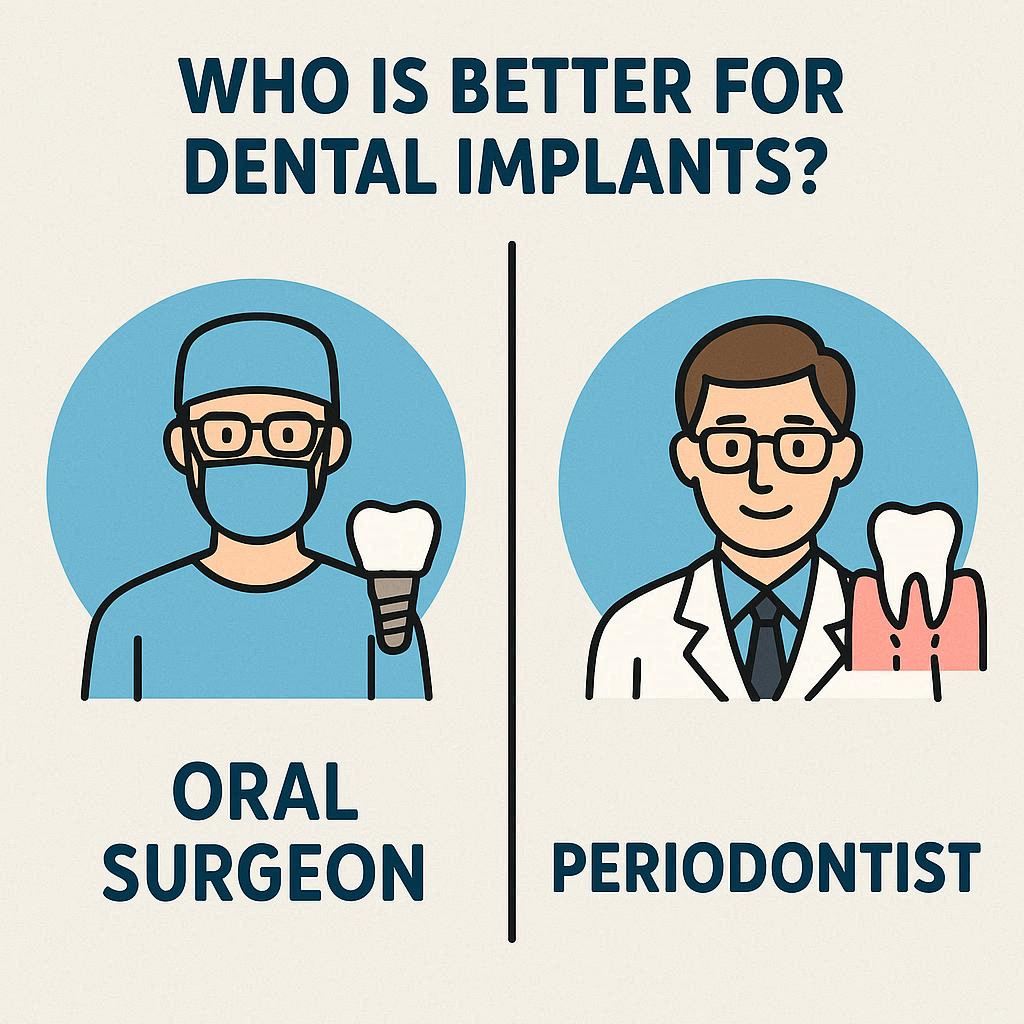
What Is An Oral Surgeon?
An oral and maxillofacial surgeon is a dentist who goes back to school for four to six extra years after dental school. During that time, they work in hospitals. They learn to handle the entire face, mouth, and jaw. They train alongside medical residents in anesthesia, emergency medicine, and surgery.
Key training fact: Oral surgeons spend thousands of hours learning how to remove impacted teeth, fix broken jawbones, treat facial trauma, and place implants in very tricky situations.
Because of this intense training, oral surgeons are the experts you call when things get complicated. They handle cases involving nerve damage risks, severe bone loss, or infections that have spread beyond the gums.
What Is A Periodontist?
A periodontist starts the same way as any dentist. After dental school, they complete three additional years of specialized training. But their focus is narrower. They concentrate only on the gums and the bone that supports your teeth.
Periodontists are the true masters of gum health. They treat advanced gum disease. They perform gum grafting. And yes, they place dental implants too. Their entire world revolves around keeping the foundation of your teeth strong and healthy.
Key training fact: Periodontists are trained to diagnose and treat gum disease at a very deep level. They also learn advanced bone grafting techniques because saving bone is essential for their work.
Now that you know their backgrounds, let us compare them directly on the things that matter most to you.
Head To Head Comparison: Oral Surgeon Vs Periodontist For Implants
To help you see the differences clearly, we have put together a simple comparison table. This table looks at the key factors you should consider when choosing a specialist.
| Factor | Oral Surgeon | Periodontist |
|---|---|---|
| Years of extra training | 4-6 years (hospital-based) | 3 years (clinic-based) |
| Primary focus | Entire jaw, face, and mouth structure | Gums and supporting bone |
| Anesthesia options | Deep sedation and general anesthesia (hospital level) | Local anesthesia and mild sedation |
| Bone grafting skills | Excellent for large, complex defects | Excellent, especially for preserving existing bone |
| Handling medical risks | Best for patients with serious health issues | Good for stable, mild health conditions |
| Managing complications | Best for nerve injuries, fractures, infections | Best for gum healing and gum-related issues |
| Average cost per implant | Usually slightly higher ($200-$500 more) | Generally moderate |
| Soft tissue management | Good | Exceptional |
| Typical case type | Complex, high-risk, full-mouth reconstructions | Single tooth, few teeth, gum disease patients |
This table gives you a bird’s eye view. But let us dig deeper into each category so you really understand what these differences mean for your everyday life.
Training And Expertise: Why It Matters For You
Training is not just a certificate on a wall. It changes how a surgeon thinks and acts when you are in the chair.
The Oral Surgeon’s Operating Room Mindset
Oral surgeons complete their training in hospital operating rooms. They learn to manage trauma. They see patients who have been in car accidents or suffered facial fractures. This environment shapes their approach.
They are very comfortable with deep sedation. If you are extremely anxious about dental work, an oral surgeon can put you completely to sleep. They also know how to respond if a medical emergency happens during your surgery. Heart issues, breathing problems, or allergic reactions? An oral surgeon has handled these before.
The Periodontist’s Preservation Philosophy
Periodontists train in a different environment. They work in dental school clinics focused on saving teeth and restoring gum health. Their mindset is about preservation.
They learn to be gentle with soft tissues. They are experts at making tiny incisions that heal quickly and look natural. If your gums are thin or receding, a periodontist knows exactly how to fix that before placing your implant. They think about the long-term health of your gum collar around the implant, which is vital for preventing infections later.
Important note: Both specialists are highly trained. The question is not who is more skilled overall. It is whose specific training matches your specific dental problem.
When To Choose An Oral Surgeon
An oral surgeon is often the better choice in these specific situations. If you recognize yourself in any of these scenarios, you should lean toward seeing an oral surgeon.
You Have Significant Bone Loss
When you lose a tooth, the bone that held it starts to melt away. If you have waited a year or more to replace a missing tooth, you may have lost a lot of bone volume. In severe cases, you might not have enough bone width or height to hold a standard implant.
Oral surgeons handle these big bone defects regularly. They can perform advanced bone grafting from your chin, hip, or even a donor source. They are also trained to use specialized implants called zygomatic implants that anchor into your cheekbone when your upper jaw has no bone at all.
You Need Multiple Implants Or Full Arch Reconstruction
Are you replacing all your upper teeth, all your lower teeth, or both? This is called full-arch reconstruction. Procedures like “All-on-4” or “All-on-6” involve placing four to six implants in very specific positions to support a full set of fixed teeth.
Oral surgeons perform these large cases every week. They are efficient. They can place all the implants in one surgery under deep sedation. And they work closely with a restorative dentist who builds the final teeth. The oral surgeon handles the surgical part, which is often the most physically demanding.
You Have A Complex Medical History
Do you have uncontrolled diabetes, heart disease, osteoporosis, or take blood thinners? Do you have a history of head and neck radiation? These conditions make implant surgery riskier.
Oral surgeons have hospital privileges. They work with anesthesiologists and other medical doctors. They can coordinate your care to make sure you are as safe as possible. If something goes wrong during surgery, they are already in the best environment to fix it quickly.
Realistic warning: No specialist can eliminate all risks if you have serious health problems. But an oral surgeon is better equipped to manage those risks when they appear.
Your Implant Is Near A Nerve
Your lower jaw contains the inferior alveolar nerve. This nerve gives feeling to your lower lip, chin, and gums. If an implant touches or damages this nerve, you could have permanent numbness or a tingling sensation called paresthesia.
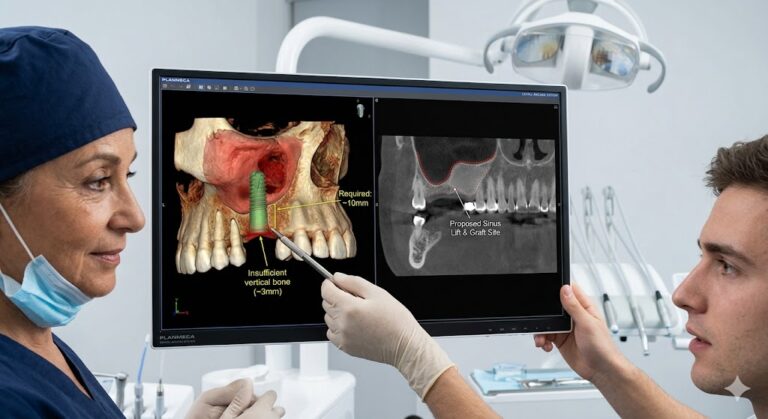
Oral surgeons use advanced imaging like 3D CT scans to map your nerves before surgery. They have the surgical skill to avoid these nerves even when space is very tight. If a nerve is already damaged from a previous extraction or injury, an oral surgeon is your best choice for a safe repair or a different implant plan.
When To Choose A Periodontist
Now let us look at the other side. A periodontist is often the superior choice for many routine implant cases. Here is when you should look for a periodontist.
You Have Active Or Past Gum Disease
Periodontists are the number one experts on gum disease. If you have red, swollen, bleeding gums, you have some level of infection. Placing an implant into infected gums is a recipe for failure. The infection can attack the bone around your new implant, leading to a condition called peri-implantitis.
A periodontist will not place an implant until your gums are completely healthy. They will perform deep cleanings (scaling and root planing) or even gum surgery to eliminate the infection first. They also monitor your gum health very closely after the implant is placed.
Key fact: Studies show that patients with a history of gum disease have a higher risk of implant failure. Seeing a periodontist who understands this risk is a smart move.
You Need A Single Tooth Implant In A Visible Area
If you are missing a front tooth or a premolar that shows when you smile, appearance matters tremendously. The gum tissue around an implant must look natural. It should match the color and contour of the gums around your other teeth.
Periodontists are masters of soft tissue. They can perform gum grafting to build up thin or missing gum tissue. They can sculpt the gum to create a natural-looking emergence profile. While oral surgeons can do this too, periodontists do it more often in their daily practice.
You Want A Less Invasive Procedure
Periodontists often use a technique called “flapless” surgery. Instead of cutting and folding back your gum tissue, they make a tiny punch hole. They place the implant through this small hole. The result is less pain, less swelling, and faster healing.
Not every patient is a candidate for flapless surgery. You need enough bone and healthy gums. But if you are, a periodontist can often give you a much gentler experience than the traditional open-flap approach.
You Have A Simple, Straightforward Case
Do you have healthy gums, good bone density, and only need one or two implants? Do you have no major medical issues? In this simple scenario, a periodontist is perfectly qualified. They can often do the entire process for a lower cost than an oral surgeon. And their focus on gum health will help ensure your implant stays infection-free for decades.
The Overlap: Where Both Are Equally Good
For many common situations, both specialists are equally excellent. You will not make a wrong choice if you fall into this middle zone.
| Situation | Oral Surgeon | Periodontist |
|---|---|---|
| Single molar implant with healthy gums | ✓ | ✓ |
| Implant after recent extraction | ✓ | ✓ |
| Sinus lift for upper back teeth | ✓ | ✓ (some training) |
| Two to three adjacent implants | ✓ | ✓ |
| Patient with mild, controlled diabetes | ✓ | ✓ |
In these cases, your decision should come down to other factors. Which doctor do you trust more? Who has better reviews? Who is closer to your home or office? Who listens to your concerns? Sometimes the “better” specialist is simply the one who makes you feel most comfortable.
Cost Comparison: What Will You Actually Pay?
Let us talk about money. Dental implants are not cheap, and the cost is often the biggest worry for patients. Here is a realistic breakdown of what you can expect to pay.
Average Cost Per Implant
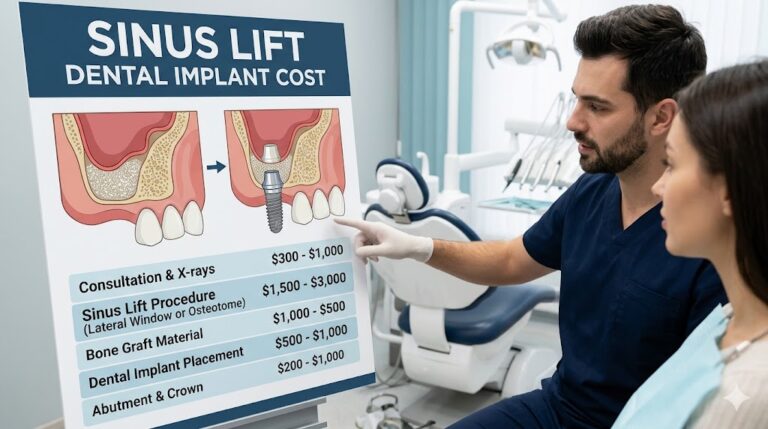
In the United States, a single dental implant placed by a general dentist typically costs between $1,500 and $3,000 for the surgical part. But specialists charge more because of their advanced training.
- Periodontist: $1,800 to $4,000 per implant
- Oral Surgeon: $2,000 to $5,000 per implant
Why the difference? Oral surgeons often include the cost of deeper sedation or general anesthesia in their fee. Periodontists usually use local anesthesia (numbing shots) with maybe an oral sedative pill, which costs much less.
Important note: These prices do not include the abutment (connector piece) or the crown (fake tooth). Those add another $1,500 to $3,000 per tooth. Always ask for the “all-in” price before you agree to anything.
Insurance And Payment Plans
Most dental insurance plans do not cover the full cost of implants. They may cover a small portion, like $1,000 to $1,500 per year, or they may cover the crown but not the implant itself. Medical insurance might cover implants if you lost teeth due to an accident or a medical condition like cancer. This is rare but worth checking.
Both oral surgeons and periodontists offer payment plans through third-party companies like CareCredit. Many also offer in-house financing. Do not be shy about asking for a payment plan. These are expensive procedures, and doctors understand that.
Risks And Complications: Who Handles Them Better?
No surgery is risk-free. Even with the best specialist, things can go wrong. The question is not how to avoid all risk, but which specialist handles problems best if they happen.
Common Implant Complications
Here are the most frequent problems that can occur:
- Infection around the implant site
- Implant failure (the bone does not fuse to the implant)
- Nerve damage causing numbness
- Sinus problems (if implants in the upper jaw push into the sinus cavity)
- Gum recession around the implant
- Poor aesthetics (the crown looks fake or unnatural)
Who Wins For Each Complication?
| Complication | Better Specialist | Why |
|---|---|---|
| Infection | Periodontist | Gum infection is their specialty |
| Implant failure | Tie | Both can replace or remove failed implants |
| Nerve damage | Oral surgeon | Trained in full-face nerve anatomy and repair |
| Sinus problems | Oral surgeon | Perform formal sinus lifts and repairs |
| Gum recession | Periodontist | Perform gum grafting routinely |
| Poor aesthetics | Periodontist | Focus on natural-looking soft tissue |
The honest truth is that serious complications are rare with either specialist when you choose an experienced doctor. But if you have a high-risk factor (like a nerve close to the site or a history of sinus infections), you should choose the specialist who handles that specific risk best.
Questions To Ask Before You Choose
You have read all the information. Now it is time to meet some doctors. Here are the exact questions you should ask during your consultation. Write these down and take them with you.
Questions for any specialist:
- How many dental implants do you place each year? (Look for 50+ per year minimum)
- What is your implant success rate? (95% or higher is standard)
- Do you use 3D CT scans for planning? (Yes is the only acceptable answer)
- What happens if my implant fails? Will you replace it for free?
- Can you show me before-and-after photos of your own patients?
- What type of anesthesia do you recommend for me, and what is the cost?
- Who will make my final crown? Do you work with a specific restorative dentist?
Questions about your specific case:
- Is my bone density good enough for a standard implant?
- Do I need a bone graft or sinus lift first?
- Do I have any signs of gum disease that need treatment first?
- Is my implant site close to a nerve or sinus?
- How long will the entire process take from start to finish?
A confident, ethical specialist will answer these questions directly. If a doctor gets defensive or rushes you, that is a red flag. Walk away.
The Team Approach: Why You Might Not Have To Choose
Here is a secret that many patients do not know. In the best dental practices, you do not have to choose one specialist for everything. Some offices use a team approach. The periodontist prepares your gums and places the implant. Then the oral surgeon steps in for the bone grafting if needed. Or the oral surgeon places the implant, and the periodontist manages your long-term gum health around it.
This collaborative model gives you the best of both worlds. The periodontist protects your soft tissues. The oral surgeon handles the complex bone and nerve anatomy. And a general dentist or prosthodontist makes the beautiful final tooth.
Question to ask: “Do you ever work with [the other type of specialist] on complex cases? Would a team approach benefit me?”
If a doctor says they never collaborate, that is a warning sign. The best specialists know their limits and welcome help from other experts.
Geographic And Availability Factors
Let us be realistic. You can read all the research in the world, but if the best specialist for your case is a three-hour drive away, you might not go. Convenience matters.
- Oral surgeons are less common. They are usually found in larger cities or near hospitals. You may wait several weeks for an appointment.
- Periodontists are more common. Many medium-sized towns have at least one. Wait times are often shorter.
If you live in a rural area, your choice may simply come down to who is available. In that situation, focus on experience rather than title. A periodontist who places 200 implants a year is better than an oral surgeon who only places 20.
How To Verify Credentials And Experience
Do not just trust what a website says. Any dentist can say they are an “implant expert.” You need to verify.
Step one: Look for board certification.
- Oral surgeons should be “Board Certified” by the American Board of Oral and Maxillofacial Surgery (ABOMS).
- Periodontists should be “Board Certified” by the American Board of Periodontology (ABP).
Step two: Check state dental board records. Search for “[your state] dental board license verification.” Look for disciplinary actions or malpractice claims.
Step three: Read real patient reviews. But be smart about it. Five-star reviews are nice, but look for detailed reviews that mention the specific procedure you need. “Dr. Smith placed my two implants and I felt nothing” is a good sign.
Step four: Ask to see their implant success data. This is uncommon, but great specialists track their own results. If they have data showing a 98% success rate over five years, you have found your doctor.
Real Patient Scenarios: Putting It All Together
Let us walk through three different patient stories. These are fictional but based on real clinical situations. See which one sounds most like you.
Scenario 1: Sarah, Age 45, Single Missing Molar
Sarah lost her lower left first molar five years ago. She has healthy gums, does not smoke, and has no medical problems. She has good bone density because she wears a removable partial denture that stimulates the bone a little.
Best choice: Periodontist.
Why: This is a simple, routine case. A periodontist can do it for less money, with less invasive surgery, and they will ensure her healthy gums stay that way for decades.
Scenario 2: Michael, Age 62, Missing All Upper Teeth
Michael has worn dentures for ten years. His upper jawbone has melted away significantly. He has a history of high blood pressure and takes a blood thinner. He also has sinus issues and very little bone under his sinuses.
Best choice: Oral surgeon.
Why: Michael needs advanced bone grafting or zygomatic implants. He needs hospital-level sedation because of his blood thinner. And his sinus issues require an oral surgeon who can perform formal sinus lifts and repairs.
Scenario 3: Linda, Age 55, Gum Disease And Two Missing Front Teeth
Linda has struggled with bleeding gums for years. She recently lost two upper front teeth due to gum disease. Her gums are thin and receding. She wants a beautiful smile that looks natural.
Best choice: Periodontist.
Why: Linda must treat her active gum disease before any implant is placed. A periodontist will save her remaining teeth and control the infection. Then they will perform gum grafting to build up her thin tissues before placing implants for a natural, aesthetic result.
Long-Term Success Rates: The Numbers You Need
You want your implants to last for decades, maybe for life. Here is what the research says about long-term success with each specialist.
- Oral surgeon implants: 10-year success rate of 95% to 97% in healthy patients
- Periodontist implants: 10-year success rate of 94% to 96% in healthy patients
These numbers are essentially identical. Both specialists achieve excellent long-term results when the patient is a good candidate.
Where the numbers differ is in high-risk patients.
- Patients with gum disease history: 90% success with periodontists vs 85% with oral surgeons
- Patients with severe bone loss: 92% success with oral surgeons vs 88% with periodontists
See the pattern? Each specialist does better with the problems they see most often. A periodontist manages gum disease better, so their success rate is higher in those patients. An oral surgeon handles bone loss better, so their success rate is higher in those patients.
Takeaway: Match your problem to the specialist who sees that problem every single day.
Final Decision Guide: A Simple Checklist
You have read a lot of information. Let us simplify everything into one easy checklist. Print this page or write down your answers.
Ask yourself these six questions:
- Do I have active gum disease (bleeding, red, swollen gums)?
- Yes → Lean toward Periodontist
- No → Either specialist
- Do I have significant bone loss or need a complex bone graft?
- Yes → Lean toward Oral Surgeon
- No → Either specialist
- Is my missing tooth in a very visible front tooth area?
- Yes → Lean toward Periodontist (for better gum aesthetics)
- No → Either specialist
- Do I have a serious medical condition (uncontrolled diabetes, heart disease, blood thinners)?
- Yes → Lean toward Oral Surgeon
- No → Either specialist
- Is my implant very close to a nerve or sinus?
- Yes → Lean toward Oral Surgeon
- No → Either specialist
- Do I want the lowest possible cost for a simple case?
- Yes → Lean toward Periodontist
- No → Either specialist
If you answered “Either specialist” to all questions, congratulations. You have a straightforward case. Choose the doctor you like personally, who has great reviews, and who makes you feel calm and informed.
Conclusion
Choosing between an oral surgeon and a periodontist for dental implants does not have to be stressful. Oral surgeons are the experts for complex bone loss, full-mouth reconstructions, near nerves, and patients with serious medical conditions. Periodontists shine when managing gum disease, creating beautiful aesthetics for front teeth, and handling routine single-tooth cases with less invasive techniques. For most healthy patients with simple needs, both specialists deliver excellent, long-lasting results, so focus on finding a doctor with experience, clear communication, and a team approach to your care.
Frequently Asked Questions (FAQ)
1. Can a general dentist place dental implants?
Yes, many general dentists place implants after taking continuing education courses. However, they do not have the advanced training of a specialist. For straightforward cases, a skilled general dentist is fine. For complex cases, a specialist is safer.
2. Which specialist has a higher success rate for implants?
In healthy patients, both have success rates above 95% over ten years. The difference appears in high-risk patients. Periodontists do better with gum disease patients. Oral surgeons do better with severe bone loss patients.
3. Do oral surgeons cost more than periodontists?
Generally, yes. Oral surgeons often charge $200 to $500 more per implant because they provide deeper sedation and have more hospital-based training. However, prices vary widely by geographic location.
4. Can a periodontist put me to sleep for implant surgery?
Periodontists can provide mild to moderate sedation using oral pills or nitrous oxide (laughing gas). For deep sedation or general anesthesia where you are completely unconscious, an oral surgeon is the better choice.
5. How do I know if I need a bone graft before my implant?
Only a 3D CT scan can tell for sure. Both specialists will order this scan. If you have less than 1-2 millimeters of bone around the planned implant site, you will need some form of grafting.
6. What happens if my implant fails years later?
Your warranty depends on the doctor. Some offer a free replacement for five years. Others do not. Always ask this question before surgery. Also, both specialists can remove a failed implant and place a new one, but the bone may need time to heal first.
7. Should I see an oral surgeon or periodontist for a sinus lift?
Oral surgeons perform formal sinus lifts more often, especially for large lifts. Many periodontists can perform smaller sinus lifts (internal sinus lifts). For small lifts, either works. For large lifts, choose an oral surgeon.
8. Is one specialist better for same-day implants (teeth in a day)?
Both can perform same-day implants. However, oral surgeons who do full-arch reconstructions (like All-on-4) often have more experience with the complex planning required for same-day teeth.
Additional Resource
For a deeper dive into dental implant success statistics and to find board-certified specialists near you, visit the American Academy of Implant Dentistry (AAID) . Their website offers a free “Find a Dentist” tool that lets you search specifically for oral surgeons, periodontists, or general dentists with advanced implant training.
👉 Recommended link: www.aaid.com (Search for “Find an Implant Dentist”)
Disclaimer:
This article is for informational purposes only and does not constitute medical advice. Dental implant surgery involves risks, including infection, nerve damage, and implant failure. Always consult with a licensed dental professional to evaluate your specific medical history, oral health, and treatment options before undergoing any surgical procedure. The author and publisher are not responsible for any outcomes resulting from the use of this information.