Tooth Removal and Implant
Deciding to remove a tooth can feel scary. The thought of placing a metal screw into your jawbone right after might sound even more intimidating. But let me tell you a secret: millions of people go through this process every year, and most of them say the anxiety was worse than the reality.
This guide is here to walk you through everything. We will talk about why a tooth might need to go, what happens during the extraction, how the implant works, and what you can expect regarding pain, costs, and recovery.
No complicated medical jargon. No false promises of “painless magic.” Just real, honest information to help you make the best choice for your smile.
Why Save a Tooth? (And When to Let Go)
Dentists love saving teeth. That is the first thing you should know. Pulling a tooth is usually the last resort. But sometimes, holding onto a bad tooth can actually hurt your overall health more than removing it.
The Obvious Signs: Pain and Infection
Persistent pain is your body’s way of screaming for help. If you have a tooth that keeps you awake at night, or if your face swells up like a balloon, you are likely dealing with deep decay or infection.
In many cases, a root canal can fix this. However, if the tooth is cracked vertically down to the root, or if the bone around it is severely damaged, a root canal won’t save it. In those cases, removal is the only healthy option.
Crowding and Orthodontic Reasons
Sometimes, teeth are perfectly healthy but need to go. Do you have an overcrowded mouth? Before getting braces, an orthodontist might recommend removing one or two teeth to make room for the others to shift into alignment.
Gum Disease (Periodontitis)
This is the sneaky one. Gum disease doesn’t always hurt. Over time, it eats away the bone that holds your teeth in place. You might notice your tooth feels loose. If a tooth is “mobile” (wiggly) because of bone loss, an implant might be a sturdier, longer-lasting solution than trying to keep the natural tooth.
Understanding the Tooth Extraction Process
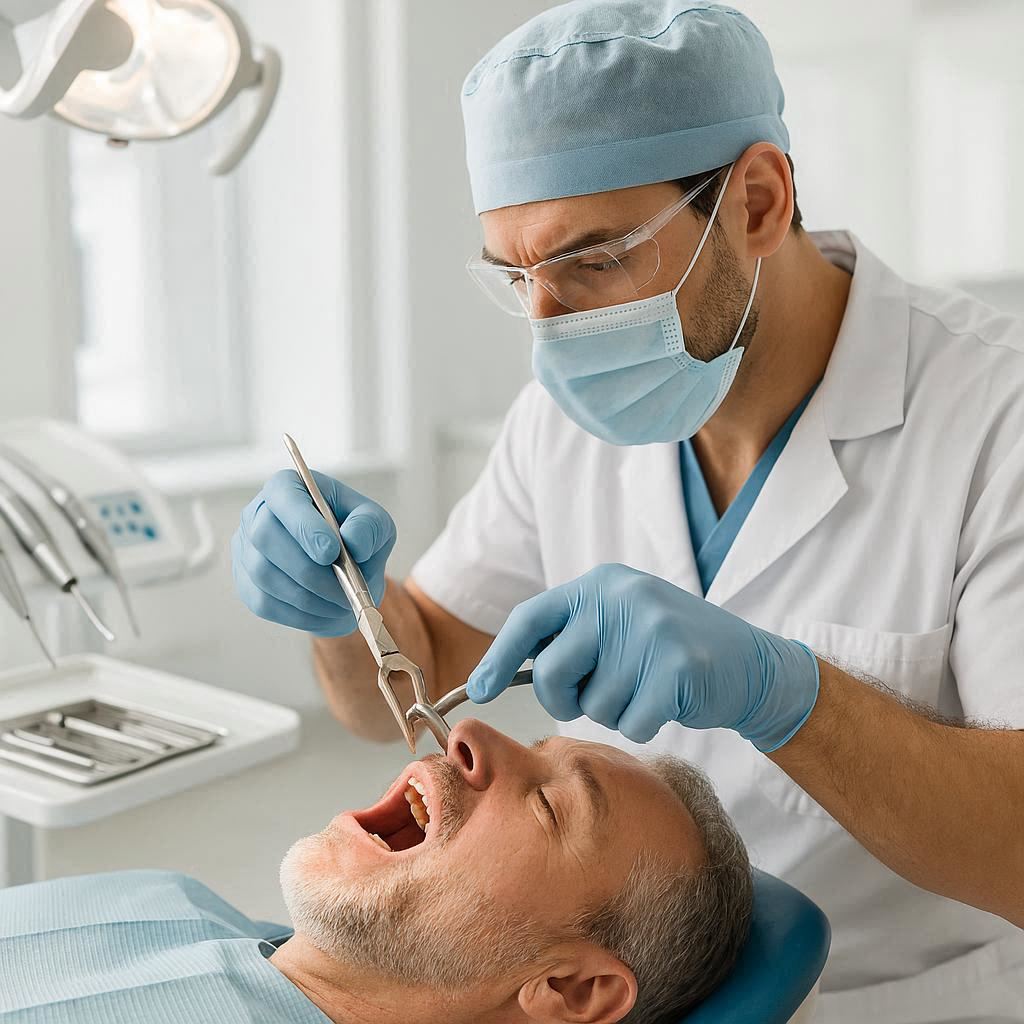
Let’s get one thing straight: modern dentistry has come a long way. If you are worried about pain, take a deep breath. You will be numb. Very numb.
Before any removal, the dentist will take an X-ray (or a 3D scan) to see the shape of the roots and the condition of the bone. This map helps them avoid nerves and sinuses.
Simple Extraction vs. Surgical Extraction
| Feature | Simple Extraction | Surgical Extraction |
|---|---|---|
| Tooth condition | Visible above the gum line | Broken off, impacted, or not erupted |
| Process | Loosened with an elevator, pulled with forceps | Requires incisions (cuts) in the gum |
| Time | Usually 20–40 minutes | Often 45–90 minutes |
| Recovery | Shorter, less swelling | Longer, more swelling potential |
| Cost | Lower | Higher |
Reader Note: If you have a surgical extraction, do not panic. You will still be numb. You might hear drilling or pressure, but you should not feel sharp pain. If you do, raise your hand immediately.
What Does the Removal Actually Feel Like?
This is the question everyone asks. You will feel pressure. It feels like someone is pushing hard on your head. You might hear a cracking sound (that is the ligament breaking, not the tooth shattering). The actual “pull” lasts about two seconds. Once the tooth is out, the pressure disappears instantly.
Immediate Aftercare: The First 24 Hours
The work is not over when the tooth is out. Healing starts now.
- Bite on gauze: Keep firm pressure for 30–45 minutes to stop bleeding.
- No spitting: Spitting creates suction that pulls out the blood clot. This causes a “dry socket,” which is very painful.
- Ice packs: 20 minutes on, 20 minutes off. This keeps the swelling down.
- Soft foods: Yogurt, applesauce, soup. No hot coffee or crunchy chips for a few days.
The Bone Graft: A Crucial Step You Might Need
Here is a reality check. When a tooth comes out, the bone that surrounded the root starts to melt away. It shrinks. This is called resorption.
If you leave the hole empty for six months, you might lose 30-50% of the bone width. That is a problem because an implant needs thick, solid bone to hold onto.
What is a Bone Graft?
Imagine a scaffold inside the empty socket. The dentist packs a special material (usually synthetic or from a cow/cadaver source) into the hole. This material encourages your body to grow new bone cells to replace it.
- Do you always need it? No. If the socket is big, or if the bone is thin, yes. If the tooth was small and the bone is healthy, maybe not.
- Does it hurt? It feels like the extraction. Usually, you get it done at the same time as the removal.
- Time added: A graft needs 4 to 6 months to heal before you can place the implant.
What is a Dental Implant?
Let’s clear up a common myth. An implant is not the fake tooth you see in the mirror.
An implant is a small titanium post. The surgeon places this post deep into your jawbone. Over time, your bone grows tightly around the titanium. This is called osseointegration (a big word that just means “bone fusing to metal”).
Once the post is solid, the dentist attaches a connector (abutment) and then glues or screws the fake tooth (crown) onto the top.
The Three Parts of an Implant System
- The Fixture (Post): The screw in the bone.
- The Abutment: The tiny cap that sticks out above the gum.
- The Crown: The visible, white tooth.
Step-by-Step: The Complete Tooth Removal and Implant Journey
This is a marathon, not a sprint. From the day the tooth comes out to the day you chew steak on the new tooth, expect 6 to 9 months. Sometimes longer. Anyone promising you a “tooth in a day” is either doing a very specific type of procedure or oversimplifying things.
Phase 1: Extraction and Grafting (Day 1)
You arrive at the office. You get numbed. The dentist removes the tooth. If needed, they pack the bone graft material into the hole. They place stitches. You go home with an ice pack.
Phase 2: Healing and Integration (Months 2 to 6)
Your body does the heavy lifting. The socket closes up. The gum covers the hole. Underneath, the bone graft turns into your own hard tissue. You live life normally. You just have a “gap” in your smile.
Important Note: Do not put pressure on the healing site. Try to chew on the other side.
Phase 3: Implant Placement Surgery (Month 4-7)
The dentist checks the bone with a scan. If ready, they numb you again. They make a tiny punch in the gum. They drill a precise hole into the bone (using a sequence of bits, like a pilot hole). They screw the titanium post into the hole. They put a healing cap on top. Stitches go back in.
Pain level? Most patients say it is easier than the extraction. The bone itself does not have many pain nerves. The soreness comes from the gum stitches.
Phase 4: Osseointegration (Months 5 to 8)
Now you wait again. The implant needs 3 to 6 months to “glue” itself to the bone. You cannot put the crown on until the dentist confirms the implant is tight and stable. If you put a crown on a loose implant, it will fail.
Phase 5: The Abutment and Crown (Month 9)
The surgeon exposes the top of the implant. They screw on the abutment. They take an impression (a mold) of your mouth.
A lab makes your custom crown. This takes 2-3 weeks. When it arrives, the dentist tries it in. They check the bite (how it touches the opposite tooth). If it feels good, they cement or screw it permanently.
Visual Timeline
text
Month 0: Extraction + Graft
  |
  v
Months 1-4: Rest & Heal (Socket closes)
  |
  v
Month 5: Implant Placed
  |
  v
Months 6-8: Osseointegration (Bone grows)
  |
  v
Month 9: Crown Attached
  |
  v
DONE: You have a new tooth!
Does It Hurt? The Honest Pain Report
Let’s rank things on a scale of 1 to 10.
- The Injection (Novocaine): 2/10. A tiny pinch and a weird cold burn for 10 seconds.
- The Extraction Pressure: 0/10 for pain. 5/10 for discomfort/pressure.
- The Day After Extraction: 4/10. Achy. Tylenol or ibuprofen usually knocks it out.
- The Implant Surgery: 1/10 during. 3/10 after.
- The Worst Part: The waiting. The hunger for crunchy food. The anxiety before the first surgery.
A quote from a real patient: “I built it up in my head for two years. When I finally did it, I fell asleep in the chair during the implant placement. The noise is weird, but the pain was basically zero.”
Costs: The Elephant in the Room
I will be straight with you. This is expensive. But think of it as a permanent investment. A bridge lasts 10-15 years. An implant, if cared for, can last 40+ years.
Here is a realistic breakdown (USD estimates for a private US clinic without insurance):
| Procedure | Estimated Cost |
|---|---|
| Consultation + X-ray/CBCT scan | 150–350 |
| Simple Extraction | 200–400 |
| Surgical Extraction (complex) | 400–800 |
| Bone Graft (if needed) | 500–1,200 |
| Implant Fixture (the screw) | 1,500–2,500 |
| Abutment | 300–600 |
| Crown (the fake tooth) | 1,000–2,000 |
| Total (Single Tooth, with graft) | 4,000–4,000–7,000 |
Total (Single tooth, no graft, simple case): 3,000–5,000
Insurance reality: Many dental plans cover the extraction (50-80%). They rarely cover the implant fully. They might cover the crown portion (up to $1,500). Call your provider and ask for “implant restoration coverage.”
Living With a Gap: Is It Bad to Wait?
You pulled the tooth. Now you are thinking, “Can I just leave the hole?”
Technically, yes. You can live with a missing tooth forever. But there are consequences.
- Teeth shift: Your back tooth will lean forward into the gap. Your top tooth will drop down (super-erupt).
- Bone loss: The jawbone shrinks. After a few years, you might no longer have enough bone for an implant without a massive, expensive block graft.
- Chewing problems: You start favoring one side, which can cause jaw pain (TMJ).
If you are not ready for an implant, ask your dentist about a partial denture (a fake tooth on a retainer) to hold the space. It costs a few hundred dollars and buys you time.
Success Rates: Do Implants Fail?
Implants are one of the most successful medical devices in history. The success rate is over 95% for lower front teeth and about 90-95% for upper back molars.
However, they can fail. Usually, failure happens in the first 3 months.
Why Implants Fail
- Infection (Peri-implantitis): This is gum disease around the implant. It is the #1 cause of late failure. You must floss.
- Smoking: Smokers have a failure rate nearly double that of non-smokers. Nicotine chokes the blood flow to the bone.
- Grinding (Bruxism): If you grind your teeth at night, you need a night guard. Implants are rigid. They don’t have a ligament to cushion pressure like natural teeth. Grinding can snap the screw.
- Medical conditions: Uncontrolled diabetes or cancer radiation to the jaw.
Aftercare: How to Make It Last a Lifetime
You paid thousands for this tooth. Protect it.
- Brush twice a day: Use a soft brush. Pay attention to the gumline where the implant meets the crown.
- Floss daily: Use “super floss” or implant-specific floss with a stiff end to thread under the crown.
- Water flosser: Highly recommended. It blasts food out from under the bridge of the crown.
- Regular cleanings: See your hygienist every 6 months. They have special plastic scrapers (metal ones scratch the implant).
- Night guard: If you clench, get one. It is cheaper than replacing the implant.
Alternatives to an Implant
Maybe surgery is not for you. Maybe the cost is too high. That is fine. You have options.
Option A: Fixed Dental Bridge
The dentist grinds down the teeth on either side of the gap. Then they glue a three-piece fake tooth (pontic) over the gap.
- Pros: Faster (3 weeks). Cheaper upfront (2,000−3,500). No surgery.
- Cons: Damages healthy teeth. Harder to clean. Lasts 10-15 years.
Option B: Removable Partial Denture
A plastic plate with a fake tooth and metal clasps that hook onto your other teeth.
- Pros: Lowest cost (500−1,500). Non-invasive.
- Cons: Feels bulky in the mouth. Can be embarrassing to remove. It can wobble when you chew.
Option C: Do Nothing
- Pros: Free today.
- Cons: Expensive later (bone loss, shifting teeth, cavities in tilted teeth).
Special Cases: Front Tooth vs. Back Tooth
Replacing a front tooth is different from a molar.
Front Tooth (esthetic zone):
- The dentist must match the color perfectly.
- You might need a “flipper” (temporary denture) during healing so you don’t have a hole when you smile.
- Often requires a bone graft 100% of the time to keep the gum looking pink and full.
Back Tooth (molar):
- Strength matters more than beauty.
- Chewing forces are huge. The implant must be wider (4.5mm to 6mm in diameter).
- Esthetics are less critical. A metal abutment showing is fine because no one sees it.
Frequently Asked Questions (FAQ)
Q: Can I get the tooth removed and the implant placed on the same day?
A: Sometimes. This is called “immediate implant placement.” It requires perfect conditions: no infection, thick bone, and a dentist trained in the technique. In most regular extractions, dentists prefer to wait for the gum to heal first.
Q: Does insurance cover tooth removal and implant?
A: Usually, insurance covers the extraction (medical necessity) and up to 50% of the crown. Implants are often considered “cosmetic” or “elective” by older plans. Always get a pre-treatment estimate.
Q: Is 70 years old too old for an implant?
A: No. Age is not a factor if you are healthy. Many 80-year-olds get implants to stabilize dentures. The bigger question is bone density and healing capacity.
Q: Can I use my own tooth for the bone graft?
A: Rarely. Usually, the removed tooth is hollow and infected. Dentists use synthetic or donated bone because it is sterile and predictable.
Q: Will my face look different after extraction?
A: If you replace the tooth with an implant, no. The implant supports the gum and bone. If you leave the gap for years, eventually the bone sinks, and your lip might look slightly collapsed on that side.
Q: How do I clean under the implant crown?
A: You cannot remove it. You use a floss threader or a water flosser to get underneath. Think of it like cleaning under a low bridge.
Additional Resource
For a deeper dive into the science of bone healing and finding a specialist near you, visit the American Academy of Implant Dentistry (AAID). Their public education section offers a “Find a Dentist” tool and free downloadable guides on patient rights and implant brands.
[Link: aaid-implant.org/patient-resources] (Note: Verify this link is active. As a writer, I recommend searching “AAID patient resources” if the direct link fails.)
Final Checklist: Before You Say Yes
Before you schedule your tooth removal and implant, ask your dentist these three questions:
- “Do I have enough bone right now, or do I need a graft?”
- “What is the total cost including the crown and any surprises?”
- “If the implant fails, what is your replacement policy?”
Conclusion
Tooth removal and implant treatment is a journey of patience, but it ends with the closest thing to a natural tooth that modern science can offer. You will trade a few months of soft foods for decades of confident chewing and a smile that stays in place. Remember, the pain is manageable, the success rate is high, and the cost—while significant—spreads out over a lifetime of better oral health.
Disclaimer: This article is for informational purposes only and does not constitute medical advice. Always consult with a licensed dental professional to diagnose your specific condition and create a treatment plan. Do not rely on this article to replace a physical examination.