Tysons Corner Dental Implants: Your Complete Guide to a Natural, Permanent Smile
If you are missing one or more teeth, you already know how much it can affect your daily life. Eating becomes a chore. Smiling feels awkward. Speaking clearly might even feel like a challenge.
You are not alone. Millions of adults face tooth loss, and for a long time, the only solutions were dentures or bridges. But today, there is a better option.
Dental implants have changed modern dentistry. They look, feel, and function like real teeth. And if you live in or near Tysons Corner, you have access to some of the most advanced implant dentistry in Northern Virginia.
This guide walks you through everything you need to know. No fluff. No fake promises. Just honest, clear, and useful information to help you make the right choice for your smile and your budget.
Let us begin.
Understanding Dental Implants: The Basics
Before we dive into costs and specialists, it helps to understand what a dental implant actually is. Many people imagine a complex metal device. Others picture a fake tooth glued to a screw.
The truth lies somewhere in between.
What is a dental implant?
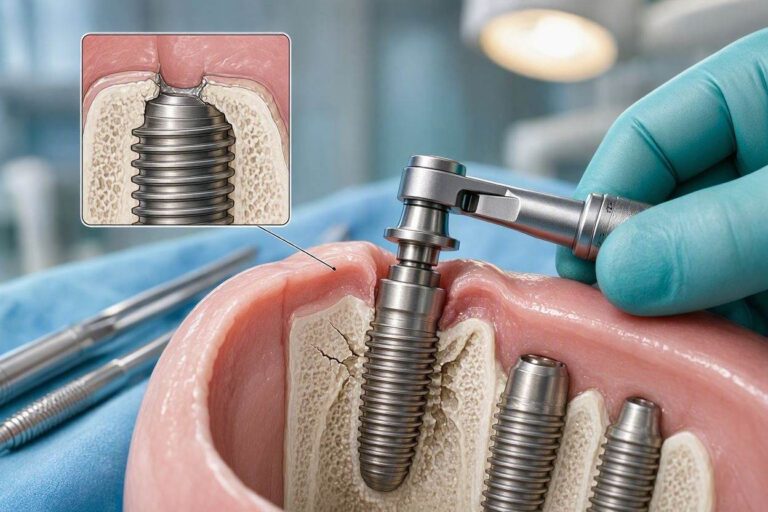
A dental implant is a small, threaded post made of medical-grade titanium. Your dentist surgically places this post into your jawbone, right where your natural tooth root used to be.
Over time, the bone grows around the implant. This process is called osseointegration. It sounds technical, but it simply means the implant becomes part of your body.
Once the implant is secure, your dentist attaches a custom-made artificial tooth (called a crown) on top.
The three main parts of a dental implant
| Component | Purpose | Material |
|---|---|---|
| Implant post | Replaces the tooth root | Titanium or zirconia |
| Abutment | Connects post to the crown | Titanium or ceramic |
| Dental crown | Visible part that looks like a tooth | Porcelain, ceramic, or zirconia |
Each part plays a critical role. Together, they recreate your natural tooth from root to chewing surface.
Note for readers: Not all implants are the same. Some systems are better suited for front teeth, while others work best for molars in the back. Your dentist in Tysons Corner will choose based on your specific anatomy and needs.
How implants differ from other tooth replacement options
Here is a quick comparison to help you see why implants have become so popular.
| Option | Pros | Cons |
|---|---|---|
| Dental implants | Permanent, natural feel, preserves bone | Higher upfront cost, requires surgery |
| Fixed bridge | No surgery needed, faster | Damages healthy adjacent teeth, lasts 7-15 years |
| Removable dentures | Least expensive, non-invasive | Unstable, bone loss over time, affects speech |
| Implant-supported dentures | Stable, more comfortable | Higher cost than regular dentures, requires implants |
The main advantage of implants is that they stop bone loss. When you lose a tooth, your jawbone starts to shrink. Implants stimulate the bone, just like natural roots do. That keeps your face shape intact and prevents that sunken look often seen with traditional dentures.
Why Choose Tysons Corner for Your Dental Implants?
Tysons Corner is not just a hub for shopping and business. It has also become a center for high-quality dental care in Northern Virginia.
Access to experienced implant specialists
Many general dentists offer implants. But Tysons Corner is home to multiple prosthodontists and oral surgeons who focus entirely on implant dentistry. These specialists have advanced training beyond dental school. They place hundreds of implants every year.
That experience matters. A specialist knows how to handle complex cases like low bone density, sinus issues, or previous failed implants.
Convenient location
Located just outside Washington, D.C., Tysons Corner is easy to reach from McLean, Vienna, Falls Church, Reston, and even Arlington. The Silver Line Metro makes it accessible even without a car.
Modern dental technology
Many Tysons Corner implant dentists use technology you will not find everywhere:
- 3D Cone Beam CT scans – These give a complete picture of your jawbone, nerves, and sinuses. No guesswork.
- Digital smile design – You can see your final smile before surgery even begins.
- Same-day implants – Some clinics offer teeth-in-a-day using advanced computer-guided placement.
All of this means better outcomes, fewer surprises, and often faster healing.
Types of Dental Implants Available in Tysons Corner
Not every implant patient is the same. Some need a single tooth replaced. Others need an entire arch. Your Tysons Corner dentist will recommend a specific type based on your situation.
Single tooth implants
This is the most straightforward type. One implant supports one crown. It does not touch the neighboring teeth. That is a huge advantage over a bridge, which requires grinding down healthy teeth on either side.
Best for: People missing one natural tooth.
Timeframe: Usually 3 to 6 months from start to finish.
Multiple implants for several missing teeth
If you are missing two, three, or even four teeth in a row, you do not need an implant for every single gap. Your dentist can place two or three implants and connect them with a custom bridge.
This approach saves money while still protecting your jawbone and giving you stable chewing power.
Best for: People missing adjacent teeth.
Timeframe: 3 to 6 months.
All-on-4 and All-on-6 implants
For patients missing all teeth on the upper arch, lower arch, or both, full-mouth restoration is possible using just four or six implants per jaw.
The All-on-4 technique places two implants in the front of the jaw and two angled implants in the back. This avoids the sinus cavities and often eliminates the need for bone grafting.
Important note: All-on-4 is not for everyone. It works best when you have enough bone in specific areas. Some patients still need bone grafting. A good Tysons Corner implant dentist will be honest about whether you are a candidate.
Best for: Patients with significant tooth loss or failing teeth.
Timeframe: Some cases completed in one day. Full healing takes 4 to 6 months.
Implant-supported dentures
Traditional dentures rest on your gums. Implant-supported dentures snap onto two to four implants. They do not slip when you talk or eat. And they are removable for cleaning, which many patients prefer.
Best for: Patients who want more stability than regular dentures but do not want or need fixed teeth.
Timeframe: 3 to 5 months.
Zygomatic implants (for severe bone loss)
This is a less common but life-changing option. If you have been told you do not have enough bone for regular implants, zygomatic implants might still work. They anchor into the cheekbone (zygoma) instead of the upper jaw.
Very few dentists offer this. But some specialists in the Tysons Corner area are trained in this advanced technique.
Best for: Patients with severe bone loss who have been turned away elsewhere.
Timeframe: 6 to 9 months.
The Step-by-Step Process of Getting Dental Implants in Tysons Corner
Knowing what to expect removes fear and uncertainty. Here is a realistic walkthrough of the entire implant process.
Step 1: Initial consultation and imaging
Your first visit is all about information gathering. The dentist will:
- Review your medical history
- Examine your mouth and remaining teeth
- Take a 3D Cone Beam CT scan
- Discuss your goals and budget
This appointment usually takes 45 to 90 minutes. You should leave with a clear treatment plan and a written cost estimate.
Step 2: Preparatory procedures (if needed)
Not everyone needs extra work. But some patients require:
- Bone grafting – If your jawbone is too thin or soft, the dentist adds bone material to create a solid foundation.
- Sinus lift – For upper back molars, the sinus cavity may need to be raised to make room for the implant.
- Tooth extraction – Damaged teeth that cannot be saved are removed.
- Gum disease treatment – Active infection must be treated before implants can be placed.
These steps add time and cost, but they are essential for long-term success. Skipping them leads to implant failure.
Step 3: Implant placement surgery
This is the main event. Here is what happens:
- The area is numbed with local anesthetic.
- If you chose sedation, you will receive medication to help you relax.
- The dentist makes a small incision in your gum.
- A precise hole is drilled into your jawbone.
- The titanium implant is screwed into place.
- A healing cap or cover screw is placed on top.
- The gum is stitched closed.
Most single implants take 30 to 60 minutes. Full-arch cases take 2 to 3 hours.
Is it painful? You should not feel pain during surgery because of the anesthetic. Afterward, most patients compare the discomfort to having a tooth pulled. Over-the-counter pain relievers usually handle it.
Step 4: Osseointegration (healing period)
This is the most important phase. Your bone needs time to grow around the implant. That bond is what makes implants so strong.
Healing takes:
- Lower jaw: 3 to 4 months
- Upper jaw: 4 to 6 months
During this time, you will eat softer foods and avoid putting direct pressure on the implant site. Your dentist may give you a temporary crown or denture so you are not walking around with a gap.
Step 5: Abutment placement
Once the implant is fully fused with the bone, the dentist uncovers the implant and attaches a small connector piece called the abutment. This is a minor procedure. It usually takes 15 to 30 minutes.
Step 6: Crown fabrication and placement
Your dentist takes impressions of your mouth. A dental lab uses those impressions to craft your permanent crown, bridge, or denture.
This takes 2 to 4 weeks. When it is ready, you return for the final appointment. The dentist checks the fit, color match, and bite. Then they screw or cement the restoration onto the abutment.
And just like that, you have a new tooth.
Cost of Tysons Corner Dental Implants: Realistic Numbers
Let us talk money. This is often the biggest concern, and for good reason. Dental implants are an investment.
Prices vary depending on the dentist, the implant system used, and any extra procedures you need. But here are realistic ranges for the Tysons Corner area.
Average costs in Tysons Corner
| Procedure | Typical cost range |
|---|---|
| Single implant (including crown) | 4,000–7,000 |
| Implant bridge (2-3 implants, 3-4 crowns) | 8,000–15,000 |
| Implant-supported denture (per arch) | 7,000–15,000 |
| All-on-4 (per arch, fixed teeth) | 18,000–30,000 |
| All-on-6 (per arch, fixed teeth) | 24,000–40,000 |
| Full mouth restoration (both arches) | 40,000–70,000+ |
| Bone grafting (per site) | 500–3,000 |
| Sinus lift | 1,500–5,000 |
Important note: These are out-of-pocket estimates without insurance. Your actual cost may be lower or higher depending on your specific case.
Why Tysons Corner prices might be higher or lower
You will find cheaper implants in other states or even in other parts of Virginia. But prices in Tysons Corner reflect:
- Higher overhead costs for rent, staff, and equipment
- Access to specialists with advanced training
- Use of premium implant brands like Nobel Biocare, Straumann, or Zimmer
- Newer technology like CT scanners and digital impression systems
That said, you can still find affordable options. Some dental schools within driving distance offer reduced fees. And many Tysons Corner dentists offer payment plans or in-house membership programs.
Does insurance cover dental implants?
It depends. Most dental insurance plans still classify implants as “cosmetic” or “major restorative” with limited coverage.
Here is what to look for in your policy:
- Annual maximum – Most plans cap coverage at 1,000to2,000 per year.
- Waiting periods – Some plans require you to be enrolled for 6 to 12 months before covering major work.
- Missing tooth clause – If the tooth was missing before your policy started, some plans will not cover it.
Even with limited coverage, use what you have. Your dentist’s office can file the claim for you. Many also accept CareCredit or other medical financing.
Dental Implants vs. Other Options: An Honest Comparison
You have choices. Let us compare implants to the two most common alternatives so you can decide with your eyes open.
Dental implants vs. traditional bridges
| Factor | Implant | Bridge |
|---|---|---|
| Impact on healthy teeth | None | Adjacent teeth are filed down |
| Longevity | 20+ years to lifetime | 7-15 years |
| Bone preservation | Yes | No |
| Chewing power | 90-95% of natural | 70-80% of natural |
| Upfront cost | Higher | Lower |
| Requires surgery | Yes | No |
A bridge might make sense if you cannot have surgery or if cost is the only factor. But for most patients, the implant is the better long-term value.
Dental implants vs. traditional dentures
| Factor | Implant-supported | Traditional dentures |
|---|---|---|
| Stability | Does not move | Can slip and click |
| Speech | Clear | May lisp or slur |
| Taste | Unaffected | Palate covered, reduced taste |
| Bone loss | Stops or slows | Progressive bone loss |
| Sleeping | Can leave in or remove | Must remove nightly |
| Maintenance | Brush and floss like normal | Requires soaking and adhesives |
If you have struggled with loose dentures or sore spots, implant-supported options are life-changing.
Risks, Complications, and Honest Expectations
No medical procedure is perfect. Implants have a very high success rate — 95 to 98% — but things can go wrong. You deserve to know the risks.
Common but manageable side effects
- Swelling and bruising – Normal for 3 to 7 days.
- Minor bleeding – Usually stops within 24 hours.
- Temporary numbness – Lip or chin numbness from nerve proximity, usually resolves.
- Discomfort while eating – Soft food diet recommended during healing.
Less common but serious complications
- Implant failure – The bone does not fuse to the implant. This happens more often in smokers and people with uncontrolled diabetes.
- Infection – Peri-implantitis is like gum disease around the implant. It can cause bone loss if not treated.
- Nerve damage – Rare but possible, leading to permanent tingling or numbness in the lip or chin.
- Sinus problems – Implants in the upper back teeth can protrude into the sinus cavity.
How to reduce your risk
You have control over several factors:
- Choose an experienced dentist – Do not bargain-hunt for implant surgery.
- Stop smoking – Smokers have a failure rate up to 20% higher.
- Control medical conditions – Stable diabetes and blood pressure are fine. Uncontrolled conditions increase risk.
- Follow aftercare instructions – No straws, no spitting, no hard foods during healing.
Quote from a Tysons Corner implant specialist: “The patients who fail are almost never the ones who followed instructions. They are the ones who thought they knew better. Listen to your dentist.”
Finding the Right Tysons Corner Dental Implant Provider
You have many dental offices to choose from. Here is how to narrow down your search.
Types of implant providers
| Provider type | Training level | Best for |
|---|---|---|
| General dentist | Dental school + CE courses | Simple single implants |
| Prosthodontist | 3 extra years of restorative training | Complex crowns, bridges, full-mouth rehab |
| Oral surgeon | 4-6 years surgical residency | Bone grafting, sinus lifts, sedation |
| Periodontist | 3 years gum and bone specialty | Soft tissue management, gum health |
| Implant center | Team of multiple specialists | Full-arch, All-on-4, difficult cases |
For a single implant in a healthy jaw, a skilled general dentist is fine. For full-mouth reconstruction or complex anatomy, see a specialist or implant center.
Questions to ask before you choose
Write these down and bring them to your consultation.
- How many implants have you placed? (Look for hundreds or thousands)
- What is your success rate? (Should be 95% or higher)
- Do you use 3D CT scanning on-site?
- What implant brands do you use?
- What happens if my implant fails? Do you replace it for free?
- Can you show me before-and-after photos of similar cases?
- Do you offer sedation? What kind?
- What is the total cost including everything — surgery, parts, crown, and any unexpected procedures?
A good dentist answers these questions openly. A dentist who gets defensive or vague is a red flag.
Red flags to avoid
- Prices that seem too good to be true (under $2,000 for a full implant and crown)
- No CT scanner (using only 2D X-rays is outdated)
- High-pressure sales tactics or “today-only” discounts
- No online reviews or years of negative reviews
- Dentist who performs every step alone without a team or specialist referral
Recovery and Aftercare: What to Expect Week by Week
You have had your implant placed. Now what? Here is a realistic timeline.
Days 1 to 3
- Swelling peaks around day 2. Ice packs help.
- Bleeding stops by day 2. Use gauze as directed.
- Pain controlled with ibuprofen or prescribed medication.
- Diet – Only cold or lukewarm soft foods. Nothing hot, crunchy, or chewy.
- No spitting, using straws, or rinsing vigorously.
Days 4 to 7
- Swelling goes down.
- You can switch to warm salt water rinses (gently).
- Most patients return to work or normal activities.
- Continue soft foods. Avoid the surgical site when chewing.
Weeks 2 to 4
- Stitches dissolve or are removed.
- You may notice less sensitivity at the site.
- You can eat more normally, but still avoid hard or sticky foods near the implant.
- Start gentle brushing around the healing cap.
Months 2 to 6 (osseointegration)
- The implant feels like part of your jaw.
- No pain or movement.
- Attend all follow-up appointments so your dentist can check bone integration.
After the final crown
Once your permanent crown is attached, treat it like a natural tooth.
- Brush twice daily.
- Floss around the implant using special floss or a water flosser.
- Visit your dentist every 6 months for checkups and cleanings.
- Avoid chewing ice, hard candy, or pens.
Implants cannot get cavities, but the gum tissue around them can get infected. Good hygiene keeps your implant healthy for decades.
Frequently Asked Questions About Tysons Corner Dental Implants
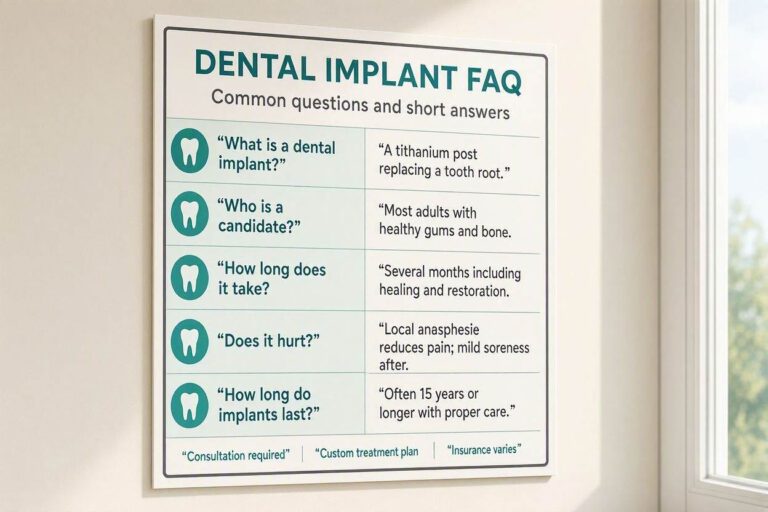
How long do dental implants last?
With proper care, most implants last 20 years to a lifetime. The crown may need replacement after 10 to 15 years due to normal wear, but the titanium implant itself is designed to be permanent.
Are dental implants painful?
The procedure is done with local anesthesia, so you should not feel pain during surgery. Afterward, most patients compare the discomfort to a tooth extraction. Over-the-counter medication usually manages it well.
Can I get dental implants if I have bone loss?
Yes, but you may need bone grafting first. Some patients with moderate bone loss are still candidates for shorter implants or zygomatic implants. A 3D CT scan will give you a clear answer.
How much do Tysons Corner dental implants cost with insurance?
Insurance typically covers only a portion, often 1,000to2,000 of the total. Your out-of-pocket cost depends on your specific plan and the type of implant you need.
Do dental implants look natural?
Yes. Modern crowns are made from layered porcelain or zirconia that mimics natural tooth enamel. Your dentist will match the color, shape, and translucency to your existing teeth.
Can smokers get dental implants?
Yes, but the failure rate is significantly higher. Most Tysons Corner implant dentists strongly recommend quitting smoking at least 2 weeks before surgery and throughout the healing period.
How long does the entire implant process take?
A single implant takes 3 to 6 months from surgery to final crown. Full-arch cases like All-on-4 can be completed in one day with a temporary set of teeth, but final teeth arrive after 4 to 6 months of healing.
Are dental implants covered by Medicare or Medicaid?
Original Medicare does not cover dental implants. Some Medicare Advantage plans offer limited dental benefits. Virginia Medicaid covers implants only in very specific cases, usually for minors or medically necessary situations.
What is the success rate of dental implants in Tysons Corner?
In healthy patients treated by experienced dentists, success rates range from 95% to 98%. This matches national averages.
Can I have all my teeth replaced in one day?
Yes, through same-day implants or Teeth-in-a-Day procedures. Your dentist places the implants and attaches a temporary fixed bridge or denture on the same day. However, the final permanent teeth require full healing before they can be placed.
Additional Resources
For more information about dental implants and finding care in Virginia, visit the American Academy of Implant Dentistry patient education page:
🔗 https://www.aaid.com/patients
This resource includes a dentist search tool, detailed procedure guides, and answers to advanced clinical questions.
Conclusion
Dental implants in Tysons Corner offer a permanent, natural-looking solution for missing teeth. You can expect to pay between 4,000and7,000 for a single implant, or 18,000to40,000 for a full-arch restoration. Choose an experienced provider, follow aftercare instructions carefully, and your new teeth can last a lifetime.
Disclaimer: This article is for informational purposes only and does not constitute medical or dental advice. Always consult with a licensed dentist in Tysons Corner to evaluate your specific oral health needs. Individual results vary.