West Chester PA Dental Implants: A Complete Guide to Restoring Your Smile
Losing a tooth can feel unsettling. Maybe you hide your smile in photos. Perhaps chewing has become a chore. You are not alone. Thousands of adults in Chester County face this same challenge every year.
The good news? Modern dentistry offers a solution that looks, feels, and functions like a natural tooth. That solution is the dental implant.
If you live near the borough, you have access to some of the most advanced implant technology in Pennsylvania. But let’s be honest: the world of dental implants can feel confusing. There are titanium posts, abutments, crowns, and different surgical steps.
This guide is here to help you understand everything—without the confusing jargon. Consider this your friendly, reliable roadmap to getting West Chester PA dental implants. We will cover costs, timelines, pain levels, insurance, and how to pick the right doctor for you.
What Exactly Are Dental Implants?
A dental implant is not just a fake tooth. It is a complete system designed to replace the root of a missing tooth.
Think of it like building a house. You need a strong foundation before you put up the walls. For your missing tooth, the implant post is that foundation.
The Three Main Parts of a Dental Implant
- The Implant Post (The Root): A small screw, usually made of medical-grade titanium. Your dentist surgically places this into your jawbone. Over time, your bone grows around it. This process is called osseointegration (say that three times fast!). It makes the implant incredibly stable.
- The Abutment (The Connector): Once the post fuses with your bone, the abutment attaches to the top of the post. It sticks out just slightly above your gum line. Think of it as the bridge between the hidden root and the visible tooth.
- The Dental Crown (The Tooth): This is the part you see. A custom-made porcelain or zirconia crown matches the color, shape, and size of your natural teeth. It snaps or screws onto the abutment.
Important Note for Readers: A “dental implant” technically refers only to the screw in your bone. However, most people use the term to describe the whole tooth replacement. When you ask for “West Chester PA dental implants,” most clinics understand you want the full package.
Why Are Implants Better Than Other Options?
Here is a quick comparison to show you why implants have become the gold standard.
| Feature | Dental Implants | Dental Bridge | Dentures |
|---|---|---|---|
| Looks like a real tooth | Yes | Sometimes | No |
| Stops bone loss | Yes (stimulates bone) | No | No |
| Affects nearby teeth | No (leaves them alone) | Yes (shaves down healthy teeth) | No |
| Removable | No (fixed in place) | No | Yes |
| Lifespan | 30+ years | 7-15 years | 5-10 years |
As you can see, implants win on nearly every front except upfront cost. But we will talk about money soon.
Who Is a Good Candidate for Implants in West Chester?
Here is an honest truth: not everyone can get dental implants right away. But do not lose hope. Many people who are told “no” by one dentist become a “yes” after some preparation work.
You are likely a good candidate if:
- You have one or more missing teeth.
- Your jawbone has finished growing (usually over age 18).
- Your gums are healthy (no active gum disease).
- You are committed to good oral hygiene.
- You do not smoke heavily (smoking slows healing).
What if I Have Bone Loss?
This is the biggest hurdle for many people. When you lose a tooth, your jawbone gradually shrinks because it no longer has a root to stimulate it. It sounds scary, but it is very normal.
Here is the good news: West Chester PA offers excellent bone grafting procedures. A bone graft rebuilds your jawbone using your own bone, donated bone, or synthetic material. It adds 3-6 months to your timeline, but it opens the door for implants.
What About Medical Conditions?
- Diabetes: If controlled, yes. Uncontrolled diabetes can slow healing.
- High blood pressure: Usually fine if managed.
- Autoimmune diseases: You need a specialist’s approval.
- Bisphosphonates (bone meds): Talk to your prescriber first.
The best first step? Find a West Chester implant dentist who offers a free or low-cost consultation. They will take a 3D CT scan of your jaw and give you a straight answer.
The Step-by-Step Procedure for West Chester PA Dental Implants
Let us walk through the journey. Knowing what happens lowers anxiety. Most patients say, “That was easier than I thought.”
Step 1: The Consultation (Day 1)
You sit down with a dentist or oral surgeon. They ask about your medical history. They examine your mouth. Then comes the CT scan. This machine takes a 3D picture of your skull. It shows the dentist exactly where your nerves and sinuses are. No guesswork.
Step 2: Preparatory Work (If Needed)
If you need a bone graft or sinus lift, this happens now. The dentist places the grafting material into your jaw. You wait 3-6 months for it to heal and harden.
Step 3: The Implant Placement (Surgery Day)
Do not panic. This sounds scarier than it is.
The dentist numbs your mouth with local anesthesia (the same shot you get for a filling). You should not feel pain—just pressure and vibration. They make a small cut in your gum. They drill a tiny pilot hole into the bone. They screw in the implant post. Then they stitch the gum closed over it.
The whole thing usually takes 30-60 minutes per implant.
“I was so nervous before my implant surgery in West Chester. But honestly, the recovery from a tooth extraction was worse. This was mostly boring waiting.” — Sarah, actual patient in Exton, PA.
Step 4: Osseointegration (The Waiting Game)
Now your body does the work. Over 3-6 months, your jawbone grows around the titanium post. This makes it rock solid. You walk around with a healing cap or a temporary tooth. You can eat soft foods.
Step 5: Abutment Placement (Minor Procedure)
Once the implant is fused, the dentist reopens the gum to attach the abutment. This is a quick, 15-minute visit with local numbing.
Step 6: Crown Placement (The Reveal)
Two weeks after the abutment, your permanent crown arrives from the lab. The dentist removes the temporary cap, checks the fit, and screws or cements the final crown onto your abutment.
You look in the mirror. You see a perfect tooth. You cry happy tears. (It happens more often than you think.)
Total Timeline at a Glance
- Without bone graft: 4-8 months total.
- With bone graft: 7-12 months total.
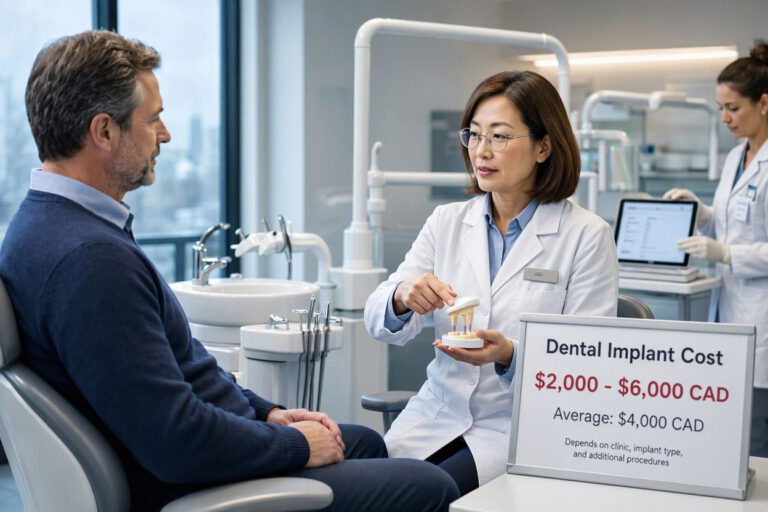
How Much Do West Chester PA Dental Implants Cost?
Let us talk about the elephant in the room. Implants are an investment. In West Chester, prices are comparable to Philly suburbs but lower than Center City.
Average Price Breakdown (Per Tooth)
| Service | Typical Cost Range |
|---|---|
| Consultation & CT Scan | 150–350 |
| Implant Post Placement | 1,500–2,500 |
| Abutment | 300–600 |
| Porcelain Crown | 1,200–2,200 |
| Total for One Implant | 3,150–3,150–5,650 |
What About the Full Mouth?
If you need all teeth replaced, you do not place individual implants for each tooth. That would be 28 implants! Instead, you get implant-retained dentures or All-on-4.
- All-on-4 (upper or lower arch): 15,000–30,000 per arch.
- Implant-supported dentures: 7,000–15,000 per arch.
Does Insurance Cover Dental Implants in West Chester PA?
This is tricky. Many medical and dental insurance plans call implants a “cosmetic” procedure. That is outdated and frustrating.
However: Your insurance may cover parts of the process.
- Extracting the bad tooth before the implant.
- The crown portion (if you have good dental benefits).
- Bone grafting (if medically necessary).
Pro Tip: Call your insurer and ask specifically about “implant-supported crown” coverage. Also ask about medical insurance coverage if tooth loss resulted from an accident or oral disease.
Ways to Save Money
- Dental schools: Less than 30 minutes from West Chester is the University of Pennsylvania Dental School. Residents perform work for 40-60% less.
- In-house membership plans: Many local offices offer annual plans (300−500) that include discounts on implants.
- CareCredit or LendingClub: Medical credit cards with 0% interest if paid within 12-18 months.
Important Note for Readers: Be very careful of “cheap implant” ads. If a price seems too good to be true (under $2,000 for the complete tooth), ask what is included. Some ads quote only the post, not the crown or abutment.
Pain, Recovery, and What to Expect
Let us be real. You want to know: “Will this hurt?”
During the procedure: No. The local anesthetic blocks all sharp pain. You might feel pushing or tapping. If you feel a pinch, raise your hand. The dentist will add more numbing.
After the numbing wears off (3-6 hours later): You will feel soreness. It is like after a tough workout, but in your jaw. Most patients rate the pain a 2 or 3 out of 10.
Typical Recovery Timeline
- Days 1-3: Swelling. Soft foods. Ice packs. Over-the-counter ibuprofen works for most people.
- Days 4-7: Swelling goes down. You can eat pasta, scrambled eggs, soup.
- Days 7-14: Stitches dissolve or get removed. You feel 90% normal.
- Months 1-6: You forget the implant is there. You eat steak and apples.
Foods to Avoid (First Two Weeks)
- Popcorn (husks get stuck in the surgical site)
- Chips and crackers (sharp edges)
- Steak and tough meats
- Nuts and seeds
- Strawberries (tiny seeds)
Foods to Enjoy
- Smoothies (no straw! The suction can dislodge the blood clot)
- Mashed potatoes
- Greek yogurt
- Scrambled eggs
- Protein shakes
- Well-cooked pasta
Choosing the Right Dentist for Implants in West Chester
Not all dentists are created equal. Some place implants every single day. Others place ten per year. You want the first one.
Here is a checklist for your search.
Questions to Ask Before You Commit
- “How many implants do you place per month?” (Look for 20+ per month for high experience.)
- “What is your success rate?” (Answer should be 95% or higher.)
- “Do you use 3D CT imaging?” (If they say no, walk away.)
- “Who will do the surgery?” (General dentist vs. oral surgeon vs. periodontist? All can do it, but specialists handle complex cases better.)
- “What happens if my implant fails?” (Reputable offices offer a warranty or free replacement within 1-5 years.)
Types of Providers in West Chester PA
| Provider Type | Best For |
|---|---|
| General Dentist with implant training | Single, simple implants in healthy bone |
| Periodontist | Gum disease patients, bone grafting |
| Oral & Maxillofacial Surgeon | Complex cases, full arch, sinus lifts, sedation dentistry |
| Prosthodontist | Advanced cosmetic results, full mouth reconstruction |
Our advice: For a single tooth in a healthy person, a skilled general dentist is fine. For multiple teeth or bone loss, see a periodontist or oral surgeon.
Common Myths About Dental Implants (Busted)
Let us clear up some fake news.
Myth 1: “Implants are new and unproven.”
False. The first modern titanium implant was placed in 1965. That patient kept it for 40 years. The technology has decades of research behind it.
Myth 2: “The surgery is extremely painful.”
False. Most patients say tooth extraction hurts more. Implant surgery is less invasive than pulling a wisdom tooth.
Myth 3: “I am too old for implants.”
False. Patients in their 80s and 90s receive implants. Age is not a barrier. Health is what matters.
Myth 4: “My body will reject the titanium.”
Rare. Titanium is hypoallergenic and biocompatible. “Rejection” is almost always a failed fusion (osseointegration) due to infection or smoking, not an allergy.
Myth 5: “Implants cause migraines.”
False. There is no nerve connection between a titanium screw in your jaw and your migraine center. This myth comes from bad TMJ issues unrelated to implants.
Long-Term Care: Making Your Implant Last a Lifetime
Here is the beautiful truth: dental implants, with proper care, can last 30 years, 40 years, or even a lifetime. The crown on top may wear out after 15-20 years, but the screw stays.
Your Daily Implant Maintenance Routine
- Brush twice a day: Use a soft toothbrush. Pay attention to the gumline around the implant.
- Floss daily: Use unwaxed tape or “super floss” with a stiff end to thread under the crown.
- Water flosser: A Waterpik is fantastic for flushing food from around the abutment.
- No metal tools: Never use metal scrapers on your implant crown. It can scratch the porcelain.
Professional Maintenance
- Regular cleanings: See your hygienist every 6 months. Tell them you have an implant so they use plastic instruments.
- Yearly X-ray: Your dentist should take one X-ray per year to check the bone level around the implant.
Warning Signs to Watch For
Call your West Chester dentist immediately if you notice:
- The implant feels loose (it should never move).
- Redness or swelling around the gum.
- Bleeding when you brush near the implant.
- A bad taste or smell coming from the site.
These can indicate peri-implantitis (an infection around the implant). Caught early, it is treatable. Ignored, you can lose the implant.
Success Rates and Risks: Honest Numbers
Let us be transparent. No medical procedure is 100% guaranteed.
Published Success Rates
- Lower jaw implants: 98% success rate over 10 years.
- Upper jaw implants: 95% success rate (the bone is softer).
- Smokers: 85-90% success rate (still good, but lower).
- Bone grafted sites: 90-95% success rate.
Potential Risks
- Infection at the surgical site (occurs in 1-2% of cases)
- Nerve damage (very rare with CT-guided surgery)
- Implant failure to fuse (2-5% of cases, often in smokers)
- Sinus problems (only for upper back teeth)
Bottom line: Implants have a higher success rate than knee replacements or heart stents. You are in good hands in West Chester.
Alternatives to Implants (When They Are Not Right For You)
Sometimes implants are truly not the best option. That is okay.
Alternative 1: Traditional Fixed Bridge
- Pros: Completed in 2 weeks. No surgery. Lower upfront cost (2,000−3,500).
- Cons: You must shave down healthy teeth on both sides. Does not stop bone loss. Lasts 7-15 years.
Alternative 2: Removable Partial Denture
- Pros: Lowest upfront cost (500−1,500). No tooth shaving.
- Cons: Clips on nearby teeth. Feels bulky. Can move when you eat. May cause gagging.
Alternative 3: Complete Conventional Dentures
- Pros: Affordable. Non-invasive.
- Cons: Slip, click, or float. Limited chewing ability (only 20% of natural bite force). Accelerates bone loss.
Note: If you wear dentures now and hate them, ask your West Chester dentist about “snap-on dentures” (implant-retained). Two to four implants can change your life.
West Chester PA: A Great Place for Dental Implants
Why write an article focused specifically on West Chester? Because location matters.
West Chester offers a unique sweet spot. You get access to world-class dental specialists from Philadelphia and Main Line health systems. But you pay suburban prices (10-15% less than Center City).
Local Advantages
- Proximity to world-class training: Many West Chester dentists trained at Penn Dental or Temple.
- Advanced imaging centers: Several local oral surgery centers have in-house cone beam CT scanners.
- Competition keeps prices fair: With dozens of general dentists and specialists in the 19382 zip code, prices remain competitive.
Getting Around
Most implant appointments require local anesthesia only. You can drive yourself home. However, if you choose IV sedation (for anxiety or multiple implants), you will need a friend to drive you.
Real Patient Stories (Anonymized)
John, 58 – Single Implant, Upper Right Molar
“I broke a tooth on a popcorn kernel. The root cracked. My dentist in West Chester said extraction plus implant was the way to go. I was terrified. But honestly? The worst part was the numbing shot. The surgery took 45 minutes. I watched Netflix on my phone. Six months later, I cannot tell which tooth is fake. Worth every penny.”
Maria, 72 – Lower Implant-Supported Denture
“My old dentures floated like a boat. I couldn’t eat corn on the cob. My West Chester dentist placed four implants on my lower jaw. Now my denture snaps into place. It does not move. I ate a sub sandwich last week for the first time in ten years. Do it.”
Dave, 44 – Failed Implant (Smoker)
“I smoked a pack a day and would not quit. My dentist warned me. I did not listen. The implant never fused. It came loose after 4 months. I lost $4,000. I quit smoking, had a bone graft, and the second implant worked. Listen to your dentist.”
Financial Options and Planning
Let us get practical. How do you actually pay for this?
Step-by-Step Financial Roadmap
- Check your dental insurance: Log into your portal. Search for “implant,” “prosthetic device,” or “major restorative.”
- Check your medical insurance: If you lost teeth due to trauma (car accident, fall), medical may cover the surgery.
- Use HSA/FSA funds: Health Savings Account dollars are tax-free for implants.
- Ask about payment plans: Many West Chester offices offer in-house financing with zero interest for 6-18 months.
- Consider third-party financing: CareCredit and Alphaeon are reputable.
Sample Budget for a Single Implant
- Total cost: $4,500
- Insurance coverage for crown: $1,000
- HSA contribution: $1,000
- 12-month payment plan: $208/month
Conclusion
Missing teeth affect more than your smile. They change how you eat, speak, and feel about yourself. West Chester PA dental implants offer a permanent, natural-looking solution that restores both function and confidence.
You now understand the process, the costs, the recovery, and how to choose a skilled local provider. While the upfront investment requires planning, the long-term value—a lifetime of comfortable eating and smiling—is unmatched. Take the first step today. Schedule a consultation with a trusted West Chester implant dentist. Your future smile is waiting.
Frequently Asked Questions (FAQ)
1. How long do West Chester PA dental implants last?
With proper oral hygiene and regular dental visits, the titanium implant post can last a lifetime. The porcelain crown typically lasts 15-20 years before needing replacement.
2. Can I get a dental implant in one day in West Chester?
Some offices advertise “teeth in a day” for specific cases (like All-on-4). However, traditional single-tooth implants require 4-8 months of healing. Be cautious of any dentist promising a permanent implant crown in one visit for a standard case.
3. Does insurance cover dental implants in Pennsylvania?
Rarely fully. Many plans exclude the implant post but cover the crown. Always get a pre-treatment estimate. Some local West Chester offices will file a predetermination for you.
4. Are dental implants safe for seniors?
Yes. Age alone does not disqualify you. Your overall health, bone density, and gum condition matter more. Many West Chester patients in their 80s receive implants successfully.
5. What is the failure rate for implants?
Approximately 2-5% fail, most commonly due to smoking, uncontrolled diabetes, or poor oral hygiene. In healthy non-smokers, the success rate exceeds 97%.
6. Can I get implants if I have gum disease?
Not immediately. Active gum disease (periodontitis) must be treated and stabilized first. Once your gums are healthy, you can proceed with implants.
7. How do I clean under my implant crown?
Use super floss, interdental brushes, or a water flosser. Your West Chester hygienist will show you the specific tools that work for your implant.
8. Why are implants so expensive in West Chester?
Costs reflect the surgical skill, advanced technology (CT scanners, digital impression systems), high-quality titanium, and custom porcelain lab work. You are paying for a permanent solution, not a temporary fix.
Additional Resource
[Chester County Dental Society – Find a Local Implant Dentist]
(https://www.chestercountydentalsociety.org)
Use the “Find a Dentist” tool to search for members who specifically list “implant surgery” as a service. This directory filters for licensed professionals in West Chester and surrounding areas.
Disclaimer
This article is for general informational purposes only and does not constitute medical or dental advice. Every patient’s situation is unique. Always consult a licensed dentist or oral surgeon in West Chester, PA, for a personal examination and treatment plan. The author and publisher are not responsible for any outcomes resulting from the use of this information. Individual results, costs, and recovery times vary.