Under What Circumstances Are Dental Implants Not Recommended?
Dental implants are a transformative solution for missing teeth. They restore function, preserve bone, and provide a fixed, natural-feeling result that dentures and bridges cannot match. The success rates are outstanding, exceeding 95% in healthy patients. This can create a perception that implants are a universal solution for every missing tooth in every person. The clinical reality is different. There are specific, well-defined circumstances where dental implants are not recommended, either temporarily or absolutely. A responsible dentist does not just identify who is a candidate; they identify who is not. Placing an implant into a compromised biological environment is not a service to the patient—it is a set-up for failure, infection, and further bone loss. This article provides a thorough, honest exploration of the contraindications to dental implant treatment. You will learn about the conditions that can be managed to make implants possible, and the rare circumstances where an alternative treatment must be chosen.
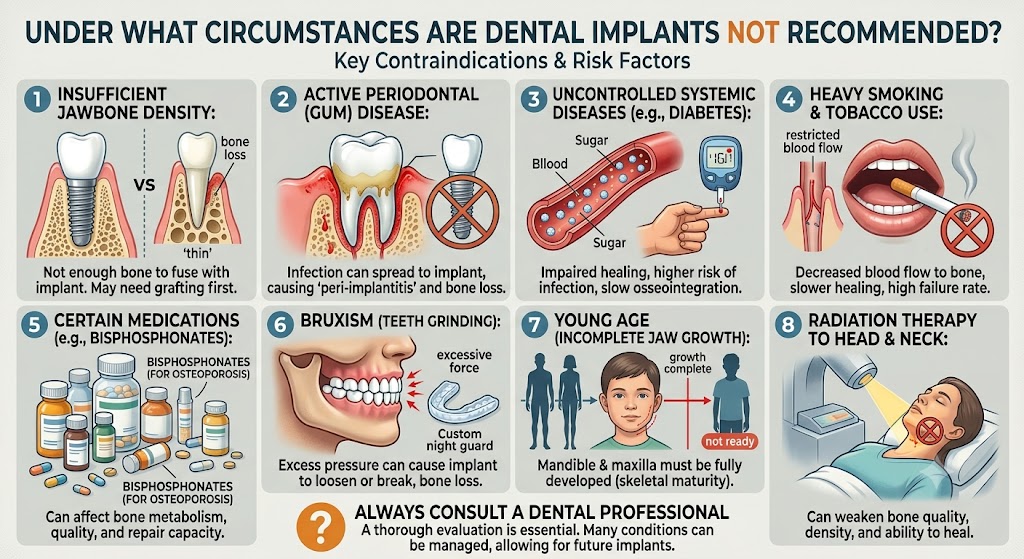
Absolute vs. Relative Contraindications
In medical decision-making, contraindications are divided into absolute and relative. An absolute contraindication means the risk of the procedure far outweighs any potential benefit. The treatment should not be performed. A relative contraindication means the treatment carries an elevated risk, but with careful management, mitigation, and patient-informed consent, it can still be performed safely and successfully. Most medical conditions discussed in implant dentistry are relative contraindications. The skill of the implant team lies in correctly managing these risks. A patient with uncontrolled diabetes has a relative contraindication; a patient with controlled diabetes, with an HbA1c below 7%, is a good candidate. It is the management of the condition that dictates the recommendation.
1. Uncontrolled Systemic Medical Conditions
The body’s capacity to heal the surgical wound and to osseointegrate the implant is directly dependent on the systemic health of the patient. Certain uncontrolled diseases poison the healing environment.
Uncontrolled Diabetes Mellitus
This is the most common systemic relative contraindication. Chronically elevated blood glucose impairs the function of neutrophils, the white blood cells that fight infection. It reduces collagen synthesis, the protein scaffold of wound healing. It causes microvascular disease, reducing the blood supply to the surgical site. A patient with uncontrolled diabetes, defined typically by an HbA1c above 7.5% or 8%, is a poor healer and an infection waiting to happen. They have a significantly higher risk of peri-implantitis and implant failure. The recommendation is not a permanent “no.” It is a “yes, after control.” The patient must work with their physician to bring their blood sugar under excellent control. Once a stable, acceptable HbA1c is documented, implant treatment can proceed with a longer healing protocol, prophylactic antibiotics, and strict aseptic technique.
Immunocompromised States
A patient with a suppressed immune system cannot mount a normal healing response and is vulnerable to opportunistic infections. This includes patients on high-dose corticosteroids, chemotherapeutic agents, or immunosuppressants for organ transplantation. It includes patients with poorly controlled HIV/AIDS with a low CD4 count. An HIV-positive patient with a normal CD4 count and an undetectable viral load on antiretroviral therapy is not contraindicated. The decision is made on a case-by-case basis in close consultation with the patient’s physician. The risks of infection and impaired osseointegration are carefully weighed against the functional benefit.
Bleeding Disorders and Anticoagulation
Patients with hemophilia, severe thrombocytopenia, or other coagulopathies are at risk for uncontrolled bleeding during and after surgery. This is a high-risk scenario. Modern implant surgery is minimally invasive, but it is still surgery. Patients on anticoagulant medications like warfarin, clopidogrel, or the newer direct oral anticoagulants (DOACs) require a careful, protocol-driven approach. The old practice of stopping anticoagulants for surgery is now understood to carry a risk of a life-threatening thromboembolic event. The current standard, developed with the patient’s physician, is often to continue the anticoagulant and manage the local bleeding with meticulous surgical technique, local hemostatic agents, and tranexamic acid mouthwash. An INR test is performed on the day of surgery. If the INR is within a safe therapeutic range (usually below 3.5), the procedure is performed.
2. Bone Health and Medication-Related Risks
The bone is the foundation of an implant. Any condition or medication that fundamentally alters bone metabolism is a major concern.
Medication-Related Osteonecrosis of the Jaw (MRONJ)
This is one of the most serious, and in some cases, absolute contraindications in modern implant dentistry. Bisphosphonates, potent antiresorptive drugs, are used to treat osteoporosis and, in much higher intravenous doses, to manage bone metastases from cancers. They severely suppress the bone’s natural remodeling cycle. A patient taking an oral bisphosphonate like alendronate (Fosamax) for osteoporosis for less than three years, and without other risk factors, is generally considered at a low but elevated risk. With informed consent, a drug holiday (if approved by the physician), and a minimally traumatic surgery, an implant may be placed. A patient on intravenous bisphosphonates for cancer treatment is at a very high risk of MRONJ. In this scenario, an extraction or implant surgery can trigger a non-healing area of dead, exposed jawbone that is notoriously difficult to treat. Implants are generally not recommended in this group. The same high-risk profile applies to other antiresorptive drugs like denosumab (Prolia, Xgeva) and anti-angiogenic cancer medications.
Active Osteoporosis with Severe Fragility
Osteoporosis itself is not a contraindication. However, severe, untreated osteoporosis with a history of multiple fragility fractures represents a compromised bone environment. The bone density is low, and the implant’s primary stability is difficult to achieve, and the long-term osseointegration is less predictable. A bone density scan (DXA scan) and a medical consultation are essential.
3. Oral and Local Contraindications
Sometimes the problem is not the patient’s body but the condition of their mouth.
Inadequate Bone Volume That Cannot Be Grafted
An implant must be surrounded by a minimum volume of bone. If the bone has resorbed to such an extreme degree that even a CT scan shows insufficient width and height, and if the patient is unwilling or unable to undergo the extensive grafting procedures required to rebuild it, then conventional implants are not an option. This is the classical indication for a zygomatic implant in the upper jaw (as discussed in a previous article) or for a subperiosteal implant, but these are specialized, high-risk alternatives. In many such cases, a modern, well-constructed removable denture remains the safest and most practical solution.
Untreated Active Periodontal Disease
Placing an implant into a mouth with active, bleeding, infected gum disease is like building a house on a toxic waste site. The bacteria from the periodontal pockets will colonize the healing implant wound and the new implant surface. The risk of early peri-implantitis and implant failure is extreme. Periodontal disease must be diagnosed, treated, and brought to a state of stable health and excellent patient home care compliance before any implant treatment begins.
Radiotherapy to the Jaws
A patient who has received high-dose radiation therapy to the head and neck for cancer has a permanently compromised blood supply to the jawbone. The bone is hypovascular, hypoxic, and hypocellular. This condition is called osteoradionecrosis (ORN) of the jaw. The bone heals very poorly, and the risk of a non-healing wound that exposes dead bone is high. Elective implant surgery in an irradiated field is considered a high-risk procedure. It is not an absolute contraindication, but it requires a very experienced team, often with hyperbaric oxygen therapy (HBO) before and after surgery to stimulate blood vessel growth, and a very conservative surgical protocol. The risk of implant failure is elevated.
4. Lifestyle and Behavioral Contraindications
The patient’s own behavior can be the single greatest predictor of implant failure.
Heavy Smoking
Smoking is arguably the most powerful single patient-related modifiable risk factor. Nicotine is a vasoconstrictor, cutting off the vital oxygen and healing cells to the wound. The heat and chemicals of smoke impair the immune response. A heavy smoker (more than 10 cigarettes a day) has an implant failure rate two to three times higher than a non-smoker. Their risk of peri-implantitis is dramatically elevated. A responsible dentist will strongly advise smoking cessation. Some will decline to treat a heavy smoker who refuses to quit, as the probability of a successful, long-term outcome is so severely compromised. This is not a judgment; it is a clinical risk assessment.
Uncontrolled Substance Abuse
Active alcohol or drug addiction is an absolute contraindication. The patient is unlikely to maintain the meticulous oral hygiene required, the systemic health is often compromised, and compliance with post-operative instructions is unreliable.
Severe Parafunctional Habits (Bruxism)
A patient who severely grinds or clenches their teeth generates destructive forces that far exceed normal chewing loads. An implant, being rigidly fused to bone without the shock-absorbing periodontal ligament, can be overloaded. This can lead to screw loosening, porcelain fracture, crestal bone loss, or even implant fixture fracture. Bruxism is a relative contraindication. It can be managed with a well-designed, full-coverage hard acrylic nightguard that protects the implants and the teeth, and by using a larger number of implants to distribute the load.
5. The Temporarily Contraindicated: Growth and Pregnancy
Some circumstances are a question of timing.
Adolescents with Incomplete Jaw Growth
Dental implants are not placed in children or adolescents whose jawbones are still growing. An implant placed too early will act like an ankylosed tooth. As the rest of the jaw grows downward and forward, the implant stays fixed in its position. The result is an implant that ends up submerged, out of occlusion, and aesthetically displaced, with a severely compromised bone contour. Implant placement is delayed until skeletal maturity is confirmed by serial cephalometric radiographs. For females, this is typically around 16-17 years; for males, 18-20 years or older.
Pregnancy
Elective surgical procedures, including dental implant placement, are not performed during pregnancy, particularly during the first trimester. The risk to the developing fetus from medications, the stress of surgery, and the need for X-rays all mandate postponement. All elective implant treatment is deferred until after delivery.
The Ethical Responsibility: When to Say No
The dental implant market is commercially driven, and patients with unrealistic expectations can pressure a clinician into treatment. The ethical responsibility of the dentist is to act as a physician of the mouth, not a salesperson. Saying “no” to an implant in a high-risk patient is an act of professionalism. It protects the patient from a predictable failure, from further bone loss, from financial waste, and from the emotional devastation of a failed reconstruction. The alternative treatments—a well-made conventional bridge or a modern, precision-fit removable partial or full denture—are not failures of modern dentistry. They are the correct, medically indicated treatments for that specific patient. The goal is always a healthy, functional, and lasting result for the patient, not the placement of an implant at any cost.
Important Note: Many conditions listed as “contraindications” in older textbooks are now manageable with modern medical and surgical protocols. The line between a candidate and a non-candidate is dynamic. The essential elements are a thorough, honest medical history, a collaborative relationship with the patient’s physician, full disclosure of the elevated risks to the patient, and a documented informed consent process. A risk-managed implant is a valid clinical choice when the patient fully understands and accepts the increased probability of complications.
Conclusion
Dental implants are not recommended in circumstances of uncontrolled systemic disease like severe diabetes, active intravenous bisphosphonate therapy with a high MRONJ risk, irradiated hypovascular jawbone, active untreated periodontal disease, heavy smoking with an unwillingness to cease, and in patients with incomplete skeletal growth. Most other conditions, from controlled diabetes to mild osteoporosis, are relative contraindications that can be managed with medical collaboration, modified surgical protocols, and rigorous patient compliance. The decision not to place an implant is as important as the decision to place one, and it is the hallmark of an ethical, biologically principled practitioner.
FAQ
1. Can I get dental implants if I have a heart condition?
It depends on the condition. A patient with stable, well-controlled hypertension or a history of a heart attack years ago with cardiologist clearance is often a candidate. A patient with a recent heart attack, unstable angina, or severe valvular disease may need to wait or be declined. Infective endocarditis prophylaxis with antibiotics may be required. A medical consultation is mandatory.
2. Is age itself a contraindication for implants?
No. Chronological age is not a contraindication. A healthy 85-year-old with good bone is a better candidate than a 40-year-old heavy smoker with uncontrolled diabetes. It is the biological age and medical status, not the number of birthdays, that matters.
3. If I am told I am not a candidate for implants, what are my best options?
Modern dentistry offers excellent alternatives. A resin-bonded bridge (Maryland bridge) is a minimally invasive, fixed option for a single tooth. A well-made, precision-attachment partial denture can be highly aesthetic and functional. For a full arch, high-quality, properly fitted complete dentures still provide a good quality of life for many patients.
Additional Resource
For more information on the medical evaluation of surgical candidates, visit the American Association of Oral and Maxillofacial Surgeons: https://www.aaoms.org/