What Are Annapolis Dental Implants?
The term “Annapolis dental implants” is not a special brand, a unique material, or a proprietary surgical technique. It is a geographic designation. It refers to the dental implant treatment provided by the community of highly trained dentists, oral surgeons, and periodontists practicing in Annapolis, Maryland, and the surrounding Anne Arundel County area. This small, historic, and affluent capital city on the Chesapeake Bay is home to a concentration of advanced dental practices. Patients searching for this term are typically seeking a local, trustworthy, and clinically excellent provider for their tooth replacement. They want to understand what standard of care to expect, what technology is available, and what differentiates the implant experience in this specific location. This article provides a comprehensive profile of what you can expect from Annapolis dental implants, from the diagnostic technology and surgical expertise to the restorative artistry and the coastal Maryland context.
The Annapolis Standard of Care
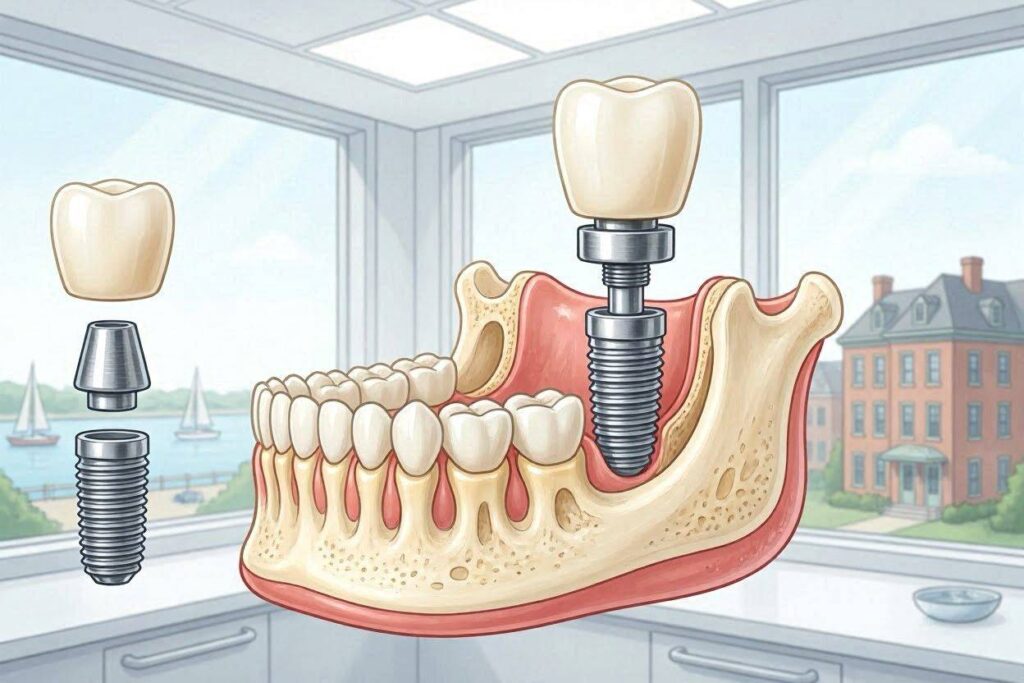
Annapolis is not a large metropolis, but it is a sophisticated medical and dental market. The presence of major government institutions like the United States Naval Academy, the state government, and a population of discerning, educated residents creates a high demand for top-tier healthcare. Dental practices in Annapolis that offer implant services are, as a rule, equipped to a very high standard. The standard of care you will encounter is one of comprehensive diagnosis and prosthetically-driven treatment planning. A single-tooth implant in Annapolis is not started with a cursory look and a quick X-ray. It begins with a thorough examination, a review of your medical and dental history, and a Cone Beam Computed Tomography (CBCT) 3D scan. The CBCT is the standard of care, not an optional extra. It allows the Annapolis implant dentist to see the precise three-dimensional volume of your jawbone, trace the path of the inferior alveolar nerve, evaluate the maxillary sinuses, and detect any pathology.
The Specialist and Generalist Mix
In the Annapolis dental community, you will find both pathways to implant treatment, and both can be excellent. Some patients are treated entirely within a single general dental practice where the dentist has pursued advanced training and performs both the surgical placement and the final crown restoration. Other patients are treated by a team: an oral and maxillofacial surgeon or a periodontist performs the surgical phase, and the patient’s general dentist or a prosthodontist performs the restorative crown phase. Both models thrive here. The surgical specialists often have hospital affiliations, deep experience with complex bone grafting and sedation, and manage the highest-risk cases. The restorative dentists focus on the art and science of the custom abutment and crown. A hallmark of the Annapolis approach is a close, collegial, and communicative relationship between the surgeon and the restorative dentist.
Advanced Technology Commonly Found in Annapolis Practices
The practices serving the Annapolis market invest heavily in digital dental technology that makes implant treatment more precise, less invasive, and more predictable.
3D Imaging and Digital Planning
In-practice CBCT scanners are common. The data from the scan is used to virtually plan the implant placement using software like SimPlant, coDiagnostiX, or the implant manufacturer’s proprietary platform. This software allows the dentist to merge the CBCT with a digital scan of your teeth, creating a virtual patient. The implant is placed in the software in the exact, prosthetically-driven ideal position. This plan is then exported to fabricate a 3D-printed surgical guide. The use of a static surgical guide makes the surgery faster, flapless in many cases, and ensures the implant is placed with sub-millimeter accuracy, avoiding vital structures and optimizing the restorative outcome.
Digital Intraoral Scanning and CAD/CAM
Annapolis restorative dentists widely use digital intraoral scanners, such as the iTero or TRIOS. Instead of a tray full of gooey impression material, a small wand scans the implant position and your teeth. This digital file is sent to a specialized dental laboratory or an in-office milling unit. Many Annapolis practices offer same-day crowns for natural teeth, but the workflow for implant crowns, especially custom abutments, usually involves the local high-end dental laboratory. The lab uses the digital file to design and mill a patient-specific custom abutment and a perfectly matched ceramic crown.
Sedation Dentistry
For the anxious patient, Annapolis implant practices typically offer various levels of sedation. Oral conscious sedation (a pill taken before the procedure), nitrous oxide (laughing gas), and IV sedation administered by a trained dentist anesthesiologist or a specialist surgeon are all available. This ensures that even patients with dental phobia can comfortably undergo the surgical phase of implant treatment.
The Types of Implant Cases Treated
Annapolis implant dentists manage the full spectrum of tooth replacement, from the simple to the extraordinarily complex.
- Single Tooth Implants: The bread-and-butter case. A single failing tooth is removed, often with immediate implant placement and a temporary crown to preserve the gum architecture. The final, custom-shaded all-ceramic crown is delivered months later.
- Multiple Teeth and Implant Bridges: Replacing two or more adjacent teeth with implant-supported bridges, minimizing the number of surgical sites while restoring a full quadrant of function.
- Full-Arch Rehabilitation (All-on-4/All-on-6): For the edentulous patient or a patient with a terminal dentition, Annapolis specialists offer the “Teeth in a Day” concept using the All-on-4 protocol. Four strategically angled implants are placed, and a full-arch temporary fixed bridge is delivered on the same day. After healing, a final, high-strength zirconia or titanium-acrylic hybrid bridge is fabricated.
- Zygomatic and Complex Grafting Cases: For the patient with severe bone loss who has been told they are not a candidate for implants, a few highly specialized oral surgeons in the greater Annapolis-Baltimore corridor offer zygomatic implants and major bone reconstruction.
The Patient Experience: A Coastal Maryland Context
Choosing a local Annapolis implant dentist has a qualitative dimension. The practices are situated in a beautiful, historic maritime city. The patient experience often reflects the pace and character of the community. Appointments are rarely rushed. There is an emphasis on building a long-term relationship. The patient is treated as a whole person, not a mouth with a missing tooth. The post-operative instructions will be thorough. You will have direct access to your surgeon if complications arise. The follow-up and maintenance protocols are rigorous. Annapolis patients tend to be well-read, ask informed questions, and expect a high level of communication and transparency, and the dental community is structured to meet that expectation.
How to Select an Annapolis Implant Dentist
The decision of who to trust with your implant is profound. In a community with many excellent providers, how do you choose? Look for specific, verifiable markers of quality. A Fellow or Diplomate status in a recognized implant organization, such as the International Congress of Oral Implantologists (ICOI) or the American Board of Oral Implantology (ABOI), indicates a commitment to education and peer-reviewed standards that goes beyond the minimum. A Diplomate of the American Board of Periodontology or the American Board of Oral and Maxillofacial Surgery is a surgical specialist at the highest level. Look for a practice that has in-house CBCT technology, not one that refers you to an external radiology center for the scan. Read patient reviews that mention the implant experience specifically. Look for reviews that talk about meticulous planning, good communication, and a comfortable surgical experience. A strong portfolio of before-and-after photos of actual patient cases is a sign of a confident, transparent clinician. The initial consultation should be a dialogue, not a sales pitch. The dentist should examine you, review your scan with you, and present a clear, written treatment plan with all fees itemized.
Important Note: The term “Annapolis dental implants” will lead you to a search results page filled with local practices. Do not select a practice based on Google Ads or a generic website alone. Call the office. Ask who performs the surgical placement and what their specific implant training is. A practice that is proud of their clinicians and their technology will answer your questions directly and clearly. A practice that is evasive should be crossed off your list.
Conclusion
“Annapolis dental implants” refers to the high standard of comprehensive, technologically advanced implant care provided by the experienced general dentists, periodontists, and oral surgeons in the capital city of Maryland. Patients can expect the routine use of 3D CBCT imaging, digital intraoral scanning, guided surgery, and a strong collaborative network between surgical and restorative clinicians to deliver everything from a single crown to a full-mouth All-on-4 rehabilitation. The selection of a provider in this competitive market should be based on verifiable credentials, transparent communication, in-house technology, and a demonstrable commitment to continuing education.
FAQ
1. Are Annapolis dental implant costs higher than the national average?
The cost of living and the overhead of running a high-tech dental practice in the Annapolis area are elevated, so fees may be at the upper end of the national average range. However, the market is competitive, and the value provided by comprehensive, 3D-planned care and high-quality restorative materials is excellent.
2. Can I get a same-day implant and crown in Annapolis?
Yes, several practices offer immediate implant placement and an immediate, non-functional temporary crown on the same day, particularly for single anterior teeth. The final, permanent crown is placed after osseointegration. A fully functional, definitive same-day tooth is a specific protocol with strict prerequisites.
3. Do Annapolis dentists treat patients from outside the local area?
Absolutely. Given the concentration of specialists and the advanced technology, patients from the broader Maryland Eastern Shore, Southern Maryland, and even the D.C. suburbs often travel to Annapolis for implant treatment.
Additional Resource
To find a board-certified specialist in the Annapolis area, you can search the directory of the American Academy of Periodontology: https://www.perio.org/