What Are Loganville Dental Implants?
The term “Loganville dental implants” refers not to a unique brand or a locally invented device, but to the comprehensive, advanced tooth replacement therapy available to residents of Loganville, Georgia. It describes the process of receiving state-of-the-art dental implants from a qualified local provider, restoring not just teeth, but the function, health, and confidence that come with a complete smile.
This article is a definitive guide for anyone in the Loganville area seeking to understand this life-changing procedure. You will learn the precise biological and mechanical definition of a dental implant, the detailed phases of treatment you can expect from a Loganville practice, the different types of implant restorations, and the profound, long-term health advantages that make implants the gold standard in modern restorative dentistry.
The Biological Reality of Tooth Loss
To fully grasp what a dental implant does, you must first understand the hidden consequence of losing a natural tooth. A tooth is composed of the visible crown and the root, which is securely embedded in the jawbone. The root is far more than a passive mechanical anchor. Every time you chew, the root transmits compressive and tensile forces into the surrounding bone. This stimulation is a biological signal. It tells the body that the bone tissue in that area is vital and required.
When a tooth is lost, this critical signaling stops. The body, in a process of metabolic efficiency, begins to resorb the now-unstimulated bone. The jawbone slowly shrinks in both height and width. This bone atrophy is invisible at first, but over the course of years, it fundamentally alters the structure of the face. The lips can appear thinner, the chin rotates forward, and the lower third of the face collapses, creating the characteristic sunken appearance of long-term tooth loss.
A dental implant is the only form of tooth replacement that directly intervenes in and halts this biological process. It replaces the root and restores the bone-preserving stimulus.
Defining a Dental Implant: The Three-Part System
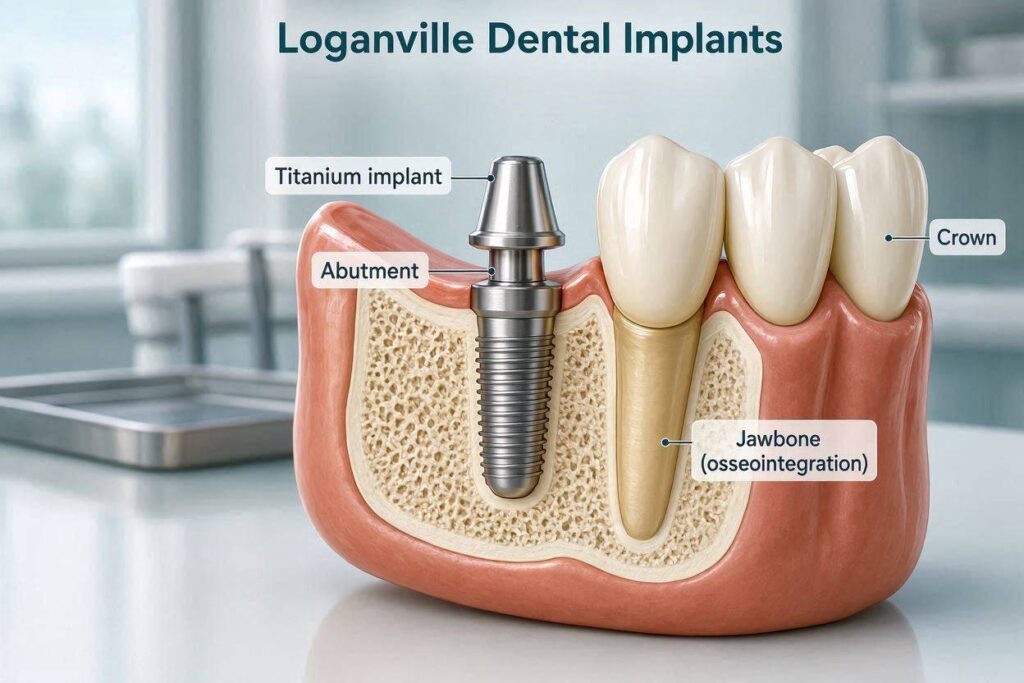
A dental implant is a highly engineered medical device that replicates the full anatomical structure of a natural tooth. It is not one piece but a system of three distinct, interconnected components.
Part 1: The Implant Fixture (The Synthetic Root)
The implant fixture is the component that is surgically inserted into the jawbone. It is a small, precision-crafted post, typically screw-shaped, and it is manufactured from medical-grade titanium alloy. Titanium is the material of choice due to its unique property of biocompatibility. The human immune system does not identify titanium as a foreign threat. It does not trigger a rejection response. More importantly, living bone tissue has a natural affinity for the titanium oxide surface layer. Bone cells will grow directly onto and structurally fuse with the roughened titanium surface in a process called osseointegration. Once this biological fusion is complete, the implant fixture serves as a synthetic tooth root, locked permanently into the skeleton.
Part 2: The Abutment (The Precision Connector)
After the healing and osseointegration phase, a secondary component called the abutment is attached. The abutment screws directly into the implant fixture and protrudes through the gum tissue into the mouth. Its function is to provide a stable, precision-machined platform for the final visible tooth. In high-quality restorations, this abutment is a custom-milled component, designed with CAD/CAM software to precisely support the surrounding gum tissue and provide an ideal shape for the crown to emerge from.
Part 3: The Implant Crown (The Visible Tooth)
The final component is the prosthetic crown. This is the part you see, use to chew, and smile with. It is not an off-the-shelf piece. A master ceramist in a dental laboratory fabricates the crown from a solid block of advanced ceramic material—most commonly layered zirconia or lithium disilicate. These materials are chosen for their exceptional durability and their ability to precisely mimic the color, translucency, and light-reflecting properties of natural human enamel.
The Comprehensive Implant Process for Loganville Patients
Receiving a dental implant is a journey that follows a precise, biologically respectful timeline. A reputable Loganville implant practice will follow a structured protocol and will not rush the healing phases.
Step 1: The 3D Diagnostic Workup
Your first appointment is a comprehensive diagnostic session. The cornerstone is a Cone Beam Computed Tomography (CBCT) 3D scan. A flat, two-dimensional dental X-ray is not adequate for precise implant planning. The CBCT produces a high-resolution three-dimensional model of your entire maxillofacial anatomy. Your dentist uses this model to measure bone volume and density, precisely locate the mandibular nerve and maxillary sinuses, and perform a complete virtual surgery on a computer screen before a single actual instrument touches you.
Step 2: Foundational Bone Grafting
If the CBCT reveals that the bone ridge is too thin or too short to encase a standard implant, a preparatory bone graft is required. This is a common and predictable procedure. The surgeon places a sterile bone grafting material—synthetic, donor, or autogenous—directly onto the deficient ridge. This graft material functions as a scaffold that your body’s own cells populate and remodel into living, vascularized bone. For missing upper back teeth, a sinus lift procedure elevates the sinus floor to create adequate vertical bone. This foundational phase adds several months to the timeline but is a prerequisite for long-term success.
Step 3: Atraumatic Implant Surgery
The surgery is performed under profound local anesthesia, with sedation options available to ensure complete comfort. The surgeon makes a precise, small incision, creates a carefully sized channel in the bone using the digitally planned guide, and gently inserts the titanium implant. The gum tissue is then closed, and the biological healing phase begins.
Step 4: Osseointegration
This is the defining biological event of implant therapy. Over the next 3 to 6 months, the patient wears a comfortable temporary tooth. Beneath the gum surface, the body is actively building new bone that intimately fuses with the titanium implant. This osseointegration is what provides the implant with its rock-solid, permanent stability.
Step 5: Digital Restoration
Once healing is verified, the final phase begins. The implant is uncovered, the custom abutment is placed, and a digital scan is taken of the implant’s position. A custom crown is milled and sintered in a dental laboratory. At the final delivery appointment, the crown is secured, and the restoration is complete.
Types of Implant Restorations Available in Loganville
The implant platform is modular and can address any level of tooth loss.
- Single Tooth Implant: One implant, one custom crown. A completely independent unit that does not involve neighboring teeth.
- Implant-Supported Bridge: Where multiple teeth are missing in a row, two or more implants support a span of fused ceramic teeth. This is a fixed, non-removable alternative to a partial denture.
- Full-Arch Fixed Restoration (All-on-4): For an entire arch of missing teeth, as few as four or six implants can anchor a complete set of fixed, non-removable prosthetic teeth. This often allows the patient to leave the surgery with a full set of functional, temporary teeth.
- Implant-Retained Overdenture: For patients who desire a removable option, two to four implants equipped with special snap-attachments can provide dramatic stability to a lower or upper denture. The prosthesis snaps securely onto the implants, eliminating the rocking, slipping, and need for messy pastes.
The Health and Lifestyle Advantages
Dental implants deliver a set of health benefits that no other tooth replacement option can provide.
- Jawbone Preservation: Only the implant delivers the mechanical load to the bone that stops the natural resorption process. This preserves the facial skeleton and maintains a youthful facial profile.
- Preservation of Healthy Teeth: A traditional tooth-supported bridge requires the irreversible reduction of the healthy teeth on either side of the gap. A dental implant is a stand-alone solution that leaves these natural teeth completely untouched.
- Restored Function and Confidence: Anchored in bone, an implant restores a bite force virtually identical to natural teeth. You can eat all foods. You can speak and laugh in social situations without the constant, subconscious fear of a denture shifting or clicking.
Candidacy for Dental Implants
Most adults with a single missing tooth or full edentulism are candidates. Adequate bone volume is the primary anatomical requirement, and modern grafting techniques have made this achievable for nearly everyone. A thorough medical history review is essential. Uncontrolled metabolic diseases, like uncontrolled diabetes, and heavy smoking significantly increase the risk of implant failure and must be addressed as part of a comprehensive pre-surgical optimization plan.
What to Look for in a Loganville Provider
When selecting a Loganville implant dentist, seek out a clinician with substantial, verifiable post-graduate training in implant surgery and prosthetics. Look for a specialist—an oral maxillofacial surgeon, a periodontist, or a prosthodontist—or a general dentist who has achieved Fellow or Diplomate status with a recognized implant academy. The practice must utilize in-office 3D CBCT imaging for every case. The consultation should include a personalized, all-inclusive written treatment plan, a review of the dentist’s own before-and-after case portfolio, and a transparent discussion of risk factors and long-term maintenance protocols.
Conclusion
Loganville dental implants are a three-component tooth replacement system—titanium root, custom abutment, and aesthetic ceramic crown—that replaces a missing tooth in its entirety and restores the vital bone-stimulating function of a natural root. The treatment is a structured, multi-phase process beginning with 3D diagnostic planning, proceeding through any necessary bone regeneration, a precise surgical placement, a critical period of biological bone fusion, and a final digital restoration. The result is a permanent, fixed tooth that stops jawbone loss, protects healthy adjacent teeth, and fully restores a patient’s ability to eat, speak, and smile with total confidence.
FAQ
1. How long will my Loganville dental implant last?
With excellent daily home care and consistent professional maintenance cleanings, the implant fixture can last a lifetime. The crown, like any prosthetic, may require replacement due to normal wear over many years.
2. Is the implant placement procedure painful?
No. It is performed under local anesthesia. Post-operative discomfort is generally mild to moderate and is well-controlled with standard analgesics for a few days.
3. How much does a dental implant cost in Loganville?
The total fee is based on the individual treatment plan. A single implant restoration is a significant investment, and a comprehensive, all-inclusive written quote covering the surgical, abutment, and crown fees should be provided during the consultation.
4. Will my dental insurance cover the treatment?
Many plans cover a portion of the restorative crown. Surgical placement is often an out-of-pocket expense. Your provider’s financial coordinator will perform a detailed benefits check and explain your exact coverage.
5. How do I clean and maintain my implant?
Maintain it like a natural tooth. Brush twice daily, use implant-specific floss or a water flosser to clean beneath the gum line around the abutment, and adhere to a schedule of professional hygiene recall visits.
Additional Resource
For an independent, science-based overview of the long-term benefits and success rates of dental implants, read the patient-focused information published by the American Academy of Implant Dentistry (AAID).