What Are Glyndon MD Dental Implants?
The search for a permanent solution to tooth loss brings many residents of Glyndon, Maryland, to one of modern dentistry’s most sophisticated and scientifically validated procedures: the dental implant. The phrase “Glyndon MD dental implants” refers to the delivery of this advanced, multi-phase treatment by qualified local professionals who combine surgical precision with restorative artistry.
This comprehensive guide will provide you with a complete, patient-centered understanding of dental implants. You will learn the precise definition of the implant system, the biological process that makes it work, the step-by-step journey from initial consultation to a fully restored smile, and the health benefits that set this treatment apart from all other forms of tooth replacement.
The Unseen Consequence of Tooth Loss
To truly appreciate the function of a dental implant, you must first understand the full impact of losing a natural tooth. A tooth is composed of a clinical crown, the hard white structure visible above the gums, and a root, which is firmly anchored within a precise socket in the jawbone. The root is not a static piece of anatomy. It has a dynamic, biological purpose.
When you chew, the periodontal ligament and the root transmit forces deep into the bone that surrounds it. The bone cells, called osteocytes, sense this mechanical load. The body interprets this signal as an instruction to maintain and regenerate the bone in that area. When a tooth is extracted or lost, this vital biomechanical signal ceases entirely. The body begins a natural, progressive process called resorption, where it removes the now-unnecessary mineralized tissue. The jawbone gradually shrinks away in both height and width. Over a period of years, this bone loss can alter the foundational support for the lips and cheeks, leading to a collapsed, prematurely aged facial appearance.
A dental implant is the only tooth replacement technology that interrupts this process by replacing the stimulatory function of the natural tooth root.
What is a Dental Implant? The Tripartite System
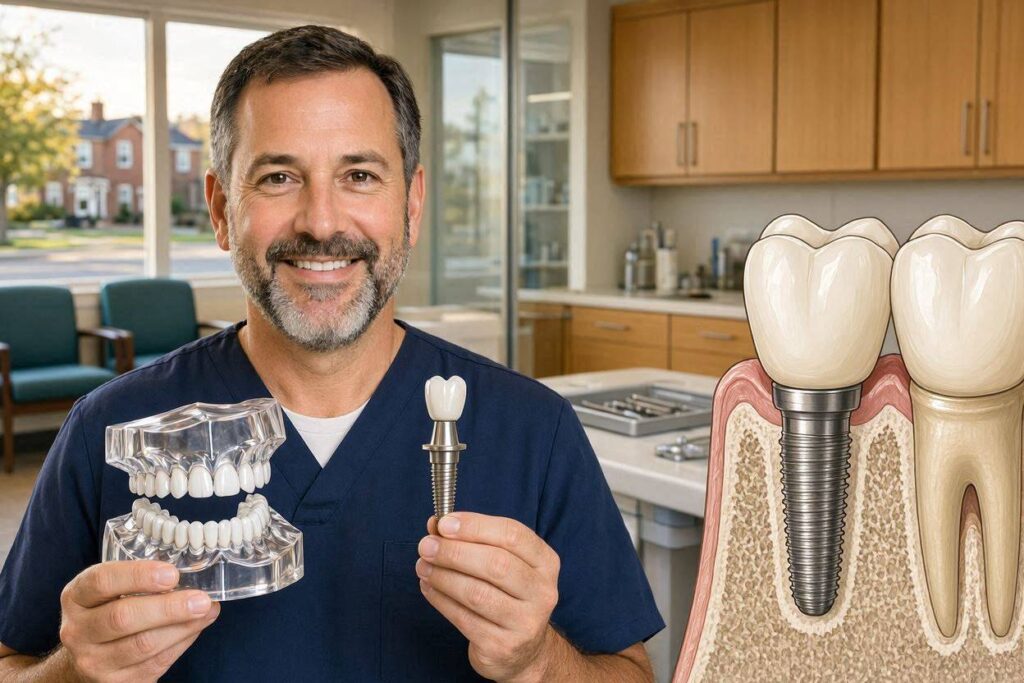
A dental implant is not a single, uniform object. It is a highly engineered, three-part medical device that replicates the complete structure of a natural tooth.
The Implant Fixture: A Biocompatible Titanium Root
The foundational component is the implant fixture, or body. It is a small, precision-manufactured post, most commonly shaped like a screw with threads along its length. It is fabricated from medical-grade titanium or a titanium alloy, a material chosen specifically for the property of osseointegration. This is the biological process by which living bone cells attach directly to the titanium oxide layer on the surface of the implant. There is no soft tissue scar layer between the bone and the implant. The connection is a direct, structural, and functional fusion. The implant becomes a synthetic root, permanently integrated into the patient’s skeleton.
The Abutment: The Engineered Connector
Once the implant fixture has achieved full osseointegration, a second component, the abutment, is attached. This is a small connector post that screws into the internal channel of the implant body. It extends from the level of the bone, through the soft tissue of the gum, and into the oral cavity. The abutment provides the precise anchoring point for the final crown. In modern aesthetic dentistry, the abutment is often custom-milled using a digital CAD/CAM process. A custom abutment is designed to support the gum tissue in a natural, scalloped contour and to provide an ideal emergence profile for the prosthetic tooth.
The Implant Crown: The Custom-Crafted Aesthetic Tooth
The visible, functional part of the system is the implant crown. It is not a pre-fabricated, stock tooth. It is a custom work of prosthetic artistry. Using a digital scan of the patient’s mouth, a skilled dental laboratory technician mills the crown from a solid block of high-strength, aesthetic ceramic. Materials such as layered zirconia or lithium disilicate are selected for their ability to withstand the heavy forces of mastication and to precisely replicate the translucency, color, and texture of natural enamel. The crown is cemented or screwed onto the abutment, completing the restoration.
The Dental Implant Procedure: A Phased Clinical Journey
The path from a missing tooth to a permanently restored implant is a carefully sequenced, multi-phase process. A reputable Glyndon implant practice adheres to a biology-driven timeline and never rushes healing.
Phase 1: Comprehensive 3D Diagnosis and Virtual Treatment Planning
Your care begins with a thorough diagnostic session. The dentist performs a complete oral examination and reviews your medical history. The essential technology at this stage is the Cone Beam Computed Tomography (CBCT) scan. This device produces a highly detailed, three-dimensional X-ray model of your maxillofacial skeleton. Using the CBCT, the implant surgeon evaluates the height, width, and density of the jawbone, precisely maps the location of the inferior alveolar nerve and the maxillary sinuses, and uses specialized software to perform the entire surgery virtually. The implant’s exact position, angle, depth, and diameter are all planned in the digital environment before any procedure is performed.
Phase 2: Regenerative Foundation Building
If the diagnostic scan shows that the jawbone has atrophied and lacks the volume to fully surround and support an implant, a preparatory surgery is necessary. A bone graft involves placing a sterile, biocompatible grafting material into the area of deficiency. This material forms a scaffold that guides the patient’s own cells to regenerate new, living bone. In the upper posterior jaw, if the maxillary sinus has expanded downward, a sinus lift procedure gently raises the sinus membrane and packs grafting material underneath it to build up the floor of the sinus. This foundational phase requires its own healing period, typically 4 to 9 months.
Phase 3: Surgical Implant Placement
The placement surgery is performed in the dental office under local anesthesia. Patient anxiety is managed with sedation options ranging from nitrous oxide to oral conscious sedation or intravenous sedation. The surgeon makes a precise, minimal incision in the gum to expose the bone. A sequence of highly calibrated surgical drills, guided by the 3D treatment plan, is used to create a receptor site of exact dimensions. The titanium implant fixture is then threaded into this site with precise torque. The gum is closed, and the implant is left to heal.
Phase 4: The Osseointegration Healing Period
The next phase is a waiting period, typically lasting 3 to 6 months for a single-stage approach. The patient wears a temporary, non-load-bearing tooth. Deep within the jaw, the body is performing its biological work. Osteoblast cells are migrating to the implant surface, laying down new bone matrix, and creating a rigid, living fusion. This osseointegration process is the physiological event that distinguishes dental implants from every other dental procedure.
Phase 5: Prosthetic Restoration
Once the surgeon confirms that the implant is stable and fully integrated, the restorative phase begins. The implant is uncovered, and the custom abutment is placed. The restorative dentist captures a digital impression using an intraoral scanner. This scan is the blueprint for the final crown. A master ceramist designs and mills the crown, which is then delivered and secured in a final appointment. The new tooth is now a permanent part of the patient’s dentition.
Implant Solutions for Every Level of Tooth Loss
The implant system is modular and can be scaled to treat any presentation of tooth loss.
- Single Tooth Replacement: A standalone implant and crown.
- Implant-Supported Bridge: Multiple implants anchor a fixed span of porcelain teeth, avoiding a removable partial denture.
- Full-Arch Fixed Restoration: A complete arch of fixed teeth supported by four to six implants (the All-on-4 concept).
- Implant-Retained Overdenture: A removable denture that snaps securely onto two or more implants, providing dramatic stability.
The Definitive Health and Functional Benefits
Dental implants offer a unique set of biological and functional advantages.
- Preservation of Alveolar Bone: Implants are the only tooth replacement that stops the bone resorption process by delivering a mechanical load to the bone.
- Integrity of Adjacent Dentition: A fixed bridge requires grinding down the healthy teeth next to the gap. An implant is a solitary unit that does not compromise the structure of neighboring teeth.
- Complete Functional Restoration: An integrated implant allows for a bite force and chewing efficiency that is comparable to a natural tooth. There is no movement, no slipping, and no need for adhesive creams.
Implant Candidacy
Most adults who are missing one or more teeth and are in reasonably good health are candidates. The presence of sufficient, healthy bone is the main local prerequisite, and modern bone grafting has made this achievable for the vast majority of patients. Heavy, uncontrolled diabetes and active heavy smoking are significant risk factors that must be medically managed and discussed with your surgical team.
Choosing Your Implant Provider in Glyndon
When selecting a provider for Glyndon MD dental implants, look for a clinician with a deep background in surgical implantology. This may be a board-certified oral and maxillofacial surgeon, a board-certified periodontist, or a restorative dentist with advanced credentialing such as a Diplomate from the American Board of Oral Implantology. The practice should be equipped with an in-office CBCT scanner and should be able to present a portfolio of their own clinical cases. A comprehensive consultation will include a transparent, itemized treatment plan, a thorough discussion of risks, and a clear long-term maintenance protocol.
Conclusion
Glyndon MD dental implants are a three-part tooth replacement system comprising a titanium root, a custom abutment, and an aesthetic ceramic crown, designed to completely replace a missing tooth and restore the bone-stimulating function of a natural root. The process involves a digital 3D diagnostic phase, any necessary bone regeneration, a precise surgical placement, a critical biological healing period of osseointegration, and a final custom restoration. This treatment uniquely halts the progression of jawbone loss, protects the health of adjacent teeth, and provides a lifetime solution for a fully functional and confident smile.
FAQ
1. Is the dental implant procedure painful?
The surgery itself is performed under local anesthesia and is painless. The post-operative phase involves mild to moderate soreness, well-controlled with prescribed or over-the-counter analgesics for a few days.
2. How long is the entire process from start to finish?
For a straightforward single implant case without grafting, plan for 3 to 6 months. Cases requiring significant bone grafting may take 9 to 12 months.
3. How do I properly clean my dental implant?
You must brush the crown twice daily and clean around the abutment under the gum line daily with implant-specific floss, interdental brushes, or a water flosser. Professional maintenance visits every 3 to 6 months are mandatory.
4. What is the long-term success rate?
Dental implants in healthy patients with good oral hygiene have a documented survival rate of over 95% over 10 years.
5. Will my insurance pay for this treatment?
Dental insurance may provide a benefit toward the crown as a major restorative service. The surgical fees are often an out-of-pocket investment. Your provider’s office will verify and explain your benefits in detail.
Additional Resource
For credible, patient-centered education on the entire implant process, visit the official information page of the American Academy of Periodontology (AAP).